

Remote fuel management is defined as the practice of monitoring, scheduling, and delivering fuel to isolated sites through integrated sensor networks, automated logistics platforms, and Vendor Managed Inventory (VMI) systems. Fuel vendors managing remote locations face a distinct set of operational pressures that standard fleet routing software cannot solve. Limited road access, no on-site personnel, and unpredictable consumption rates all create supply chain risk that compounds quickly. The vendors who keep remote operations running without interruption do so by combining real-time tank monitoring, API-driven scheduling, and proactive replenishment models that remove the human bottleneck from the supply chain entirely.
How do fuel vendors manage remote locations with technology?
Smart tank monitoring is the foundation of every effective remote fuel management solution. Tank gauges integrated via cellular or satellite connect directly to cloud platforms, enabling 24/7 monitoring without requiring on-site IT infrastructure or staff. That single capability eliminates the most common failure point in remote fuel operations: the manual inspection that never happens on time.
Cloud-based interfaces centralize data from dozens of remote sites into a single dashboard. Operations managers can view real-time tank levels, consumption trends, and delivery history across a mining operation in Utah, a data center in Dallas, and a construction site in West Texas, all from one screen. This visibility converts reactive decision-making into a scheduled, predictable process.
Key technologies that enable remote fuel vendors to operate efficiently include:
- Automated tank gauges that transmit level readings at configurable intervals
- Cellular and satellite communication for sites beyond standard network coverage
- Cloud-based fleet and inventory platforms that consolidate multi-site data
- Alert systems that trigger replenishment orders when tanks reach threshold levels
- API-driven scheduling software that connects inventory data directly to dispatch systems
Automated inventory tracking can reduce operational downtime by up to 36%. That figure reflects the direct cost of fuel shortages on equipment uptime, not just the inconvenience of a missed delivery.
Pro Tip: If your remote sites run legacy analog gauges, retrofit digital transmitters before replacing the full tank system. Most modern cloud platforms accept analog sensor inputs through low-cost signal converters, avoiding a full infrastructure replacement.
How do fuel vendors optimize delivery logistics to remote locations?
Delivery logistics for remote sites require solving multiple constraints at once. Fuel tanker fleet management demands simultaneous optimization of driver Hours of Service (HOS) limits, tanker compartment configurations, and contamination prevention. Standard routing software handles traffic and distance. Fuel tanker logistics adds regulatory compliance, product sequencing, and load planning to that equation.

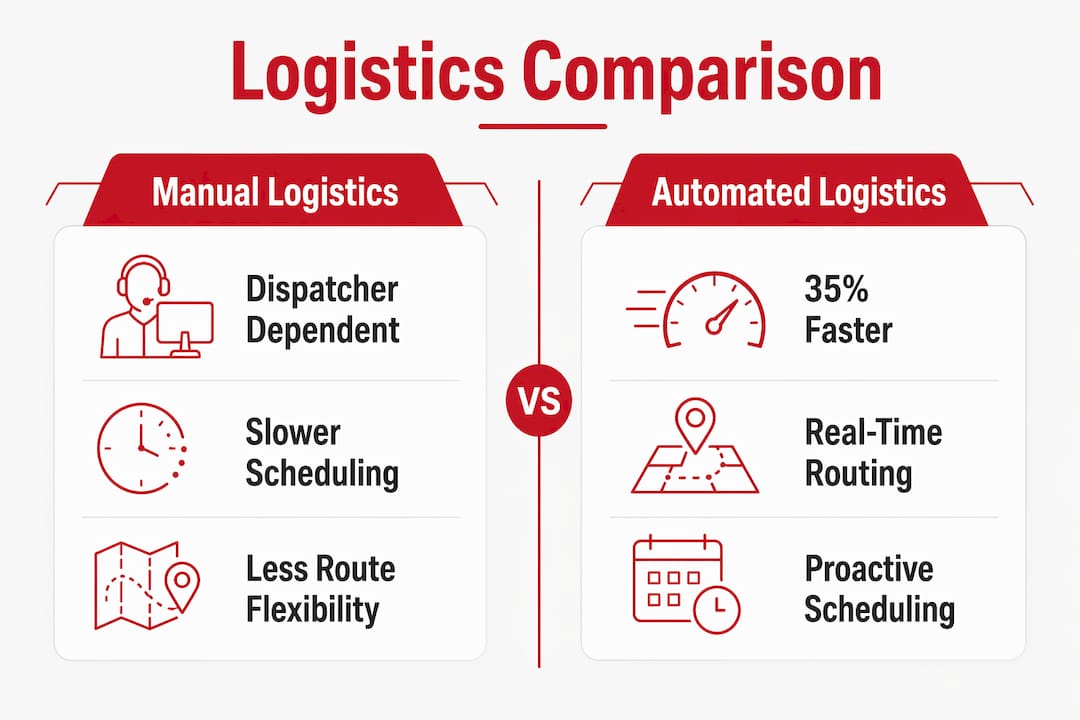
API-driven scheduling software addresses this directly. Intelligent scheduling platforms accelerate scheduling by 35%, generate orders 40% faster, and reduce delivery distance by 30% through optimized routing. Those gains compound across a large remote site portfolio, where each unnecessary mile adds cost and driver hours.
Delivery sequencing prevents product contamination in multi-product tankers. Downstream fuel distribution requires planning that automates coordination of terminal loading windows, tanker compartment configuration matching, and load sequencing to prevent contamination. A diesel delivery followed immediately by a gasoline load in the wrong compartment order creates a product quality failure that shuts down equipment. Getting this right is not optional.
| Metric | Manual logistics | Automated logistics |
|---|---|---|
| Scheduling speed | Dispatcher dependent | 35% faster with API-driven tools |
| Order generation | Manual entry, error-prone | 40% faster, system-generated |
| Delivery distance | Unoptimized routes | Up to 30% reduction |
| HOS compliance | Manual tracking | Automated constraint checks |
| Real-time rerouting | Phone-based updates | Dynamic recalculation |
Advanced fleet management systems recalculate routes in real time to adapt to traffic delays, urgent orders, and equipment failures. That dynamic adjustment capability is what separates a vendor who can serve remote locations reliably from one who cannot.
The role of technology in fuel delivery extends beyond routing. It creates a feedback loop where every completed delivery improves the data model for the next one.
What role does Vendor Managed Inventory play in remote fuel supply?
Vendor Managed Inventory is the model where the fuel supplier, not the customer, takes ownership of monitoring tank levels and triggering replenishment orders. VMI shifts replenishment responsibility to the supplier, who monitors tank levels daily using consumption models to schedule deliveries before the customer notices low fuel. This is a fundamental shift in how supply chain relationships work.
The practical difference between reactive ordering and VMI is the difference between a phone call at 6:00 AM saying “we’re out of fuel” and a delivery that arrived two days before that call was ever necessary. For remote mining operations, oil field sites, and data centers running backup generators, that difference is measured in production hours and uptime percentages.
VMI delivers measurable operational gains:
- Fewer stockouts because deliveries are triggered by data, not by someone remembering to check the tank
- Reduced downtime through proactive supply that keeps equipment running through shift changes and weather delays
- Lower delivery costs through route consolidation, with VMI reducing kilometers per delivery by 10–25% and active fleet size by over 20%
- Improved forecasting as consumption models become more accurate over time
- Simplified procurement for operations teams who no longer manage fuel ordering manually
The transition from reactive ordering to VMI fundamentally changes the supply chain relationship. Vendors become operational partners rather than order-takers. That shift requires trust, data sharing, and a vendor with the technology infrastructure to act on sensor data reliably.
Pro Tip: Before transitioning a remote site to VMI, run a 30-day consumption baseline using your existing tank gauge data. Vendors need accurate daily usage rates to build a reliable delivery model. Sites with high consumption variability, such as harvest season agriculture or peak-load data centers, need seasonal adjustment factors built into the model from day one.
Diesel engine availability is a direct function of fuel supply reliability. When diesel availability in logistics drops, the downstream effects on fleet operations compound quickly. VMI removes that risk at the source.
How do fuel vendors ensure safety and compliance at remote sites?
Safety and regulatory compliance in remote fuel operations is not a back-office function. It is built into the delivery routing, tank monitoring, and documentation systems that run the operation. The U.S. Department of Transportation (DOT) and HAZMAT regulations apply to every fuel delivery, regardless of how far the site sits from a paved road.
Automated compliance tools generate audit-ready documentation for leak detection, inventory records, and HAZMAT paperwork, reducing manual errors and inspection readiness burden. A vendor managing 50 remote sites cannot rely on paper logs to stay compliant. Digital systems that generate records automatically are the only practical solution at scale.
Key compliance checkpoints for remote fuel deliveries include:
- Driver HOS documentation logged automatically through electronic logging devices (ELDs)
- HAZMAT placarding and manifest verification before each load departs the terminal
- Leak detection reporting generated by tank monitoring systems and stored in the cloud
- Product quality records confirming correct fuel grade delivered to each site
- Spill prevention and containment protocols documented per EPA Spill Prevention, Control, and Countermeasure (SPCC) plan requirements
Replenishment thresholds set at 30–40% tank capacity trigger delivery orders targeting 90% fill levels. That protocol balances inventory buffer with transport efficiency, and it also reduces the risk of tanks running completely dry, which creates additional compliance documentation requirements for restart procedures.
Pro Tip: Build your SPCC plan documentation into your tank monitoring platform. When a sensor detects an anomalous level drop that suggests a leak rather than consumption, the system should automatically flag it for review and generate a preliminary incident record. Waiting for a manual inspection at a remote site wastes hours you do not have.
Effective job site fuel tracking connects monitoring data to compliance records in real time, giving operations managers a single source of truth for both inventory and regulatory documentation.
Key Takeaways
Fuel vendors manage remote locations effectively by combining real-time tank monitoring, automated scheduling, VMI models, and digital compliance systems to maintain continuous supply without on-site personnel.
| Point | Details |
|---|---|
| Remote monitoring is the foundation | Cellular and satellite tank gauges enable 24/7 visibility without on-site staff. |
| Automated scheduling cuts costs | API-driven platforms reduce delivery distance by up to 30% and generate orders 40% faster. |
| VMI shifts supply chain ownership | Vendors monitor and replenish proactively, reducing stockouts and cutting fleet kilometers by 10–25%. |
| Compliance must be built in | Automated DOT and HAZMAT documentation reduces audit risk and manual error at scale. |
| Replenishment thresholds prevent dry tanks | Setting triggers at 30–40% capacity and targeting 90% fill levels balances buffer stock with transport efficiency. |
Remote fuel delivery services from Anytimefuelpros
Operations teams managing remote sites need a fuel partner who brings the technology and the trucks. Anytimefuelpros delivers on-site diesel, gasoline, and DEF to remote locations across Texas, Utah, and nationwide through a trusted partner network, with scheduled recurring deliveries, bulk tank fills, and 24/7 emergency response built into every service agreement.
Whether your site is a mine in the Utah desert, an oil field in West Texas, or a data center running backup generators through a storm, Anytimefuelpros has the logistics infrastructure to keep fuel flowing. Explore the benefits of fuel delivery for remote operations, or review on-site diesel delivery options to find the right service structure for your site. For bulk storage needs, the bulk fuel delivery guide covers tank sizing, placement, and delivery scheduling for isolated locations.
FAQ
How do fuel vendors monitor tank levels at remote sites?
Fuel vendors use automated tank gauges connected via cellular or satellite networks to cloud platforms, enabling real-time level monitoring without on-site personnel. These systems generate alerts when tanks reach replenishment thresholds, triggering delivery orders automatically.
What is Vendor Managed Inventory in fuel distribution?
VMI is a supply model where the fuel vendor monitors tank levels and schedules deliveries proactively, before the customer requests fuel. It reduces stockouts, cuts delivery costs through route consolidation, and removes the ordering burden from operations teams.
What replenishment threshold do fuel vendors use for remote sites?
Standard practice sets replenishment triggers at 30–40% tank capacity, with deliveries targeting 90% fill levels. This protocol maintains an inventory buffer while keeping transport runs efficient.
How do fuel vendors stay compliant with DOT regulations on remote deliveries?
Vendors use electronic logging devices for HOS compliance, automated HAZMAT manifest systems, and cloud-based leak detection reporting to generate audit-ready records. Digital compliance tools replace manual paperwork and reduce the risk of documentation errors at scale.
How much can automated fuel logistics reduce delivery costs?
API-driven scheduling platforms reduce delivery distance by up to 30% and generate orders 40% faster than manual dispatch. VMI models further reduce kilometers per delivery by 10–25% through route consolidation across multiple remote sites.
Recent Comments