
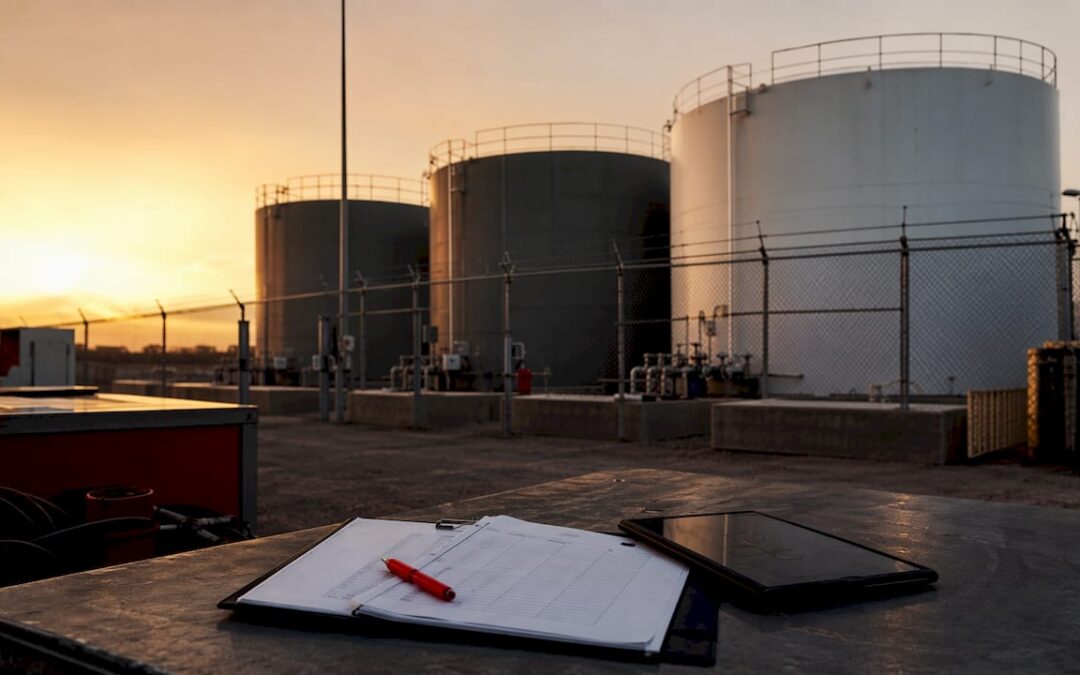
The most reliable approach to bulk fuel tank fill scheduling is a telemetry-driven reorder point, with a fallback using a qualitative fraction of tank capacity when ATG data is unavailable. This combination reduces emergency fills, keeps per-gallon costs predictable, and removes the guesswork that causes run-outs during peak demand or bad weather.
Start this week with four actions:
- Set an initial reorder threshold at a low fraction of usable tank capacity until you have sufficient consumption data to refine it.
- Confirm your supplier’s actual order-to-delivery lead time in writing, not just their advertised window.
- Enable ATG polling or establish a daily manual dip-check routine so inventory data is current before every ordering decision.
- Negotiate a written SLA that covers standard delivery windows, after-hours response, and surge routing commitments.
One caveat before automating anything: verify your ATG sensor accuracy with a manual dip check before you trust it to trigger orders. Sensor drift is common, and an automated system built on a faulty reading will either over-order or, worse, miss a run-out entirely.
Table of Contents
- Why scheduled bulk fuel fills protect your operation
- How tank type and capacity shape your delivery schedule
- How a safe and efficient bulk fill actually works
- Which scheduling method fits your site?
- How to calculate your reorder point
- Tank monitoring and telemetry: what actually works
- Emergency delivery and contingency planning
- U.S. regulatory and compliance requirements for bulk fuel storage
- Step-by-step checklist to implement scheduled bulk fills
- Key Takeaways
- Anytimefuelpros delivers the schedule you need, without the gaps
- Authoritative sources and further reading
Why scheduled bulk fuel fills protect your operation
A bulk fuel tank fill is a commercial on-site delivery where a road tanker transfers fuel directly into a fixed storage tank at your facility. The delivery replaces what your equipment, generators, or fleet vehicles have consumed since the last fill, keeping the tank at a level that supports continuous operations.
The use cases span nearly every asset-intensive industry. Transport depots rely on bulk diesel to wet-hose fleets overnight. Construction yards need consistent supply for excavators, dozers, and telehandlers. Data centers depend on generator standby fuel that must be fresh and at the right level before a grid event, not after. Mining sites and agricultural operations often sit far from retail fuel infrastructure, making on-site storage the only practical option.
The operational risk of reactive fills is real and measurable. When a site runs out of fuel, equipment stops, crews stand idle, and workflow sequencing collapses. Emergency deliveries carry premium fees on top of the base fuel cost. Reactive ordering also puts you at the back of the queue during regional supply disruptions, when every other operation is calling the same suppliers at the same time.
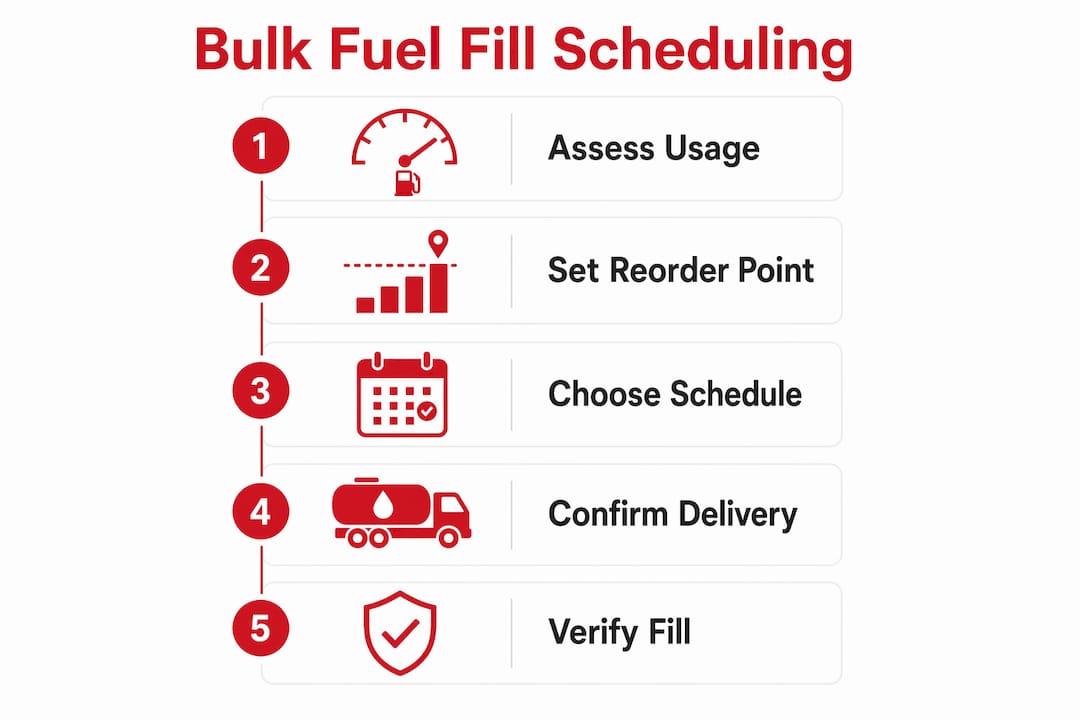
Scheduled fills flip that dynamic. You control the timing, you negotiate volume pricing in advance, and your supplier can plan routes efficiently, which often translates to better per-gallon rates. The operational benefits of on-site fuel delivery compound quickly once a schedule is in place: fewer admin hours, no retail fuel runs, and a documented supply chain that satisfies compliance audits.
How tank type and capacity shape your delivery schedule
Tank configuration is not just a storage decision. It directly determines how often you order, what minimums your supplier will accept, and what your per-gallon transport cost looks like.
Aboveground vs. underground tanks
Aboveground storage tanks (ASTs) are the standard choice for most commercial and industrial sites. They are easier to inspect, simpler to permit under EPA and state programs, and faster to install. Underground storage tanks (USTs) are regulated under a separate federal program administered by the EPA’s UST rules, which adds leak detection, release prevention, and corrective action requirements that increase compliance overhead significantly. For most new installations, ASTs are the practical default unless space or zoning forces a different choice.
Capacity ranges and scheduling implications
| Tank Type | Typical Capacity Range | Common Use Case | Scheduling Impact |
|---|---|---|---|
| Horizontal AST | — | Job sites, depots, farms | Frequent fills at smaller sites; less frequent at 10,000+ gal |
| Vertical AST | 10,000+ gallons | Industrial plants, data centers | Monthly or quarterly fills possible |
| Portable/skid tank | — | Temporary job sites | Weekly fills likely; constrained by supplier minimums |
| UST | — | Retail, fleet yards | Regulated fill protocols; ATG mandatory in most states |
Commercial horizontal tanks range from a few hundred gallons up to 12,000 gallons and beyond, with vertical tanks scaling further for industrial applications. The practical scheduling lesson: a tank that is too small forces frequent deliveries, and each delivery carries a fixed transport cost. Spreading that cost over a larger volume per drop is one of the most direct ways to reduce your per-gallon landed price.
Usable capacity is not the same as nameplate capacity. Ullage (the headspace required for thermal expansion) typically reduces usable volume by around 5–10%. Bunding or secondary containment requirements may also limit how much you can store in a given footprint. Factor both into your reorder calculations, not just the tank’s rated size.
For temporary job sites or lease-limited pads, your options are constrained. A skid-mounted portable tank may be the only viable choice, which means accepting higher delivery frequency and negotiating with suppliers who can accommodate smaller minimums. Aligning tank capacity with delivery logistics to consolidate fills into larger volumes spreads transport costs and improves your pricing leverage over time.
Pro Tip: If your current tank forces you to order more than twice a month, run the numbers on a capacity upgrade. The reduction in per-delivery transport cost often pays back the tank investment within one to two years at typical commercial consumption rates.
How a safe and efficient bulk fill actually works
A bulk fill looks straightforward from the outside, but the steps between tanker arrival and departure carry real spill and fire risk if any one of them is skipped. Operations managers should audit their supplier’s procedure against this checklist and include it in their SLA.
Pre-delivery checks
- Confirm site access is clear and the tanker can reach the fill point without reversing over unmarked ground or crossing live traffic lanes.
- Complete site induction for the driver if required by your safety plan.
- Identify the correct tank and verify the product grade matches the delivery ticket.
- Check ullage: calculate available capacity before the driver opens any valve. Never assume the tank is empty.
- Verify bonding and grounding points are accessible and in working condition.
- Confirm overfill protection devices (overfill prevention valves or high-level alarms) are functional.
During delivery
- Attach bonding cable from tanker to tank before any hose connection to prevent static discharge.
- Ground the tanker to earth independently of the bonding connection.
- Open valves slowly and monitor flow rate; slow-fill protocols reduce turbulence and static buildup.
- Maintain communication between the driver and your site contact throughout the fill. Do not leave the fill point unattended.
- Keep a spill kit within arm’s reach of the fill point. Confirm the kit is stocked before the tanker opens.
Post-delivery
- Read the tank gauge immediately after fill completion and compare to the delivery ticket volume.
- Walk the tank perimeter and inspect fittings, vents, and the fill point for leaks or seepage.
- Reconcile the delivery ticket against your inventory records the same day.
- Store delivery paperwork in your compliance file; SPCC plans require documented delivery records.
- Inspect hose storage and ensure the driver’s equipment is secured before departure.
Diesel storage best practice also requires regular inspection for water contamination and microbial growth, particularly in tanks that sit partially full for extended periods. Storing diesel safely means keeping tanks away from heat sources, maintaining bunding, and checking for water at the bottom of the tank on a scheduled basis.
Pro Tip: Run a manual dip check immediately after every ATG-monitored delivery and compare the dip reading to the ATG display. If the two diverge by more than 1–2%, schedule a sensor calibration before the next automated order cycle.
Which scheduling method fits your site?
Three models cover the full range of commercial fuel scheduling needs. The right choice depends on how predictable your consumption is and how much risk you can tolerate.
Fixed calendar scheduling
You order on a set day every week, two weeks, or month regardless of actual tank level. This works well for sites with stable, predictable consumption: a fleet depot running a fixed number of vehicles on fixed routes, or a standby generator that draws a known test-cycle volume. The weakness is that calendar schedules do not respond to consumption spikes. A cold snap that runs generators harder, or a project surge that adds equipment to the yard, can drain a tank faster than the calendar expects.
Usage-based (reorder point) scheduling
You order when the tank hits a defined trigger level, calculated from your daily consumption rate and supplier lead time. Platforms like EKOS calculate Days on Hand automatically and can generate a purchase order the moment the tank crosses the threshold. This model is more responsive than calendar scheduling and tends to reduce both emergency fills and over-ordering. It requires reliable telemetry or consistent manual checks to function correctly.
Hybrid scheduling
You maintain a calendar baseline but add a telemetry trigger for high-consumption periods. A construction site might schedule biweekly fills from April through October, then switch to usage-based triggers during winter when equipment hours drop. Data centers often run a hybrid model: a monthly scheduled top-off plus an automatic trigger if the generator tank drops below a critical level between fills.
Contract and SLA items to lock in
Whatever model you choose, the supplier contract needs to specify:
- Delivery windows (days and hours available for standard fills)
- Minimum order volume per delivery
- After-hours and surge delivery fees, stated as a fixed surcharge or percentage
- Notification lead time required to schedule or cancel a fill
- Escalation contacts and response time commitments for emergency orders
- Dispute resolution process for short deliveries or product quality issues
Reviewing your schedule quarterly catches seasonal drift before it becomes a problem. Fleet managers handling heavy equipment fueling schedules across multiple sites benefit from centralizing order visibility so one person can see all tank levels and pending deliveries in a single dashboard.
How to calculate your reorder point
The standard reorder level formula is:
Reorder Level = (Daily Usage × Lead Time in Days) + Safety Buffer Stock
Each input matters. Daily usage should be your 30–90 day rolling average, not a single week’s data. Lead time is the actual order-to-delivery days your supplier delivers consistently, not their best-case estimate. Safety buffer is the extra stock that covers weather delays, traffic disruptions, and unexpected consumption spikes.
Worked example
| Input | Value |
|---|---|
| Daily average consumption | 2,000 gallons/day |
| Supplier lead time | 3 days |
| Safety buffer (2 days of usage) | 4,000 gallons |
| Reorder level | (2,000 × 3) + 4,000 = 10,000 gallons |
In this example, the site manager places an order the moment the tank gauge reads 10,000 gallons. The tanker arrives within 3 days, and the 4,000-gallon buffer covers any delay without touching the operational minimum.
For urban sites with reliable supplier access, a 1–2 day safety buffer is usually sufficient. Remote sites, project locations in hurricane-prone regions, or mines with single-road access should carry a 3–5 day buffer. When planning long-term scheduled deliveries for remote sites, verify supplier minimums and lead-time variability, then add a larger buffer to the reorder point to account for weather-related delivery delays.
Key figure: A 2-day safety buffer on a 2,000-gallon/day site requires 4,000 gallons of reserve stock. For a 10,000-gallon tank, that reserve represents a significant fraction of total capacity — which means your effective ordering window is the range between this reserve and whatever your supplier’s minimum delivery volume requires.
Tank monitoring and telemetry: what actually works
Automatic Tank Gauges (ATGs) are the backbone of modern fuel inventory management. A properly installed ATG gives you real-time percent-full readings, gallons remaining, drawdown rate, and water detection for diesel tanks. The data feeds directly into ordering software, eliminating the manual gauge-check cycle.

Cell-based telemetry units sit on top of existing tanks and transmit level data over a cellular network without requiring hardwired integration. They are the practical choice for sites that lack ATG infrastructure or for temporary installations. Simple float-and-probe level sensors are the lowest-cost option but provide only a point-in-time reading rather than continuous data.
Software like FleetPanda integrates with multiple tank monitor vendors and auto-creates orders based on custom thresholds, which removes the manual step between “tank hits reorder level” and “order placed.” The key metrics to track in any monitoring platform are: percent full, gallons remaining, Days on Hand, last delivery date, drawdown rate, and water detection status.
Automated ordering is only as reliable as the ATG it connects to. Experienced managers run periodic manual dip checks and set alerts for sensor anomalies to avoid inaccurate inventory reporting. Before you activate auto-ordering on any site, validate the sensor reading against a physical dip measurement on three consecutive days. If the readings match within 1–2%, the sensor is reliable enough to automate. If they diverge, calibrate first.
Emergency delivery and contingency planning
Even a well-run scheduled program will face a scenario where the plan breaks down: a supplier truck breaks down, a weather event delays delivery, or an unexpected equipment surge drains the tank faster than the reorder point anticipated. The operations that handle these moments well are the ones that planned for them before they happened.
Emergency scenarios to plan for
- Run-out or near-run-out: Tank drops below operational minimum before scheduled delivery arrives.
- Supplier failure: Primary supplier cannot fulfill an order due to equipment, staffing, or supply chain issues.
- Extreme weather: Hurricane, ice storm, or flooding blocks delivery routes or spikes consumption.
- Pipeline or terminal disruption: Regional supply tightens and standard lead times extend without warning.
Contingency checklist
- Maintain a secondary supplier contact with pre-negotiated emergency rates and confirmed minimum order volumes.
- Identify priority assets at each site (generators, critical equipment) and document the fuel allocation sequence if supply is constrained.
- Set a pre-authorized emergency order limit so your team can act without waiting for procurement approval during a crisis.
- Where feasible, allocate a spare portable tank as a buffer reserve for mission-critical equipment.
- Suspend non-essential fueling immediately when a supply constraint is confirmed.
SLA items for emergency response
Your supplier contract should specify: guaranteed response time for emergency orders (a 24/7 window with a stated hour commitment), after-hours surcharge amounts, surge routing commitments during regional events, and named escalation contacts with direct phone numbers. For sites with emergency fuel delivery needs, vague SLA language is a liability.
Emergency fills carry premium fees. Quantify the expected surcharge in your budget and compare it to the cost of holding a larger safety stock. In most cases, the carrying cost of an extra day or two of buffer stock is lower than a single emergency delivery premium, particularly during hurricane season or peak construction periods.
U.S. regulatory and compliance requirements for bulk fuel storage
Scheduling fills without accounting for U.S. regulatory requirements creates compliance gaps that can result in fines, permit revocations, or liability exposure after a spill. Four federal frameworks apply to most commercial bulk fuel operations.
SPCC (Spill Prevention, Control, and Countermeasure): The EPA’s SPCC rule applies to facilities that store more than 1,320 gallons of oil aboveground (or 42,000 gallons underground) in aggregate. SPCC plans must document tank capacities, secondary containment, inspection schedules, and spill response procedures. Delivery records are part of the required documentation, which is why post-fill ticket reconciliation is not optional.
UST regulations: Underground storage tanks are regulated under a separate EPA program with requirements for leak detection, release prevention, operator training, and financial assurance. State UST programs often add requirements on top of the federal baseline. If your site has USTs, check your state environmental agency’s program before scheduling fills.
NFPA standards: NFPA 30 (Flammable and Combustible Liquids Code) governs on-site storage and delivery procedures, including tank spacing, venting, bonding, and spill containment. NFPA 30 is the primary reference for fire safety during bulk fills and is adopted by most state and local fire codes.
DOT transport rules: The driver delivering your fuel operates under DOT hazardous materials regulations. Delivery paperwork must include a bill of lading, Safety Data Sheet (SDS), and placarding documentation. Your site’s responsibility is to confirm the driver has the required credentials and that your access route meets DOT weight and clearance limits.
Compliance note: “Operators should confirm that their SPCC plan, UST registration (where applicable), and NFPA 30 compliance documentation are current before entering into a new scheduled delivery contract. A supplier who asks about your containment setup and permit status before the first delivery is a supplier who takes compliance seriously.”
Site-level checks to build into your schedule: verify permits annually, inspect bunding and secondary containment before each fill season, confirm emergency response plan alignment with your local fire authority, and document all inspections in your SPCC file. Gasoline stored in a sealed, cool bulk tank can remain usable for 6–12 months under good storage conditions, but diesel has different stability characteristics and benefits from fuel treatments and regular contamination checks.
Step-by-step checklist to implement scheduled bulk fills
Follow this sequence to move from reactive ordering to a structured, contracted fill program.
-
Collect baseline data. Pull 30–90 days of consumption records from fuel logs, delivery tickets, or ATG history. Calculate daily average usage and identify any seasonal spikes or project-driven surges.
-
Calculate initial reorder points. Apply the reorder formula to each tank using your baseline daily usage, confirmed supplier lead time, and a safety buffer appropriate to your site’s risk profile (1–2 days urban, 3–5 days remote or hurricane-exposed).
-
Propose schedule options. Based on your reorder points and tank capacity, determine whether a calendar, usage-based, or hybrid model fits your consumption pattern. For sites with variable demand, usage-based is usually the stronger starting point.
-
Request proposals and SLAs from suppliers. Ask each supplier for minimum order volumes, standard and emergency lead times, after-hours surcharges, ATG integration capabilities, and invoicing cadence. Red flags: vague SLA language, no ATG integration, inconsistent delivery ticketing, or reluctance to put response time commitments in writing.
-
Pilot automation on a single site. Before rolling out ATG-triggered auto-ordering across multiple locations, run a 30-day pilot on one site. Validate sensor accuracy daily, compare auto-generated orders to what a manual review would have produced, and confirm the supplier’s system receives and confirms orders correctly.
-
Roll out and review. After a successful pilot, extend the program to additional sites. Schedule a quarterly review of reorder thresholds, consumption trends, and SLA performance. Adjust safety buffers before hurricane season, harvest season, or any period when consumption or delivery reliability is likely to shift.
Questions to ask every prospective supplier: What is your guaranteed delivery window for standard orders? What is your emergency response time, and what does it cost? What is your minimum order volume? How do you handle short deliveries or product quality disputes? Do you integrate with ATG systems, and which vendors?
For construction and project-based operations, the on-site fuel delivery and tank sizing guide covers how to align tank capacity with project phase consumption so you are not over-ordering early or under-stocked at peak.
Key Takeaways
A telemetry-driven reorder point, set at (Daily Usage × Lead Time) + Safety Buffer, is the most reliable foundation for bulk fuel tank fill scheduling, with a fallback trigger based on a qualitative fraction of the tank capacity.
| Point | Details |
|---|---|
| Set your reorder threshold first | Use (Daily Usage × Lead Time) + Safety Buffer; start at a low fraction of usable capacity until you have 30–90 days of data. |
| Validate ATG sensors before automating | Manual dip checks must confirm sensor accuracy within 1–2% before auto-ordering goes live. |
| Lock in SLA terms in writing | Contracts must specify delivery windows, emergency response time, after-hours surcharges, and escalation contacts. |
| Build seasonal and remote buffers | Remote or hurricane-exposed sites need a 3–5 day safety buffer; urban sites can typically use 1–2 days. |
| Anytimefuelpros for scheduled and emergency fills | AFP provides scheduled recurring deliveries, 24/7 emergency response, and multi-site management across the continental U.S. |
Anytimefuelpros delivers the schedule you need, without the gaps
Running a reliable fuel program means having a supplier who can match your schedule, respond when the plan breaks, and handle the compliance paperwork without putting it back on your desk. That is exactly what Anytimefuelpros is built for.
AFP handles bulk fuel delivery and on-site storage for operations across Texas, Utah, and the continental U.S. through a national partner network. Scheduled recurring deliveries, ATG integration, multi-site management, and 24/7 emergency response are all part of the program. When you engage AFP, the process starts with a site assessment: tank capacity, daily consumption, lead time requirements, and SLA terms are confirmed before the first delivery. Invoicing is transparent and consolidated, so your procurement team is not chasing down tickets from multiple regional vendors. Whether you are managing a data center in Dallas, a mining operation in Utah, or a construction fleet across multiple states, AFP gives you a single point of contact and a delivery program built around your reorder thresholds, not a generic route schedule. Order now or request a site assessment to get your scheduled fill program in place before the next demand spike.
Authoritative sources and further reading
The sources below back the regulatory, operational, and technical claims in this article. Use them in the order listed for compliance reading: start with the EPA and NFPA references, then move to operational scheduling and telemetry guides.
How to use these sources: The EPA’s UST and SPCC pages are the primary compliance references for U.S. operations. The EKOS and FleetPanda resources explain automation mechanics in practical terms. The scheduling and tank-sizing guides from the research pool provide copyable calculation frameworks you can adapt directly into a spreadsheet.
- EPA Aboveground Storage Tanks and UST Program — Federal regulatory baseline for AST and UST compliance, SPCC documentation, and leak detection requirements.
- EKOS Bulk Fuel Ordering — Explains Days on Hand calculation, ATG polling, and auto-PO generation for usage-based scheduling.
- FleetPanda Fuel Delivery Software — Multi-vendor ATG integration and threshold-based auto-ordering for fleet and depot operations.
- TrueNorth Steel: Bulk Fuel Storage Tanks — Commercial tank capacity ranges and configuration options for AST sizing decisions.
- Fredericks Fuel: Safe Diesel Storage — Diesel storage best practices: temperature, contamination inspection, bunding, and water detection.
- Elan Fuels: Fuel Shelf Life Guide — Gasoline and diesel shelf life under different storage conditions; useful for rotation planning.
- Burk Fuel: Schedule and Manage Bulk Fuel Deliveries — Reorder level formula, safety buffer guidance, and delivery consolidation strategy (Australian market; formula and principles apply universally).
- Anytimefuelpros: Bulk Fuel Delivery Services — AFP’s scheduled delivery, ATG integration, and emergency response capabilities for U.S. commercial operations.
- Renewal tips for fleet operators — Operational and procurement timing considerations for fleet managers, including how fueling contracts interact with broader fleet cost management.
Recent Comments