
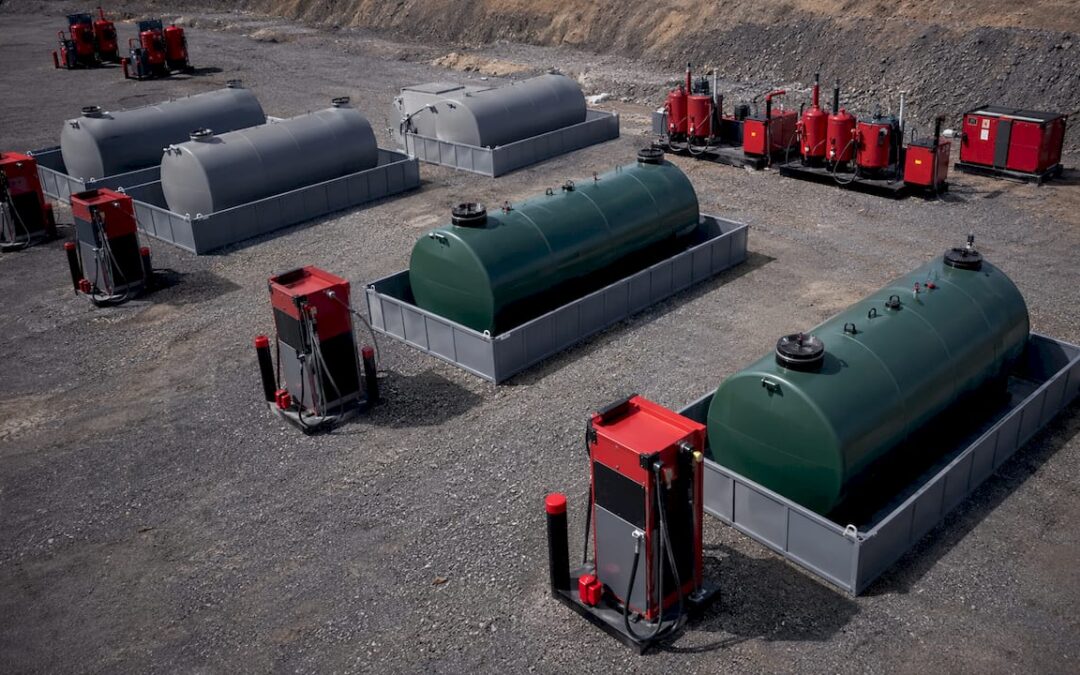
For remote and high-demand U.S. mining operations, the baseline fuel logistics model that consistently delivers uptime is single-source bulk diesel supply combined with on-site self-bunded storage, telemetry-enabled monitoring, and vendor-managed inventory (VMI). Here are three examples you can adapt this week:
- Example A — Large open-pit production site: 100KL self-bunded tanks positioned at the primary fuel point, scheduled bulk tanker fills every 5–7 days, telemetry triggers set at 25% capacity, and a VMI agreement with the delivery partner. Haul trucks, drills, and auxiliary equipment fuel from fixed dispensers; a wet-hose truck handles mobile equipment.
- Example B — Remote exploration camp: Two 13–30KL deployable tanks commissioned within 5 business days of contract award, VMI top-ups scheduled around access windows, and telemetry alerts sent directly to the supplier’s dispatch system. Road access constraints dictate delivery timing, so buffer stock covers at least 10 days of camp consumption.
- Example C — Seasonal or winter road operation: Staged tanker resupply timed to weather windows, satellite storage tanks at intermediate points along the haul route, and a contingency rule requiring 15 days of fuel on hand before road closure. Batch scheduling replaces weekly fills during the access season.
Manual fuel operations at mine sites commonly produce some fuel discrepancy due to leakage and recording errors. Automating delivery and dispense capture reduces fuel loss observed in manual operations. DOT regulates the transport of diesel as a hazardous material, and EPA’s Spill Prevention, Control, and Countermeasure (SPCC) rules govern on-site storage. Anytimefuelpros handles bulk diesel delivery, tank deployment, and telemetry-enabled VMI for mining operations across the continental United States.
Table of Contents
- What fuel-delivery models work best at mine sites?
- How to choose on-site storage: tanks, bunding, and deployment timelines
- How to forecast fuel demand and schedule deliveries reliably
- What telemetry features actually reduce fuel loss and downtime
- What U.S. regulations govern mine site fuel handling?
- How to build contingency plans that prevent operational shutdowns
- Three sample logistics plans you can adapt for your site
- What pricing models and contract terms should you expect?
- How to choose a fuel partner: ten questions that reveal capability
- Key Takeaways
- Anytimefuelpros delivers fuel where mining operations need it most
- Authoritative sources and further reading
What fuel-delivery models work best at mine sites?
Mine site fuel logistics examples fall into four primary operating models. Matching the right model to your site profile is the first decision that determines cost, uptime risk, and administrative load.

Bulk tanker fills to fixed on-site tanks is the workhorse model for production sites with reliable road access and consistent daily burn rates. A tanker delivers to a fixed self-bunded or above-ground storage tank on a scheduled cadence. The site controls dispensing, and the supplier manages delivery frequency. This model carries the lowest per-gallon cost at volume but requires capital or rental investment in storage infrastructure and depends on road access remaining open.
Mobile tank rentals and self-bunded deployable tanks suit exploration camps, temporary drill programs, and sites where permanent infrastructure is not justified. Deployable self-bunded tanks in the 13KL–100KL range can be commissioned within 5 business days of contract award, making them the fastest path to compliant on-site storage. The tradeoff is a higher per-gallon cost and the need to manage tank relocation as the program moves.
Wet-hose fleet fueling sends a fuel truck directly to equipment in the field, eliminating the need for operators to drive to a fixed fuel point. It works well for dispersed fleets, shift-change fueling, and sites where equipment downtime from travel to a fuel point is measurable. The constraint is cost per gallon and the need for a reliable wet-hose provider with access to the site.
VMI with telemetry is less a delivery model than an operating layer that sits on top of any of the above. The supplier monitors tank levels remotely and dispatches deliveries autonomously. VMI with web-enabled telemetry reduces site admin burden and lowers emergency delivery incidence. It is the recommended operating layer for any site where a supply disruption would halt production.
Statistic callout: Fuel price volatility and supply-chain disruptions mean diesel is exposed to risks that can halt operations entirely. Proactive, automated monitoring is the primary operational defense.
| Model | Best for | Top constraints to check |
|---|---|---|
| Bulk tanker fills to fixed tanks | High-volume production sites, consistent burn | Road access, tanker axle limits, permitting |
| Mobile/deployable self-bunded tanks | Exploration, temporary programs | Relocation cost, access windows |
| Wet-hose fleet fueling | Dispersed fleets, shift-change fueling | Per-gallon cost, provider access |
| VMI with telemetry | Any site with uptime-critical operations | Telemetry connectivity, supplier dashboard access |
Pro Tip: Operators who control dependable transport capacity and terminal access reduce mid-chain delivery failures that cause local shortages. When evaluating suppliers, ask specifically whether they own their transport fleet or broker it.
How to choose on-site storage: tanks, bunding, and deployment timelines
Storage infrastructure is where logistics plans either hold or fail. The right tank type and capacity for your site role determines how much buffer you carry, how fast you can commission, and whether you meet EPA and local fire code requirements from day one.
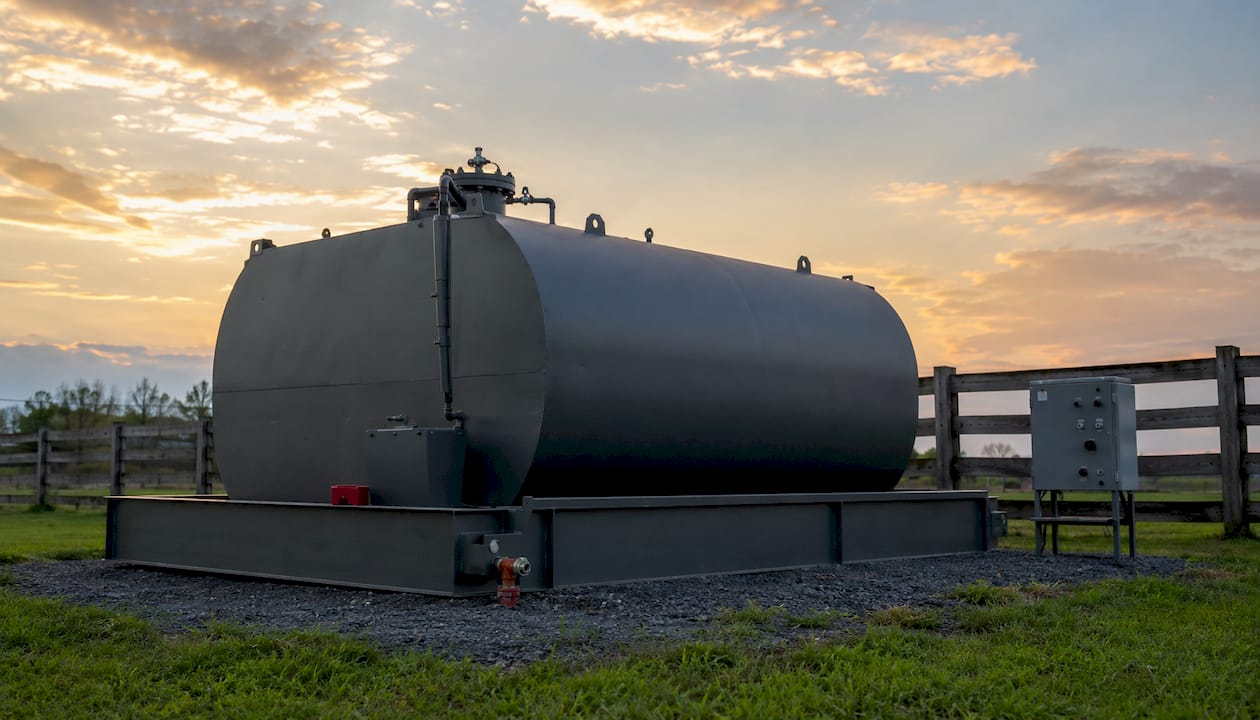
Self-bunded tanks are the standard choice for remote and semi-remote U.S. mining sites. The integrated secondary containment bund eliminates the need for a separate civil bunding structure, which cuts both permitting time and site preparation cost. Capacities run from 13KL to 100KL, and they can be trucked to site and commissioned quickly once a contract is in place. For most exploration and mid-tier production applications, a pair of 26KL self-bunded tanks gives enough working volume to absorb a missed delivery without shutting down.
Frac tanks and day tanks serve different roles. A frac tank (typically 21,000 gallons) is a temporary, high-volume option often used during peak construction or commissioning phases when permanent storage is not yet in place. Day tanks are smaller, purpose-built tanks positioned close to a generator or processing plant to provide a short-duration fuel buffer, usually 8–24 hours of runtime. They are fed from a larger primary tank and reduce the frequency of manual transfers.
Prefabricated super skids integrate pumps, compressed air, motor controls, and metering on a single factory-tested module. Super skid designs reduce on-site piping and electrical work and shorten commissioning time for large, complex fuel facilities at major production sites.
| Tank type | Typical sizes | Primary on-site use |
|---|---|---|
| Self-bunded tank | 13KL–100KL | Camp, plant, mobile refueling, backup power |
| Frac tank | 21,000 gal | Temporary high-volume storage, construction phase |
| Day tank | 500L | Generator, processing plant short-duration buffer |
| Prefabricated super skid | Custom | Large production fuel facilities, multi-product dispensing |
Siting and permitting checklist for U.S. mine sites:
- Confirm secondary containment volume meets EPA SPCC requirements (110% of the largest tank)
- Verify DOT hazardous materials placarding and transport compliance for delivery vehicles
- Check local fire code setback distances from structures, ignition sources, and property lines
- Confirm NFPA 30 compliance for flammable and combustible liquid storage
- Obtain any state or county above-ground storage tank (AST) permits before commissioning
- Install overfill protection and emergency shutoff valves before first fill
Pro Tip: Self-bunded tanks can be on-site and operational within 5 business days of contract award when a supplier has units in inventory. Build that timeline into your project schedule rather than treating tank procurement as a last-minute item.
How to forecast fuel demand and schedule deliveries reliably
Reliable scheduling starts with a burn rate calculation, not a guess. Once you know how much fuel your fleet or plant consumes per day, every other number in your logistics plan follows from it.
Worked example — haul truck fleet:
- Fleet: 8 haul trucks, each burning approximately 25 gallons per hour at full operation
- Operating hours: 20 hours per day
- Daily burn: 8 × 25 × 20 = 4,000 gallons per day
- Recommended tank size: 10 days of working stock = 40,000 gallons (approximately 151KL); use two 26KL self-bunded tanks plus one 100KL primary tank
- Reorder point: 5 days of stock remaining = 20,000 gallons; trigger delivery at that level
- Delivery cadence: every 5 days under normal conditions, with a 48-hour lead time SLA from the supplier
The reorder point is where most manual operations fail. Setting it too low leaves no margin for a delayed tanker. A practical rule: set your reorder point at (lead time in days + 2 buffer days) × daily burn. For a 48-hour lead time and 4,000 gallons per day, that is 4 days × 4,000 = 16,000 gallons minimum reorder trigger, rounded up to 20,000 for safety.
Contract types and when to use each:
- Scheduled recurring deliveries: Best for production sites with predictable burn. Fixed cadence, lower per-gallon cost, easy to budget.
- Standing orders with VMI: Best for sites where burn varies by shift or season. The supplier monitors telemetry and dispatches when the tank hits the reorder point.
- Emergency call-outs: A backstop, not a strategy. Emergency deliveries carry premium fees and are not guaranteed within a specific window. Treat them as a failure of planning, not a routine option.
What telemetry features actually reduce fuel loss and downtime
Telemetry is the difference between knowing your tank level in real time and finding out it is empty when a loader stops. The technology is mature, and the operational case is clear: automating fueling data capture eliminates much of the 3–6% fuel discrepancy common in manual mining operations.
Features to require in any fuel management system:
- Real-time tank level monitoring with configurable low-level and high-level alerts
- Transaction capture at the point of dispense (card reader, PIN, or RFID) linked to equipment ID
- Flow rate alerts that flag abnormal dispense events (potential theft or equipment fault)
- API integration with ERP, CMMS, or SCADA systems for automated work order and cost allocation
- Automated delivery triggers that push a resupply request to the supplier when the reorder point is reached
- Encrypted data transmission and role-based access for supplier VMI dashboards
Statistic callout: Small discrepancies of 3–6% typically emerge from multiple small errors across the delivery and dispense chain. End-to-end traceability — from tanker meter to dispense transaction — is required to bring this down measurably.
Integration tips for existing site systems:
Validate meter accuracy at commissioning with a calibrated test measure before relying on telemetry data for VMI triggers. Require encrypted telemetry as a contract term, not an optional add-on. Run a 30-day pilot with manual cross-checks against delivery dockets before switching fully to automated VMI. Grant your supplier read access to tank level data and write access to delivery scheduling only, keeping dispense transaction data behind site-controlled credentials.
For mine site bulk diesel management, the combination of real-time telemetry and VMI is the most reliable way to maintain days-of-fuel targets without tying up site staff in manual dip testing and phone calls to dispatch.
What U.S. regulations govern mine site fuel handling?
Compliance at a U.S. mine site fuel operation touches three primary regulatory bodies and several practical site controls. Getting these right from commissioning avoids enforcement actions, spill liability, and insurance complications.
“There is a breakdown occurring within the commercial supply chain between major wholesalers and independent operators, who traditionally ensure fuel is delivered to remote and regional project sites.” — Warren Pearce, CEO, Association of Mining and Exploration Companies (AMEC). The same structural risk applies to U.S. operations: shortages at mine sites frequently trace to commercial logistics failures, not national supply gaps.
Primary U.S. regulatory touchpoints:
- DOT (49 CFR): Governs the transport of diesel as a hazardous material. Delivery vehicles must carry proper placards, shipping papers, and driver training certifications. Confirm your supplier’s drivers hold current HazMat endorsements.
- EPA SPCC (40 CFR Part 112): Requires a Spill Prevention, Control, and Countermeasure plan for facilities storing more than 1,320 gallons of oil above ground. Secondary containment must hold 110% of the largest tank’s capacity.
- NFPA 30: Sets separation distances, ventilation, and construction requirements for flammable and combustible liquid storage. Local fire marshals enforce this at the county or municipal level.
Practical site safety checklist:
- Secondary containment inspected and certified before first fill
- Overfill protection (automatic shutoff or high-level alarm) installed and tested
- Emergency shutoff valves accessible and labeled at each dispense point
- PPE requirements posted at all fuel points (gloves, eye protection, fire-resistant clothing)
- Staff trained on spill response procedures and emergency contact cascade before handling fuel
- Spill kit staged within 50 feet of each tank
Dyed vs. clear diesel: Off-road equipment at mine sites uses dyed (red) diesel, which carries a lower federal excise tax and is not legal for on-road use. On-road vehicles (pickup trucks, service vehicles) must use clear (taxed) diesel. Keep these products in separate tanks with clear labeling. IRS audits and state fuel tax enforcement agencies check for dyed diesel in on-road vehicle tanks, and penalties are significant. Maintain delivery dockets and dispense records by product type for at least three years.
How to build contingency plans that prevent operational shutdowns
A junior iron ore miner in Western Australia came within days of running out of diesel, forcing scaled-back operations and a fundamental rethink of diesel dependence. That scenario is not unique to remote Australia. U.S. mining operations face the same exposure whenever they rely on a single supplier with no owned transport and no buffer stock policy.
Buffer guidelines by operation type:
- Critical baseload power (generators, processing plant): minimum 7 days of fuel on hand at all times
- Haul fleet and primary production equipment: minimum 5 days
- Camp and auxiliary equipment: minimum 10 days (camp shutdowns carry welfare and regulatory implications)
- Seasonal or winter road operations: minimum 15 days before road closure, with staged satellite tanks at intermediate points
Staging options for supply resilience:
- Satellite tanks at secondary access points reduce the impact of a primary road closure
- Mobile tank rentals provide surge capacity during peak demand or supply disruption
- Cross-site pooling agreements with nearby operations allow emergency transfers when one site has surplus
- For seasonal corridors, batch tanker scheduling during weather windows is the only viable model; De Beers’ Gahcho Kué operation moved 1,141 truckloads totaling 50 million liters in a single winter road resupply season, illustrating the scale of pre-positioning required
Emergency response checklist:
- Notification cascade: site manager → operations director → fuel supplier emergency line → alternate supplier contact
- Alternate supplier pre-qualified and on file before an emergency occurs
- Prioritized fueling list: processing plant generators first, haul fleet second, camp third, non-essential equipment last
- Environmental spill response: isolate source, deploy spill kit, notify EPA and state environmental agency per SPCC plan, document with photos and timestamps
Three sample logistics plans you can adapt for your site
These three plans are worked examples with specific numbers. Adjust burn rates and tank sizes to your actual fleet data.
Sample plan A: High-volume open-pit production site
Assumptions: 12 haul trucks at 25 gal/hr, 20 operating hours/day = 6,000 gal/day total fleet burn, plus 500 gal/day for auxiliary equipment. Total: 6,500 gal/day.
Tank configuration: One 100KL (26,400-gallon) primary self-bunded tank at the main fuel point, one 26KL (6,870-gallon) secondary tank for auxiliary equipment and mobile refueling.
Delivery cadence: Bulk tanker fill every 4 days (26,000 gallons per delivery). Reorder trigger at 30% capacity (approximately 7,900 gallons in primary tank).
SLA targets: 48-hour delivery lead time from trigger to fill; fill tolerance ±1% of ordered volume; meter calibration certificate provided at each delivery.
Deployment timeline: Primary tank commissioned within 5 business days of contract award; telemetry live before first fill; VMI active from day 7.
Sample plan B: Remote exploration camp
Assumptions: 2 drill rigs at 15 gal/hr, 18 operating hours/day = 540 gal/day; camp generators at 80 gal/day; service vehicles at 40 gal/day. Total: 660 gal/day.
Tank configuration: Two 13KL (3,434-gallon) self-bunded tanks; combined capacity covers approximately 10 days of consumption.
Delivery cadence: VMI-triggered delivery every 7–9 days depending on drilling intensity. Telemetry alert at 35% capacity (approximately 2,400 gallons combined) triggers supplier dispatch.
Access constraint management: Delivery windows confirmed 72 hours in advance with site access coordinator. Road condition reports required from supplier before dispatch.
SLA targets: 72-hour lead time from trigger to fill; emergency 24-hour response available at premium rate.
Sample plan C: Seasonal winter road resupply
Assumptions: 60-day access window; site consumes 2,000 gal/day during full operation; 180-day isolation period requires 360,000 gallons pre-positioned.
Staging: Primary storage at site (two 100KL tanks = 52,800 gallons); satellite tanks at two intermediate staging points along the winter road (one 26KL each). Batch tanker scheduling runs 6 days per week during the access window.
Contingency rule: Operations scale back non-essential equipment if on-hand stock drops below 15 days (30,000 gallons) before road closure.
Weather window protocol: Supplier provides 7-day weather forecast review before each batch dispatch; deliveries suspended if road conditions fall below defined load-bearing threshold.
| Plan | Daily burn | Primary tank | Delivery cadence | Lead time SLA |
|---|---|---|---|---|
| A: Production | 6,500 gal | 100KL | Every 4 days | 48 hours |
| B: Exploration camp | 660 gal | 2 × 13KL | Every 7–9 days (VMI) | 72 hours |
| C: Seasonal resupply | 2,000 gal | 2 × 100KL | Batch during access window | Weather-dependent |
Pro Tip: Run plan B or C as a 30-day pilot before committing to a long-term contract. A pilot surfaces access issues, meter accuracy gaps, and telemetry connectivity problems before they become operational crises.
What pricing models and contract terms should you expect?
Fuel pricing at mine sites is not a single number. Understanding the components prevents invoice surprises and gives you the leverage to negotiate terms that protect uptime.
Common pricing models:
- Per-gallon delivered: The base fuel price (typically indexed to OPIS or a regional rack price) plus a delivery fee per gallon. Transparent and easy to audit against market indices.
- Fuel plus flat delivery fee: Base fuel price plus a fixed fee per delivery regardless of volume. Favors high-volume sites where the fixed fee is spread across a large load.
- Tank capacity rental: A daily or monthly rental fee for self-bunded or mobile tanks, separate from fuel pricing. Confirm whether the rental includes maintenance, inspection, and relocation.
- Emergency and after-hours premiums: Expect a surcharge of 15–30% on the delivery fee for after-hours or emergency dispatches. This is standard; the goal is to avoid triggering it through good VMI setup.
| Commercial term | What to require |
|---|---|
| Delivery lead time SLA | Maximum hours from trigger to fill, with penalty clause |
| Fill tolerance | ±1% of ordered volume; excess billed at delivered quantity |
| Meter calibration | Certificate provided at each delivery; annual third-party calibration |
| Invoicing cadence | Per-delivery invoice with delivery docket attached |
| Dispute resolution | 30-day window to raise discrepancies; telemetry vs. docket reconciliation |
Invoice verification checklist: Every delivery docket should show the delivery date and time, vehicle registration, meter start and end readings, net volume delivered, product type (dyed or clear), and driver signature. Match docket volume against telemetry tank level change at each delivery. A consistent gap between docket volume and telemetry delta is the earliest indicator of a meter calibration issue or a short delivery.
How to choose a fuel partner: ten questions that reveal capability
Choosing a fuel vendor for remote locations is a procurement decision with direct uptime consequences. These ten questions separate capable partners from brokers with a phone and a price list.
- Do you own your transport fleet, or do you broker deliveries? Owned fleets give you a direct accountability chain. Brokered deliveries introduce a third party whose reliability you cannot vet.
- What is your emergency response capability and guaranteed response window? Get the answer in writing, with a specific hour commitment, not “as fast as possible.”
- Can you provide real-time telemetry and VMI for our tanks? Ask for a demonstration of the supplier dashboard, not a brochure.
- What is your largest active mining account by daily volume? This reveals whether they have the transport capacity and operational experience your site requires.
- Do you carry environmental liability insurance for spill response? Confirm coverage limits and whether your site is named as an additional insured during delivery operations.
- What is your meter calibration protocol and how often are certificates issued? Annual third-party calibration is the minimum; per-delivery certificates are better.
- Can you supply both dyed and clear diesel, and do you maintain separate tanks and vehicles for each? Cross-contamination creates compliance exposure for your operation.
- What is your delivery lead time SLA for our site, and what triggers a penalty? Vague SLAs are not SLAs.
- Do you have references from mining operations with similar access constraints? Ask for contact details, not just company names.
- Can you commission tanks on-site and integrate telemetry with our ERP or CMMS? A supplier who can only drop fuel but not support the infrastructure is a partial solution.
Red flags to walk away from: No owned transport; inability to demonstrate telemetry capability; SLAs written in ranges rather than maximums; no evidence of SPCC-compliant delivery procedures; no on-site commissioning support; references that are all from construction or fleet fueling rather than mining.
A strong initial contract structure is a 90-day pilot with defined performance metrics (delivery SLA adherence, fuel discrepancy percentage, days-of-fuel on hand) and a clear exit clause if metrics are not met. Lock in long-term pricing only after the pilot confirms operational reliability.
Key Takeaways
The most effective fuel logistics model for U.S. mining sites combines bulk diesel supply, self-bunded on-site storage, telemetry-enabled monitoring, and VMI to maintain uptime and eliminate the 3–6% fuel discrepancy common in manual operations.
| Point | Details |
|---|---|
| Baseline model | Bulk tanker fills to self-bunded tanks with VMI and telemetry is the lowest-risk starting point for most sites. |
| Discrepancy reduction | Automating delivery and dispense capture eliminates much of the fuel discrepancy common in manual operations. |
| Three metrics to track | Monitor delivery SLA adherence, fuel discrepancy percentage, and days-of-fuel on hand weekly. |
| Buffer rules | Hold 5–15 days of fuel depending on operation type; seasonal sites need 15 days before road closure. |
| Anytimefuelpros | Provides bulk diesel delivery, self-bunded tank deployment, telemetry-enabled VMI, and 24/7 emergency response for U.S. mining sites. |
Anytimefuelpros delivers fuel where mining operations need it most
Mine sites that run on tight margins cannot afford a fuel partner that brokers deliveries and hopes for the best. Anytimefuelpros provides on-site diesel delivery for mining operations across the continental United States, including bulk tank fills, self-bunded tank deployment, dyed and clear diesel supply, DEF delivery, and 24/7 emergency response.
The execution model is straightforward: Anytimefuelpros deploys tanks to your site, commissions telemetry before the first fill, and runs a 30-day pilot with full delivery docket and meter reconciliation so you have hard data before committing to a long-term contract. For multi-site or multi-state operations, a single point of contact through AFP’s national partner network replaces the coordination overhead of managing multiple regional suppliers.
If you are sizing tanks for a new program, building a contingency plan, or replacing a supplier that has missed deliveries, the right next step is a direct conversation. Submit your site details and fuel requirements at Anytimefuelpros fuel delivery questions and get a response from an operations team that has handled remote mining logistics before.
Authoritative sources and further reading
The sources below back the regulatory references, operational data, and sample plan figures in this article. Use them to go deeper on specific technical or compliance questions.
- ControlIMS — Fuel management in mining operations: The primary source for the 3–6% fuel discrepancy figure and end-to-end traceability guidance. Contains practical detail on transaction capture and dispense controls.
- VERIDAPT — Fuel and lubricant management best practice guide: Covers VMI setup, telemetry requirements, and supplier dashboard access protocols. Includes deployment and operational checklists.
- IOR — Remote site fuel supply and storage: Source for the 5-business-day commissioning timeline and 13KL–100KL capacity range for self-bunded tanks. Also covers integrated supply chain design for high-volume remote operations.
- EPA SPCC guidance (40 CFR Part 112): The primary regulatory reference for secondary containment requirements and SPCC plan obligations at U.S. mining sites.
- DOT Hazardous Materials Regulations (49 CFR): Governs transport of diesel as a hazardous material, including placarding, shipping papers, and driver certification requirements.
- AMEC — Fuel supply strain report: Documents how commercial logistics failures, not national supply gaps, cause mine site shortages. Directly relevant to vendor selection and contingency planning.
- De Beers — Gahcho Kué winter road resupply: Contains the 1,141-truckload, 50-million-liter seasonal resupply figure used in Sample Plan C. The best publicly available case study on large-scale staged winter road logistics.
- CrossBoundary Energy — Diesel as a supply chain risk: Covers hybrid energy options (solar + battery + genset) as a resilience strategy for reducing diesel dependency at remote sites.
- Anytimefuelpros — Fuel delivery for remote mining: Operational strategies and infrastructure considerations for remote U.S. mining sites, including storage options and delivery scheduling.
Note: This article is general operational guidance, not legal, environmental, or tax advice. Confirm current DOT, EPA, IRS, and state regulatory requirements with the relevant primary sources or a qualified compliance professional for your specific site and jurisdiction.
Recent Comments