
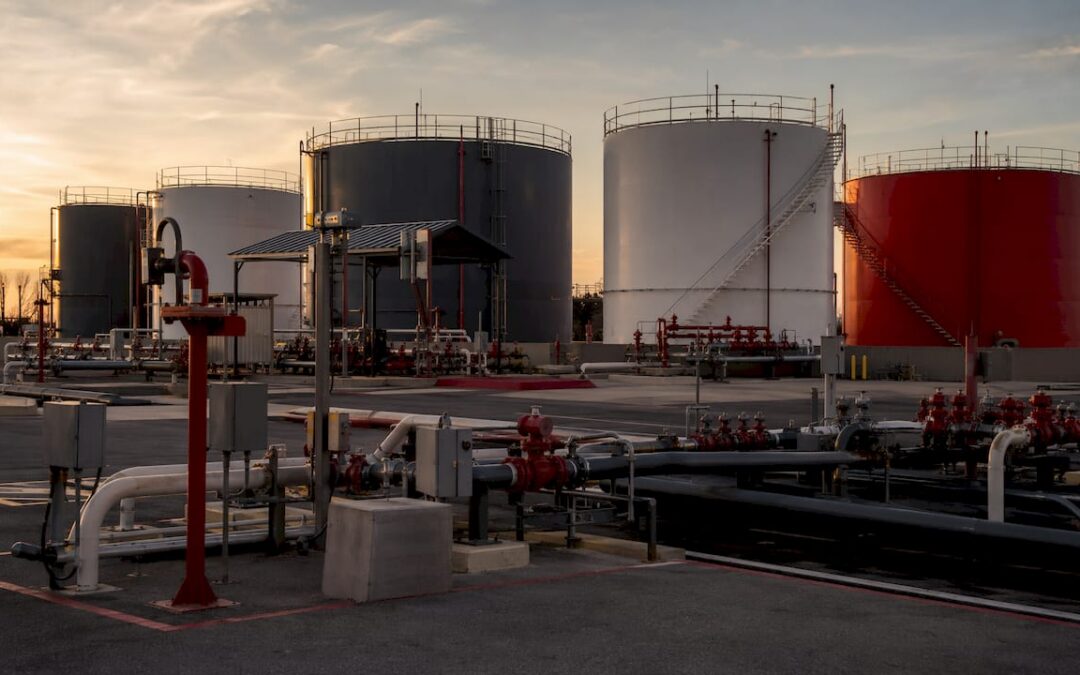
For mission-critical industrial operations, the most reliable utility infrastructure fueling strategy combines scheduled bulk delivery, telemetry-enabled inventory management, and a contracted 24/7 emergency retainer. This blended model gives you predictable capacity planning, real-time fuel visibility, and a guaranteed response window when supply gaps threaten uptime. The DOE’s integrated resource planning guidance recommends modeling multiple load scenarios and demand flexibility options, which maps directly to how a layered fueling strategy should be structured. ESIG’s integrated planning framework reinforces this: breaking down silos between fuel systems and load models produces the least-cost, most reliable outcomes. Anytimefuelpros executes this blended model across data centers, mining operations, municipal fleets, and construction sites nationwide.
The three non-negotiables for any high-uptime fueling strategy: a contracted scheduled delivery cadence tied to real consumption data, telemetry that triggers automated reorders before you hit a critical threshold, and a documented emergency SLA with a provider who can actually respond at 2 AM on a Sunday.
- Scheduled bulk delivery: predictable cost, high-volume capacity, best for sites consuming 500+ gallons per week
- Telemetry-enabled inventory management: real-time tank visibility, automated alerts, eliminates manual dip-stick checks
- 24/7 emergency retainer: guaranteed response windows, prioritized staging, documented escalation paths
Table of Contents
- What are the core utility infrastructure fueling strategies?
- How do you choose the right fueling strategy and provider?
- How to implement a fueling strategy: phases and timelines
- Fuel types, storage, and U.S. compliance essentials
- What telemetry and reporting should your fueling program include?
- How do you build emergency redundancy into your fueling plan?
- How do you assess fueling risk across utility infrastructure?
- Environmental and sustainability considerations in fueling strategy
- What U.S. regulations govern on-site fueling infrastructure?
- Health and safety protocols for on-site fueling operations
- How do you future-proof your fueling strategy for alternative fuels?
- Anytimefuelpros: your partner for mission-critical fueling
- Key Takeaways
- Useful sources and further reading
What are the core utility infrastructure fueling strategies?
Not every site needs the same approach. The five core strategies each serve a distinct operational profile.
| Strategy | Best For | Typical Cadence | Emergency SLA Expectation |
|---|---|---|---|
| Scheduled bulk delivery | Data centers, mining, municipal fleets | Weekly to monthly | Not primary; retainer supplements |
| On-demand / emergency response | Any site with unplanned outages | As-needed | 2–4 hours typical |
| Fleet wet-hosing | Construction yards, trucking depots | Daily to weekly | Same-day |
| Onsite storage / tank fills | Remote sites, high-consumption operations | Weekly to bi-weekly | Depends on reserve volume |
| DEF delivery | Any Tier 4 diesel fleet | Synchronized with diesel delivery | Same-day where available |
Scheduled bulk delivery suits high-consumption sites where consumption is predictable and downtime costs are severe. A data center running N+1 generator redundancy, for example, needs fuel topped off on a fixed cadence so backup capacity is always available. On-demand response fills the gaps when consumption spikes or a delivery misses its window. Fleet wet-hosing eliminates the labor cost of sending drivers to retail stations, which adds up quickly across large equipment fleets. Onsite storage with regular tank fills works well for remote mining or construction sites where access is limited and a buffer of several thousand gallons is the only protection against a supply interruption.
DEF delivery is often overlooked until a Tier 4 engine goes into limp mode. Synchronizing DEF drops with diesel deliveries removes a separate logistics variable entirely.
Pro Tip: Pair scheduled deliveries with telemetry from day one. Sites that install tank-level sensors before their first scheduled delivery typically reduce emergency surcharge costs because they catch low-inventory conditions before they become crises.

How do you choose the right fueling strategy and provider?
Start with your uptime target, not your budget. A site with a 99.9% uptime requirement needs a different contract structure than a construction yard that can tolerate a two-hour delay.
Decision checklist:
- What is your target uptime SLA, and what is the cost of one hour of downtime?
- What is your average daily and peak-day fuel consumption?
- How much onsite storage capacity do you have, and is secondary containment in place?
- Does your site have telemetry infrastructure, or does it need to be installed?
- What compliance requirements apply: dyed vs. clear diesel, DEF handling, state reporting?
- Do you need multi-state or multi-site coverage under a single contract?
| Capability | What to Require |
|---|---|
| Emergency SLA | Documented response window (e.g., 4 hours), not just “best effort” |
| Cost model | Per-gallon pricing with transparent surcharge schedule; contract minimums stated upfront |
| Compliance handling | Dyed vs. clear diesel segregation, DEF handling protocols, delivery documentation |
| Telemetry & reporting | GPS/time-stamped proof of delivery, tank-level integration, consumption trend reports |
| Multi-state coverage | Named partner network or owned fleet with verified coverage in your operating states |
Ask every prospective provider for a sample SLA, proof of insurance and carrier certifications, and at least two references from comparable sites such as data centers or municipal fleets. Providers who hesitate on any of these are telling you something. Review heavy equipment fueling schedule best practices to benchmark cadence expectations before entering contract negotiations.
How to implement a fueling strategy: phases and timelines
Phase 1: Audit and risk assessment (1–3 weeks)
- Profile fuel consumption by asset type and shift pattern
- Survey tank condition, secondary containment, and labeling compliance
- Assess telemetry compatibility and identify permitting requirements
- Establish an environmental baseline for spill prevention planning
Phase 2: Equip and integrate (2–6 weeks)
- Install tank-level sensors and connect to your CMMS or ERP
- Draft standard operating procedures for deliveries, spill response, and after-hours escalation
- Run pilot deliveries to verify routing, access, and documentation workflows
- Confirm DEF storage is segregated and properly labeled
Phase 3: Scale and optimize (1–3 months)
- Activate full scheduled delivery cadence based on pilot consumption data
- Verify SLA response times with a tabletop drill
- Set quarterly review cadence for consumption trends and contract terms
- Stage emergency reserves at secondary locations for multi-site operations
Remote sites, tank upgrades, and state permitting can extend Phase 1 and Phase 2 timelines. Build that buffer into your project plan. Condition-based programs can cut unplanned downtime by 30–50% and reduce maintenance costs by 10–40% compared with reactive repairs, which makes the telemetry install in Phase 2 one of the highest-ROI steps in the entire roadmap.
Fuel types, storage, and U.S. compliance essentials
Clear on-road diesel is taxed and used in licensed highway vehicles. Dyed off-road diesel carries a red dye marker, is tax-exempt, and is restricted to non-highway equipment such as generators, excavators, and agricultural machinery. Mixing them up triggers IRS penalties and state enforcement actions. DEF is a urea-water solution that must be stored separately from diesel, kept below 86°F to prevent degradation, and handled with dedicated equipment to avoid contamination.
On-site storage requires secondary containment sized to hold at least 110% of the largest tank’s capacity, per EPA Spill Prevention, Control, and Countermeasure (SPCC) regulations. Tank labeling must clearly identify fuel type and grade. Electrical zones near fuel storage must comply with NFPA 30 and NEC Article 500 classifications. Routine inspection schedules, typically monthly visual checks and annual formal inspections, keep you ahead of state environmental agency audits. AFP’s bulk fuel delivery and storage resources cover practical storage configurations for job sites and industrial yards.
Pro Tip: For DEF bulk deliveries, require dedicated hoses and fittings that never contact diesel. A single cross-contamination event can damage selective catalytic reduction systems across an entire fleet, and the repair costs dwarf the cost of proper equipment.
State-level permitting thresholds vary. California’s SPCC requirements and aboveground storage tank (AST) rules differ from Texas’s TCEQ standards, which differ again from Utah’s DEQ requirements. Confirm your state’s trigger thresholds before commissioning new storage.
What telemetry and reporting should your fueling program include?
Fuel data becomes an operational asset when it feeds your broader asset management and planning systems. Require these capabilities from any provider or telemetry vendor:
- Real-time tank level with configurable low-inventory alerts (e.g., trigger at 25% capacity)
- Temperature monitoring for DEF storage
- GPS and time-stamped proof-of-delivery records for every drop
- Automated reorder thresholds that generate a delivery request without human intervention
- API or flat-file export compatible with your CMMS, ERP, or EAM platform
| Reporting Output | Recommended Cadence | Primary User |
|---|---|---|
| Delivery confirmation with GPS POD | Per delivery | Operations / compliance |
| Tank-level trend report | Weekly | Facilities manager |
| Consumption vs. forecast variance | Monthly | Procurement / finance |
| Emergency event log | Per event + monthly summary | Risk / continuity team |
| Invoice reconciliation report | Monthly | Finance / accounts payable |
ESIG’s integrated planning guidance emphasizes aligning data formats across systems to avoid blind spots. The same principle applies to fuel: when tank-level data lives in a silo disconnected from your load forecasts and maintenance schedules, you lose the early-warning advantage that telemetry is supposed to provide. Schedule a quarterly data review with your operations, procurement, and facilities teams to close that loop.
How do you build emergency redundancy into your fueling plan?
A fueling strategy without a tested emergency protocol is a liability, not an asset. The goal is to eliminate single points of failure before an outage exposes them.
Continuity measures to build in:
- Maintain onsite reserves at N+1 minimum (enough fuel to run critical loads for 72 hours without a delivery)
- Contract an emergency retainer with a documented response window, not an ad-hoc arrangement
- Stage secondary inventory at a geographically separate location for multi-site operations
- Establish mutual-aid agreements with your provider for priority dispatch during regional emergencies
SLA items to demand in writing: guaranteed response window (e.g., four hours for critical loads), prioritized staging for your highest-criticality assets, documented escalation paths with named contacts, and proof-of-delivery standards that create an auditable record. Anytimefuelpros provides specialized emergency fuel services for data centers with after-hours response capability built for mission-critical uptime requirements.
Run a tabletop exercise quarterly to verify that your escalation paths and contact lists are current. An annual full-scale drill, where you simulate a supply interruption and activate your emergency protocol, reveals gaps that tabletops miss. Where grid capacity constraints exist, operators are increasingly pairing backup generators with on-site solar and battery storage to reduce dependence on any single fuel supply chain, as California depot operators have demonstrated with microgrid deployments.
How do you assess fueling risk across utility infrastructure?
Risk assessment for fueling infrastructure follows the same logic as utility asset management: rank assets by criticality, then by probability of failure, and allocate mitigation resources accordingly.
Start with a consumption and dependency map. Identify every asset that depends on liquid fuel, its criticality tier (life-safety, revenue-critical, or deferrable), and its current reserve margin. Cross-reference that map against your delivery lead times and storage capacity to find the gaps where a single missed delivery creates a critical shortfall.
Apply a consequence-of-failure score to each asset. A data center generator that supports a Tier III facility scores higher than a backup pump at a warehouse. That score drives your inspection frequency, your minimum reserve threshold, and your SLA requirements with your fuel provider. Utility asset management best practices recommend classifying assets by potential impact and using that ranking to set maintenance and inspection cadences, which translates directly to fueling infrastructure.
Document your vulnerabilities in a risk register. Update it after every emergency event, every near-miss, and every quarterly review. A risk register that never changes is a sign that no one is actually using it.
Environmental and sustainability considerations in fueling strategy
Fuel delivery operations carry real environmental obligations, and the regulatory bar is rising. SPCC plans are required for facilities storing more than 1,320 gallons of oil in aboveground containers, per EPA rules. Spill prevention, secondary containment, and documented response procedures are not optional, and state agencies conduct inspections.
Beyond compliance, corporate sustainability goals are pushing operations teams to account for emissions from backup generation and on-site equipment. Tracking fuel consumption by asset and comparing it against load forecasts, as the DOE IRP framework recommends for large industrial loads, gives you the data to identify reduction opportunities without sacrificing reliability.
Renewable diesel (R99 or R100) is a drop-in replacement for petroleum diesel that reduces lifecycle carbon emissions and requires no equipment modifications. It is increasingly available through commercial fuel distributors in Texas, California, and other major markets. Biodiesel blends (B5, B20) are another option, though cold-weather operability and storage stability require attention in northern climates.
What U.S. regulations govern on-site fueling infrastructure?
The regulatory picture for on-site fueling spans federal, state, and local layers, and the requirements vary enough by jurisdiction that a one-size-fits-all compliance checklist will leave gaps.
At the federal level, EPA’s SPCC rule governs spill prevention for facilities above the storage thresholds noted above. DOT regulations under 49 CFR govern the transport of hazardous materials, including diesel fuel, and apply to your delivery carrier’s vehicles and documentation. IRS rules on dyed fuel use are enforced through roadside inspections and audits.
At the state level, Texas’s TCEQ, California’s CUPA program, and Utah’s DEQ each set their own AST registration thresholds, secondary containment standards, and reporting requirements. Some counties and municipalities layer additional permitting on top of state rules, particularly for facilities near waterways or in urban areas. Confirm requirements with your state environmental agency before commissioning new storage or expanding existing capacity. This article provides general information; confirm current rules with a qualified environmental consultant or attorney for your specific site.
Health and safety protocols for on-site fueling operations
On-site fueling introduces ignition, spill, and vapor exposure risks that require active controls, not just posted signs.
Bonding and grounding connections between the delivery vehicle and the receiving tank must be established before any fuel transfer begins, eliminating static discharge as an ignition source. No-smoking and no-open-flame zones must be enforced within a minimum radius of active fueling points, typically 25 feet per NFPA 30 guidance. Personnel involved in fuel transfers should wear chemical-resistant gloves and safety glasses as a baseline; sites handling large volumes should have spill kits staged within reach of every transfer point.
Wet-hosing operations, where fuel is delivered directly into equipment tanks, require the equipment to be shut down and cooled before fueling begins. Fueling near overhead power lines requires a minimum clearance check. All delivery personnel should be trained on your site’s emergency response procedures, not just their own company’s protocols. Maintain a site-specific emergency contact list, including your fuel provider’s after-hours line, at every fueling station.
How do you future-proof your fueling strategy for alternative fuels?
Diesel will remain the dominant fuel for backup generation and heavy equipment through the near term, but the transition is already underway in fleet and freight applications. ACEEE’s freight infrastructure analysis advises prioritizing shared, truck-ready battery-electric charging hubs and cautions that hydrogen infrastructure carries higher cost and stranded-asset risk without phased deployment.
For operations teams planning infrastructure investments today, the practical path is to design storage and delivery infrastructure with flexibility in mind. Renewable diesel requires no modifications to existing tanks or equipment. Biodiesel blends require attention to material compatibility and cold-flow properties. Hydrogen and battery-electric infrastructure require entirely different site layouts and utility connections, making them longer-horizon investments that should be phased and demand-tested before committing capital.
Build a fuel-type review into your annual planning cycle. Track what your equipment OEMs are certifying, what your state’s incentive programs are funding, and what your peer operators are piloting. The linehaul trucking sector is already navigating this transition, and the infrastructure decisions being made there will shape commercial fueling options across adjacent industries within the next decade.
Anytimefuelpros: your partner for mission-critical fueling
When your uptime depends on fuel being there before you need it, the provider you choose matters as much as the strategy you build.
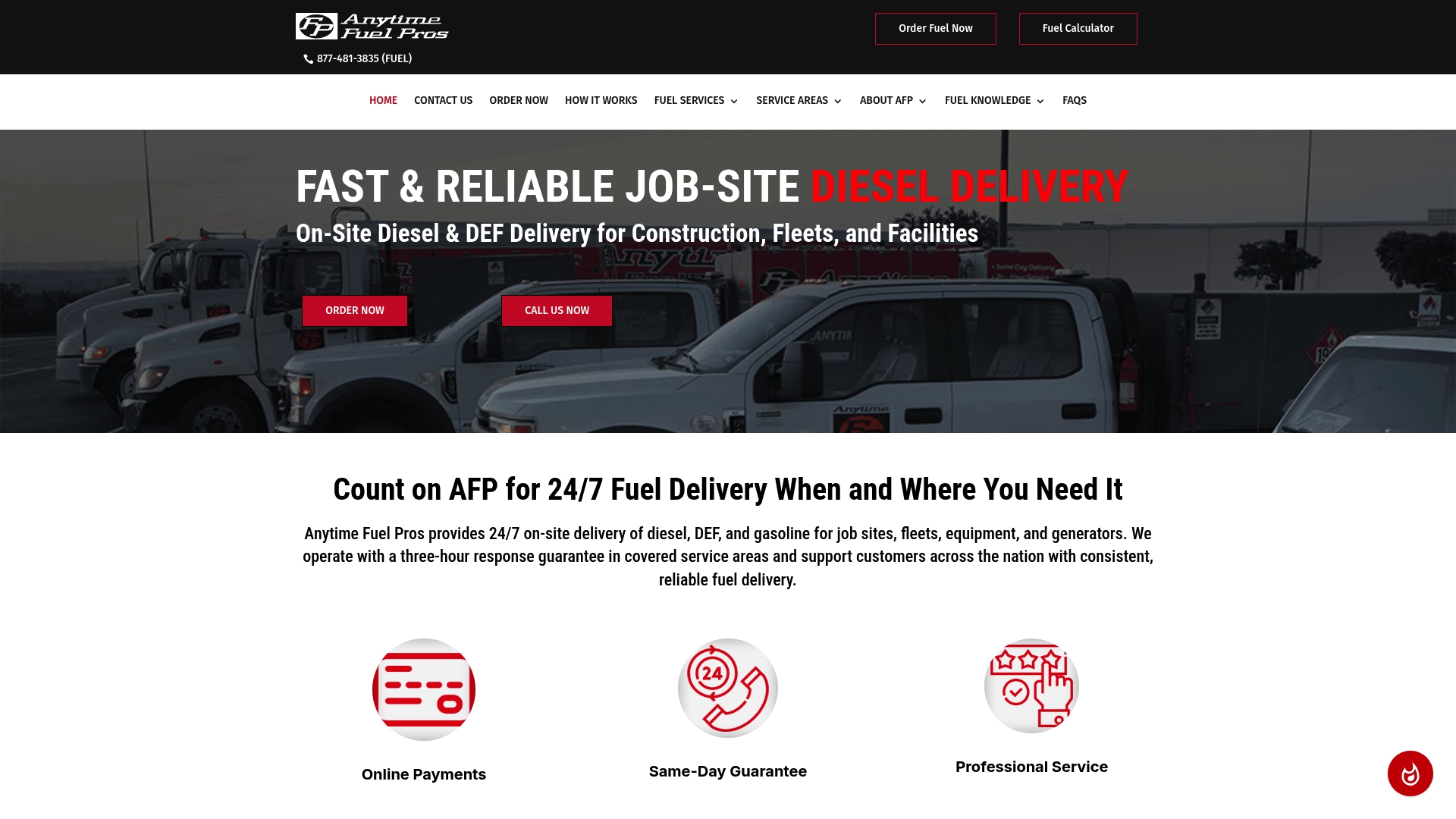
Anytimefuelpros delivers scheduled bulk diesel, emergency response fueling, DEF delivery, fleet wet-hosing, and remote site fueling across Texas, Utah, and the continental United States through a national partner network. Primary markets include San Antonio, Austin, Dallas-Fort Worth, and Salt Lake City, with multi-state enterprise contracts handled through a single point of contact. Every delivery comes with transparent invoicing, GPS-confirmed proof of delivery, and 24/7 emergency response capability backed by after-hours dispatch. For data centers, mining operations, municipal fleets, and construction sites, AFP brings the SLA structure and technology-driven operations that mission-critical sites require. Explore AFP’s full service capabilities or request a site audit and emergency retainer quote to get your fueling strategy on a documented, defensible footing.
Key Takeaways
A blended fueling model combining scheduled bulk delivery, telemetry, and a contracted emergency retainer delivers the highest uptime reliability for mission-critical industrial and utility infrastructure sites.
| Point | Details |
|---|---|
| Lead with a consumption audit | Profile fuel use by asset and shift before selecting a delivery cadence or contract structure. |
| Install telemetry before first delivery | Tank-level sensors reduce emergency surcharge exposure and give your CMMS the data it needs. |
| Demand a written SLA | Require a documented response window, escalation path, and proof-of-delivery standard from every provider. |
| Stage emergency reserves at N+1 | Maintain 72 hours of critical-load fuel onsite; stage secondary inventory at a separate location for multi-site operations. |
| Anytimefuelpros covers the full model | AFP delivers scheduled bulk, DEF, emergency response, and nationwide coverage under a single contract. |
Useful sources and further reading
ESIG on integrated planning: “Aligning data formats and modeling assumptions across systems supports robust, least-cost planning” — a principle that applies directly to fuel-data integration with CMMS and ERP platforms.
- DOE Best Practices in Integrated Resource Planning — capacity expansion modeling, load scenario planning, and demand flexibility guidance for large industrial loads
- ESIG Foundations of Integrated Planning (2025) — cross-system data alignment and least-cost reliability planning
- ACEEE: Pathways to Zero-Emission Freight — alternative fuel infrastructure phasing and stranded-asset risk for freight and heavy-duty applications
- Canary Media: California EV-Truck Depot Microgrids — on-site generation and hybrid resilience strategies for grid-constrained sites
- Utility Asset Management Best Practices — condition-based monitoring, risk-based maintenance, and the 30–50% downtime and 10–40% maintenance cost reduction case for telemetry-driven programs
- Anytimefuelpros Fuel Services — scheduled delivery, emergency response, DEF, and bulk storage service details
- AFP Emergency Fuel Services for Data Centers — mission-critical SLA structure and after-hours response capabilities
Recommended
- Why More Job Sites Are Choosing On-Site Fuel Delivery (And Why Yours Should Too) – Anytime Fuel Pros
- How On-Site Fuel Delivery Can Elevate Your Business – Anytime Fuel Pros
- Top Industries That Benefit Most from On-Site Diesel Delivery – Anytime Fuel Pros
- Fuel Delivery for Utility Companies: A Manager’s Guide
Recent Comments