

A national fuel delivery network is a coordinated system of regional terminals, partner carrier fleets, and centralized dispatch that delivers diesel, gasoline, and DEF directly to commercial and industrial sites anywhere in the continental United States under a single contract. Before you award a contract, verify site-specific SLAs, confirm 24/7 emergency response capability, and require electronic proof-of-delivery (ePOD) for every primary location. The U.S. moves more than 12 million barrels of transportation fuel every day across roughly 70,000 miles of refined product pipelines, which means the underlying supply chain is large but regionally constrained. Anytimefuelpros operates within this system, delivering fuel to job sites, data centers, mining operations, and municipal fleets across Texas, Utah, and the rest of the country through a trusted partner network.
Table of Contents
- How does a national fuel delivery network actually work?
- What services do national fuel networks typically provide?
- What does “nationwide” really mean for coverage and SLAs?
- What should your procurement checklist include?
- How does pricing work and what drives your total cost?
- What compliance and safety requirements must vendors meet?
- What technology and reporting features should you require?
- When should you choose a national network over local suppliers?
- Anytimefuelpros delivers what the procurement checklist requires
- Key Takeaways
- Useful sources for procurement teams
How does a national fuel delivery network actually work?
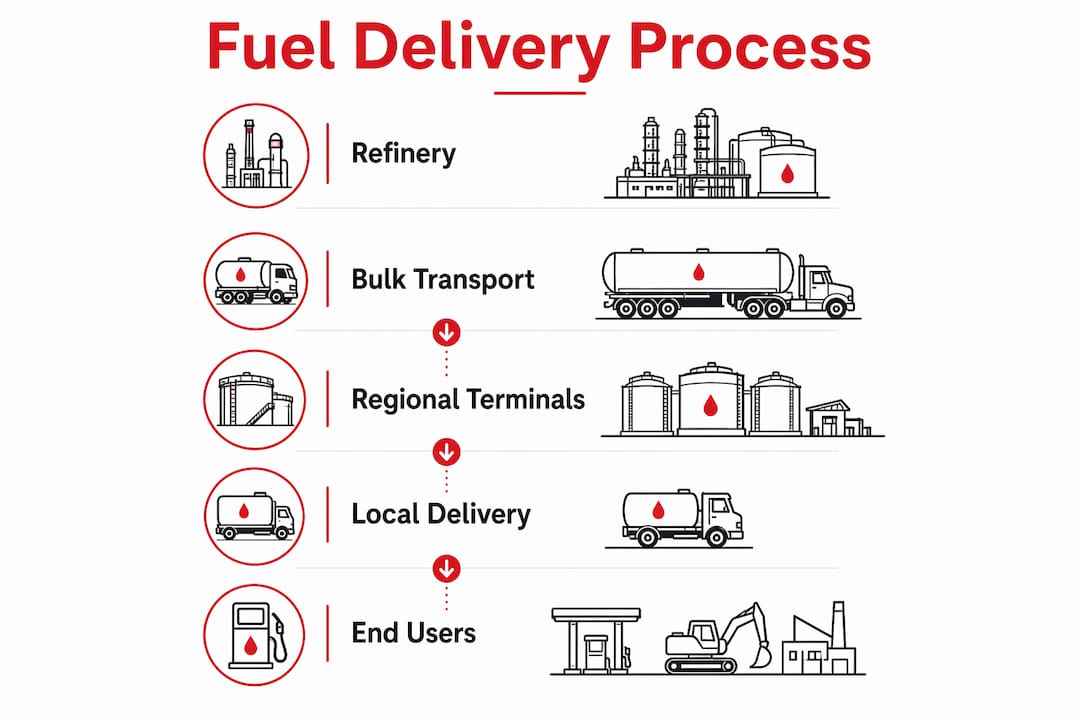
Networks move fuel in a left-to-right chain: refinery or terminal → bulk transport (pipeline, rail, or barge) → regional distribution terminal → network partner tankers → your site. The national coordinator manages contracts, pricing, dispatch, and consolidated invoicing. Local partners handle the last mile, including driver scheduling, equipment, and on-site delivery. Third-party carriers fill gaps in remote or low-volume markets.
Operationally, the building blocks are dispatch and route planning, ePOD with timestamp confirmation, inventory scheduling tied to your consumption rate, and emergency staging at regional terminals. On-site diesel delivery follows this same sequence, from scheduling through delivery confirmation, with technology touchpoints at each step.

| Industry metric | Scale |
|---|---|
| Daily U.S. transportation fuel consumption | 12+ million barrels per day |
| Refined product pipeline miles (U.S.) | ~70,000 miles |
| CFN cardlock commercial fueling locations | 3,000+ |
Pro Tip: Ask your network coordinator which regional terminals serve your primary sites and what the contingency plan is when a terminal goes offline. That answer tells you more about real-world reliability than any marketing claim.
What services do national fuel networks typically provide?
National networks typically provide scheduled on-site diesel and gasoline delivery, DEF, bulk tank fills, fleet card access, and 24/7 emergency fueling. The full AFP service catalog maps directly to what procurement teams expect from a national provider.
- Scheduled on-site bulk delivery: Weekly or bi-weekly fills for construction sites, logistics yards, and mining operations. Delivery quantity and frequency are set by your consumption rate and tank capacity.
- Emergency and after-hours response: Activated when a generator, piece of heavy equipment, or fleet vehicle runs dry outside normal hours. Response time depends on local partner proximity.
- DEF delivery: Required for Tier 4 diesel equipment and modern truck fleets. Often bundled with diesel delivery on the same truck run.
- Fleet card access: Cardlock networks like the Commercial Fueling Network (CFN) give drivers access to 3,000+ commercial fueling locations without requiring on-site delivery.
- Bulk storage fills: Large-volume deliveries to on-site tanks for remote frac sites, data center generator farms, or agricultural operations during harvest season.
A typical use case: a remote frac site in West Texas receives scheduled weekly bulk diesel fills of 5,000–10,000 gallons, with ePOD confirmation sent to the procurement team and a standing emergency response commitment for unplanned outages.
Pro Tip: For data centers and other mission-critical sites, negotiate a dedicated emergency staging allocation at the nearest regional terminal, not just a general “best effort” emergency clause.
What does “nationwide” really mean for coverage and SLAs?
“Nationwide” indicates network reach, not uniform speed or resource availability in every local market. Regional constraints tied to pipeline access, PADD movement restrictions, and boutique fuel blends mean that delivery windows and emergency response times vary significantly by geography. A network that delivers in four hours in Dallas may need 12–18 hours in a remote Wyoming basin.
SLA elements to require in writing:
- Guaranteed delivery window by site type (urban, suburban, remote)
- Emergency response ETA with a specific hour commitment, not “as soon as possible”
- Minimum order size per delivery
- Fuel specification control (dyed vs. clear diesel, blend grade)
- ePOD delivery verification with timestamp and driver confirmation
Typical reference points by market type: urban markets often see 2–4 hour emergency response; suburban markets 4–8 hours; remote or rural sites 8–24 hours depending on terminal proximity. Require site-specific SLA addenda for every high-priority location, not a single blanket SLA for the whole contract.
Pro Tip: If a vendor cannot provide historical response-time data for sites comparable to yours, treat that as a red flag, not a negotiating point.
What should your procurement checklist include?
Insist on site-specific SLAs, ePOD, transparent invoicing, insurance, and exit clauses before signing. Vendor SLA standards for fuel delivery cover the core metrics; your contract should go further.
Numbered contract clause checklist:
- Site-specific SLA with guaranteed delivery windows and emergency ETAs
- Emergency response protocol with escalation contacts and contingency for terminal outages
- Minimum order quantities and automatic replenishment triggers
- Pricing adjustment mechanics (index-linked, fixed margin, or spot-plus)
- Invoicing cadence, format, and cost-center coding requirements
- Data and reporting rights: ePOD per delivery, monthly usage reports by site
- Insurance and indemnity: minimum liability limits, certificate of insurance at signing
- Environmental remediation responsibilities for spills or storage failures
- Contract exit terms: notice period, volume shortfall penalties, and data portability
Minimum documentation at signing:
- Certificate of insurance with your entity named as additional insured
- Sample ePOD showing timestamp, quantity, driver ID, and site confirmation
- Pilot invoice matching your expected billing format
- Escalation matrix with 24/7 emergency contact numbers
Require fleet insurance documentation that covers cargo liability and environmental damage, not just vehicle liability. Consult legal counsel for jurisdictional specifics before finalizing contract language.
How does pricing work and what drives your total cost?
Pricing is a combination of per-gallon commodity price plus delivery fee plus minimum order surcharges, and may include network access fees or card fees. The per-gallon commodity price tracks the OPIS or Platts rack price at the nearest terminal; everything else is negotiable.
- Per-gallon market price: Moves daily with crude and refinery margins. Contract pricing locks in a fixed margin above rack; spot pricing gives you market rate with no commitment.
- Delivery distance: Longer hauls from terminal to site add a per-mile or zone-based surcharge.
- Emergency and after-hours premiums: Typically a flat fee or per-gallon surcharge above the standard delivery rate.
- Minimum delivery quantities: Falling below the minimum triggers a surcharge or a flat trip fee.
- Fuel specification complexity: Boutique blends, dyed diesel, or low-sulfur requirements can add cost at the terminal level.
- Environmental handling fees: Required for certain storage configurations or spill-prevention compliance.
Contract pricing suits high-volume, predictable demand. Spot pricing is cheaper for one-off emergency fills when you have no committed volume. To compare quotes fairly, calculate total landed cost per gallon: commodity price plus all fees divided by gallons delivered.
Pro Tip: Include a pricing normalization table in your RFP. Require vendors to quote commodity price, delivery fee, emergency premium, minimum surcharge, and any card or network access fees as separate line items so you can compare apples to apples.
What compliance and safety requirements must vendors meet?
Vendors must follow DOT shipping rules, EPA fuel specifications, local storage and spill-prevention requirements, and proper handling protocols for dyed versus clear diesel and DEF. Verify each of these before a truck rolls onto your site.
- DOT transport and placarding: Drivers must hold a valid CDL with hazmat endorsement; tankers must display correct placards for flammable liquids.
- EPA fuel blend restrictions: Clear diesel must meet ULSD standards; dyed diesel is restricted to off-road use and carries tax implications if misused.
- State boutique fuel rules: California, Texas, and other states impose additional blend requirements that affect terminal sourcing and delivery routing.
- Local storage permitting: Above-ground storage tanks above certain thresholds require state or local permits and secondary containment.
- Driver certifications and spill kits: Require proof of spill-response training and confirm each delivery truck carries a compliant spill kit.
- Emergency response contact matrix: Site teams and vendors should both have a 24/7 contact list for spill events, not just delivery scheduling.
Include a contract clause assigning environmental remediation responsibility to the vendor for spills caused by their equipment or personnel. The EPA’s Spill Prevention, Control, and Countermeasure (SPCC) rule governs on-site storage above 1,320 gallons of aggregate aboveground capacity.
What technology and reporting features should you require?
Look for GPS-enabled deliveries, ePOD with timestamp and photo, consolidated invoicing by site and cost center, automated reconciliation, and ERP or TMS integrations. These features cut admin time and reduce payment disputes across multi-site programs.
- GPS ETA tracking: Lets site teams prepare for delivery without waiting on phone calls.
- ePOD with timestamp, photo, and driver ID: Creates an auditable delivery record that resolves quantity disputes before they become invoice disputes.
- Consolidated invoicing by site and cost center: Eliminates manual allocation across departments or projects.
- API or flat-file integrations: Connect delivery data directly to your ERP, TMS, or accounting platform.
- Mobile driver apps: Confirm delivery details in real time and push ePOD to the customer portal immediately.
- Usage dashboards with customizable reports: Let procurement track consumption by site, flag anomalies, and forecast replenishment.
Requiring ePOD plus API or flat-file delivery reporting is the single most effective step procurement can take to reduce invoice disputes and speed reconciliation across a multi-site fuel program. When delivery data flows automatically into your accounting system, the manual matching step disappears entirely.
Require delivery and usage data per site as a contractual right, not a vendor courtesy. If a vendor cannot export ePOD data in a standard format, that is a systems limitation that will cost you time every billing cycle.
When should you choose a national network over local suppliers?
Choose a national network when you need standardized SLAs, consolidated billing, and multi-state coverage. Choose local suppliers when you need best-in-market local availability or lower spot pricing for a single region. The tradeoff is real, and the right answer depends on your site count, uptime requirements, and reporting needs.
| Factor | National network | Local/regional supplier |
|---|---|---|
| Multi-site billing | Consolidated, single vendor | Separate invoices per vendor |
| Pricing predictability | Contract margin, index-linked | Spot market, more variable |
| Emergency staging | Pre-positioned at regional terminals | Depends on local inventory |
| Local responsiveness | Varies by partner quality | Often faster in home market |
| Reporting and integrations | Centralized dashboard, API-ready | Typically manual or limited |
Decision questions to ask before choosing:
- How many sites need fuel, and are they in multiple states?
- What is the cost of a single unplanned outage at your highest-criticality site?
- Do you need consolidated reporting for compliance or cost allocation?
- What fuel specifications do your sites require, and can a local supplier meet all of them?
For logistics yard operations, typical lead time from contract signing to full service deployment runs two to four weeks for standard scheduled delivery. Emergency response capability is usually active within days of contract execution. For nationwide managed service comparisons, the consolidation benefit tends to outweigh local pricing advantages once a company crosses three or more active sites.
Anytimefuelpros delivers what the procurement checklist requires
Anytimefuelpros offers on-site diesel and gasoline delivery, scheduled and emergency response, bulk fills, DEF delivery, ePOD confirmation, and consolidated invoicing across Texas, Utah, and the continental United States through a national partner network.
AFP’s services map directly to the buyer checklist: scheduled recurring deliveries for construction job sites and logistics yards, 24/7 emergency fuel response for data centers and disaster scenarios, bulk on-site fills for mining and frac operations, and DEF delivery bundled with diesel runs. Every delivery includes ePOD with timestamp and quantity confirmation. Invoicing is consolidated by site and cost center, with reporting available for compliance and cost allocation. The benefits of on-site fuel delivery go beyond convenience: reduced labor hours, eliminated dry-tank downtime, and a single vendor contact for multi-state programs.
Request a site-specific SLA addendum and a pilot delivery for your highest-priority location to evaluate AFP’s response time and reporting before committing to a full contract.
Key Takeaways
A national fuel delivery network delivers consistent, contracted fuel service across multiple sites only when procurement enforces site-specific SLAs, ePOD requirements, and verified emergency response commitments at the contract stage.
| Point | Details |
|---|---|
| Verify SLAs per site | Require guaranteed delivery windows and emergency ETAs for each location, not a single blanket SLA. |
| Require ePOD and consolidated invoicing | Electronic proof-of-delivery with timestamp and API export eliminates manual reconciliation across sites. |
| Confirm emergency response and insurance | Get a specific-hour emergency ETA and a certificate of insurance naming your entity before signing. |
| Understand total landed cost | Compare per-gallon commodity price plus all fees and minimums, not headline rate alone. |
| Anytimefuelpros | Offers scheduled delivery, emergency response, DEF, bulk fills, and ePOD reporting across the continental U.S. |
Useful sources for procurement teams
AFP resources and external references used in this article:
- AFP on-site diesel delivery process (AFP resource): Operational walkthrough of scheduling, dispatch, delivery, and ePOD. Use when drafting RFP process requirements.
- AFP vendor SLA procurement guide (AFP resource): SLA metrics, delivery window standards, and contract language guidance. Cite directly in RFP SLA sections.
- AFP disaster response services (AFP resource): Emergency delivery capabilities and contingency planning for mission-critical sites.
- AFP bulk fuel delivery and storage (AFP resource): Tank sizing, fill schedules, and recordkeeping for large or remote sites.
- U.S. Fuel Distribution Network Assessment (external, Transportation Energy): Primary source for pipeline miles, daily fuel volumes, and regional supply constraints. Cite for regulatory context and supply chain background in RFPs.
- CFN Commercial Fueling Network guide (external): Reference for cardlock network scale and fleet card program structure.
Recent Comments