

Vendor SLA fuel delivery standards are defined as the contractual service expectations that govern how, when, and in what condition a fuel supplier delivers product to your operation. These standards translate vague vendor promises into measurable, enforceable commitments covering delivery timing, fuel quality, volume accuracy, and communication protocols. Procurement teams that skip this step pay for it in equipment downtime, billing disputes, and supply gaps at the worst possible moments. Regulatory frameworks like API MPMS Chapter 11, quality benchmarks from ASTM, and EPA compliance requirements all shape what a credible fuel supply agreement must address. Getting these standards right before you sign is the difference between a vendor relationship that holds under pressure and one that collapses when you need it most.
What key performance metrics should vendor SLAs for fuel delivery include?
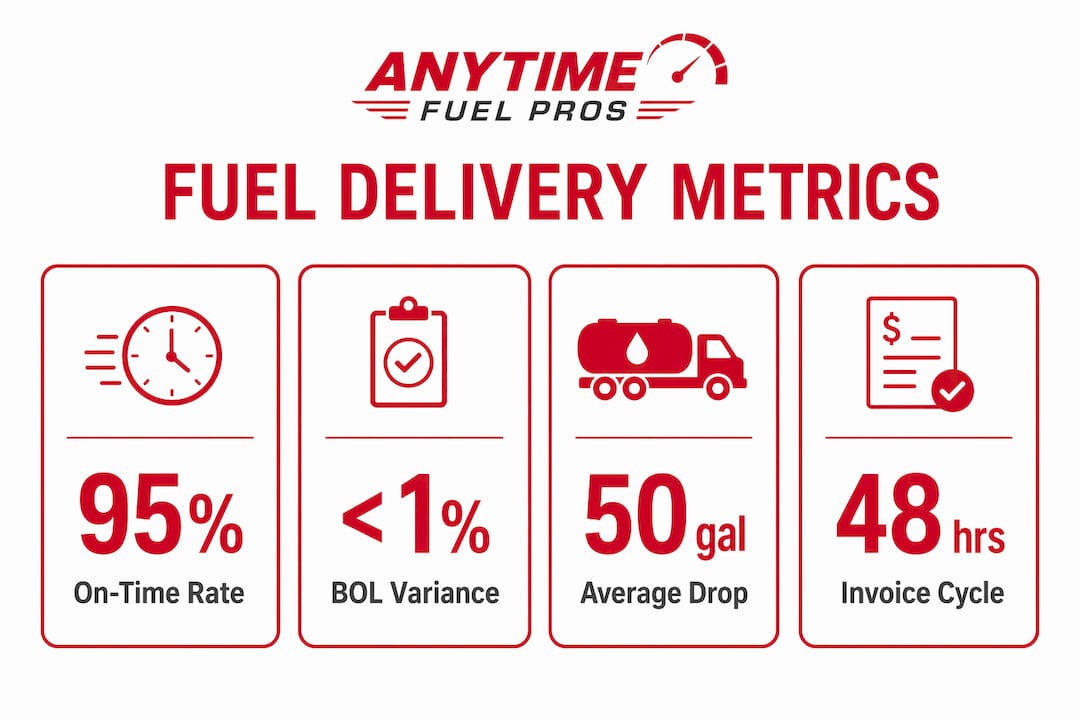
Procurement teams should track five core metrics for fuel SLA compliance: on-time delivery rate, average drop size, urgency of re-dispatches, variance between bill of lading (BOL) and meter totals, and invoice cycle time. Each metric targets a different failure point in the supply chain. Together, they give you a complete picture of vendor performance.
On-time delivery rate measures the percentage of deliveries that arrive within the agreed window. A target of 95% or higher is a reasonable baseline for operations with scheduled recurring demand. Anything below that signals a pattern worth escalating.

BOL-to-meter variance is the metric most procurement teams underestimate. Diesel expands roughly 0.08% per degree Celsius, which means apparent volume discrepancies of up to 1.2% can appear on deliveries without any actual product loss. Contracts that do not specify net standard volume corrected to 60°F create billing disputes that are nearly impossible to resolve after the fact.
Invoice cycle time tracks how quickly a vendor produces an accurate invoice after delivery. Long invoice cycles hide errors and complicate budget reconciliation, especially for multi-site operations managing dozens of deliveries per month.
| Metric | Definition | Target |
|---|---|---|
| On-time delivery rate | Percentage of deliveries within agreed window | 95% or higher |
| BOL-to-meter variance | Volume difference between paperwork and actual meter reading | Less than 0.5% |
| Average drop size | Volume delivered per trip versus contracted amount | Within 2% of order |
| Re-dispatch urgency rate | Frequency of emergency re-dispatches due to missed deliveries | Below 5% of total orders |
| Invoice cycle time | Time from delivery to accurate invoice receipt | 24–48 hours |
Meter calibration is the foundation of all volume-based metrics. Calibration documentation must be verified annually per legal trade standards. Require your vendor to provide current calibration certificates before the contract starts, and include a clause that makes recertification a condition of continued service.
Pro Tip: Request the vendor’s last 90 days of BOL-to-meter variance data before signing. A vendor who cannot produce it likely does not track it, and that is a red flag for billing accuracy.
How to develop clear and enforceable SLA clauses for fuel delivery
A well-drafted fuel supply agreement turns performance expectations into legal obligations. Vague language like “timely delivery” or “quality fuel” is unenforceable. Specific, measurable clauses are not.
The following components belong in every fuel delivery SLA:
- Delivery timeline clause. State the maximum hours between order placement and delivery for both scheduled and emergency requests. Specify separate windows for standard orders, urgent re-dispatches, and after-hours emergency calls.
- Volume and quality standards. Require fuel to meet ASTM D975 for diesel or the applicable ASTM standard for your product. For aviation or specialty fuels, reference DEF STAN 91-91 or the relevant specification. Fuel quality standards in contracts ensure regulatory compliance and consistent delivery, with verification through sampling, testing, and regular audits.
- Net standard volume requirement. Specify that all deliveries are billed on net standard volume corrected to 60°F using API MPMS Chapter 11 methodology. This single clause eliminates the most common source of billing disputes.
- Notification and escalation protocol. Define who contacts whom, by what method, and within what timeframe when a delivery will be delayed, shorted, or disrupted. Name specific contacts on both sides.
- Regulatory priority and force majeure clause. Suppliers may be legally required to prioritize fuel delivery to government and critical sectors under 2026 energy regulations. Your contract must acknowledge this reality and define how the vendor will notify you if your supply is diverted, and what remedies apply.
- Remedies for breach. Specify financial penalties for missed delivery windows, volume shortfalls beyond the agreed variance threshold, and quality failures. Remedies without teeth do not change vendor behavior.
Pro Tip: Include a secondary sourcing clause that gives you the right to procure fuel from another vendor at the primary vendor’s expense if they miss a delivery by more than a defined threshold. This clause alone changes how seriously vendors treat your SLA.
Fuel delivery SLAs must also include clear communication protocols for supply changes, disruptions, or inventory issues. Timely notification is not optional when regulatory and market conditions shift quickly.
What tools and processes support SLA compliance monitoring?
Monitoring SLA compliance requires more than reviewing invoices after the fact. The right tools create a real-time audit trail that makes disputes rare and resolution fast.
The core technology stack for fuel delivery SLA monitoring includes:
- Temperature-correcting flow meters. Flow meters that measure corrected net flow volume improve accuracy and reduce disputes. Manual measurement is only acceptable for tanks under 2,000 gallons. Larger tanks require automatic gauging and independent flow meter verification.
- Remote tank gauges. Automated level sensors give procurement teams live visibility into on-site inventory without relying on vendor-reported data. They also trigger automatic reorder alerts before a site runs low.
- Electronic bills of lading (eBOL). eBOL systems capture delivery data at the point of transfer and feed it directly into your ERP or fuel management platform. This eliminates manual data entry errors and creates a timestamped record for every transaction.
- Digital fuel logistics platforms. Digitalization in fuel logistics enables live data integration across levels, usage, orders, pricing, meters, and compliance. Automation supports dynamic routing, eBOL capture, billing reconciliation, and tax preparation.
| Monitoring method | Strength | Limitation |
|---|---|---|
| Temperature-correcting flow meter | High volume accuracy, reduces billing disputes | Requires annual calibration verification |
| Remote tank gauge | Real-time inventory visibility | Does not verify delivery volume directly |
| eBOL system | Timestamped delivery record, ERP integration | Depends on vendor system compatibility |
| Manual dip measurement | Low cost, no technology required | Only reliable for tanks under 2,000 gallons |
Independent verification matters even when vendors use their own meters. Require your vendor to provide calibration certificates and allow your team or a third party to conduct spot audits. Integrating automated meter readings with temperature correction removes common billing disputes and strengthens the enforceability of SLA volume commitments.
What common challenges arise in managing fuel delivery SLAs?
The most expensive SLA failures are the ones procurement teams did not anticipate when drafting the contract. Three patterns account for the majority of disputes.
Volume discrepancies from temperature variation are the most frequent source of billing conflict. Diesel volume changes with ambient temperature, and a delivery made in summer heat will measure differently than the same mass of fuel delivered in winter. Contracts that specify gross volume instead of net standard volume create a built-in dispute mechanism. The fix is straightforward: require API MPMS Chapter 11 temperature correction on every delivery.
Supply disruptions from regulatory diversion catch procurement teams off guard. Procurement teams often underestimate the need to explicitly address regulatory priorities and force majeure in fuel SLAs, risking contractual ambiguities when supply is legally diverted to government or critical infrastructure. The solution is a contract clause that defines exactly what the vendor must do, and how fast, when your allocation is affected.
Communication breakdowns during disruptions compound every other problem. A delayed delivery that gets communicated four hours in advance is manageable. The same delay with no notice shuts down a job site. Secondary sourcing and clear SLA language covering delivery time, escalation paths, inventory commitments, and force majeure directly impact fuel supply resilience.
Practical steps to address these challenges:
- Audit your current contracts for gross versus net volume language and correct it at renewal.
- Add named escalation contacts on both sides with required response times.
- Build a secondary vendor relationship before you need it, not during a shortage.
- Schedule a formal SLA review every six months, not just at contract renewal.
- Require vendors to report any regulatory obligation that could affect your allocation within 24 hours of notification.
Pro Tip: Ask your vendor how they handled their last major supply disruption. The quality of their answer tells you more about their operational reliability than any SLA clause you can write.
Understanding fuel delivery service levels and the metrics behind them gives procurement teams the foundation to negotiate from a position of knowledge rather than assumption.
Anytimefuelpros: built for SLA-grade fuel delivery
Procurement teams that have done the work of defining vendor SLA fuel delivery standards need a delivery partner who can actually meet them.
Anytimefuelpros delivers on-site diesel, gasoline, DEF, and bulk fuel to job sites, data centers, mining operations, logistics yards, and municipal fleets across Texas, Utah, and nationwide through a trusted partner network. Scheduled deliveries, 24/7 emergency response, transparent invoicing, and temperature-corrected volume reporting are built into every service agreement. Whether you need on-demand diesel delivery for a single site or a nationwide contract covering multiple states, Anytimefuelpros operates as a single point of contact. For answers to specific delivery requirements and SLA terms, the fuel delivery FAQ covers the questions procurement teams ask most.
Key Takeaways
Effective vendor SLA fuel delivery standards require five measurable metrics, net standard volume billing per API MPMS Chapter 11, enforceable contract clauses, real-time monitoring tools, and a secondary sourcing strategy to maintain supply resilience.
| Point | Details |
|---|---|
| Define five core metrics | Track on-time rate, BOL-to-meter variance, drop size, re-dispatch rate, and invoice cycle time. |
| Require net standard volume | Specify API MPMS Chapter 11 temperature correction to eliminate billing disputes. |
| Include regulatory clauses | Address force majeure and government priority diversion explicitly in every fuel supply contract. |
| Deploy monitoring technology | Use temperature-correcting flow meters and eBOL systems to create a real-time audit trail. |
| Build secondary sourcing in | Add a clause allowing alternate procurement at vendor expense if delivery thresholds are missed. |
FAQ
What is a vendor SLA in fuel delivery?
A vendor SLA in fuel delivery is a contractual agreement that defines measurable performance expectations for a fuel supplier, covering delivery timing, volume accuracy, fuel quality, and communication requirements. It converts general service promises into enforceable obligations with defined remedies for non-compliance.
What metrics should a fuel delivery SLA include?
A fuel delivery SLA should include on-time delivery rate, BOL-to-meter variance, average drop size, re-dispatch urgency rate, and invoice cycle time. Meter calibration documentation must be verified annually per legal trade standards to support accurate volume measurement.
Why does temperature correction matter in fuel delivery contracts?
Diesel expands roughly 0.08% per degree Celsius, causing apparent volume variances of up to 1.2% without any actual product loss. Contracts that require net standard volume corrected to 60°F using API MPMS Chapter 11 eliminate this as a source of billing disputes.
How do you enforce an SLA breach in fuel delivery?
Enforce SLA breaches through pre-defined financial penalties for missed delivery windows, volume shortfalls beyond the agreed threshold, and quality failures. Include a secondary sourcing clause that allows you to procure fuel elsewhere at the vendor’s expense when they miss a defined threshold.
What is force majeure in a fuel supply agreement?
Force majeure clauses define the conditions under which a vendor is legally excused from SLA performance, such as regulatory diversion of supply to government or critical infrastructure. Contracts should require vendors to notify buyers within 24 hours of any regulatory obligation that affects their allocation.
Recent Comments