
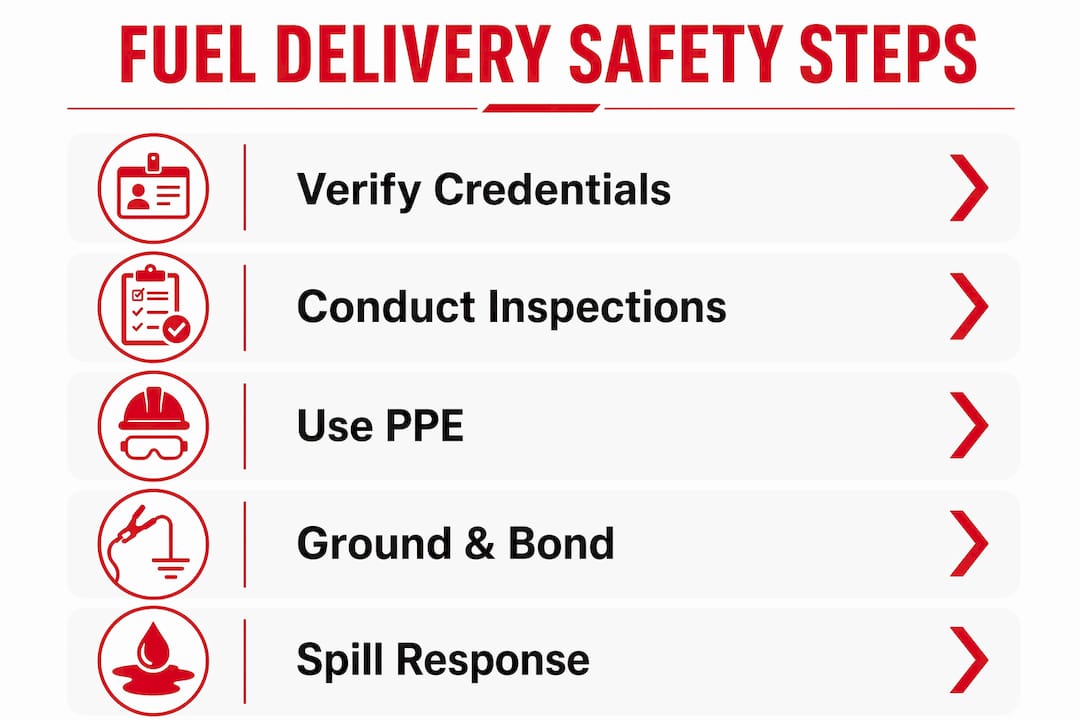
Safe, compliant fuel delivery at any site depends on a coordinated set of procedures that cover every phase of the operation, from the moment a tanker enters your gate to the final post-delivery inspection. The core fuel delivery safety protocols sites must enforce include verified driver qualifications, pre-delivery hazard checks, proper PPE, grounding and bonding, spill containment, ignition source elimination, documented emergency response plans, and a structured post-delivery audit. These requirements draw from OSHA standards (including 29 CFR 1926.152), DOT hazardous materials regulations, and EPA spill prevention guidelines. No single party owns the risk. Site management and tanker drivers share legal and operational responsibility for a safe transfer.
Key protocol elements every site must have in place:
- Verified CDL and HazMat endorsements for all delivery drivers
- Completed pre-delivery site and vehicle inspection checklist
- Appropriate PPE for all personnel in the delivery zone
- Grounding and bonding connections established before any fuel flows
- Active spill containment equipment staged at the fill point
- Enforced no-smoking and no-ignition-source zone around the tanker
- Written emergency response procedures accessible to both driver and site staff
- Post-delivery documentation signed by both parties
What driver certifications and qualifications does your site need to verify?
Every driver delivering fuel to your site must hold a valid commercial driver’s license with a HazMat endorsement. Hazardous materials training must be refreshed at least every three years, and motor vehicle records should be reviewed annually. DOT-required drug testing must be current, with all records maintained and accessible.
Beyond the license, your site protocol should require:
- Proof of current HazMat certification before access is granted
- Documented familiarity with your site-specific delivery instructions
- Demonstrated competency in grounding, bonding, and hose connection sequences
- Record of any prior incidents or safety violations on file with the carrier
Drivers who repeatedly deliver to the same location can develop assumptions that bypass critical checks. Written delivery instructions and a mandatory pre-delivery walkthrough counter that drift.
Pre-delivery safety checks your team should run every time
Before a single valve opens, both the driver and site representative must complete a documented inspection. Certified drivers follow a standardized stepwise process that covers vehicle positioning, brake setting, bonding, and valve verification at every site.
Your pre-delivery checklist should confirm:
- Tank capacity gauged and sufficient space confirmed for the incoming volume
- Correct product identification verified against the delivery ticket and fill pipe labeling
- All fill pipes and caps labeled or color-coded to industry standards
- Hoses, valves, and couplings inspected for wear, cracking, or damage
- Spill containment equipment (drip trays, absorbent pads, booms) staged at the fill point
- No ignition sources present within the hazardous zone
- Tanker engine off and parking brake set, with wheels chocked
Pro Tip: Keep a laminated pre-delivery checklist posted at your fill station. Drivers and site reps sign it before transfer begins, creating an instant accountability record.
PPE requirements during fuel delivery
Flame-resistant clothing is the baseline for anyone working in the fuel delivery zone. Drivers and site personnel handling hoses or connections must also wear chemical-resistant gloves, safety glasses or a face shield, and steel-toed boots rated for petroleum environments. The specific PPE requirements vary by fuel type: gasoline vapor presents a different flash-point risk than diesel, and your site safety plan should reflect that distinction.
Consistent PPE use depends on training, not just availability. Conduct periodic checks to confirm that all personnel in the delivery area are properly equipped before transfer begins. PPE stored in a truck cab or a supply room does nothing if it is not on the person.
How to properly ground and bond during fuel transfer
Static discharge during fuel transfer is a real ignition risk, and the sequence of connections matters as much as the connections themselves. Follow these steps every time:
- Position the tanker and set the parking brake before any electrical connections are made.
- Attach the grounding cable from the tanker to an approved earth ground point at the site. Verify conductivity before proceeding.
- Connect the bonding cable between the tanker and the receiving tank or fill point to equalize electrical potential.
- Inspect all grounding and bonding clips, plugs, and posts. They must be clean, unpainted, and in good condition.
- Place grounded metal drip containers under the unloading valve. Plastic containers are not acceptable because they accumulate static charge.
- Open hoses and begin transfer only after grounding and bonding are confirmed.
- During transfer, monitor for any static buildup or unusual sparking near connections.
- At the end of transfer, disconnect hoses before removing bonding and grounding cables, reversing the connection sequence.
The driver must remain with the vehicle throughout the entire unloading period and must cease transfer immediately if any hose, connection, or joint shows a leak.
Spill prevention and response measures
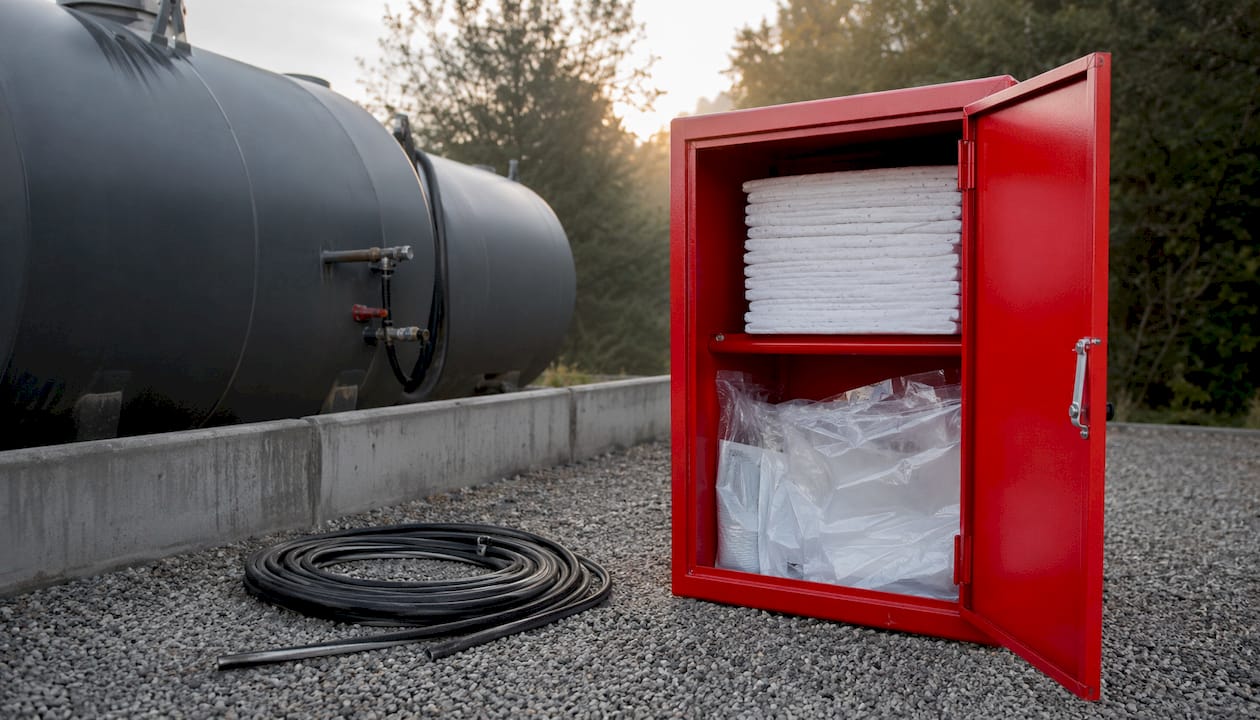
Drip trays and collection buckets at every connection point are the first line of defense against fuel releases. Absorbent pads placed around the fill inlet before dispensing begins contain minor drips before they spread. Your spill containment kit should include booms, absorbent material, and a lidded container for recovered product.
When a spill occurs, the response sequence is:
- Stop fuel flow immediately by closing the transfer valve
- Alert site personnel and the facilities manager
- Contain the spill using available absorbent materials and booms
- Prevent fuel from reaching storm drains, manholes, or waterways
- Contact an approved licensed contractor for removal of contaminated materials
- Initiate spill reporting procedures per your EPA and state requirements
Spill kits should be inspected twice yearly, with any depleted supplies replaced promptly. A kit that has been partially used and not restocked is a compliance gap waiting to become an incident.
Pro Tip: Run a tabletop spill drill with your site team quarterly. Knowing where the kit is and who calls whom cuts response time when it counts.
No-smoking and ignition source control policies
OSHA 1926.152 sets the legal no-smoking hazardous zone at a minimum of 50 feet from the tanker. That boundary must extend further downwind, because fuel vapors travel along terrain and can ignite well beyond the immediate transfer point.
Enforce these controls every delivery:
- Post no-smoking signage at all entry points to the delivery zone before the tanker arrives
- Require all personnel to remove lighters, matches, and non-intrinsically-safe electronic devices before entering the zone
- Shut down any welding, cutting, or burning operations within the hazardous area for the duration of transfer
- Turn off the tanker engine except where it powers an unloading pump, and engage the master isolation switch
- Suspend movement of other equipment in the immediate fueling area
A single uncontrolled ignition source in a vapor-rich environment can escalate faster than any response plan can contain. Zero tolerance on this point is not an overreaction.
Emergency procedures during fuel delivery
When something goes wrong during transfer, a clear, practiced response plan prevents a manageable incident from becoming a catastrophe. Site managers and drivers should rehearse these steps before an emergency, not during one.
- Stop fuel transfer immediately. Close all valves and shut down the pump.
- Alert the site facilities manager and the driver’s dispatch office.
- If a fire or explosion risk exists, call 911 and initiate site evacuation.
- Cordon off the affected area to prevent pedestrian and vehicle access.
- For unignited spills, begin containment using the onsite spill kit while awaiting emergency services if needed.
- For ignited spills, prioritize evacuation and emergency services over containment attempts.
- The facilities manager coordinates all onsite activity until emergency services arrive and assume command.
- Document the incident, timeline, and actions taken for regulatory reporting and post-incident review.
Both the tanker operator and site operator should develop these procedures together, with coordination between both parties built into the written plan before any delivery takes place.
Site preparation checklist for fuel delivery
A prepared site reduces the chance that a driver has to make judgment calls on the fly. Run through this checklist before every scheduled delivery:
- Clear the delivery area of debris, loose materials, and any equipment that could obstruct the tanker or create a hazard
- Set safety cones and barriers to define the vehicle path and exclusion zone
- Confirm spill containment equipment is staged and fully stocked at the fill point
- Verify that all drain covers are in place over nearby storm drains
- Check that lighting is adequate for the time of day, including night deliveries
- Confirm fill pipes are labeled, caps are secured, and site maps are current
- Restrict access to the delivery zone and post signage at all entry points
- Verify fire extinguisher availability and confirm it is rated for flammable liquid fires
Updated, labeled site maps showing fill points, vents, and shutoffs should be provided to the driver before transfer begins. Old or unlabeled infrastructure is a leading cause of cross-contamination and spills.
Post-delivery safety procedures and audits
The delivery is not complete when the hose comes off. A structured post-delivery process closes the loop on compliance and catches problems before they become incidents.
- Disconnect hoses in the correct sequence: product hose first (tanker end), then vapor recovery hose
- Replace all caps, access covers, and fill point locks
- Inspect hoses, valves, and fill points for leaks, damage, or residual drips
- Conduct a visual sweep of the delivery area for any unreported releases
- Document delivery quantity, tank measurements, and inspection results
- Return spill kits and safety equipment to storage and note any replenishment needs
- Both the driver and site representative sign the delivery documentation before the tanker departs
A brief debrief between the driver and site rep after each delivery surfaces issues that checklists miss, and builds the institutional knowledge that makes every subsequent delivery safer.
How site managers share responsibility for fuel delivery safety
Site management is legally and operationally co-responsible for fuel delivery safety alongside drivers. Documented fueling procedures and consistent checklists significantly reduce delivery risks, and that documentation is management’s responsibility to create, maintain, and audit.
Site managers must:
- Conduct a risk assessment of the delivery area before each scheduled delivery
- Provide drivers with current site maps showing fill points, vents, and emergency shutoffs
- Ensure all site personnel involved in the delivery have completed safety training
- Maintain written fueling procedures with documented communication protocols
- Audit compliance with those procedures on a regular schedule
- Coordinate with the delivery operator to eliminate ignition hazards before transfer begins
Relying on the driver alone to identify and manage site hazards is both a compliance failure and an operational risk. The trained operators guide from Anytimefuelpros covers how shared accountability between site staff and drivers reduces incident rates across commercial operations.
Training requirements for site staff on fuel delivery safety
Site personnel who receive, assist with, or work near fuel deliveries need documented training, not just a verbal briefing. Training programs should cover hazard recognition, PPE use, spill response procedures, emergency communication protocols, and the specific steps of your site’s fueling procedure. Training records must be maintained and updated when procedures change.
At minimum, refresher training should occur annually and whenever a significant incident or near-miss occurs. For sites with high delivery frequency, quarterly drills on spill response and emergency procedures keep skills sharp. New staff should complete training before their first exposure to a live delivery, not after.
Weather-related safety precautions during fuel delivery
Lightning is an absolute stop-work condition. The 30/30 rule applies: if the gap between a lightning flash and thunderclap is fewer than 30 seconds, all transfer operations stop immediately and personnel take shelter. Work does not resume until 30 minutes have passed with no further lightning activity.
Beyond lightning, weather affects delivery safety in other ways. High winds accelerate vapor dispersion and can carry ignition-capable concentrations further from the transfer point, requiring an expanded exclusion zone. Rain and mud increase slip hazards around the tanker and fill point. Extreme cold affects hose flexibility and connection integrity, making pre-delivery equipment checks more critical. Schedule deliveries during daylight whenever possible, and build weather assessment into your pre-delivery checklist.
Vehicle and equipment inspection standards
Hoses and couplings require monthly inspection and must be replaced if worn, cracked, or damaged. These inspections must be documented. Each delivery vehicle should carry a 4A:40B:C-rated dry chemical fire extinguisher, and all truck markings must be clean, legible, and compliant with DOT regulations.
Pre-trip and post-trip vehicle inspections are required and must be documented for every run. Tank compartment contents must be clearly identified on both the vehicle and the shipping papers, which must remain accessible in the driver’s cab at all times. Tank ladders and catwalks need an abrasive walking surface and must be kept in good repair. For on-site diesel delivery operations, equipment condition directly affects both safety outcomes and regulatory compliance.
Work with a delivery partner who takes protocols seriously
Anytimefuelpros operates with the full stack of safety protocols covered in this guide built into every delivery, from CDL and HazMat-certified drivers to documented pre-delivery checklists and 24/7 emergency response capability. Whether you manage a data center in Dallas, a construction fleet in San Antonio, or a mining operation in Utah, your site deserves a fuel partner whose procedures match your compliance requirements.
Explore bulk fuel delivery options or schedule a delivery to see how Anytimefuelpros handles safety at every stage of the operation.
Key Takeaways
Compliant onsite fuel delivery requires verified driver credentials, documented site preparation, active spill containment, enforced ignition controls, and shared accountability between site managers and delivery operators at every transfer.
| Point | Details |
|---|---|
| Driver credentials are non-negotiable | CDL with HazMat endorsement and records reviewed annually before site access is granted. |
| Grounding sequence prevents ignition | Connect grounding before bonding, and disconnect hoses before removing either cable at transfer end. |
| Spill kits need biannual checks | Inspect twice yearly and replace depleted supplies immediately to maintain response readiness. |
| No-smoking zone extends 50 feet minimum | OSHA sets the legal boundary at 50 feet from the tanker, extended further downwind for vapor travel. |
| Site managers share legal responsibility | Management must provide current site maps, written procedures, and trained personnel, not just access. |
Recent Comments