

IFTA fuel tax is the system that lets a trucking company pay motor-fuel taxes to every state it drives through with one license and one quarterly return, instead of dealing with each state separately. The International Fuel Tax Agreement covers the 48 contiguous states and 10 Canadian provinces. You report miles and gallons to your base jurisdiction, and it settles up with the others. If you run qualified vehicles across state lines, you almost certainly need to file, and the quality of your fuel records decides whether the return is routine or painful.
This guide covers who must register, what the quarterly return contains, how the math works, which records auditors expect, and where bulk or on-site fueling fits in.
TL;DR
- IFTA gives a carrier one license, one set of decals and one quarterly return covering every member jurisdiction, filed with its base jurisdiction.
- You generally need it when a qualified vehicle (over 26,000 pounds or three or more axles) operates in two or more member jurisdictions.
- Tax owed in each jurisdiction depends on miles driven there, your fleet fuel economy and that jurisdiction’s rate, minus tax already paid at the pump.
- Receipts, trip records and bulk-fuel withdrawals are the backbone of an audit-ready return; gaps between trip miles and odometer miles are a common audit issue.
- If you fuel from bulk storage or a delivery truck, the delivery ticket is your receipt, so it has to be complete.
Table of Contents
- What IFTA fuel tax actually is
- Who needs an IFTA license
- Non-IFTA jurisdictions
- How quarterly IFTA reporting works
- How to calculate IFTA tax: a worked example
- Credits and refunds
- Records that keep a return audit-ready
- Bulk fuel, yard fueling and delivered fuel
- Late filing and penalties
- How Anytime Fuel Pros helps with fuel records
- FAQ
- Sources
What IFTA fuel tax actually is
Every state taxes motor fuel at its own rate, and a truck burns fuel in many states on a single run. Without an agreement, a carrier would file in every state it touched. IFTA’s Articles of Agreement make the administration of motor-fuel-use taxes uniform for vehicles operating in multiple member jurisdictions, with one fuel-use license and one base jurisdiction per licensee. Each jurisdiction still sets its own tax rates and exemptions.
Montana’s transportation department sums up the practical benefit as one license, one decal set per qualified vehicle, one quarterly return, one payment or refund and one base-jurisdiction audit. California describes the same flow: the carrier reports fuel usage and mileage for all member jurisdictions to its base jurisdiction, and payments or refunds are handled through that base jurisdiction.
Two points trip up new fleets:
- IFTA is a reporting and settlement system, not a tax holiday. You still owe fuel tax for the fuel you burn in each state. The return just moves the money to the right place.
- Tax is based on where fuel is consumed, not where it is bought. Fill up in a low-tax state and run most of your miles in a high-tax one, and you will owe the difference.
The agreement applies to motor-fuel-use taxes on consumption in qualified motor vehicles, and fuel placed in the vehicle’s supply tank is generally taxable unless a specified exception applies.
Who needs an IFTA license
A carrier generally needs IFTA credentials when it is based in a member jurisdiction and operates a qualified motor vehicle in two or more member jurisdictions. IFTA, Inc. defines a qualified vehicle as one that has two axles and a gross or registered weight over 26,000 pounds, has three or more axles regardless of weight, or is used in a combination whose weight exceeds 26,000 pounds. States apply the same test. Washington, for example, requires a license for a carrier based there that runs qualifying vehicles in at least two states or provinces and meets the weight or axle test.
A few practical readings of that rule:
- A heavy dump truck that never leaves Texas does not need IFTA for those trips. Once it hauls a load into Oklahoma or New Mexico, it does.
- A pickup pulling a light trailer usually falls under the weight line. Check the combined weight, not just the tractor.
- Construction and mining fleets that mostly move within one state still need to watch for occasional cross-border jobs. A single out-of-state project can put equipment on the road in a second jurisdiction.
- Off-road equipment such as dozers and excavators that never run on public roads is not what the agreement is about. Its fuel is generally dyed and handled under separate rules, covered in our guide to off-road fuel compliance.
Your base jurisdiction is where you register the vehicles, keep your operational records, and where the vehicles are based for fuel-use purposes. If you are unsure, ask your state’s IFTA office before you apply.
Drivers who spend nights away from base also generate records worth keeping, from lodging to truck parking hotels on long hauls, but only the trip and fuel data feed the return.
Non-IFTA jurisdictions
Not every place you can drive is a member. Alaska, Hawaii, the District of Columbia, Yukon, the Northwest Territories and Nunavut are non-IFTA jurisdictions, and carriers traveling through them must satisfy applicable fuel-use taxes under those jurisdictions’ own laws. Texas, for instance, treats miles in Alaska, the District of Columbia, Mexico, Yukon and the Northwest Territories as non-IFTA miles, while Oregon miles remain IFTA miles. Trip-permit miles count in total IFTA miles but not in taxable miles for that jurisdiction.
The lesson: classify every trip by jurisdiction and credential status, not just by state line. A route through Washington, D.C. is not reported like a route through Virginia.
How quarterly IFTA reporting works
The return is filed four times a year with your base jurisdiction. Check your base jurisdiction’s page for the current due dates and for how it handles filing when you had no operations in a quarter.
Each quarter you report:
- Total distance and total fuel used across all jurisdictions
- Distance traveled in each jurisdiction
- Taxable fuel consumed in each jurisdiction
- Tax-paid fuel purchased in each jurisdiction
The IFTA Procedures Manual lists what the standard return contains: total miles, total fuel, an average fuel-consumption factor, jurisdictional tax rates, total and taxable miles, taxable and tax-paid gallons, net taxable gallons, tax, interest and total due. The base jurisdiction’s system does the arithmetic for you in most cases, but you must supply accurate inputs.
How to calculate IFTA tax: a worked example
The calculation has four steps. The numbers below are illustrative, and the tax rates are made up to keep the math clear. Pull the current rates for each jurisdiction from your base jurisdiction’s tax rate table.
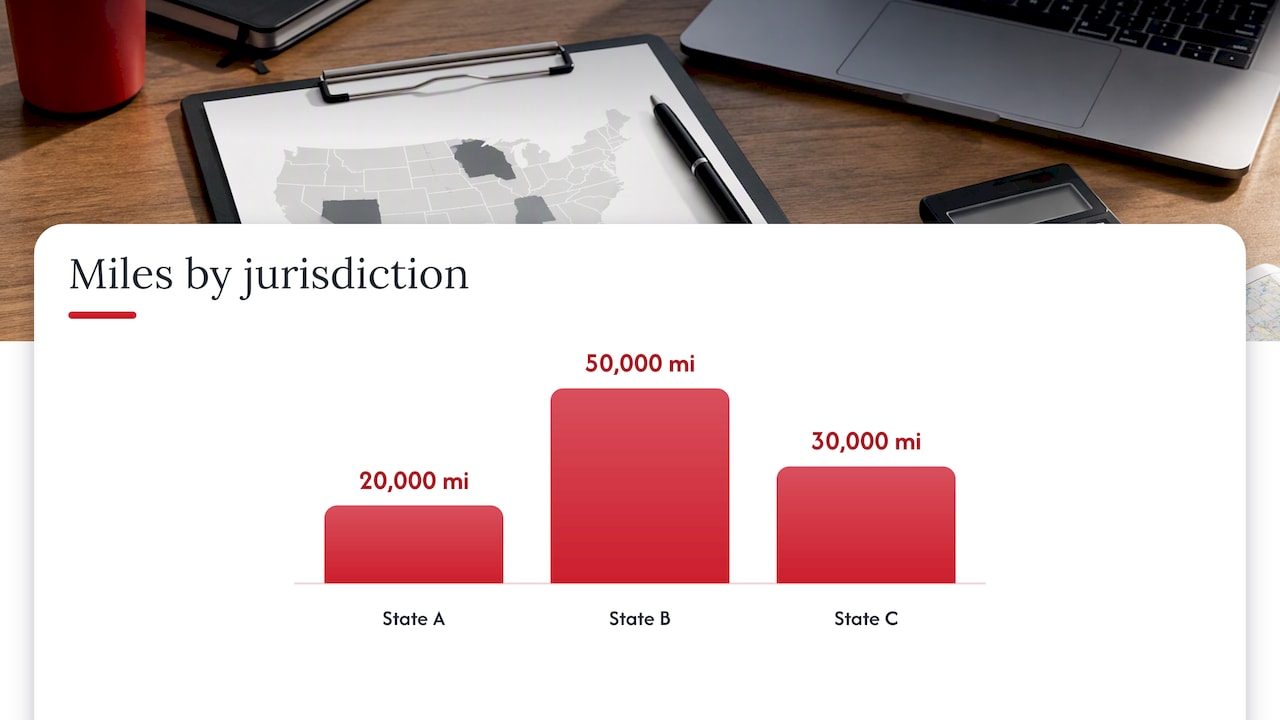
Step 1: Find fleet fuel economy. Divide total miles by total gallons used.
Example fleet: 100,000 miles and 16,000 gallons in the quarter. 100,000 ÷ 16,000 = 6.25 miles per gallon.
Step 2: Work out gallons consumed in each jurisdiction. Divide miles driven there by fleet fuel economy.
Say 20,000 of those miles were in State A. 20,000 ÷ 6.25 = 3,200 gallons consumed.
Step 3: Subtract tax-paid gallons. If you bought 2,000 gallons at the pump in State A, net taxable gallons are 3,200 − 2,000 = 1,200 gallons.
Step 4: Multiply by the rate. At an illustrative rate of $0.30 per gallon, 1,200 × $0.30 = $360 owed to State A.
Repeat for every jurisdiction. If net taxable gallons come out negative, you bought more fuel there than you burned, and that produces a credit. Add up the amounts owed and the credits, and the net is your payment or your refund position.
| Jurisdiction | Miles | Gallons consumed | Gallons purchased | Net taxable gallons | Illustrative rate | Tax or credit |
|---|---|---|---|---|---|---|
| State A | 20,000 | 3,200 | 2,000 | 1,200 | $0.30 | $360 owed |
| State B | 50,000 | 8,000 | 9,500 | −1,500 | $0.25 | $375 credit |
| State C | 30,000 | 4,800 | 4,500 | 300 | $0.35 | $105 owed |
| Total | 100,000 | 16,000 | 16,000 | 0 | $90 credit |
Notice that total purchased gallons match total consumed gallons in this example. They will not always, and that is fine, but Texas notes that total tax-paid gallons reported cannot exceed total gallons consumed. If your numbers say otherwise, a receipt or odometer reading is wrong.
Where the numbers go wrong
Most bad returns trace back to inputs, not math:
- Missing receipts. Fuel with no receipt cannot be claimed as tax-paid.
- Miles that do not reconcile. Texas points out that gap miles, the difference between trip-sheet miles and odometer or hubmeter miles, are generally an audit issue and should be reported accurately.
- Wrong jurisdiction on a trip. A detour through a non-IFTA jurisdiction or a trip on a permit changes how miles are classed.
- Fuel burned that was never taxed at the pump. Bulk withdrawals need their own tracking, covered below.
Credits and refunds
A credit appears when the tax you paid on fuel exceeds the tax calculated for the jurisdictions where the fuel was used. Under the Articles of Agreement, the base jurisdiction applies credits and issues refunds for member jurisdictions, and a refund generally requires a request and satisfaction of all outstanding liabilities.
In practice the default is a credit carried forward. Kentucky’s 2026 compliance manual says an overpayment may be claimed on the quarterly report, that the credit carries forward if no refund is requested, and that a properly due refund is paid within 90 days after the request is received. Other base jurisdictions have their own timelines, so confirm yours.
There is a separate case for exempt fuel. Tax-exempt fuel use must still be reported under IFTA, but claims for refunds of tax paid on exempt fuel go directly to the jurisdiction whose law grants the exemption, not through your IFTA return.
Records that keep a return audit-ready
Your base jurisdiction can audit the return, and the audit looks at your paper trail. IFTA, Inc. directs carriers to retain trip information such as dates, origin, destination, route, supporting receipts, bulk-fuel withdrawals and monthly or quarterly reconciliations. The Procedures Manual adds distance records and monthly summaries of fleet operations that tie to what you reported.
A workable system has five parts:
- Trip records per vehicle. Dates, origin, destination, route and odometer readings, whether from an ELD, GPS or trip sheets.
- Fuel receipts per vehicle. Date, seller name and address, gallons, fuel type, price and vehicle ID. Reconcile against your fuel card statement.
- Bulk and on-site fuel logs. Gallons removed from storage and put into each unit.
- Monthly reconciliation. Compare miles and gallons month to month and investigate anything that drifts, such as a unit suddenly showing 3 miles per gallon.
- Retention. Keep everything for the period your base jurisdiction requires. We walk through the four-year standard in our guide to clear diesel recordkeeping for IFTA.
Our related pieces on fuel consumption reporting and why fuel delivery documentation matters cover the verification habits that make these records stand up.
Bulk fuel, yard fueling and delivered fuel
Many fleets fill trucks from their own tank at the yard, or have fuel brought to them. This is where IFTA records get thin if nobody owns them. For bulk storage, Texas says operators report gallons actually removed from bulk storage and delivered into qualified vehicles. Tank deliveries by themselves do not give you per-truck gallons. You need a dispensing log that ties each fill to a unit and a date.
That changes what you want from a fuel supplier:
- A delivery ticket with date, location, fuel type (clear or dyed), gallons and signature
- Itemized invoices that match those tickets, so accounts payable and your tax filing tell the same story (see our notes on fuel delivery invoice format)
- For wet hosing and mobile fleet fueling, a per-unit record of gallons so each truck’s fuel economy is calculable
- Clear diesel for on-road units and dyed diesel kept strictly to off-road equipment, since mixing them in tanks creates compliance problems; our diesel fuel types guide explains the differences
Fleets with their own yard should also read our trucking yard fueling operating guide for how to structure the logs.
Late filing and penalties
Missing a return has a cost even when you owe nothing. The IFTA Procedures Manual specifies a late-filing charge of $50 or 10% of the tax, whichever is greater, as a standard return element, and interest accrues on unpaid tax. Your base jurisdiction can add its own consequences, including license action for repeated failures. File on time even if the return is a zero return, and call your base jurisdiction early if records are incomplete rather than guessing.
How Anytime Fuel Pros helps with fuel records
IFTA is a bookkeeping problem as much as a tax problem, and fuel you buy at random retail stops is the hardest to track. We deliver diesel, gasoline and DEF to job sites, equipment yards and fleets in San Antonio, Austin, Dallas-Fort Worth and Salt Lake City, and through our partner network across the continental U.S. Every delivery comes with itemized invoicing and delivery confirmation, so the gallons, date, fuel type and location are on paper when your return or auditor needs them.
If you run yard fueling, wet hosing or scheduled bulk fills, see our mobile fleet fueling service or our full list of fuel delivery services. Ask us how delivery tickets can be formatted to feed your dispensing logs. Pricing is quoted per delivery, so contact us with your volumes and locations.
FAQ
What does IFTA stand for, and what does it do?
IFTA stands for International Fuel Tax Agreement. It lets a carrier report fuel use and mileage for all member jurisdictions on a single quarterly return filed with its base jurisdiction, which then distributes the tax to the others. Each jurisdiction keeps its own rates and exemptions.
Which states are not part of IFTA?
Alaska, Hawaii and the District of Columbia are not IFTA jurisdictions, nor are the Canadian territories of Yukon, the Northwest Territories and Nunavut. Miles driven there fall outside the IFTA return, and fuel taxes are handled under each place’s own laws.
How do I calculate IFTA tax?
Divide total miles by total gallons to get fleet fuel economy. For each jurisdiction, divide miles driven there by that figure to get gallons consumed, subtract gallons you bought tax-paid there, and multiply the net taxable gallons by that jurisdiction’s rate. Add the results across all jurisdictions.
Can I get money back from IFTA?
Yes, when tax paid at the pump exceeds tax owed on fuel burned. The overpayment is normally applied as a credit to future returns, and a cash refund generally requires a request to your base jurisdiction and no outstanding liabilities. Refunds for exempt fuel are claimed from the jurisdiction that grants the exemption.
Do I need IFTA if I buy all my fuel from a delivery service?
Yes, if you operate qualified vehicles in two or more member jurisdictions. IFTA depends on where vehicles run, not where fuel is bought. Delivered fuel simply needs to be documented per vehicle so you can report gallons and claim tax-paid fuel correctly.
Sources
- IFTA Articles of Agreement Manual, August 2025
- IFTA Articles of Agreement Manual, January 2026
- IFTA Procedures Manual, August 2025
- IFTA, Inc. carrier information
- California CDTFA: International Fuel Tax Agreement
- Montana Department of Transportation: IFTA
- Washington DOL: Get your license and decals, IFTA
- Texas Comptroller: Fuels Taxes FAQ
- Kentucky IFTA Compliance Manual 2026
- Ontario Interjurisdictional Carrier’s Manual
Recent Comments