
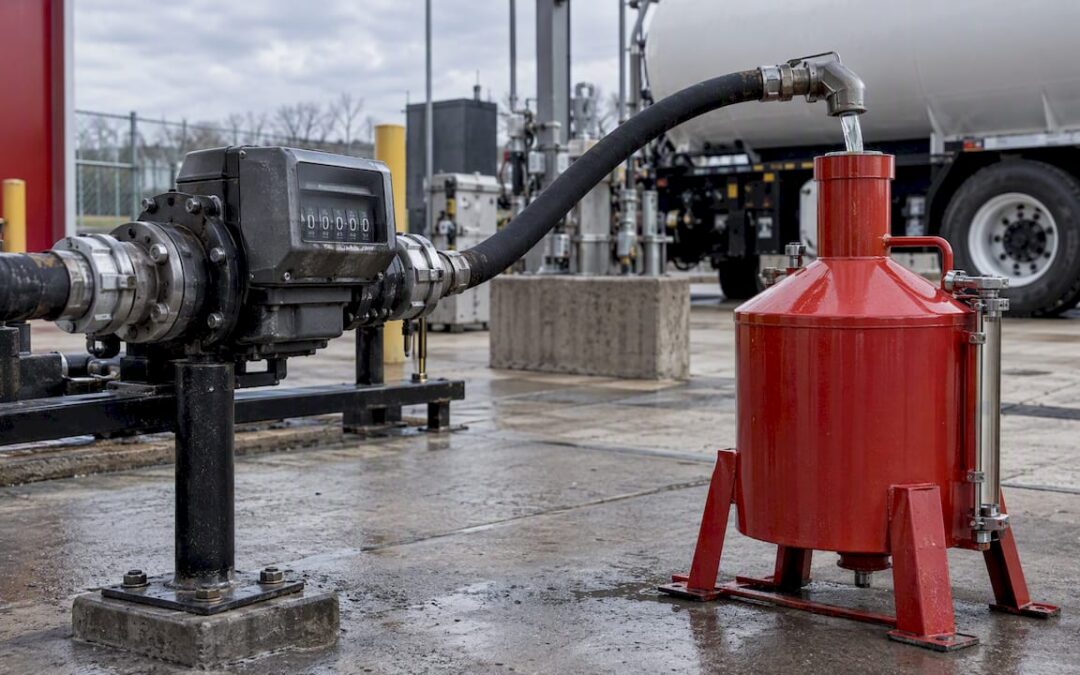
Fuel meter calibration means testing a meter’s reading against a known, traceable volume and adjusting it until it falls inside the tolerance your jurisdiction allows. If you buy or dispense fuel at volume, it is the only way to know that the gallons on the ticket are the gallons in your tank. A meter that reads even slightly high or low turns into a quiet profit killer, because the error repeats on every delivery and every fill.
This guide covers how a commercial meter is tested, the tolerances regulators apply, how to check a tank gauge against a reliable reference, what a fuel hose inspection should cover, and which records to keep. It is written for fleet managers, site superintendents, facility managers and procurement teams who run their own tanks or buy delivered fuel.
TL;DR
- Calibration compares a meter to a certified, NIST-traceable test measure and adjusts it. In-use meters get a ±6 cubic inch maintenance tolerance; new, rebuilt or serviced meters get a tighter ±3 cubic inch acceptance tolerance.
- If a calibration adjustment is made, the meter is sealed and the result recorded on the required forms.
- For underground tanks, release detection equipment needs a check every 30 days and an electronic and mechanical test at least annually.
- Check your tank gauge against a clean, legible gauge stick and reconcile inventory monthly. Do not wait for an alarm.
- Keep annual test records at least three years, and keep delivery tickets that show what was metered.
Table of Contents
- What fuel meter calibration measures
- How a commercial fuel meter is calibrated
- Understanding the tolerances
- Signs a meter or tank gauge is off
- Tank gauge calibration and checks
- What a fuel hose inspection should cover
- A practical calibration and inspection schedule
- Records that stand up to an audit
- Verifying the fuel you buy, not just the fuel you store
- Where Anytime Fuel Pros fits
- FAQ
- Sources
What fuel meter calibration measures
A fuel meter measures the volume that passes through it. Calibration checks that number against a reference of known volume. The reference matters as much as the meter: a test measure that is itself not certified proves nothing.
For devices used in commercial sales, the governing reference in the United States is NIST Handbook 44. State weights and measures offices enforce it, and their guidance often points back to it. Colorado’s calibration requirements, for example, tell inspectors to use NIST Handbook 44 for further detail that the guideline does not spell out itself. Your state’s rules may differ in details, so treat Colorado’s document as a clear example of the method rather than a universal rulebook.
Why does it matter operationally? Three reasons:
- Money. Meter error is proportional to volume. A meter that over-reads by a small fraction costs you on every gallon you buy, and one that under-reads leaves you short on tank inventory.
- Reconciliation. When delivered gallons, metered dispensing and tank levels all disagree, you cannot tell whether you have a meter problem, a theft problem or a leak.
- Leak detection. Accurate metering data also helps prevent false alarms in tank monitoring systems, a point PMP Corporation makes in its guidance on meter calibration.
How a commercial fuel meter is calibrated
The procedure is simple in principle and exacting in practice. The Colorado guideline describes the core steps: use a calibrated, NIST-traceable test measure to test meter accuracy against applicable tolerances, record the results on the required forms, and apply a security seal if any adjustment was made.
In the field, that looks like this:
- Prepare the meter. Confirm the meter, hose and nozzle are in good condition and that the system is free of air. Air in the line is one of the most common reasons a test run reads wrong.
- Run the fuel through a test measure. Dispense a defined volume into the certified measure at the normal flow rate. Reading the measure at its neck, with the fuel settled, is part of the technique.
- Compare and calculate error. The difference between what the meter registered and what the measure holds is the error.
- Adjust if outside tolerance. The calibration mechanism is changed until the meter reads true.
- Retest. An adjustment is not finished until a repeat run confirms it.
- Seal and document. An adjusted meter gets a security seal so that later tampering is visible, and the result goes on the record.
If you are setting up a brand-new meter, the work starts before the test. Manufacturer guidance, such as the PMP instructions above, has you flush a few gallons through before connecting the computer or pulser, so debris and air do not distort the first readings. Follow the manufacturer’s sequence for your model.
Understanding the tolerances
Tolerances tell you how far off a meter may be and still pass. The Colorado guidance uses two:
| Situation | Tolerance |
|---|---|
| In-use meter, routine calibration (maintenance tolerance) | ±6 cubic inches |
| New, rebuilt or serviced meter (acceptance tolerance) | ±3 cubic inches |
Both figures come from the Colorado requirements for inspection and calibration. The logic is that a meter coming out of a repair shop should be tighter than one that has spent months in service. For scale, a gallon is 231 cubic inches, so 6 cubic inches is about 0.026 gallons, roughly 2.6 hundredths of a gallon, on the test volume.
That sounds tiny, and per test it is. The point is that the allowed error is fixed as a fraction of the test volume and then applies to every gallon thereafter. A meter pushing thousands of gallons a week makes even a small bias add up. Check what your state’s weights and measures office specifies for your device type, because the test volume and interval vary by state and by application.
Signs a meter or tank gauge is off
There is no substitute for a scheduled test, but operators usually notice trouble first through patterns in their own numbers. These are practical warning signs, not regulatory thresholds:
- Persistent variance between delivered gallons and tank level change. One odd delivery can be temperature or timing. The same direction of error across many deliveries points to a meter or gauge.
- Dispensed totals that do not match equipment fuel logs. If pump totals run consistently higher or lower than what your telematics or hour-meter data suggest, something is reading wrong.
- Reconciliation that never closes. Daily inventory and monthly reconciliation should land close. A steady drift needs an explanation.
- A meter that has been serviced, bumped or run dry. Repairs, impacts and air ingestion are reasons to verify before trusting the register again.
- Broken or missing seals. A damaged security seal means the calibration can no longer be assumed.
- Gauge readings that jump or stall. A tank gauge that sticks, or an ATG that reads flat while fuel clearly moves, needs service.
Any one of these is a reason to test, not a diagnosis. The test tells you which part of the system is at fault.
Tank gauge calibration and checks
Most operators searching for tank gauge calibration are really asking two things: is the gauge reading true, and is the leak detection system doing its job? For underground storage tanks, EPA rules answer the second one directly.
Release detection equipment: monthly and annual checks
The EPA’s guidance on operating and maintaining UST systems states that, since October 13, 2018, release detection equipment must be checked every 30 days for operation, alarms or unusual conditions, and its electronic and mechanical components must be tested annually. The same page says the annual test must include a check of ATG console alarms, system configuration and battery backup, plus inspection of probes and sensors for residual buildup or damage.
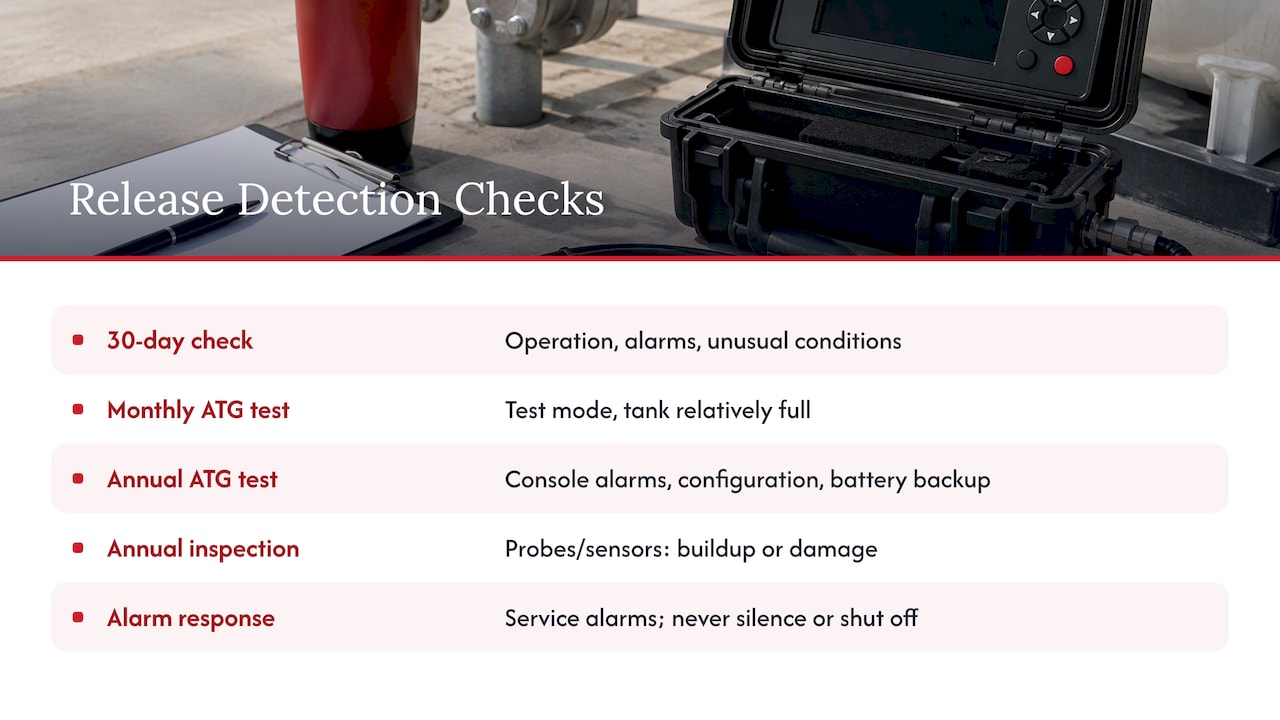
An older EPA guide on automatic tank gauging adds practical habits: run the ATG in test mode at least once a month, when the tank is relatively full. It also confirms that under the 2015 regulations, ATG controllers and other electronic and mechanical components must be tested at least annually for proper operation. Treat the date on that guide as a reminder to confirm current rules with your state UST program, which may be stricter than the federal baseline.
One warning from the same EPA material is worth repeating on your site: ignoring ATG alarms or switching the system off can let large leaks go undetected. If an alarm keeps tripping and someone silences it, the fix is service, not silence.
Checking a gauge against a reference
An ATG reading means little until you verify it against something independent. EPA’s release detection guidance gives a workable routine: make sure the ATG is connected, working and properly programmed, record inventory readings daily and reconcile them monthly, and use a gauge stick that is not warped, broken, shortened or illegibly marked.
A simple cross-check you can run on any site:
- Take a manual stick reading with a clean, legible stick.
- Record the ATG or float gauge reading at the same moment.
- Convert both to gallons using the tank’s chart.
- Log the difference and watch it over time.
A fixed offset suggests a programming or probe issue. A difference that grows suggests something is changing, and it is time to bring in a qualified service technician. For aboveground job-site tanks, the same logic applies: compare the gauge to a stick or a delivered-gallon count whenever the tank is filled. Remote monitors help here too; our guide to IIoT remote tank monitoring explains how continuous level data exposes drift and prevents run-outs.
What a fuel hose inspection should cover
The hose is part of the measuring system. A leak, a kink or a worn nozzle changes what reaches the equipment and creates a safety exposure. A routine walk-around should look for:
- Cracking, blistering, soft spots or abrasion on the hose cover
- Bulges or kinks that signal internal damage
- Leaks or weeping at couplings and swivels
- A nozzle that does not shut off cleanly, or a damaged spout or boot
- Worn, missing or loose bonding and grounding connections
- Missing or illegible identification tags and labels
A hose with a cut that exposes reinforcement, a bulge, or a leaking coupling should come out of service and be replaced, not taped. Follow your hose manufacturer’s guidance for retirement and pressure testing.
Length is also regulated in some settings. OSHA’s fuel handling rule for marine terminals allows flammable liquids to be dispensed in the open from a tank or fuel-delivery vehicle only if hoses are no longer than 50 feet and any powered nozzles are automatic-closing. That standard applies to marine terminals, so check which rules cover your own site type with your safety officer or fire marshal.
Wet hosing, where a truck fuels equipment directly, puts the delivery vehicle’s meter, hose and nozzle in the middle of your fueling record. If you use wet hosing or mobile fleet fueling, ask your supplier how its truck meters are verified and how the delivery ticket shows metered gallons.
A practical calibration and inspection schedule
Use this as a starting framework, then adjust to your state’s rules and the manufacturer’s instructions.
| Check | Suggested frequency | Basis |
|---|---|---|
| ATG operation, alarms, unusual conditions | Every 30 days | EPA UST requirements |
| ATG test mode, tank relatively full | At least monthly | EPA ATG guidance |
| Electronic and mechanical release detection test | At least annually | EPA UST requirements |
| Inventory readings | Daily; reconcile monthly | EPA release detection guidance |
| Commercial meter calibration | Per your state weights and measures schedule | State rules, NIST Handbook 44 |
| Meter after repair, rebuild or service | Before returning to service | Acceptance tolerance |
| Hose, nozzle and coupling walk-around | Frequently, and before heavy-use periods | Site safety procedure |
The first rows come straight from the EPA pages cited above. The last two are good practice you should set in your own procedures.
Records that stand up to an audit
Calibration that is not documented might as well not have happened. The paperwork also protects you in a billing dispute with a supplier or customer.
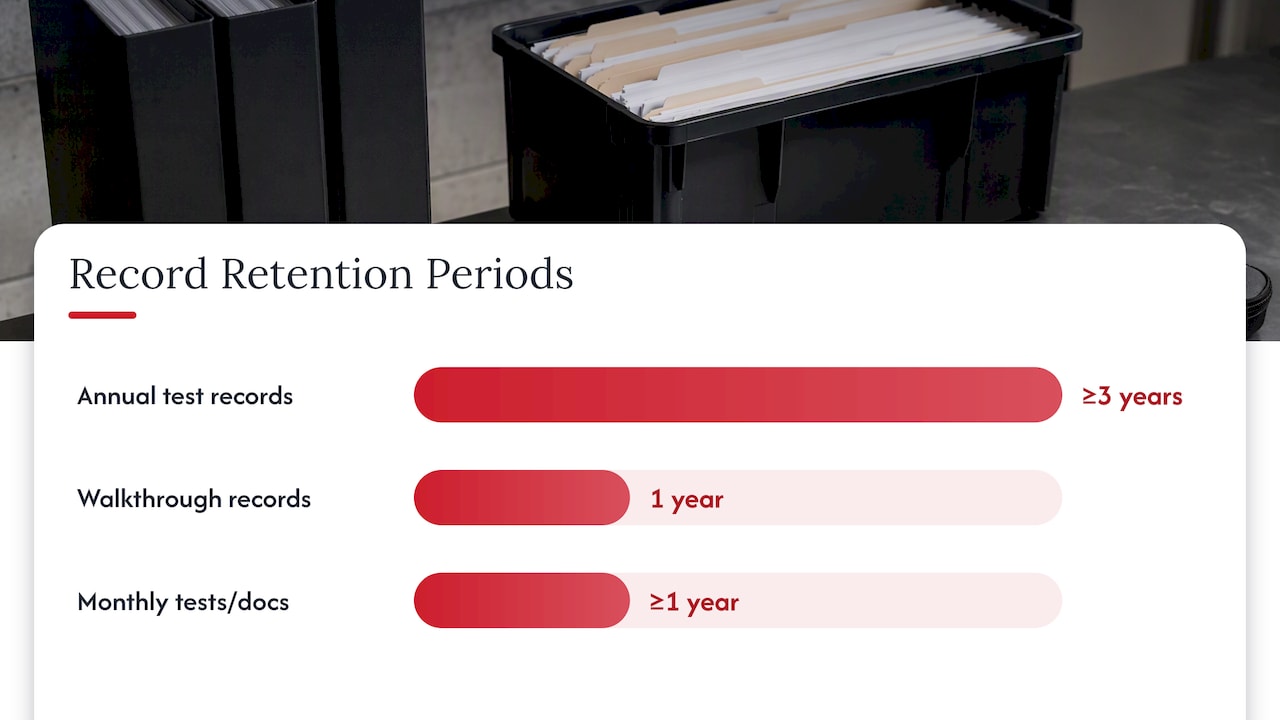
From the EPA’s UST operating guidance: keep annual release-detection equipment test records for at least three years, and walkthrough inspection records for the most recent year. The older EPA ATG guide adds that monthly test results and calibration, maintenance and repair documentation should be kept for at least one year.
A solid file for each tank and meter holds:
- Calibration certificates with date, test measure ID, results and the name of the technician
- Seal numbers before and after any adjustment
- ATG test printouts and 30-day check logs
- Daily inventory and monthly reconciliation sheets
- Hose and nozzle inspection logs, with replacements noted
- Delivery tickets showing metered gallons, product and time
Store physical paperwork somewhere dry and secure. Teams that keep compliance files on site sometimes use dedicated storage; the U.S. hazmat storage regulations are worth a read if your site also holds chemicals that trigger their own thresholds. For a closer look at why paper trails matter, see our pieces on why fuel delivery documentation matters and fuel delivery verification best practices. If you run clear diesel on the road, our clear diesel recordkeeping guide covers retention for fleets.
Verifying the fuel you buy, not just the fuel you store
Calibration of your own equipment is half the picture. The other half is the delivery coming in. When you buy fuel delivered to site, you are relying on the supplier’s truck meter, and your tank gauge is the independent check.
A verification routine on delivery day:
- Stick or gauge the tank before the delivery and record it.
- Watch the truck’s meter start and stop readings and compare them to the ticket.
- Stick or gauge the tank afterward and compare the change to the metered gallons.
- File the ticket with the reading sheet.
Do this consistently and you build a record that shows whether variance is random or systematic. It also supports audit-ready reporting; our seven site verification steps for fuel consumption reporting walks through that process, and job site fuel tracking shows how consistent logging prevents surprises. Water and sediment can also masquerade as a gauge problem, so read how fuel contamination damages equipment if readings and engine behavior stop making sense together.
Where Anytime Fuel Pros fits
We deliver diesel (red dye and clear), gasoline and DEF to job sites, fleets, generators, data centers, mining operations and events, on scheduled or on-demand terms, with 24/7 service and itemized invoicing. For operators who want fewer variables to manage, delivered fuel takes the dispensing side off your hands, and itemized tickets give you the paper trail to reconcile against your own gauge. See our full list of fuel delivery services or talk to us about bulk fuel delivery for tanks that need regular fills. If a tank is running low and you cannot wait for a scheduled drop, emergency fuel delivery is there for that situation.
FAQ
How often should a commercial fuel meter be calibrated?
It depends on your state’s weights and measures rules and the device type, so confirm the schedule with your state office. Any meter that has been repaired, rebuilt or serviced should be tested before it returns to service, against the tighter acceptance tolerance. Many operators also test after an impact or if variance patterns appear.
How do I know if my tank gauge is accurate?
Compare it to a manual reading from a clean, legible gauge stick, convert both to gallons using the tank chart, and log the difference. EPA guidance for underground tanks calls for daily inventory readings and monthly reconciliation. A gap that grows over time is a sign to call a qualified technician.
What does a fuel hose inspection involve?
Look for cracks, bulges, kinks, leaking couplings, a nozzle that fails to shut off and damaged grounding connections. Remove any hose showing exposed reinforcement, bulging or leaks from service. Follow the hose manufacturer’s retirement guidance and your site’s safety procedure.
How long do I keep calibration and test records?
For underground tank release detection, EPA requires annual equipment test records for at least three years and walkthrough inspection records for the most recent year. Your state or contract may require longer, so keep records to the longest period that applies.
Sources
- Requirements for the Inspection and Calibration of Motor Fuel Devices, Colorado
- Operating and Maintaining UST Systems: 2015 Requirements, U.S. EPA
- Getting the Most Out of Your Automatic Tank Gauging System, U.S. EPA
- UST Release Detection, U.S. EPA
- 1917.156 Fuel handling and storage, OSHA
- How to Calibrate a Meter, PMP Pulse
Recent Comments