

Diesel needs a placard when it moves in a bulk package, meaning a cargo tank, a tote or any container above 119 gallons. It generally does not when it rides in non-bulk packages of 119 gallons or less. The details that trip up fleets are which identification number goes on the placard (1202 or 1993), what happens when diesel and gasoline share a truck, and what else applies once a load is placarded. This guide covers those points, then the two topics that usually come next: spill reporting and dyed diesel labeling.
TL;DR
- Bulk packagings of diesel must be placarded on each side and each end. Combustible diesel in non-bulk packages of 119 gallons or less is not subject to the Hazardous Materials Regulations (HMR).
- For domestic shipments, diesel can be described as UN1202 or NA1993. The shipping paper and the package marking must use the same entry.
- A cargo tank carrying diesel and gasoline displays only UN1203, because gasoline has the lower flash point.
- A diesel spill that reaches waters of the United States or leaves a sheen is reportable to the National Response Center. Dyed diesel carries its own notice and penalty rules.
Table of Contents
- The short answer on diesel placards
- UN1202 or NA1993: which number goes on the placard?
- When the 1203 placard applies to diesel
- How many gallons of diesel can you carry without placards?
- What about the 1,001-pound threshold?
- Placard placement and condition
- Spill reporting: when a diesel release has to be reported
- Dyed diesel: labeling, restrictions and penalties
- A quick compliance checklist for fleets and site managers
- Why many operations hand hazmat hauling to a delivery partner
- FAQ
- Sources
The short answer on diesel placards
Diesel fuel is a combustible liquid, not a flammable one, when its flash point is at or above 100°F (38°C). That one fact drives most of the rules below.
Under 49 CFR 172.504, bulk packagings must be placarded on each side and each end. The same section says combustible diesel with a flash point of at least 100°F in non-bulk packages of 119 gallons or less is not subject to the HMR. In practice that gives you three situations:
- A cargo tank truck, tank trailer or bulk tote of diesel. Placard it.
- Drums, cans or small tanks totaling 119 gallons or less per package. No HMR placarding, no hazmat shipping papers.
- A pickup with a transfer tank. It depends on the tank size and on whether tanks are connected. More on that below.
The FMCSA’s hazardous materials marking, labeling and placarding guide states the same bulk rule in plain terms: a combustible liquid transported in bulk must be placarded.
UN1202 or NA1993: which number goes on the placard?
This is the question behind most searches. Diesel has two valid descriptions for domestic transportation:
- UN1202 is the international entry for diesel fuel.
- NA1993 is the North American entry for combustible liquid, not otherwise specified.
PHMSA has confirmed in letter of interpretation 19-0111 that diesel may be described as either UN1202 or NA1993 for domestic transportation, as long as the package marking and the shipping paper match. PHMSA also recommends in interpretation 18-0096 that shipping papers and markings stay consistent to avoid confusion during transportation.
So the choice is yours, but the consistency is not optional. A tank marked 1202 with a shipping paper reading NA1993 invites a roadside question you do not want to answer with a driver on a tight schedule.
A simple way to standardize
Pick one entry per product and write it into your dispatch templates and driver instructions. Most fleets that haul only diesel choose one number and keep it across every truck, so inspectors see the same thing on every unit.
When the 1203 placard applies to diesel
Mixed loads are common: a fuel truck with compartments for gasoline and diesel. PHMSA’s answer in 18-0096 is that a cargo tank carrying both displays only UN1203, because gasoline has the lower flash point. If the tank carries only one petroleum distillate fuel, it displays that fuel’s own identification number.
That means:
| Cargo tank contents | Identification number displayed |
|---|---|
| Diesel only | 1202 or 1993, matching the shipping paper |
| Gasoline only | 1203 |
| Diesel and gasoline in the same cargo tank | 1203 only |
So yes, a 1203 placard can appear on a truck that carries diesel, but only when gasoline is on board in the same cargo tank. A diesel-only truck with a 1203 placard is mislabeled.
How many gallons of diesel can you carry without placards?
The number readers ask about is 119 gallons. Combustible diesel with a flash point of at least 100°F, in non-bulk packages of 119 gallons or less, is not subject to the HMR, according to 49 CFR 172.504. Two cautions apply.
Connected tanks count as one
PHMSA’s interpretation 21-0001 addresses a common job-site setup: two or more tanks on a truck bed. If free flow between the tanks is allowed during transportation, they are considered a single bulk package and must meet the applicable requirements, including placarding. Two 100-gallon tanks plumbed together are not two compliant 100-gallon packages. They are one 200-gallon bulk package.
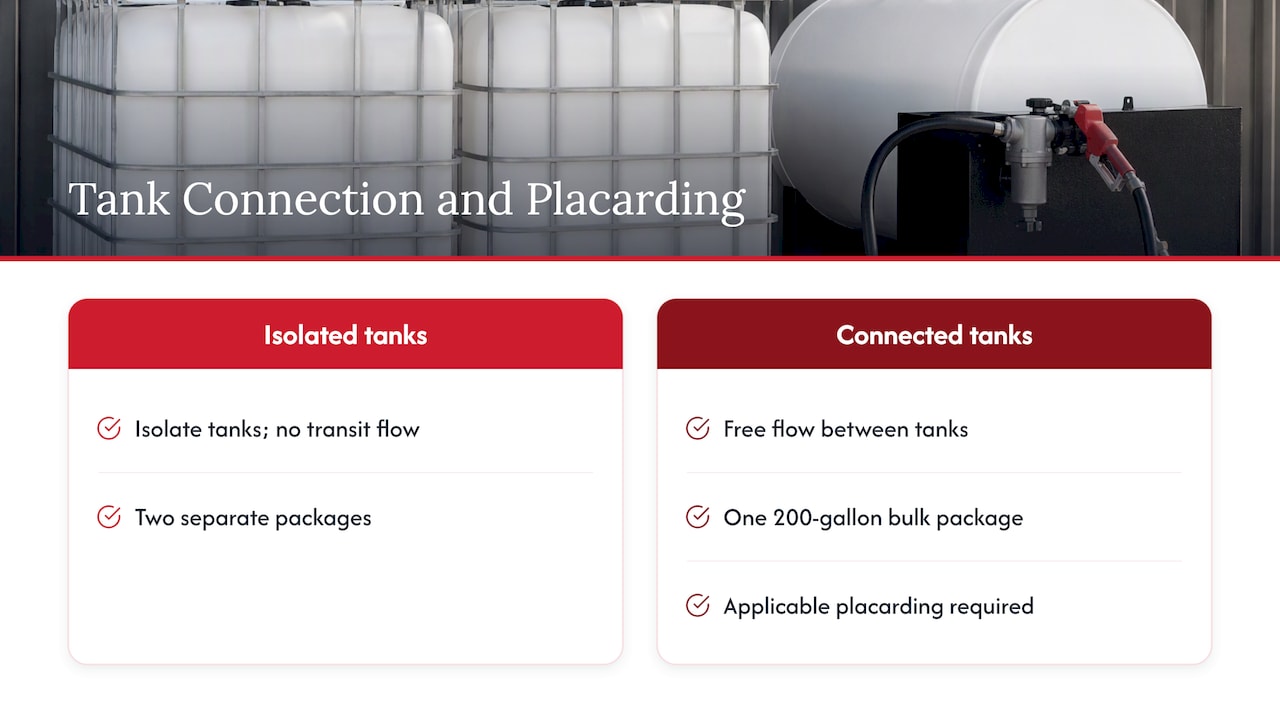
If you want separate tanks to stay separate, isolate them so fuel cannot flow between them in transit. If you cannot, treat the setup as bulk.
Placarded loads trigger other obligations
The same interpretation notes that placarded loads require USDOT registration. For a contractor with a service truck, that is the real cost of crossing the line: it brings in registration and the hazmat paperwork that comes with it. Check any state-level requirements with your state’s transportation agency as well.
What about the 1,001-pound threshold?
You may see “1,001 pounds” in placarding guidance. That figure applies to Table 2 hazardous materials in non-bulk packages, which generally require placarding at 454 kg (1,001 lbs) or more, per the FMCSA guide and the eCFR text. It is not a license to carry unlimited diesel. For ordinary combustible diesel, the 119-gallon non-bulk exception is the line that matters, and anything in bulk is placarded regardless of weight.
Placard placement and condition
Placard location is covered in the placarding subpart of the regulations, and the practical points are simple:
- Display the placard on each side and each end of a bulk packaging.
- Keep it visible and legible. Faded, dirty or peeling placards are a common roadside finding.
- Match the number to the shipping paper every time you change the product loaded.
- Use a placard holder or a marking directly on the tank so the right number stays with the right tank.
Trucks that switch between products are where mistakes happen. A driver who ran gasoline in the morning and diesel in the afternoon needs a clear process for swapping or covering placards, and a dispatcher who confirms the load before the truck leaves.
Spill reporting: when a diesel release has to be reported
Placards cover the road. Spill rules cover what happens when a hose fails or a tank overfills at a site. Readers often search for a “reportable quantity for diesel,” so it helps to separate two federal frameworks.
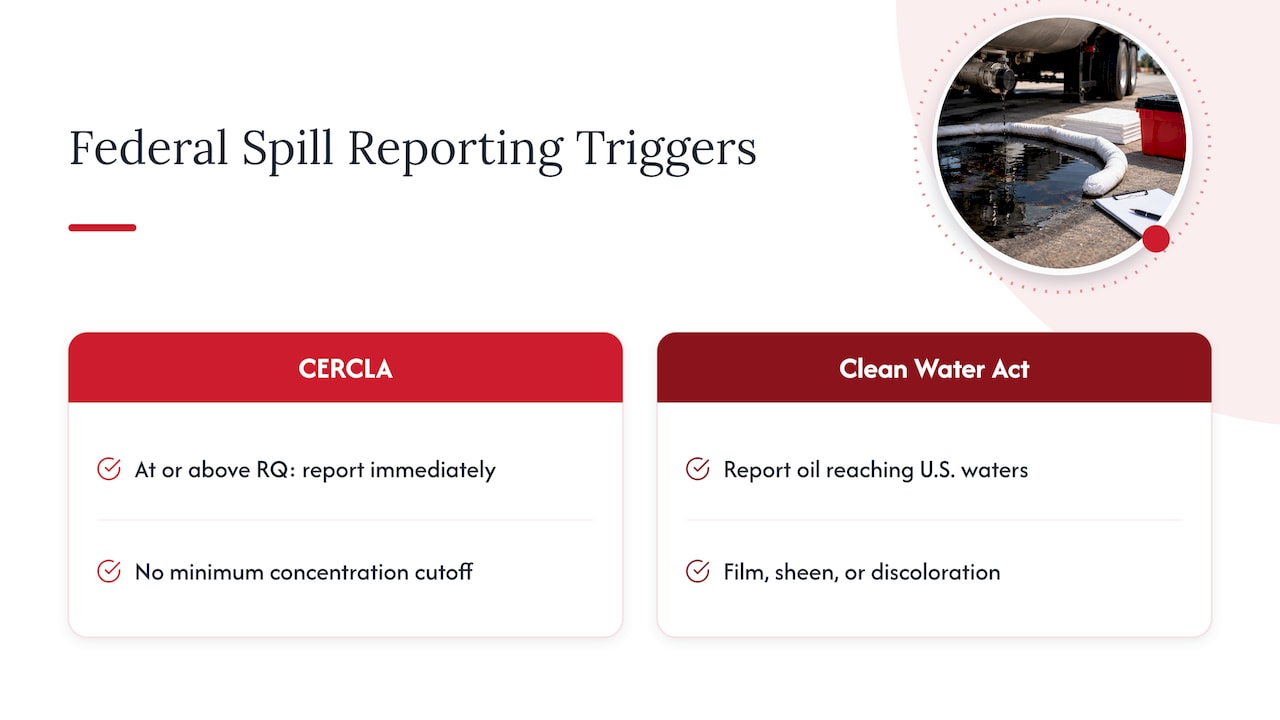
Hazardous substances under CERCLA. The person in charge of a facility or vessel must immediately report a release of a hazardous substance at or above its reportable quantity to the National Response Center, per EPA’s release notification Q&A. The same document says there are no minimum concentration cutoffs: a release equaling or exceeding the reportable quantity must be reported immediately, whatever the concentration.
Oil discharges under the Clean Water Act. For fuel like diesel, the trigger that most operators meet is water. EPA’s page on oil discharge reporting explains that a discharge of oil that reaches waters of the United States is reportable to the National Response Center under 40 CFR Part 110, including discharges that cause a film, sheen or discoloration of the water or shoreline.
So for diesel, the practical question is less “how many gallons” and more “where did it go?” A spill contained on pavement or in secondary containment is a different event from one that reaches a storm drain, ditch or creek.
What to do on site
- Stop the source and protect drains with socks, pads or berms.
- Contain and recover the product.
- If fuel reached water or left a sheen, report to the National Response Center immediately.
- Check your state and local rules. Many states have their own notification thresholds and agencies, and some are stricter than the federal baseline.
- Document what happened, how much, and what you recovered.
For a deeper action plan, see our guide to diesel spill response for facilities and fleets. Questions about how fueling is done safely at your site are covered in how safe mobile fuel delivery is.
Dyed diesel: labeling, restrictions and penalties
Placards identify the hazard. Dyed diesel rules are about tax status, and they run on a separate track.
What dyed diesel is for
Under 26 CFR 48.4082-2, dyed diesel is ordinarily untaxed when it is destined for an exempt use, such as farm use, but is taxed when sold for highway use or used on a highway. Sellers must post the prescribed notice at retail pumps or delivery facilities. In plain terms, red fuel belongs in off-road equipment, generators and other exempt uses, and the notice tells everyone it is not for highway vehicles.
Penalties
IRS Publication 510 (December 2025 revision) says the penalty for taxable use of dyed diesel is generally the greater of $1,000 or $10 per gallon of the fuel involved. It also says sellers or users who intentionally alter the dye concentration face penalties, and officers or employees involved may be held jointly and severally liable.
For a 150-gallon fill, $10 a gallon is $1,500, which beats the $1,000 floor. For a 40-gallon top-off, the $1,000 minimum applies. Our breakdown of when $1,000 beats $10 per gallon walks through more examples.
The 2026 federal relief
The IRS announced that it will not impose penalties for dyed diesel sold for highway use or used on highways from Oct. 1 through Dec. 31, 2026, and that ordinary collection and enforcement procedures are suspended, per its announcement. The relief applies only for federal tax purposes. It has no effect on state fuel taxes or on penalties a state may impose for highway use of dyed diesel.
That last point matters for fleets in Texas and Utah. State rules continue to apply, so read our guides to Texas dyed diesel rules and Utah dyed diesel rules before relying on the federal relief. Because the relief is time-limited, confirm the current status on the IRS page before you change any fueling practice.
Labeling tips for tanks and equipment
The regulation sets the notice sellers must post. Beyond that, good practice on your own site keeps audits simple:
- Label every on-site tank and tote with its fuel type: dyed (off-road) or clear (on-road).
- Keep dyed and clear tanks physically separate and clearly marked.
- Tell drivers which vehicles may and may not take red fuel.
- Keep delivery tickets that show fuel type, gallons and date.
Our dyed diesel compliance reporting guide and audit record checklist cover the paperwork. For basics, start with what dyed diesel fuel is and dyed versus clear diesel.
A quick compliance checklist for fleets and site managers
Use this before a truck leaves the yard:
- Confirm the packaging. Is the diesel in a bulk packaging or in non-bulk packages of 119 gallons or less?
- Check for connected tanks. If fuel can flow between them in transit, treat them as one bulk package.
- Pick one identification number. UN1202 or NA1993, and match it on the paper and the marking.
- Look for gasoline. If gasoline shares the cargo tank, only 1203 is displayed.
- Verify USDOT registration. Placarded loads require it.
- Stock the spill kit. Drain covers, absorbents and a posted reporting contact.
- Check the fuel’s tax status. Dyed fuel stays out of highway vehicles.
Why many operations hand hazmat hauling to a delivery partner
Owning bulk transport means placards, shipping papers, registration, driver training and spill planning. For a contractor, mine, data center or event crew, that is overhead unrelated to the core work.
Anytime Fuel Pros brings red dye diesel, clear diesel, gasoline and DEF directly to your site, with scheduled or on-demand diesel delivery, bulk fuel delivery and mobile fleet fueling. Your crews stay on the job, and the trucks that carry fuel to you are run by a company that handles transport compliance as its daily work. If you need to talk through your site’s setup, place an order or request service.
FAQ
What placard do I need for diesel fuel?
For a bulk packaging such as a cargo tank, display a placard on each side and each end showing either 1202 or 1993, matching your shipping paper. If gasoline is in the same cargo tank, display only 1203. Non-bulk diesel in packages of 119 gallons or less is not subject to the HMR.
Is diesel 1993 or 1202?
Either can be correct for domestic transportation. PHMSA says diesel may be described as UN1202 or NA1993, provided the marking and shipping paper use the same entry. Choose one and stay consistent.
How many gallons of diesel can I carry without hazmat?
Combustible diesel with a flash point of at least 100°F in non-bulk packages of 119 gallons or less is not subject to the HMR. Tanks connected so fuel can flow freely count as a single bulk package, so two small tanks plumbed together can push you over the line.
Does the 1203 placard cover diesel?
Only when gasoline and diesel share a cargo tank. In that case the tank displays 1203 alone because gasoline has the lower flash point. A tank carrying only diesel displays diesel’s own number.
When do I have to report a diesel spill?
A discharge that reaches waters of the United States, or causes a sheen or discoloration on water or shoreline, must be reported to the National Response Center. States often add their own notification rules, so check with your state environmental agency for spills on land.
Sources
- 49 CFR 172.504, General placarding requirements (eCFR)
- FMCSA Hazardous Materials Markings, Labeling and Placarding Guide
- PHMSA interpretation 19-0111
- PHMSA interpretation 18-0096
- PHMSA interpretation 21-0001
- EPA release notification Q&A
- EPA reporting requirements for oil discharges
- 26 CFR 48.4082-2 (eCFR)
- IRS Publication 510
- IRS dyed diesel fuel relief announcement
Recent Comments