
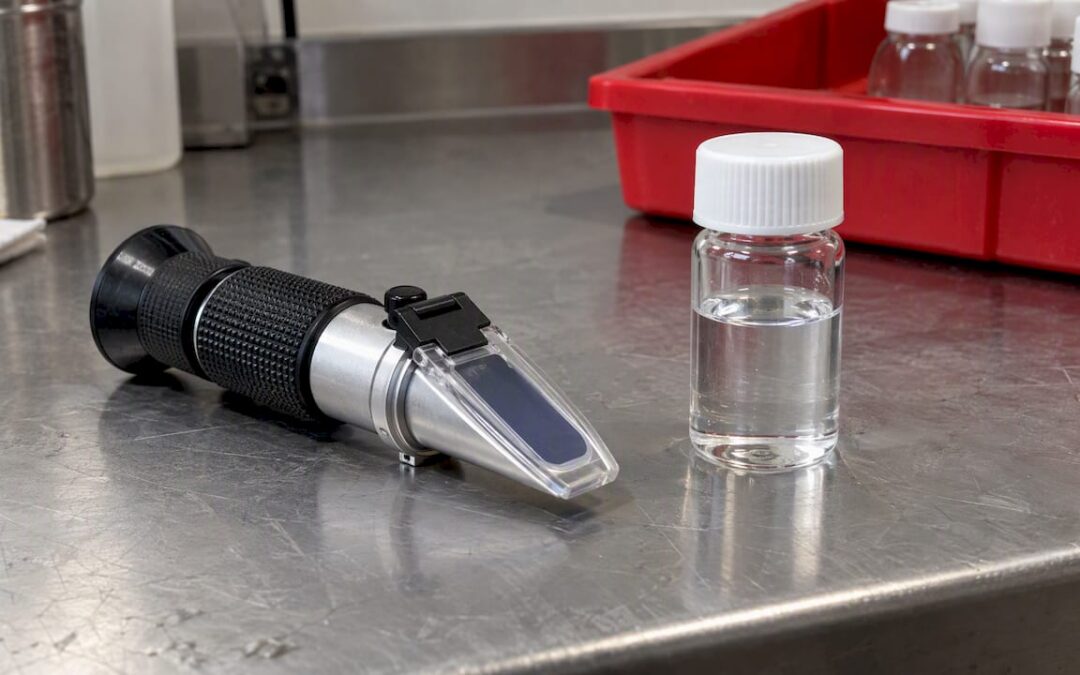
ISO 22241 is the international standard that defines what diesel exhaust fluid (DEF) must be: a 32.5% solution of technically pure urea in purified water, tested and handled so it does not harm the selective catalytic reduction (SCR) system in your engines. If your trucks, excavators, generators or loaders use DEF, the standard is the line between fluid that protects your emissions system and fluid that quietly damages it.
This guide covers what the standard says, the numbers that matter, how to confirm a delivery meets it, and how to store and dispense DEF without undoing the quality you paid for.
TL;DR
- ISO 22241 covers DEF quality (Part 1), test methods (Part 2), handling, transport and storage (Part 3), and refilling interfaces (Parts 4 and 5).
- Under ISO 22241-1:2019, urea content must fall between 31.8% and 33.2%, with a target of 32.5%, plus tight limits on impurities like biuret, aldehydes and metals.
- Ask every supplier for a Certificate of Analysis and check whether the product is API-licensed before the fluid goes into a tank.
- Contamination is the real risk: it can damage a catalyst that can cost as much as $15,000 to replace.
- Dedicated tanks, closed-loop transfer and clean dispensing equipment keep compliant DEF compliant.
Table of Contents
- What ISO 22241 actually is
- The five parts of the standard
- The numbers in ISO 22241-1
- Why compliance matters on the equipment side
- How to verify DEF before it goes in your tank
- Storing and dispensing ISO-grade DEF
- Using DEF correctly in SCR equipment
- Buying DEF in bulk instead of jugs
- DEF delivered to your site
- FAQ
- Sources
What ISO 22241 actually is
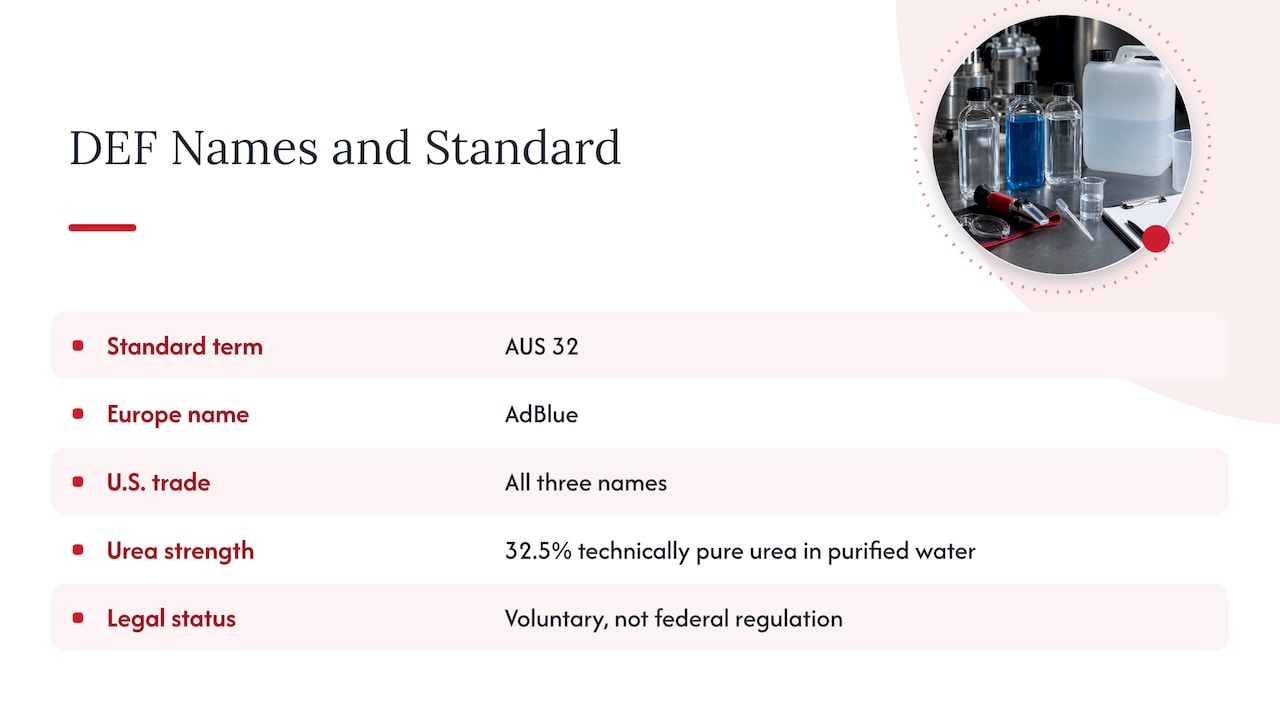
DEF goes by several names. In the standard, it is aqueous urea solution 32, or AUS 32. In Europe and on many retail shelves it is sold as AdBlue. In the U.S. trade you will see all three. According to the American Petroleum Institute, DEF is a 32.5% solution of technically pure urea in purified water, and the ISO purity standard exists so that SCR-equipped vehicles get fluid of the purity engine makers require and of a quality that preserves the emissions control system and the environment.
The U.S. Environmental Protection Agency identifies ISO 22241-1 as the industry-recognized DEF quality standard and notes that U.S. SCR systems are calibrated to the 32.5% urea concentration it specifies. That calibration is the reason concentration matters. The SCR system doses DEF into the exhaust assuming a known strength. Weak or off-spec fluid means less NOx is converted than the system believes.
One point of clarity: ISO 22241 is a voluntary industry standard, not a federal regulation. Its force comes from engine manufacturers specifying it, from EPA guidance pointing to it, and from warranty terms. EPA says operators of SCR equipment must routinely replenish DEF that meets the engine manufacturer’s recommended specification, and manufacturers predominantly recommend ISO 22241-1 DEF at 32.5% urea by weight.
For a plain-language primer on the fluid itself, see our explainer on what DEF is and why it matters.
The five parts of the standard
People often say “ISO 22241” as if it were one document. It is a family, and each part answers a different operational question. The breakdown below follows the overview presented at a fleet and truck-stop DEF strategy session.
| Part | Year | What it covers | Who cares most |
|---|---|---|---|
| ISO 22241-1 | 2019 | Quality requirements for the fluid | Buyers, suppliers, fleet managers |
| ISO 22241-2 | 2019 | Test methods | Labs, quality control staff |
| ISO 22241-3 | 2017 | Handling, transportation and storage | Yard managers, drivers, distributors |
| ISO 22241-4 | 2019 | Refilling interface for light and heavy vehicles | Equipment designers, OEMs |
| ISO 22241-5 | 2019 | Refilling interface specifics | Equipment designers, OEMs |
For a fleet or site operator, Parts 1 and 3 do most of the work. Part 1 tells you what to demand on the paperwork. Part 3 tells you what to do after the delivery truck leaves. Part 2 matters because it defines how the numbers on a certificate were produced. Intertek notes that it specifies methods for measuring properties such as refractive index, alkalinity, phosphate and metals.
The numbers in ISO 22241-1
The quality section is where a Certificate of Analysis earns its keep. API lists the characteristics the standard controls: urea content, refractive index at 20°C, alkalinity expressed as ammonia, biuret, aldehydes, insoluble matter, phosphate, and trace-metal limits for calcium, iron, copper, zinc, chromium, nickel, aluminum, magnesium, sodium and potassium.
The headline figures from ISO 22241-1:2019, as summarized by a standards reseller:
- Urea content: 31.8% to 33.2%, target 32.5%
- Alkalinity: 0.2% or less
- Biuret: 0.3% or less
- Aldehydes: 5 mg/kg or less
- Insoluble matter: 20 mg/kg or less
The insoluble matter test is the one most closely tied to cleanliness. Fluid Life describes it as the measure of DEF cleanliness, with a maximum of 20 ppm.
You do not need to memorize the limits. You need to know that a compliant certificate lists results for all of them, not just urea concentration. A certificate showing only a refractive index reading tells you the strength is right and nothing about metals, aldehydes or particulates.
Why compliance matters on the equipment side
SCR catalysts are expensive. Caterpillar notes that they use rare metals and that replacing one can cost as much as $15,000, and that contamination can damage the catalyst and void the warranty. That figure turns a bargain jug or an unverified bulk load into a poor trade.
There is also the derate problem. EPA acknowledges that SCR systems are necessary for emissions compliance, yet the derate strategy built to enforce it has caused operational difficulties, and the agency is issuing voluntary guidance to manufacturers on modifying DEF systems to reduce derates. For a site superintendent or fleet manager, the practical meaning is simple. A machine that detects poor DEF can lose power or speed, and that downtime lands in the middle of a shift, a haul schedule or a pour.
The cost chain looks like this:
- Off-spec or contaminated DEF enters the tank.
- The SCR system reads a quality fault or converts less NOx than expected.
- The machine derates, or a catalyst is poisoned over time.
- Crews stand idle, a service call is booked, and in the worst case a catalyst is replaced out of pocket.
Every step after the first is more expensive than the fluid ever was.
How to verify DEF before it goes in your tank
You cannot see compliance. Clear fluid can be diluted, contaminated or made from the wrong raw materials. API warns that agricultural-grade urea and untreated public water can introduce contaminants and metals, which is why homemade or loosely sourced DEF is a bad idea. Use this checklist instead.
Ask for a Certificate of Analysis
Request a Certificate of Analysis with every shipment, covering all the ISO quality characteristics. Match the lot number on the certificate to the lot on your delivery ticket. A supplier that cannot produce one has told you what you need to know.
Check for API licensing
API’s guidance says buyers can check its licensee directory to see whether the DEF they are buying is API-licensed. Put this step into your vendor onboarding, not into an emergency purchase.
Spot-check with a refractometer
A handheld refractometer gives a fast read on urea concentration in the field. A Navistar service bulletin states DEF must meet ISO 22241-1 and gives an operational refractometer acceptance range of 32.5% plus or minus 1.5%, a window that accounts for instrument tolerance, variability and calibration. Note that this is a field range, wider than the 31.8% to 33.2% laboratory specification. A refractometer confirms strength only. It will not catch a metal or biuret problem.
Retest stored fluid
If DEF sits in a tank for a long period, test it periodically. Navistar advises that storing DEF in a vehicle for more than six months is generally not recommended, and that quality should be checked if long storage cannot be avoided. Our page on DEF shelf life for fleets covers how scheduled delivery keeps inventory fresh.
Storing and dispensing ISO-grade DEF
Part 3 of the standard exists because DEF can leave the plant in spec and arrive in your equipment out of spec. Contamination usually happens in the handling.
API’s recommendations are specific: store DEF in dedicated bulk tanks, use a closed-loop transfer system, and dispense with dedicated equipment cleaned with distilled or de-ionized water. Never reuse a hose, pump or container that has touched fuel, oil, coolant or other chemicals.
Materials matter
DEF is corrosive to some metals. Navistar’s bulletin notes incompatibility with mild iron, zinc, aluminum, magnesium and nickel and recommends certain plastics, stainless steel or titanium for storage. A galvanized fitting or an aluminum funnel can leach exactly the metals the standard limits.
Temperature and freezing
DEF begins to freeze at 12°F (-11°C). Caterpillar says freezing does not change its effectiveness, but the fluid expands when frozen, so tanks and containers need headroom. Winter work in Utah or the Texas Panhandle makes this a real planning item. Our guide to keeping DEF between 12°F and 86°F goes deeper on storage temperature for fleets.
Practical yard setup
- Label DEF tanks and dispensers clearly so no one fills them with anything else.
- Keep fill points capped and clean, and wipe nozzles before use.
- Store out of direct sun where possible.
- Record lot numbers and delivery dates for each fill, so a fault can be traced.
- Keep the paperwork: certificates, delivery tickets and test readings. For government contracts and audits, a clean record is as valuable as clean fluid.
Using DEF correctly in SCR equipment
Follow the engine manufacturer’s specification first. The manufacturer’s manual is the final word on what your machine needs, and in practice it points to ISO 22241-1 fluid. Fill rate is worth planning around too: on Caterpillar machines the DEF tank has a 1:1 fill rate with the fuel tank, so if you add fuel you need to add DEF. Fueling crews who top off diesel and skip DEF are a common source of derates on job sites.
For mixed fleets, the rhythm is simple. Fuel and DEF should be delivered together, logged together and scheduled together. That avoids the midday trip to a retail station that costs labor hours and pulls a machine out of the workflow.
SCR is one system among many that need regular attention. While you are tightening your DEF practices, keep the rest of the truck’s fluids on schedule too, and a truck coolant flush guide is a good place to start on the cooling side. For a broader look at how DEF fits in the engine, read the role of DEF in modern diesel engines.
Buying DEF in bulk instead of jugs
Small containers are convenient, but each one is a handling event: opening, pouring, funnel, spill. A fleet fueling dozens of machines is better served by bulk DEF in a dedicated tank with a closed-loop dispenser, which matches what API recommends for storage and dispensing. Bulk purchasing also makes paperwork easier, because you receive documentation per delivery rather than per jug.
When comparing suppliers, look at the type of supplier, not just the price per gallon:
- A packaged-product distributor sells jugs and totes, and you handle storage.
- A bulk terminal or truck-stop dispenser sells by the gallon, and you handle the trip.
- A mobile delivery provider brings DEF to your site and fills your tank, so the handling risk sits with trained drivers and dedicated equipment.
Whichever you choose, the test is the same: Certificate of Analysis, API licensing, dedicated equipment. For cost considerations, see what fleets pay per gallon for DEF delivery and the benefits of DEF delivery for diesel fleets.
DEF delivered to your site
At Anytime Fuel Pros, we deliver DEF on-site to job sites, equipment yards, fleets, data center generators and remote locations, alongside red and clear diesel, so fuel and DEF arrive on one schedule and one invoice trail. We offer scheduled recurring deliveries and emergency and after-hours response, with itemized invoicing and delivery confirmation. Our primary markets are San Antonio, Austin, Dallas-Fort Worth and Salt Lake City, with nationwide coverage through our partner network.
When you request DEF from us or anyone else, ask for the Certificate of Analysis. It is the right question for any supplier. See our diesel exhaust fluid services or contact us through the fuel services page to set up a delivery.
FAQ
Is ISO 22241 DEF the same as AdBlue?
Essentially yes. The standard calls the fluid AUS 32, and DEF and AdBlue are trade names for the same 32.5% urea solution. AdBlue is a registered brand name, and in the U.S. the generic term is DEF. What matters is that the product meets ISO 22241-1 and, ideally, carries API licensing.
What urea concentration does ISO 22241 require?
ISO 22241-1:2019 sets a target of 32.5% urea, with an acceptable range of 31.8% to 33.2%. Field refractometer checks use a wider tolerance because of instrument variability. Concentration is only one of the characteristics, since impurity and metal limits matter as well.
Can I make my own DEF?
We do not recommend it. API warns that agricultural-grade urea and untreated water can introduce contaminants and metals that the standard limits. A catalyst replacement that can run to $15,000 is a steep price for the savings.
How do I know my supplier’s DEF meets the standard?
Request a Certificate of Analysis covering all ISO quality characteristics with each shipment, and check API’s licensee directory. Add a refractometer spot check on arrival for concentration. Keep the records with your delivery tickets.
Does frozen DEF still meet the specification?
Freezing starts at 12°F (-11°C), and according to Caterpillar it does not change effectiveness once thawed. Leave room for expansion in tanks and containers, and keep contamination out during thawing.
Sources
- Diesel Exhaust Fluid (DEF), American Petroleum Institute
- How to Purchase, Store & Handle Diesel Exhaust Fluid, American Petroleum Institute
- DEF Quality Monitoring Using Alternate Sensor Technologies, US EPA
- Diesel Exhaust Fluid, US EPA
- Successful Urea/DEF Strategies for Fleets and Truck Stops
- ISO 22241-1:2019 summary
- Diesel Exhaust Fluid (AdBlue) Testing, Intertek
- Common DEF Problems & How to Test for Them, Fluid Life
- Navistar service bulletin SB-10051649-7535, NHTSA
- Tips for Managing Diesel Exhaust Fluid, Caterpillar
Recent Comments