

Multiply your total distance by your price per gallon, then divide by your vehicle’s MPG, and you have your diesel cost: (Distance ÷ MPG) × Price per Gallon = Total Fuel Cost. That single equation is the engine behind every diesel calculator on the market, from a driver’s phone app to the fleet software running a 40-truck logistics operation.
To run it yourself, you need four inputs:
- Distance — the full trip length, in miles or kilometers
- Fuel efficiency (MPG) — your vehicle’s real-world diesel mileage
- Diesel price per gallon — current or projected pump price
- Units — miles vs. kilometers, gallons vs. liters, so the math lines up
Feed those into the formula and you get three outputs worth knowing before you ever leave the yard: gallons required for the trip, total dollar cost, and cost per mile. That last figure is the one fleet managers actually quote jobs against, because it strips out distance and lets you compare a Tuesday run to a 2,000-mile haul on equal footing. If you want the numbers run for you right now instead of by hand, skip ahead to the worked examples by vehicle class below.
Key Takeaways
Accurate diesel cost estimates depend on real fill-to-fill MPG, every mile driven including deadhead legs, and a price per gallon pulled from a current regional source rather than a single station.
| Point | Details |
|---|---|
| Use the core formula | (Distance ÷ MPG) × Price per Gallon gives total cost; divide by distance again for cost per mile. |
| Count every mile | Deadhead and detour miles still burn diesel and must be included for an accurate per-mile figure. |
| Match MPG to conditions | Use fill-to-fill, loaded-condition MPG rather than sticker or empty-truck numbers. |
| Prioritize speed and route fixes | Cutting highway speed or trimming route miles delivers the largest fuel savings per dollar spent. |
| Budget for volatility | Federal excise tax and ULSD refining premiums mean diesel prices swing; build a per-mile buffer. |
Table of Contents
- How the Diesel Calculator Formula Actually Works
- How to Calculate Diesel Cost for a Trip, Per Mile, or a Bulk Volume
- Worked Numeric Examples for a Car, Pickup, and Semi-Truck
- Practical Ways to Cut Your Diesel Costs
- What Actually Drives the Price of Diesel
- Sources
How the Diesel Calculator Formula Actually Works
The math is simple, but the variables hide real complexity. Written out as an equation:
Total Cost = (Distance ÷ MPG) × Price per Gallon
Distance is every mile the vehicle actually drives for the trip, not the straight-line distance between origin and destination. MPG is your fuel efficiency, ideally measured fill-to-fill rather than pulled from a manufacturer sticker. Price per gallon is the diesel rate you expect to pay, which you can pull from a recent invoice or from EIA’s weekly regional and national diesel price averages rather than a single station’s posted price, which can swing several cents from the regional norm.
International readers or fleets running mixed units need a quick conversion table:
A diesel calculator built around U.S. gallons and miles will produce nonsense if you plug in liters and kilometers without converting first. A tool like Fueleconomy lets you enter a specific vehicle and route, which is a solid way to sanity-check your own MPG assumption before committing it to a bigger cost model.
Fleet managers face one input decision that matters more than any other: which MPG number to use. A truck’s spec sheet MPG assumes ideal conditions, empty trailers, and flat highway. Real fill-to-fill MPG, tracked over several tanks, accounts for terrain, load, and idle time, and it’s almost always lower.
Pro Tip: Always include deadhead miles, the empty or non-revenue legs of a route, when calculating fleet fuel cost. A truck that runs 500 loaded miles and 150 empty miles back to base still burns diesel on all 650, and leaving those miles out of your calculator will understate your real cost per mile by a wide margin.
How to Calculate Diesel Cost for a Trip, Per Mile, or a Bulk Volume
Three common questions come up constantly, and each uses a variation of the same formula.
- Total trip cost. Multiply (Distance ÷ MPG) by price per gallon. A 400-mile trip at 22 MPG and $3.85 per gallon runs (400 ÷ 22) × $3.85, or about $70.
- Cost per mile. Divide price per gallon by MPG. At $3.85 per gallon and 22 MPG, that’s $3.85 ÷ 22, roughly $0.175 per mile, which is the number you should be quoting into any job bid.
- Cost for a set volume, like 100 gallons. Skip distance entirely and multiply gallons by price per gallon. 100 gallons at $3.85 comes to $385, useful when you’re planning a bulk fuel delivery and need to budget the purchase before the truck arrives.
Type any of these three variations straight into a spreadsheet cell and you have a working diesel usage estimator without installing anything.
The most common input traps are worth naming directly. Using highway MPG for a route that’s mostly stop-and-go city driving will underestimate cost by a meaningful margin. Forgetting detours, weigh station stops, or fuel-run miles does the same thing. And confusing a vehicle’s advertised MPG with its actual fill-to-fill average is the single biggest reason fleet fuel budgets run over.
Worked Numeric Examples for a Car, Pickup, and Semi-Truck
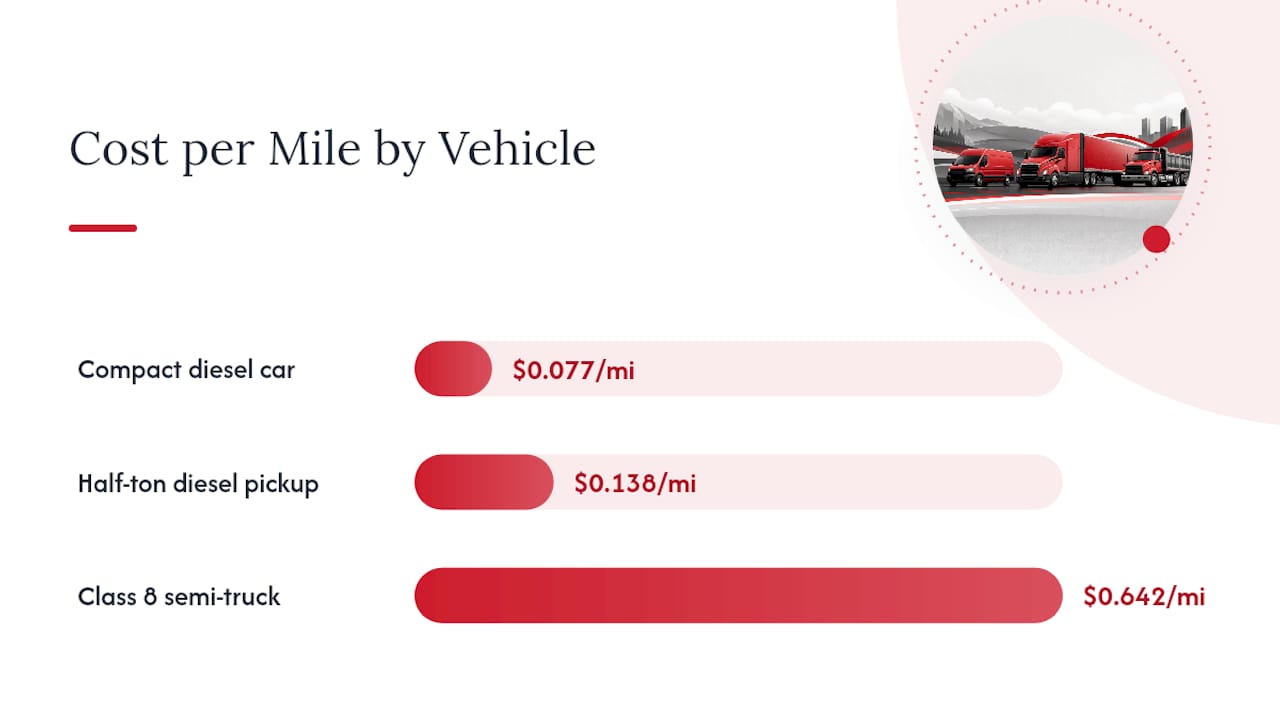
Vehicle class changes everything about the math, even when the formula stays identical. Here’s how gallons and cost per mile shift across three common vehicle types at a representative $3.85 per gallon price:
| Vehicle class | Typical MPG range | Gallons per 100 miles | Cost per mile (at $3.85/gal) |
|---|---|---|---|
| Compact diesel car | 40 MPG | 2.5 gal | $0.077 |
| Half-ton diesel pickup | 20 MPG | 3.6 gal | $0.138 |
| Class 8 semi-truck | 6–8 MPG | 12.5 gal | $0.642 |
Compact car: A 300-mile trip at 45 MPG needs 300 ÷ 45, or 6.7 gallons. At $3.85 per gallon, that’s roughly $25.75 for the trip.
Half-ton diesel pickup: The same 300 miles at 24 MPG, a realistic number once you account for around-town driving, needs 12.5 gallons, or about $48.10. Add a loaded trailer and that MPG can drop into the high teens, pushing the cost noticeably higher.
Class 8 semi: A 300-mile haul at 7 MPG needs 42.9 gallons, running close to $165.15. Now stretch that to a 2,500-mile long-haul route and you’re looking at 357 gallons and roughly $1,375, before deadhead miles or a fuel surcharge get added in. Some freight calculators, including AllTheCalculations’ diesel fuel cost tool, build an optional surcharge line directly into the output for exactly this reason.
Towing and heavy loads are the wildcard in every one of these numbers. If your calculator doesn’t let you flag “loaded” versus “empty,” run both scenarios and budget for the worse one.
Practical Ways to Cut Your Diesel Costs
Small efficiency gains compound fast once you multiply them across thousands of miles. The levers that move the needle most:
- Route optimization — cutting 10% of miles off a route cuts fuel cost by roughly the same percentage, no efficiency gain required.
- Reduce idle time — idling can burn close to a gallon per hour with zero miles to show for it.
- Speed management — dropping from 75 mph to 65 mph on the highway commonly improves diesel MPG by 10% or more.
- Tire pressure and maintenance — underinflated tires and clogged filters both drag MPG down measurably.
- Driver training — smoother acceleration and braking reduces fuel burn without changing the route or the truck.
- Load planning — consolidating loads and cutting empty-return legs directly reduces deadhead miles.
Fleets have a few additional levers individual drivers don’t. Scheduled on-site fuel delivery removes the out-of-route detour to a retail station entirely, which sounds minor until you multiply a 20-minute detour by every truck, every week. Route planning and optimization software catches inefficiencies a dispatcher would miss by hand, and locking in fuel-surcharge language on freight contracts protects margin when diesel prices spike mid-quarter.
Pro Tip: Shaving 10 mph off highway cruising speed on a Class 8 semi can improve MPG from 6.0 to 6.6, dropping cost per mile from about $0.642 to $0.583 at $3.85 per gallon. Run that improvement across 100,000 annual miles and you’ve saved close to $5,900 without spending a dollar on new equipment.
What Actually Drives the Price of Diesel
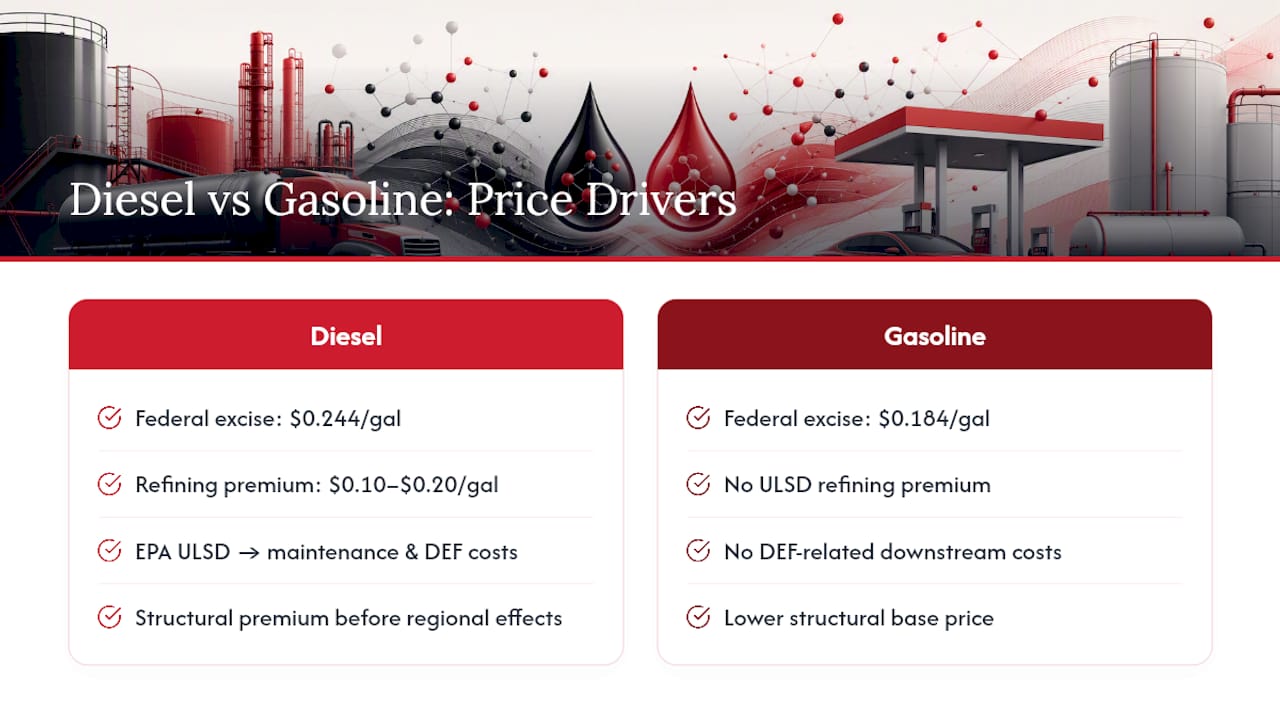
Diesel almost always costs more than gasoline at the pump, and the gap isn’t random. The federal excise tax on diesel is $0.244 per gallon compared to $0.184 per gallon for gasoline, a $0.06 baseline gap before a single drop of crude gets refined.
The federal diesel excise tax runs $0.244/gallon, and refining ultra-low-sulfur diesel (ULSD) adds an estimated $0.10 to $0.20 per gallon on top of that, according to Wharton’s Budget Model.
ULSD refining requires extra processing steps to strip sulfur content, and the EPA’s emissions standards that mandate ULSD also drive some of the maintenance and DEF-related costs fleets see downstream of the pump price. Stack the tax gap and the refining premium together and you get a structural reason diesel trades above gasoline even before regional supply and demand come into play.
That volatility has real budgeting implications. Fleets should build a per-mile buffer of a few cents to absorb short-term price swings rather than quoting jobs against today’s exact price. Regional spreads matter too. A price that looks reasonable nationally can run well above average in a tight regional market, which is why checking EIA’s regional diesel data before quoting a multi-state route beats relying on a single local price. And when diesel price fluctuations hit hard mid-contract, a locked delivery schedule with a known provider takes one variable out of an already unpredictable equation.
If you’re weighing diesel against gasoline for a light-duty pickup rather than a fleet vehicle, the math shifts. Diesel’s pump-price premium is often only recovered over a long ownership horizon unless you’re towing heavy loads or driving high annual mileage, since the fuel-cost savings scale directly with miles driven per year.
Ready to turn a calculated fuel need into an actual delivery? Anytimefuelpros runs on-site diesel fuel delivery for job sites, fleets, and generators, with both clear diesel and red dye diesel available depending on your equipment. Scheduled deliveries mean your calculated cost per mile stays predictable instead of getting blown up by a surprise station run, and if a shortfall hits without warning, 24/7 emergency fuel delivery covers the gap. Check service locations to confirm coverage for your site or fleet.
Sources
A handful of sources cover almost every input a diesel calculator needs. EIA’s petroleum data page is the best source for current regional and national pump prices, updated weekly. The EPA’s Office of Transportation and Air Quality documents ULSD specifications and emissions rules that shape fuel formulation and long-term operating costs. FuelEconomy.gov’s trip calculator lets you look up or verify a specific vehicle’s MPG and run a trip cost estimate against it. And the Alternative Fuels Data Center’s vehicle cost calculator goes a step further, modeling total cost of ownership across vehicle types for fleets weighing diesel against alternative fuels. For a deeper look at fleet-level cost-per-mile modeling, Haullytics’ cost-per-mile guide covers the operational side of the math in more depth than a single trip calculator can.
If your numbers point to a recurring fuel need rather than a one-off trip, Anytimefuelpros’ fuel knowledge hub and service pages cover scheduled and on-site delivery options built around exactly the kind of cost planning this calculator supports.
- Budgetmodel Wharton — BE2026-3
- Fueleconomy
- EIA — Petroleum: Gasoline & Diesel
- AllTheCalculations — Diesel Fuel Cost Calculator
Recent Comments