
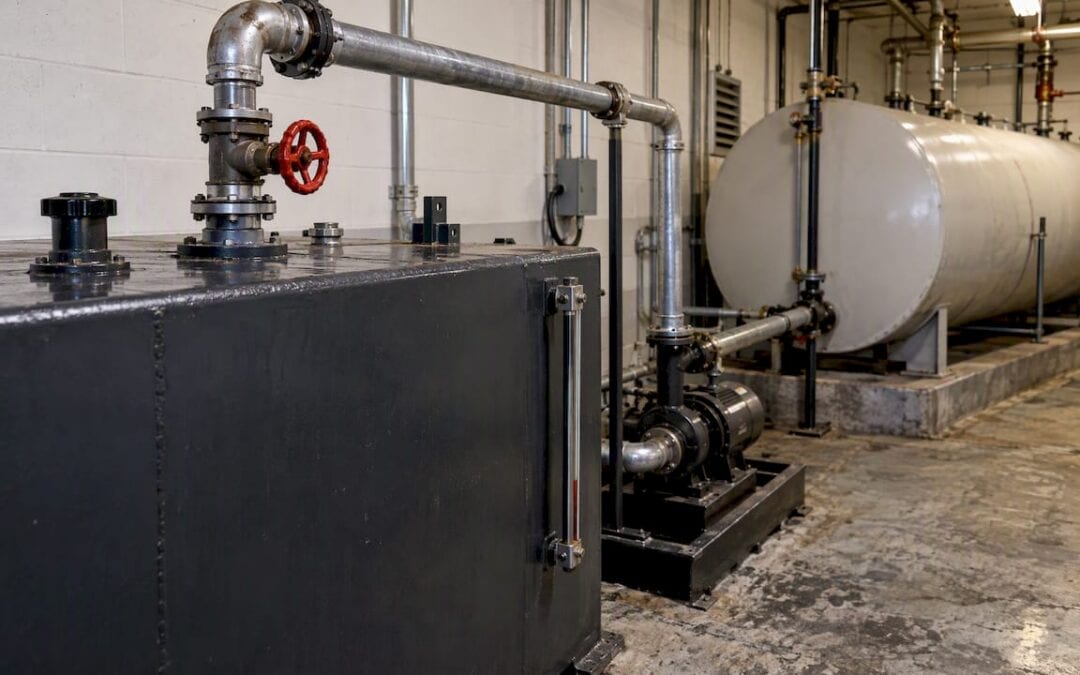
A day tank is refilled in one of two ways: automatically, from a larger bulk tank through a transfer pump and level controls, or by a fuel truck that delivers diesel straight to the day tank or to the bulk tank feeding it. Which one fits depends on your generator’s duty, your site’s storage footprint and how quickly you turn fuel over. Get it wrong and the cost is the quiet kind: starved engines, stale fuel, and a regulatory surprise nobody planned for.
This guide is written for facilities managers, operations directors and site superintendents who run diesel generators or heavy equipment and need a refill plan that holds up under load.
TL;DR
- A day tank is a small buffer tank next to the engine. It is refilled from a bulk tank by a transfer pump, or by a delivery truck, and it should never depend on someone remembering to do it.
- Refueling is governed by OSHA 1926.152(g) on construction sites: no ignition sources within 50 feet, an automatic-closing nozzle, engines off, and a 20-B:C extinguisher within 75 feet.
- Day tanks count toward the 1,320-gallon aboveground oil storage threshold that triggers an EPA SPCC plan.
- Bigger is not better. NFPA 110 expects fuel to be consumed within its storage life, or remediated, so match tank size to turnover.
- Scheduled deliveries plus fuel quality checks beat emergency calls every time.
Table of Contents
- What a day tank does, and why refilling it matters
- Three ways to refill a day tank
- Safe refilling: what the rules say
- Day tanks and the 1,320-gallon SPCC trigger
- Design and venting are not covered by NFPA 110
- Sizing and turnover: why more is not better
- Building a refill schedule that works
- Worked example: a mid-sized standby site
- Refilling during an emergency
- Where Anytime Fuel Pros fits
- Common mistakes to avoid
- FAQ
- Sources
What a day tank does, and why refilling it matters
A day tank sits close to the engine and feeds it directly. The bulk tank, often larger and farther away or underground, supplies the day tank. The reason is physical: engine fuel pumps have a limited suction lift. NFPA 110, section 7.9.2, says the fuel tanks must be close enough for the pump’s lift to meet the system requirements, or a fuel transfer pump and day tank must be provided.
Many people assume a day tank is only emergency insurance. Site power specialists describe it differently: it is a buffer that protects the engine from fuel starvation as filters clog and lines restrict with age. As filters load up, the pump’s effective suction drops, so a layout that works on commissioning day can fail years later. That is why refilling the day tank is a reliability task, not housekeeping.
The ARDT summary of NFPA 110 adds a placement rule: day tanks must be installed below the engine’s fuel return elevation.
Three ways to refill a day tank
1. Automatic transfer from a bulk tank
The standard arrangement for permanent installations. A transfer pump moves diesel from the bulk (sub-base or yard) tank into the day tank. Float switches or level sensors start the pump at a low setpoint and stop it at high, with a high-high alarm and overfill protection as backup.
What to check:
- Pump start and stop setpoints, tested rather than assumed.
- Low-level and high-level alarms that reach a person, not just a panel nobody watches.
- Fuel return lines routed so they cannot push the day tank past full.
- Whether the bulk tank itself has enough diesel to keep feeding the pump.
Automatic transfer is only as good as the bulk tank behind it. The usual failure is not the pump. It is an empty or contaminated bulk tank.
2. Delivery to the bulk tank, which feeds the day tank
For most data centers, hospitals, plants and yards, the practical refill is a truck filling the bulk tank on a schedule. The day tank then refills itself automatically. This keeps hoses and nozzles away from the engine room and puts the fueling where spill containment and ignition controls are already designed in.
The delivery side should come with a record: gallons delivered, time, and fuel type. Itemized documentation matters when auditors or government contracts ask for it.
3. Direct fill of the day tank
Smaller generators, event power and temporary job sites often have no bulk tank. A truck or portable system fills the day tank directly, usually through a fill port or a closed-loop connection. It works, but it concentrates risk: the tank is small, close to the engine and often close to people. Generator run times at events and construction sites can burn through a day tank faster than expected, so the refill interval has to be calculated, not guessed.
| Method | Best for | Main risk | What keeps it safe |
|---|---|---|---|
| Automatic transfer from bulk tank | Permanent standby generators | Empty or dirty bulk tank, failed float | Alarms, tested setpoints, fuel testing |
| Truck fills bulk tank | Data centers, plants, yards | Missed delivery windows | Scheduled, recurring deliveries |
| Truck fills day tank directly | Events, temporary sites, small units | Overfill, spills near the engine | Engine off, trained operator, closed-loop fittings |
Safe refilling: what the rules say
The federal rule most construction and site operators work from is OSHA 1926.152. Under paragraph (g) of that standard, the key points for refueling are:
- Keep open flames and ignition sources at least 50 feet away from the refueling area, with smoking prohibited.
- Use an automatic-closing nozzle with no latch-open device.
- Shut off motor-powered equipment during refueling. The standard allows limited exceptions for closed-loop systems such as Wiggins connectors.
- Keep a fire extinguisher rated at least 20-B:C within 75 feet of dispensing areas.
OSHA has also issued interpretations on fire protection during fueling of mobile equipment and on diesel storage at construction sites. If you are unsure how a rule applies to a particular tank or setup, read the interpretation and confirm with your safety director or the OSHA area office before you change the procedure.
There is a practical wrinkle for standby generators. Shutting the engine off to refill is not an option when it is carrying a live load during an outage. That is the strongest argument for automatic transfer plus a well-stocked bulk tank: the day tank refills without anyone touching a nozzle near a running engine. If your site relies on refueling a running unit, get a written procedure reviewed by your safety professional and your generator manufacturer first.
A basic manual refill checklist
- Confirm the generator or equipment status. If it is not on an approved closed-loop system, shut it down and let it cool.
- Clear the area of ignition sources and confirm the extinguisher is in reach.
- Check the day tank level and the fuel type. Red dye diesel is off-road only, so verify before anything goes into an on-road vehicle tank.
- Ground and bond as your site procedure requires, then connect the hose and use an automatic-closing nozzle.
- Fill to the marked safe level, never to the brim. Leave room for expansion.
- Close the cap, wipe up any drips, and log the volume and time.
- Restart and confirm the level gauge and alarms read correctly.
Day tanks and the 1,320-gallon SPCC trigger
Day tanks are storage containers, so they count. Under 40 CFR Part 112, a non-transportation facility with aboveground oil storage above 1,320 U.S. gallons in aggregate generally needs an SPCC plan, as explained in the EPA’s guidance on emergency generator tanks. That plan brings inspections, secondary containment and a certified spill prevention program.
Technical specialists note that owners often add day tanks for convenience and are later surprised by spill prevention audits. The count includes every container, so a 500-gallon bulk tank, a few day tanks, a mobile tank and drums can add up faster than you would think.
The EPA also explains that once a facility falls under SPCC, all aboveground containers and completely buried tanks become subject to the rule unless otherwise exempt. Check your total before you add capacity.
We cover the math in more detail in our SPCC checklist for facility managers and our guide to yard tank compliance at the 1,320-gallon trigger. If you rent tanks to stay under the threshold, read the rules for fuel tank rental first, because how the tank is classed matters.
Design and venting are not covered by NFPA 110
One common compliance mistake is treating NFPA 110 as the full installation guide. It sets the duty and says when a day tank is needed, but it does not explicitly regulate day tank design or venting. Those requirements are delegated to broader standards such as NFPA 30 and NFPA 37. For storage-side checks, see our NFPA 30 diesel storage guide. Your local authority having jurisdiction has the last word on what is acceptable at your site.
Sizing and turnover: why more is not better
The instinct is to buy the biggest tank you can fit. NFPA 110 pushes the other way. Section 7.9.1.5 says tanks must be sized so the fuel is consumed within its storage life, or provisions must be made to remediate stale or contaminated fuel or replace it with clean fuel. The same document requires fuel system design that supplies clean fuel to the engine.
The duty is what sets the tank size. Per ARDT, the number that matters is how long the generator must run at rated load without refueling. Capacity should come from that figure, not from a wish for extra margin.
Stale fuel is a real hazard because a standby generator burns almost nothing between outages. A tank that is large relative to the fuel burned on test runs may hold the same diesel for a very long time. The result is water, sediment and microbial growth that clog filters at the worst possible moment.
A simple turnover check
Use this to see whether your current setup is drifting:
- Total gallons stored (bulk plus day tank).
- Gallons burned in a typical year, from run logs and test cycles.
- Divide stored by burned. A high ratio means fuel sits for a long time and needs a testing and polishing plan.
If the ratio is high, you have three honest options: reduce stored volume, burn more fuel through scheduled load testing, or commit to regular fuel testing and fuel polishing. Hiding from the number is not one of them.
Building a refill schedule that works
Most day tank problems are scheduling problems. A workable plan has four parts.
- Set a reorder point, not a calendar guess. Choose a bulk tank level, for example the point where you have a defined number of hours of runtime left, that triggers a delivery order. Define the hours with your engineer, based on your generator’s actual consumption at load.
- Add a recurring delivery for predictable sites. Equipment yards, mining operations and data centers with regular top-offs are better served by scheduled bulk fuel delivery than by ad hoc calls.
- Plan for surge events. Storms, wildfires and grid outages multiply demand for diesel across a region at the same moment. Pre-arrange emergency service before you need it.
- Test the fuel on a fixed cycle. Sample from the tank bottom, check for water and sediment, and log results beside delivery records.
For sites running mobile equipment as well as generators, mobile fleet fueling can run on the same schedule so crews stop driving to retail stations. Our overview of how diesel gets from the refinery to your site helps explain where lead times come from.
Worked example: a mid-sized standby site
Take a hypothetical site, with illustrative numbers only. A facility has a standby generator with a 1,000-gallon sub-base bulk tank and a small day tank. It test-runs the unit for an hour a month at partial load and has not had an outage in two years.
The tank is nearly full, which looks like safety. But the fuel has been sitting for years, because the test runs burn only a small fraction of the volume. When an outage hits, the engine starts, then the filters begin to load with sediment. The day tank holds enough fuel for a short while, but the transfer pump is moving contaminated diesel from the bulk tank. The failure starts at the bulk tank, and the day tank only delays it.
The better plan: test the fuel on a schedule, polish or replace it when results warrant, keep the bulk tank topped up through a recurring delivery, and check that the day tank’s float switches and alarms work. Each step is cheap compared to a failed start.
Refilling during an emergency
When an outage runs for days, the day tank is only the last link. The bulk tank depletes, and the refill problem becomes a logistics problem: who can reach your site, with what fuel, in how many hours. Roads, fuel rationing and demand from other critical sites all slow response.
This is where having a supplier relationship in place beats a frantic call list. Documented site access, tank capacity, fill connection type and a named contact all shorten the response.
Where Anytime Fuel Pros fits
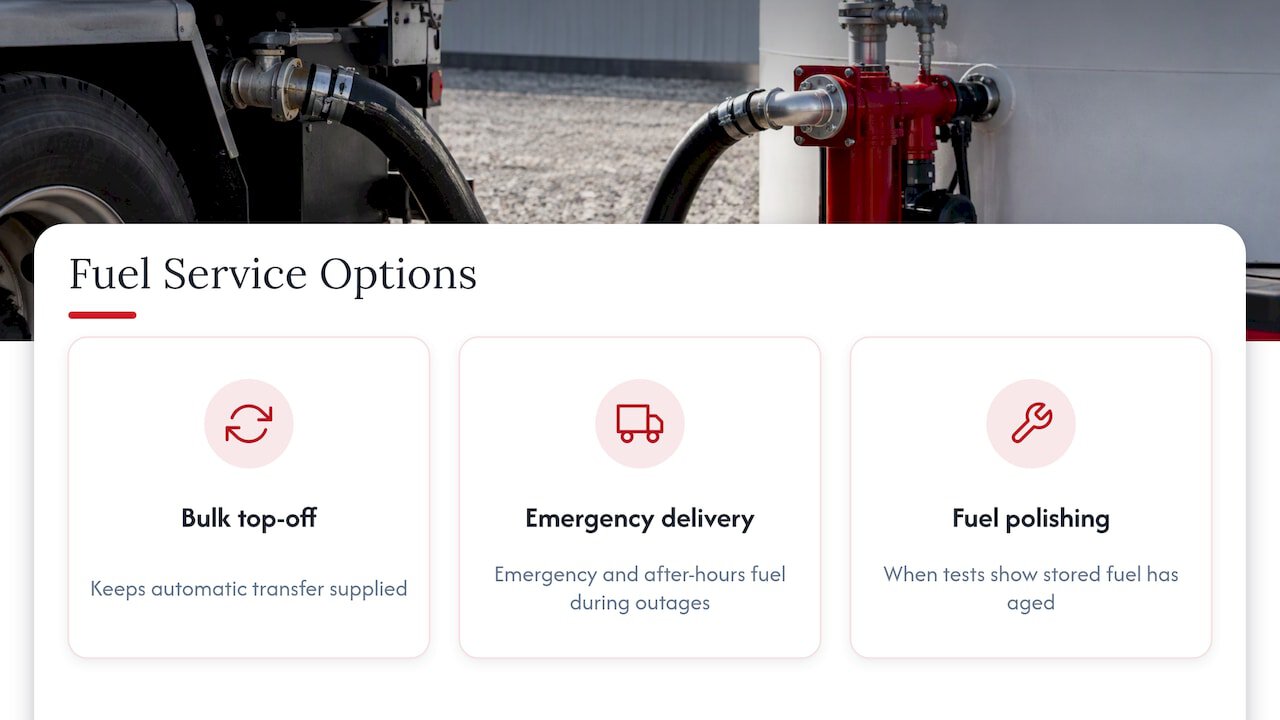
We deliver on-site diesel, both dyed and clear, along with DEF, gasoline, bulk fuel and generator fuel. For day tank systems, that usually means one of three things: a scheduled bulk tank top-off so your automatic transfer system always has supply, emergency and after-hours fuel delivery when an outage stretches on, or fuel polishing when test results show the fuel in storage has aged.
Our primary markets are San Antonio, Austin, Dallas-Fort Worth and Salt Lake City, and our national partner network extends service across the continental United States for multi-site operations. We offer 24/7 service and a 3-hour emergency response in covered areas, with itemized invoicing so each delivery is documented. You can see the full range on our fuel services page or check where we deliver. To set up a recurring delivery for your generator site, start from our diesel fuel delivery page.
Common mistakes to avoid
- Trusting the gauge without testing the float. A stuck float switch can overfill the day tank or let it run dry.
- Refilling a running engine without a closed-loop system. OSHA 1926.152(g)(10) requires engines off, with narrow exceptions.
- Adding tanks without recounting SPCC capacity. Convenience becomes a compliance obligation at 1,320 gallons aggregate.
- Oversizing for peace of mind. Large tanks with low turnover breed stale fuel.
- Mixing fuel types. Red dye diesel is for off-road use only. Label fill points clearly.
- No record of deliveries. Delivered gallons, dates and fuel type should be on file for audits.
FAQ
How often should a diesel day tank be refilled?
It depends on the tank size and the engine’s burn rate at load. In a standby setup the day tank usually refills automatically from the bulk tank, so the real question is how often the bulk tank needs a delivery. Set a reorder level based on your generator’s actual consumption and run logs, and review it after every test or outage.
Can you refill a day tank while the generator is running?
OSHA 1926.152(g)(10) requires motor-powered equipment to be shut off during refueling, with limited exceptions for closed-loop systems like Wiggins connectors. Automatic transfer from a bulk tank avoids the issue because no one handles a nozzle at the engine. For any manual refill of a running unit, get a written procedure approved by your safety professional and the generator manufacturer.
Do day tanks count toward SPCC requirements?
Yes. Day tanks are aboveground storage containers, so their capacity adds to your facility’s total. If the combined aboveground oil storage exceeds 1,320 U.S. gallons, you generally need an SPCC plan under 40 CFR Part 112. Confirm your total with a qualified professional before adding capacity.
What size should a generator day tank be?
NFPA 110 does not give a single size. Required runtime at rated load sets the overall fuel capacity, and the engine manufacturer’s data decides whether a day tank is needed at all. Size it with your engineer, and weigh fuel turnover, since fuel must be consumed within its storage life or remediated.
What should I do if the fuel in my day tank is old?
Test it first for water, sediment and microbial growth. Depending on the results, the options are fuel polishing, treatment or replacement with fresh diesel, and your fuel quality plan should say which applies. Do not run a critical generator on fuel you have not tested.
Sources
- NFPA 110 overview, ARDT
- NFPA-110 7.9.2: Fuel Supply Reliability, On-Site Power Advisor
- NFPA 110 for Emergency Power Systems, Cummins
- OSHA 1926.152, Flammable liquids
- OSHA interpretation: Fire protection during the fueling of mobile equipment
- OSHA interpretation: Storage of diesel fuel and kerosene at construction sites
- EPA: Federal UST Requirements for Emergency Power Generator UST Systems
- EPA: Underground Storage Tanks in SPCC Plans
Recent Comments