
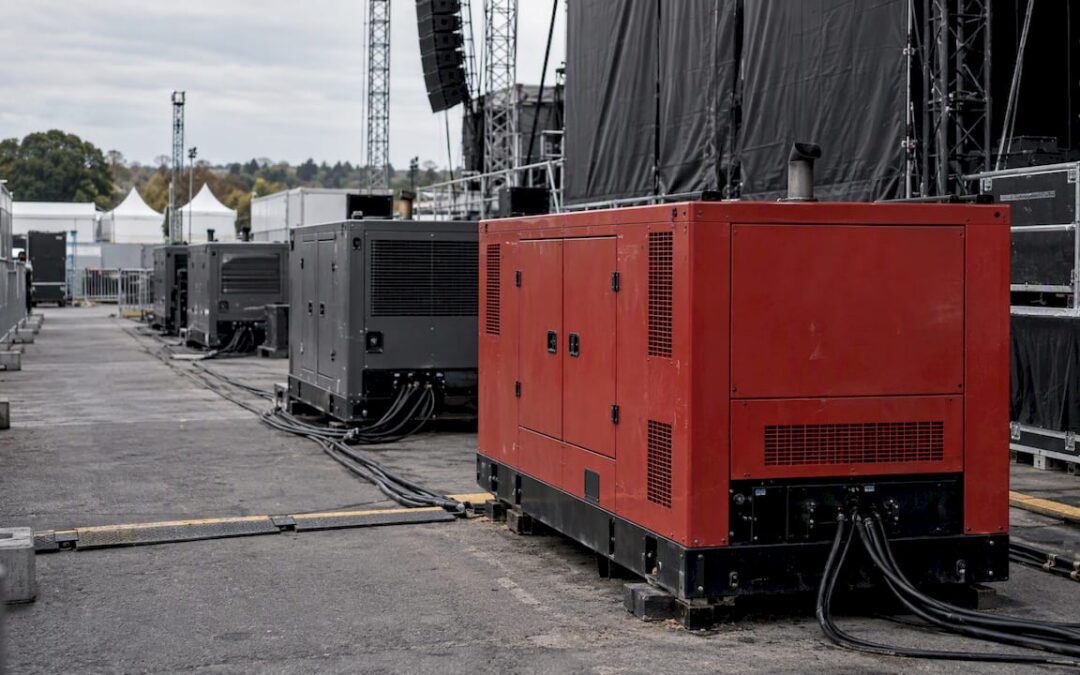
Event generator fuel planning comes down to five decisions: how long the generators must run, how many gallons that takes, where the fuel is stored, when it is delivered, and what happens if a delivery slips. Make them together with your site layout, not the week before load-in. A generator that runs dry during a headliner’s set is a planning failure, not bad luck.
This guide is for production managers, festival organizers, film coordinators and venue operators who need a defensible fuel plan. It covers the math, the fire-code constraints that catch teams off guard, a delivery schedule and a contingency model.
TL;DR
- Start from the event’s critical loads and run hours, then size generators and fuel around them. Do not size for every possible circuit.
- FEMA’s planning rule for diesel is 0.07 gallons per hour × generator kW × 24 hours. Treat it as a ceiling at full load and replace it with the manufacturer’s load curve when you have one.
- Refueling during public hours is often restricted or banned. Build delivery windows into the production schedule before you contract volume.
- Fire codes differ by city. Confirm distances, storage limits and documentation with the local fire authority early.
- Plan a reserve and a second delivery path. Fuel plans fail at the handoff, not at the tank.
Table of Contents
- Start with critical loads and run hours
- How to estimate gallons for an event
- Tank size versus event length
- Fire code: the constraints that shape your plan
- Refueling is a controlled operation
- Build a delivery schedule
- Choose the right fuel and the right supplier
- Plan the contingency, not just the base case
- Mistakes we see in event fuel plans
- How Anytime Fuel Pros supports event fuel plans
- FAQ
- Sources
Start with critical loads and run hours
FEMA’s planning approach begins with the critical functions and the required operating period, then sizes generation around them. FEMA’s guidance for critical facilities makes the point that a generator does not need to carry every load if the plan separates critical circuits from noncritical ones. For an event, that translates into a simple exercise.
- List what must not go dark. Stage audio and lighting, video walls, point-of-sale and ticket scanning, medical tent, security command post, refrigeration for vendors, and egress and emergency lighting.
- List what can drop in an outage. Decorative lighting, phone charging stations, some vendor equipment.
- Set the run window. Count from the first load-in test to final strike, not just doors to close. Overnight lighting and refrigeration often run when no one is watching.
- Split loads across generators. Dedicated units for stage, vendors and base camp let you shut one down to refuel without blacking out everything.
This is the same discipline that applies to any long-duration operation. The U.S. Department of Energy tells local leaders to define the event period, identify critical loads and calculate replenishment timing, including how fuel will be moved if on-site storage falls short.
How to estimate gallons for an event
The FEMA rule of thumb
FEMA’s generator fueling training gives a diesel planning rule: 0.07 gallons per hour × generator size in kW × 24 hours per day. Its worked example puts a 40 kW diesel generator at 67.2 gallons per day.
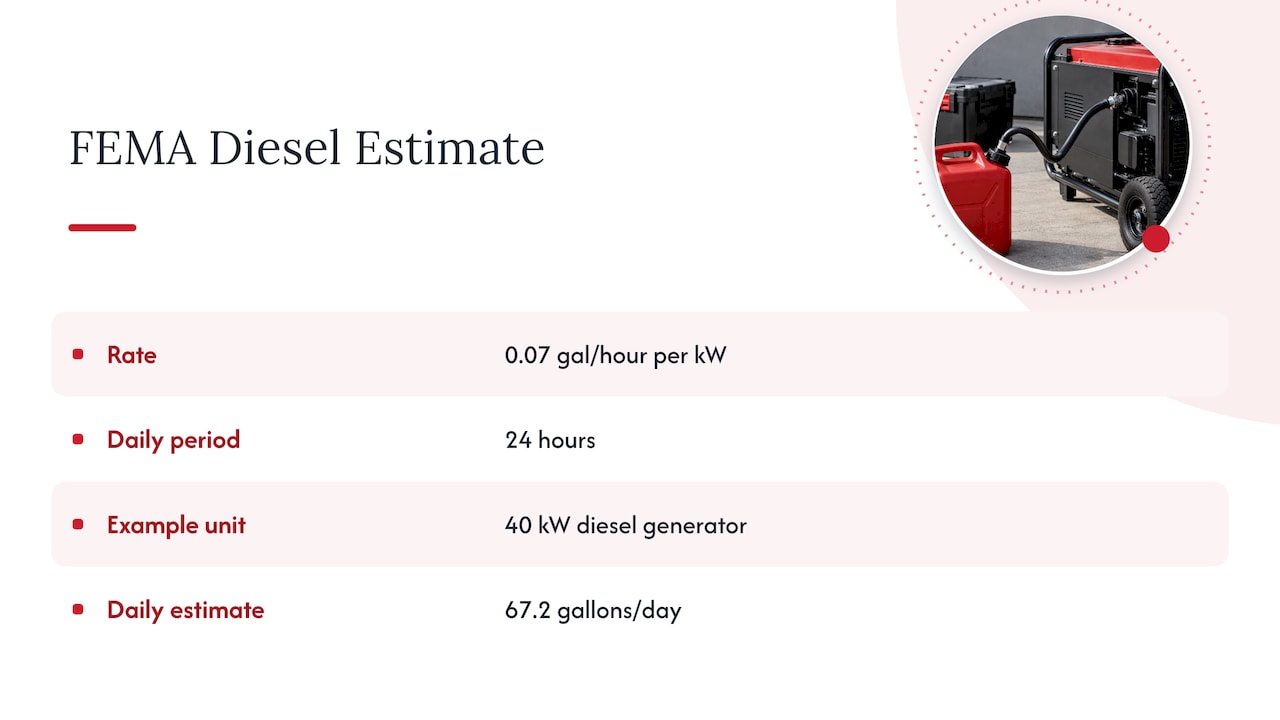
The rule assumes a heavy load. Real consumption depends on how much of the generator’s capacity you actually draw, so FEMA advises confirming the result against the specific unit’s fuel-consumption curve and expected load.
A worked example
Say a three-day festival runs one 100 kW generator for the main stage, 24 hours a day for lighting, refrigeration and overnight security.
- Planning ceiling: 0.07 × 100 × 24 = 168 gallons per day
- Three days: 168 × 3 = 504 gallons
- Add a reserve so you never plan to run to empty. We suggest holding back a meaningful share of the total, and your rental provider’s curve will tell you how much margin is sensible.
If the generator actually averages 50% load, the real number will be well below 504 gallons. That gap is the reason to measure. Matching generator size to load also affects efficiency: our event fuel consumption guide explains why oversized units running at light load burn more fuel per kilowatt hour than correctly matched ones, and shows how to track gallons per hour from runtime logs.
Tools for the next step
Once you know your loads, use our fuel consumption calculator to test scenarios, and our generator fuel consumption rates charts to compare typical burn by generator size and load. For a planner-oriented template, the event fuel vendor checklist with model burn charts walks through what to ask a supplier.
A quick answer to a common question
Readers often ask how long a small generator runs on a given amount of fuel. There is no universal answer. Runtime depends on the model, the fuel and the load, so check the manufacturer’s runtime chart for your unit rather than relying on a general figure.
Tank size versus event length
Many units arrive with a tank sized for roughly one day at full load. FEMA notes that most of its inventory generators carry 24-hour tanks, but tank duration varies and must be checked for the actual unit. Rented generators can differ from that model, so ask for the tank capacity and rated runtime in writing.
Three tank approaches are common at events:
| Approach | Best for | Watch out for |
|---|---|---|
| Base tank only, refueled on a schedule | Short events, small loads | Every refuel is a shutdown risk and a labor task |
| Oversized or sub-base tank | Multi-day events, remote sites | Fire-code limits on tank capacity and labeling |
| Temporary storage tank with transfer | Large festivals, film shoots, multi-generator sites | Containment, permits and site-plan documentation |
If a larger tank is on the table, check local rules first. Austin’s special-event requirements, for example, set a 660-gallon maximum generator fuel capacity and require larger tanks to meet labeling and UL 142 specifications. Those are Austin rules, not national ones.
Fire code: the constraints that shape your plan
There is no single U.S. rule for event generators. Municipal guidance varies, and your fuel plan has to follow whichever authority governs your site.
What the cities specify
- Austin: generators at least 10 feet from permanent structures and 20 feet from tents, with on-site fuel storage limits stated in the special-event requirements and a rule that generators cool before refueling.
- San Francisco: the event site plan asks for generator locations, fuel type, grounding, barricades, extinguisher and shutoff access, wheel blocks and signage, including a no-smoking sign.
- New York City: FDNY street fair guidance says filling portable-generator tanks during the event is not allowed.
- Frederick County, Maryland: its special events guide requires a site plan showing the event layout, and directs large generators to be fueled during off-hours.
The lesson is not to memorize these. It is to confirm requirements with the local authority having jurisdiction before you contract fuel volume or delivery timing, and to draft the fuel plan alongside the event layout. Fire authorities can ask for revisions before approval, and a late change to generator placement can ripple into cable runs, barricades and delivery routes.
Austin events
If you produce in Austin, the fuel plan is part of load-in approval. We cover that process in our guide to Austin festival fuel planning for ACE approval.
What to put in your fuel plan package
Across these jurisdictions, a complete package typically documents:
- Fuel type and tank size for each generator
- Generator locations on the site plan, with distances to tents and structures
- Extinguisher and emergency shutoff access
- Barricades or fencing that keep the public away
- Grounding method
- Spill cleanup materials and secondary containment
- Emergency lighting
- Refueling procedure, where refueling is approved
That list comes from San Francisco’s site-plan requirements and FDNY guidance. Use it as a starting checklist and add whatever your own jurisdiction asks for.
Refueling is a controlled operation
The most common surprise for first-time producers is that you cannot simply top off a generator whenever the gauge dips. Austin requires generators to cool before refueling and requires generators over 10 gallons to be refueled when the public is absent, according to the FDNY and Austin guidance summarized above and Austin Fire.
Safety basics from OSHA
OSHA’s portable generator safety guide identifies shock, carbon monoxide, fire, noise and vibration as the main generator hazards. For fueling, it calls for approved, properly marked and vented containers kept away from ignition and heat sources, and for generators to be shut down and allowed to cool before refueling. It also warns against connecting a generator directly to a structure’s electrical system unless a qualified electrician has installed it properly.
Build the refuel into the show schedule
FEMA’s refueling guidance adds the operational side: safe refueling may require shutdown and a cold-start procedure, so plan for the temporary loss of power. Frederick County, for one, requires a responsible adult who knows how to use an extinguisher to be present during refueling.
In practice:
- Pick the windows. Overnight after close and early morning before gates open are the usual choices for multi-day events.
- Stagger the generators. Never shut down every unit in the same window. Keep critical loads such as egress lighting and medical on a unit that is not being fueled, or on a backup.
- Assign an owner. One named person confirms the generator is off, cooled and that the extinguisher and spill kit are at hand before the driver starts.
- Log it. Record gallons delivered, time and generator ID. This feeds your consumption data and your invoice check.
Build a delivery schedule
A fuel plan is a calendar as much as a quantity. A simple structure works for most events:
| Phase | Fuel action | Planning note |
|---|---|---|
| Pre-event (1 to 2 weeks out) | Confirm volume, tank sizes, access routes, permits | Lock in generator placement with the fire authority |
| Load-in | Initial fill of all tanks and any temporary storage | Deliver before crowds or heavy vehicle traffic arrive |
| Event days | Scheduled top-offs in audience-free windows | Check levels at each shift change |
| Final night | Top-off only what strike requires | Avoid paying to haul leftover fuel away |
| Strike | Final reading, return or pump-out of leftover fuel | Reconcile gallons delivered against gallons burned |
Trucks need a route. Confirm where a fuel truck can stand, how it reaches each generator and whether crowd barricades or stage trucks will block it at the time of delivery. At stadiums and arenas, the same logic applies to game day windows, which we cover in fuel delivery for sporting events: a planner’s guide.
Choose the right fuel and the right supplier
Diesel type
Most event generators run on diesel. Whether you need clear (taxed, on-road) or red dyed (off-road) diesel depends on how the fuel is used and on current tax rules, so confirm with your supplier and tax adviser rather than assuming. Mixed fleets, such as generators plus on-road support trucks, may need both delivered separately.
What to ask a supplier
- Can you deliver in the audience-free windows our fire authority allows?
- Do you provide after-hours and emergency response if a unit burns faster than planned?
- What is on the delivery ticket, and is the invoice itemized by delivery and generator?
- Can you serve every site if we tour multiple venues or states?
- What is the backup if a truck is delayed?
A vendor that can only deliver on weekday business hours is a risk for a Saturday headliner.
Plan the contingency, not just the base case
NFPA’s technical guidance treats fuel as part of the emergency power supply system. In its overview of NFPA 110, fuel supply sits alongside the generator, controls and transfer equipment. Reliability depends on how fuel quality, tank sizing, alarms, pumps and controls work together. That is why a delivery plan should include monitoring and contingency actions, not only a purchase quantity.
NFPA 110 itself governs permanent emergency and standby systems, and requirements depend on classification and locally adopted code. A Denver fire guideline, for example, calls for load-duration calculations and full-load-based sizing. Temporary event power is not the same as a hospital’s installed system, but the thinking transfers well: define the run time, set a low-fuel alert point and know your tank capacity.
A practical event contingency includes:
- Low-fuel trigger: a level at which someone calls dispatch, set well above empty and based on the supplier’s drive time to your site.
- Reserve: extra fuel scheduled into the plan, not improvised.
- Second path: a backup delivery contact and a second access route.
- Load shed plan: a pre-agreed list of noncritical circuits to drop if fuel runs short.
- Weather watch: storms, wildfire smoke and road closures can delay trucks and spike demand. Our power outage fuel logistics guide explains how fuel delays develop when many sites compete for supply.
Mistakes we see in event fuel plans
- Sizing on nameplate rather than load. The generator’s rating is not its burn rate.
- Ignoring the fire authority until late. Placement changes ripple through the whole layout.
- Planning refueling during public hours. In many places this is restricted or prohibited.
- One generator for everything. A single unit makes every refuel a total blackout.
- No consumption log. Without gallons per hour on record, next year’s plan is a guess.
- Forgetting strike. Leftover fuel costs money to remove, and tanks left unattended after the event are a hazard.
How Anytime Fuel Pros supports event fuel plans
We deliver diesel and DEF on-site, including red dyed and clear diesel, and we handle generator fuel delivery for festivals, concerts, film production and large outdoor venues. Scheduled deliveries cover load-in and event days, and our emergency and after-hours response is there for the unit that burns faster than forecast. We also offer fuel tank rentals for sites that need storage. Our primary markets are San Antonio, Austin, Dallas-Fort Worth and Salt Lake City, and our partner network extends service across the continental United States for multi-site tours.
See our full range of on-site fuel delivery services, or go straight to emergency fuel delivery if your event is days away. Send us your generator list, run hours and venue, and we will help you build a delivery schedule that fits your fire authority’s rules.
FAQ
How do I calculate how much fuel an event generator needs?
Multiply 0.07 gallons per hour by the generator’s kW rating and by the hours of operation. FEMA uses this rule and illustrates it with a 40 kW diesel generator at 67.2 gallons per day. It assumes a heavy load, so replace it with the manufacturer’s fuel-consumption curve and your expected load when you can.
Can generators be refueled while the event is open to the public?
Often not. Austin requires generators over 10 gallons to be refueled when the public is absent, and FDNY guidance does not allow filling portable-generator tanks during the event. Rules vary by jurisdiction, so check with your local fire authority and schedule refueling in audience-free windows.
How far should a generator be from tents and buildings?
It depends on the city. Austin’s special-event requirements call for at least 10 feet from permanent structures and 20 feet from tents. Other jurisdictions set different distances, so confirm with the authority that approves your site plan.
How much reserve fuel should I plan for?
There is no single national figure for temporary event power. Set the reserve from your run window, your supplier’s response time and the local storage limits. Permanent standby systems follow separate rules: one Denver guideline calls for 133% tank capacity for the classification it references, but that does not apply to every event.
Should I use one large generator or several smaller ones?
Several units give you flexibility. You can shut one down to refuel while critical loads stay on another, and each runs closer to its efficient load range. A single large unit is simpler to place but turns every refuel into a total outage.
Sources
- FEMA: Operational generator fueling requirements
- FEMA: Generator refueling guidance
- FEMA P-1019: Emergency power systems for critical facilities
- U.S. Department of Energy: Local leaders prepare for an energy emergency
- Austin Fire: Special events
- SF.gov: Prepare a special event site plan for the Fire Department
- FDNY: Fire safety precautions at street fairs and outdoor gatherings
- Frederick County Fire and Rescue: Special events guide
- OSHA: Using portable generators safely
- NFPA: An overview of NFPA 110
- Denver Fire Department: Generator installation guideline 2026
Recent Comments