
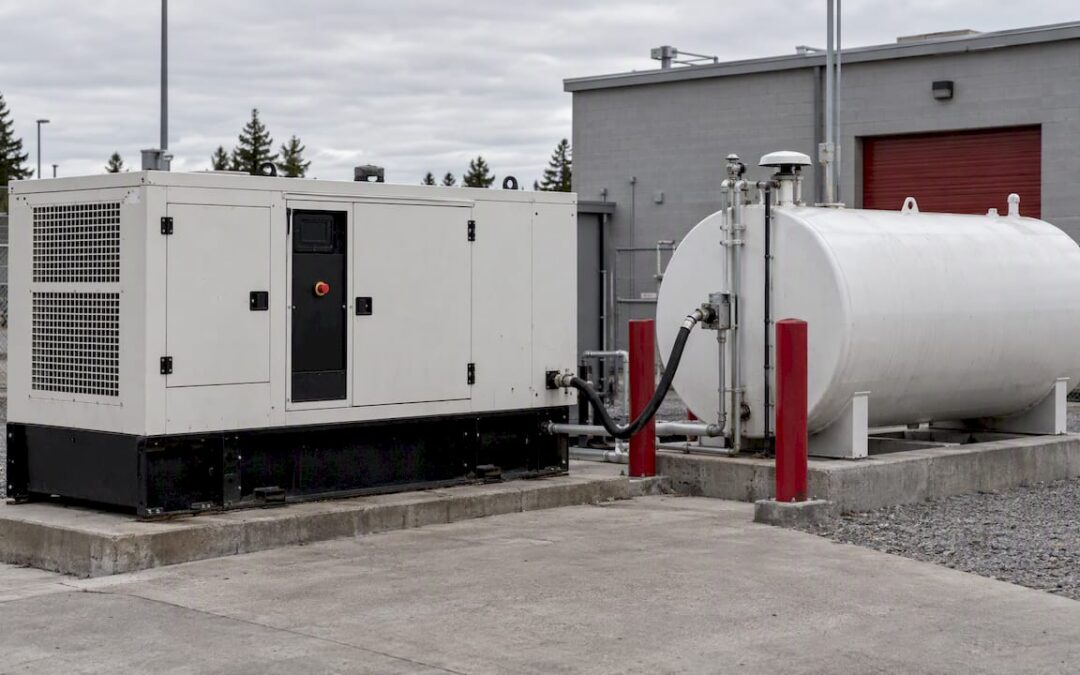
Wildfire outage fueling is the plan that keeps your backup generators supplied when a utility de-energizes lines or a fire takes down the grid. It comes down to four things settled before the event: how much fuel each generator burns, how much you store, who delivers more, and how the truck reaches your site when roads, gates and pumps are not working normally. This guide walks through each one for facilities, municipalities, job sites and event operators.
TL;DR
- Calculate daily burn per generator, then compare it with total on-site storage. EPA offers an approximate formula of kW × 0.07 gallons per hour × 24 hours.
- A fuel contract is not a fuel plan. If the transfer pump needs grid power or the delivery route is blocked, the contract does nothing.
- Use more than one supply source, name your account as a priority in writing, and document access instructions for drivers.
- Generator permits and operating limits vary by air district. Check with yours before the season, not during the shutoff.
- Plan for failure: EPA notes that more than 10% of backup equipment may fail during events.
Table of Contents
- Why wildfire outages are a fueling problem, not just a power problem
- Step 1: Know your burn rate
- Step 2: Set a refill threshold
- Step 3: Build the supply chain, not just a contract
- Step 4: Plan the last mile
- Step 5: Check permits, safety and local rules
- Step 6: Plan for failure and fuel quality
- Who needs this most
- A pre-season checklist
- How Anytime Fuel Pros fits in
- FAQ
- Sources
Why wildfire outages are a fueling problem, not just a power problem
A generator is only as dependable as the fuel behind it. Wildfire outages are tougher than a typical storm outage in three ways. They can last days, because lines are shut off ahead of the fire and re-energized only after inspection. They can close roads, which stops the normal delivery. And they often hit fuel retail too: gas stations may lose power during a wildfire outage in the same way your site does, so “send someone to fill cans” is not a plan.
EPA’s guidance frames this well. Fuel availability is a resilience-system issue. An organization can hold a fuel contract and still fail if the vendor cannot reach the site, the storage pump has no power, or staff cannot safely move fuel to the generator. EPA’s power resilience guide tells operators to maintain fuel on site and to have several ways to get and move more.
The downtime math is simple and unforgiving. A data center that drops load, a water plant that stops pumping, or a crew that sits idle while a dozer runs dry all pay the same hidden cost: every hour without fuel multiplies across people, equipment and commitments.
Step 1: Know your burn rate
Start with each generator, not the site as a whole. For each unit, record the kW rating, typical load, tank capacity, fuel type and any DEF requirement.
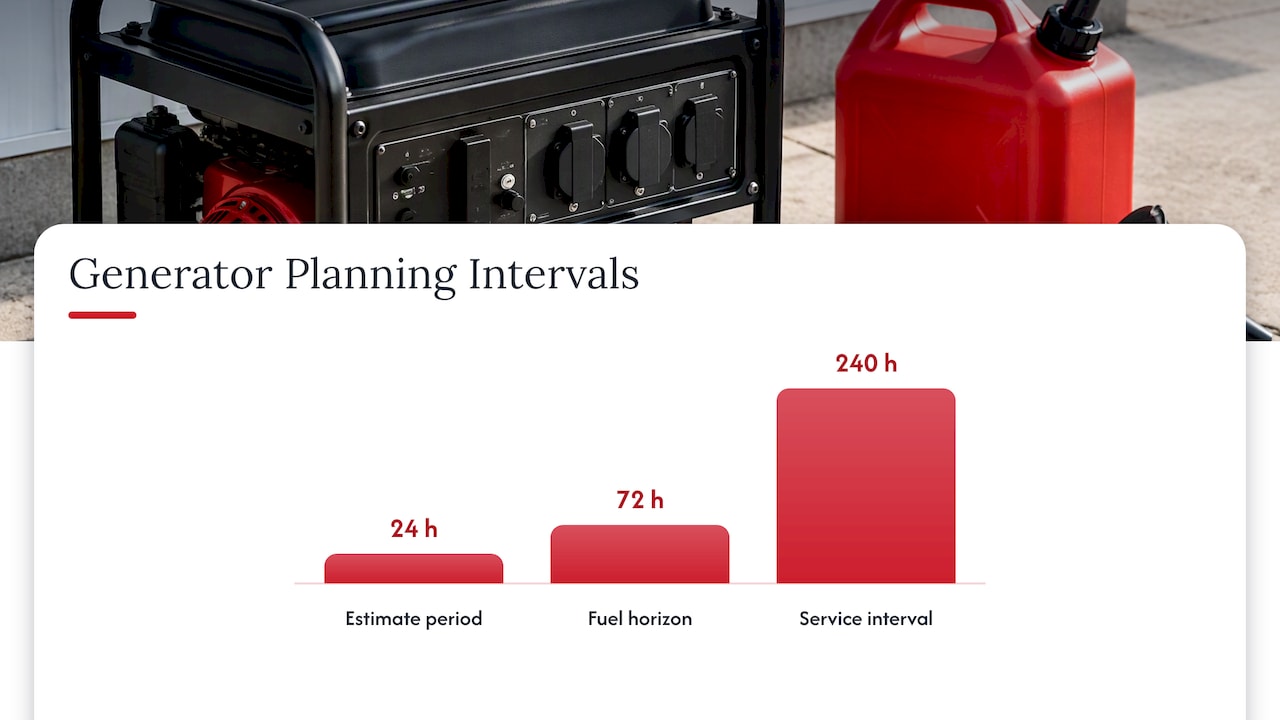
EPA’s incident checklist gives a rough planning formula for a 24-hour estimate: generator size in kW × 0.07 gallons per hour per kW × 24 hours. It is meant for approximation only. Final numbers should come from the manufacturer’s consumption data at your actual load.
A worked example using that formula:
- A 500 kW generator: 500 × 0.07 = 35 gallons per hour.
- Over 24 hours: 35 × 24 = 840 gallons per day.
- Over 72 hours: 2,520 gallons.
If the unit’s base tank holds 1,000 gallons, you have a little over a day at full load. Real loads are usually lower, but plan on the number you can defend, then adjust. Our fuel consumption calculator helps you run the same exercise across several units.
Three adjustments matter in practice:
- Load growth during an outage. Cooling, pumps and temporary equipment get added to the generator circuit.
- Runtime beyond 24 hours. EPA identifies a standard service interval of 240 operating hours, or every 10 days of continuous operation, so long events also need maintenance windows.
- DEF. Diesel engines with aftertreatment need exhaust fluid, and EPA specifically says to include it in your calculation.
For a deeper look at why 24 to 72 hours of tank capacity is not the whole answer, see our piece on data center generator fuel.
Step 2: Set a refill threshold
EPA recommends monitoring tank levels and refilling when they drop below a defined threshold. Pick that threshold around delivery lead time, not around empty. If a realistic delivery takes 6 hours in good conditions and twice that with road closures, your trigger should leave a buffer well beyond that.
When a shutoff is predicted, EPA also advises filling vehicle, equipment and storage tanks to capacity where it is safe and permitted. That top-off is the cheapest resilience you can buy. Our guide to generator fueling schedules explains how scheduled deliveries make that routine instead of a scramble.
Step 3: Build the supply chain, not just a contract
EPA’s planning documents ask five practical questions before fire season:
| Question | What a good answer looks like |
|---|---|
| How much does each generator burn per day? | Documented per unit, with the fuel type each one needs |
| What is total on-site capacity? | Hours of runtime at expected load, not just gallons |
| How will remote generators be refueled? | A named method, vehicle and responsible person |
| Which vendors are contracted? | More than one source, with after-hours contacts |
| How is fuel moved if normal logistics fail? | Alternate transport and a backup pumping method |
The EPA PSPS template adds details many teams skip: verify that transfer pumps have power redundancy, issue payment methods to staff who may need to buy fuel, and document generator fuel requirements and delivery contacts in one place.
Ask for priority in writing
EPA’s guidance says contracts should explicitly identify the customer as a priority account during an emergency. Ask any supplier, including us, how priority is defined, what the response commitment is, and which areas it covers. At Anytime Fuel Pros, we offer 24/7 emergency and after-hours response with a 3-hour emergency response target in covered areas, and we work from primary markets in San Antonio, Austin, Dallas-Fort Worth and Salt Lake City. Outside those, our national partner network lets you keep one point of contact for multi-site and multi-state needs.
Use more than one source
A second source can be another contracted supplier, a stored reserve, or a bulk tank on site. For multi-site operators, consolidating under one vendor simplifies invoicing and dispatch, but keep at least one alternate path for the site that matters most. Our guide to power outage fuel logistics covers how delays build up in the first 72 hours.
Step 4: Plan the last mile
Most wildfire fueling failures happen between the road and the tank.
Evacuation guidance from the U.S. Fire Administration warns that routes may be blocked by trees, power lines, locked gates or vehicles. EPA recommends mapping access and keeping generators and connection points reachable by qualified personnel. Turn that into a one-page delivery brief for each site:
- Primary and alternate routes, with the point where each is likely to close.
- Gate codes, key holders and who can open after hours.
- The exact fill location, hose reach and any spill containment.
- A safe staging point if the site is under an evacuation order.
- Escort requirements if fire or law enforcement controls the road.
- A named on-site contact with a working phone and a backup.
Also check the pump. If your storage-tank pump runs on grid power, you need an alternate way to move fuel, such as a generator-powered pump or a delivery truck that can fill the generator tank directly. Mobile delivery does exactly that, which is why many facilities use mobile fuel delivery as their backup to on-site storage.
Step 5: Check permits, safety and local rules
Running a generator through a wildfire shutoff is not a blanket exemption from local rules.
In California, CARB states that regulations allow large commercial backup generators to operate during a Public Safety Power Shutoff, but operators should contact the local air district before buying or renting one because local permitting may apply. That guidance covers engines above 50 brake horsepower (37 kW). The Bay Area district, for example, says that at 50 brake horsepower or greater a business may need a permit, with emergency use limits and extra restrictions within 1,000 feet of a school. That is a Bay Area rule, not a national one. In Texas, Utah or anywhere else, ask your own air-quality agency and fire marshal.
Safety basics from CARB apply everywhere:
- Never run a generator indoors or near open windows.
- Never connect one to facility wiring without qualified electrical work and required permits.
- Avoid operating near dry vegetation or when the unit cannot be monitored.
Fire departments may also restrict where and when generators run, so confirm requirements before an incident. For mission-critical sites, CARB’s advisory notes why pre-starting generators ahead of a planned shutoff can matter: staffing or automation limits may delay startup and let critical equipment lose power. Pre-starting burns fuel earlier, so build it into your consumption estimate.
Step 6: Plan for failure and fuel quality
EPA’s checklist is blunt: more than 10% of backup equipment may fail during events. Treat that as a planning assumption. Keep spare filters, trained and cross-trained operators, and a backup generator or mutual-aid arrangement where an outage would be severe. EPA also advises shutting generators down for refueling where operationally possible, and reducing nonessential loads to stretch supply.
Fuel that has sat for a year may not run cleanly under long load. EPA calls for planning fuel polishing and additives, and for stocking extra filters. The U.S. Fire Administration’s pre-fire planning handout goes further for hospitals and water systems, recommending hard-wired generators with an alternative fuel supply such as propane. If you run diesel, the lesson is the same: build a dependable fuel architecture rather than a pile of portable units.
Who needs this most
Data centers and telecom. Long runtimes, strict uptime and tight permit limits. See our emergency fuel services for data centers.
Municipalities and emergency managers. Fire stations, water systems, shelters and fleets all draw fuel at once. Our wildfire fueling plan and disaster response services pages cover contracted support, and our emergency fuel plan guide is built for procurement teams.
Construction, mining and oil and gas. Remote equipment and temporary generators on sites where roads are the first thing to close.
Events and film production. Temporary power in fire-prone areas. Food vendors face the same question of how to keep equipment running when the grid is down, and this guide to running a food trailer without mains power (in Dutch) shows how the planning logic carries over. Our event fuel vendor checklist covers burn charts for temporary power.
A pre-season checklist
- List every generator, tank and fueled vehicle, with fuel type and DEF needs.
- Calculate daily burn at realistic load and compare it with storage.
- Set refill thresholds based on delivery lead time.
- Contract at least two supply sources and request written priority terms.
- Test the transfer pump on backup power.
- Write and share a delivery brief for every site.
- Confirm air-district permits and fire department rules.
- Stock filters, additives and DEF, and schedule fuel polishing.
- Run a drill that includes a delivery, not just a generator start.
How Anytime Fuel Pros fits in
We bring diesel (red dye and clear), gasoline and DEF directly to your site, with bulk fills, generator fueling, tank rentals, fuel polishing and scheduled or emergency delivery. Our itemized invoicing and delivery confirmation help procurement and finance teams document what was delivered, which matters for government contracts and after-action reporting.
If you are building or reviewing a wildfire outage plan, start with our emergency fuel delivery service, browse the full fuel services list, or place an order to set up scheduled top-offs before fire season.
FAQ
How much fuel should I keep on site for a wildfire outage?
There is no universal number. EPA suggests calculating each generator’s daily consumption, adding your total on-site storage, and planning refills below a set threshold. Use manufacturer data at your real load, include DEF, and remember that long outages need more than 24 hours of runtime.
Can a fuel truck reach my site during a wildfire shutoff?
Often, but not always. Roads can be blocked by trees, power lines, locked gates or vehicles, and fire agencies may control access. Provide alternate routes, gate instructions, a staging point and an on-site contact in advance so a driver can act quickly.
Do I need a permit to run a backup generator during a Public Safety Power Shutoff?
It depends on your air district. CARB says large commercial generators may operate during PSPS events in California, but local permitting and limits may apply, and Bay Area guidance sets a 50 brake horsepower permit threshold. Outside California, contact your local air-quality agency and fire department.
Should I refuel a generator while it is running?
EPA advises shutting generators down during refueling where operations allow. If that is not possible for a critical load, work with your supplier and fire safety staff on a procedure, and keep ignition sources and dry vegetation away from the fill area.
Is red dye diesel acceptable for backup generators?
Off-road dyed diesel is generally used for stationary generators, while clear diesel is for on-road use. Confirm the fuel type your equipment and local rules require, and document it in your fuel plan.
Sources
- EPA Power Resilience: Guide for Water and Wastewater Utilities
- EPA Incident Action Checklist: Power Outages
- EPA Public Safety Power Shutoff SOP Template
- CARB: Regulations Allow Back-Up Generators during a PSPS
- CARB Advisory on Portable Back-up Generators
- Bay Area AQMD: Public Safety Power Shutoff Events
- U.S. Fire Administration: National Wildfire Evacuation Guidance
- U.S. Fire Administration: Pre-Fire Planning
Recent Comments