
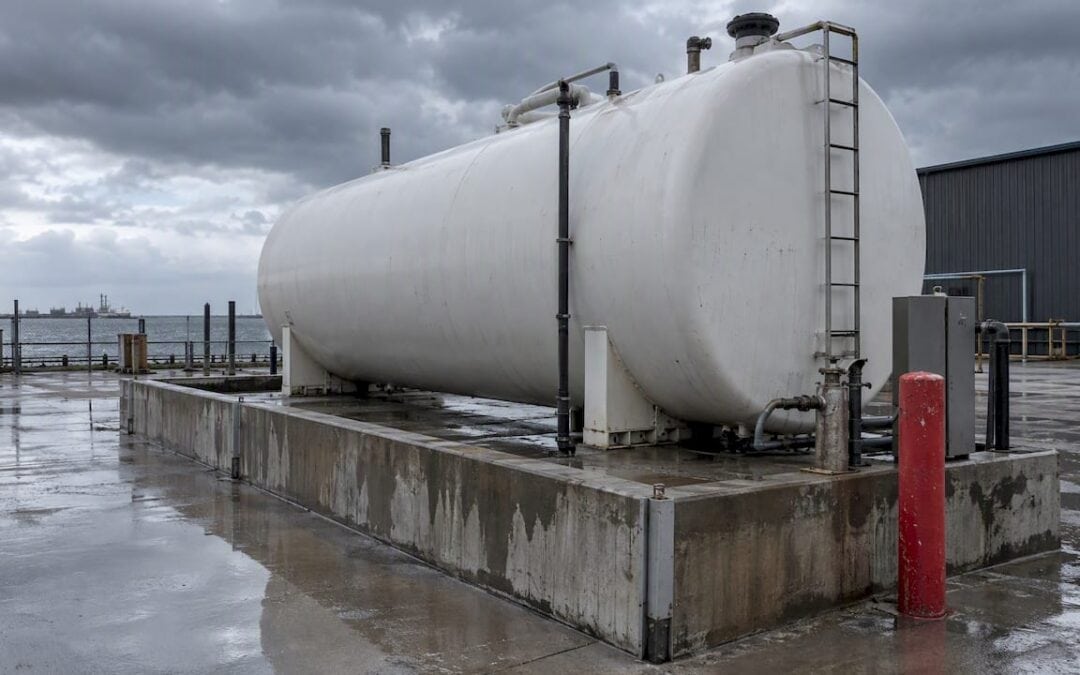
Hurricane fuel preparedness comes down to three things you settle before a storm is named: how many gallons you need on site, who will deliver the next load when roads and grids are compromised, and how you keep stored fuel usable. Most failures happen in the second item. A vendor contract that looks solid in June can mean very little in the second day of an outage.
This guide is written for facilities managers, fleet managers, site superintendents and procurement officers who run generators, heavy equipment or vehicle fleets. It is not a household checklist. If you run a data center, a construction site, a municipal yard or a distribution hub, this is the fuel side of your hurricane plan.
TL;DR
- Size your on-site diesel from the load you must carry, not from the tank you happen to own. A common planning target is five days at 70% load before resupply becomes routine.
- A fuel contract is not a guarantee. Confirm in writing that your vendor can operate without grid power and that you are listed as a priority customer.
- Stored diesel degrades. Test it at least twice a year and polish or replace fuel that has sat for 12 months or more.
- Retail fuel gets scarce and expensive fast before landfall, so do not plan to send crews to gas stations.
- Place generators at least 20 feet from buildings and use CO detectors inside. Carbon monoxide kills after storms every year.
Table of Contents
- Why fuel is the weak link in a hurricane plan
- Step 1: Work out how much fuel you actually need
- Step 2: Decide how you will store it
- Step 3: Keep stored diesel usable
- Step 4: Vet your fuel vendor before the storm
- Step 5: Plan for people, not just pipes
- Step 6: Run the timeline
- Step 7: Generator safety is part of fuel safety
- How we support hurricane fuel plans
- A one-page readiness checklist
- FAQ
- Sources
Why fuel is the weak link in a hurricane plan
Power is the first thing a hurricane takes from you, and fuel is what replaces it. Generators, pumps, refrigeration, cooling, communications and recovery equipment all run on diesel or gasoline. When the grid is down for days, your continuity plan is really a fuel logistics plan.
Fuel supply is also under stress from both ends. Demand jumps before landfall as people evacuate and top off. Then the supply chain gets hit: wind damage to trees, structures and control systems can obstruct the roads, bridges and rail lines that move fuel to terminals and distribution points.
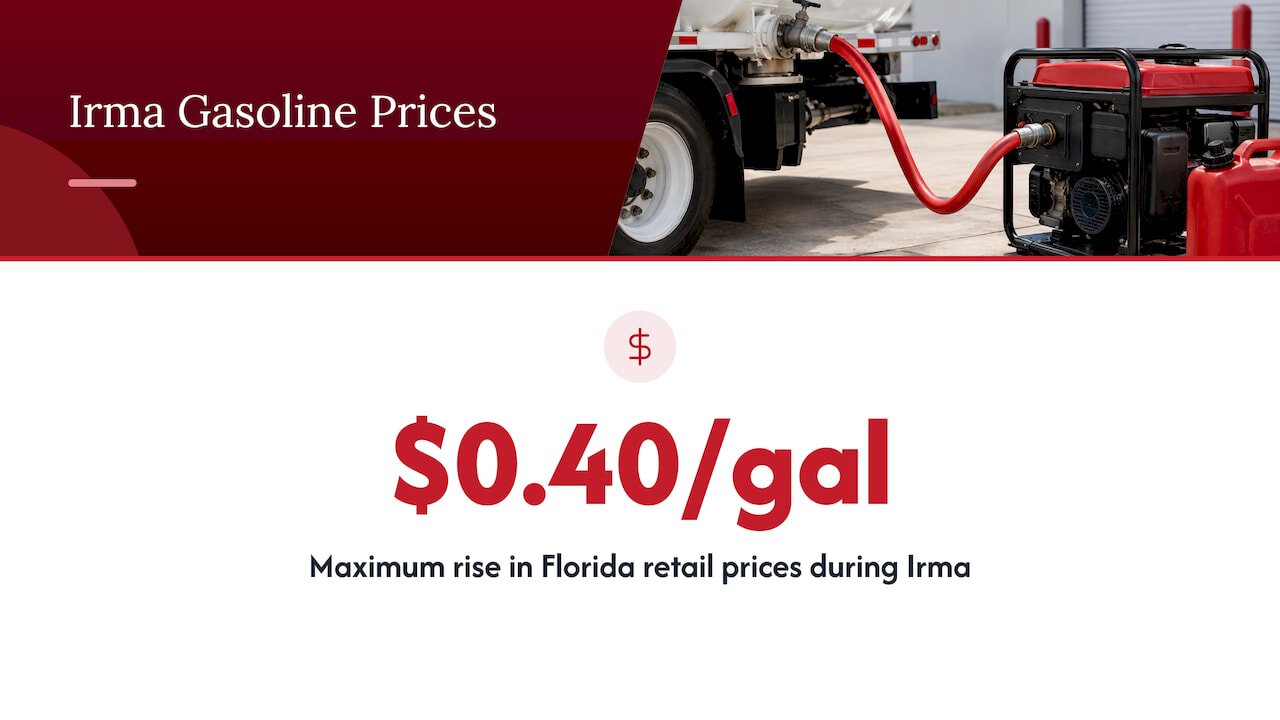
The pricing effect is documented. During Hurricane Irma, the EIA reported that retail gasoline prices in parts of Florida rose by as much as $0.40 per gallon between August 28 and September 4, 2017, as pre-storm demand collided with logistics problems. Price is the mild version of the problem. The harder version is a station with no fuel at all and a crew that has spent half a shift looking for it.
That is the downtime math our brand talks about constantly: idle equipment, paid labor with nothing to do, and a restart that takes longer than the outage itself. Fuel preparedness is the cheapest place to cut it.
Step 1: Work out how much fuel you actually need
Start with the generator. The U.S. Army Corps of Engineers formula, as cited in the EPA’s Power Resilience Guide, estimates daily diesel use as generator kW size x 0.07 gallons per hour per kW x 24 hours.
A worked example for a 500 kW unit:
- 500 kW x 0.07 gal/hr/kW = 35 gallons per hour at the formula’s baseline.
- 35 x 24 hours = 840 gallons per day.
- At a 70% load, planned over five days: 840 x 0.70 x 5 = 2,940 gallons.
The five-day, 70% figure matches the planning guidance in the same EPA guide: enough on-site capacity to carry critical infrastructure for a minimum of five days at 70% load, buying time to move into continuous resupply. The 2,940 gallons is our arithmetic applied to that guidance, not a number from the guide, so check it against your own load profile and generator spec sheet.
If you want a second explanation of how generator load translates into runtime, this power requirements walkthrough shows the same load-and-demand logic on a smaller scale.
Add everything else that burns fuel
Generators are rarely the only demand. Build a single list:
- Backup generators, including any that serve fuel pumps, lighting and communications
- Light towers, pumps and temporary power at job sites
- Heavy equipment you will need for debris clearing and restart: loaders, excavators, dozers
- Service and response vehicles, on-road (clear diesel) and off-road (dyed diesel)
- DEF for diesel fleets that need it to keep running
Then mark each item with who needs it first. Equipment that clears access to your site belongs at the top, because a generator you cannot reach is a generator you cannot refuel.
Step 2: Decide how you will store it
Tank capacity sets your buffer. If your permanent storage falls short of the number from step 1, you have a few options, and they are not exclusive.
| Option | Best for | Watch for |
|---|---|---|
| Larger permanent tank | Sites with long-term, high-uptime needs | Lead time, permitting and fuel aging |
| Seasonal tank rental | Sites that need extra buffer June through November | Secondary containment, placement outside flood zones |
| Scheduled top-offs | Generators with modest tanks | Needs a delivery slot before the storm, not during it |
| Mobile fleet fueling | Equipment yards and large fleets | Access to every unit if roads are blocked |
The EPA’s incident checklist lists seasonal fuel tank rentals and a redundant supplier network among the practices that keep organizations independent, and it points to a dedicated fuel truck for the most critical operations.
Protect the tank the way you protect the generator. The Ready Business power outage toolkit advises protecting permanently installed generators from flooding and setting up a service and maintenance routine. Fuel that sits in a flooded tank is no fuel at all.
We rent tanks and deliver bulk fuel for exactly this purpose. Our bulk fuel delivery service fills on-site tanks, and our guide to bulk fuel delivery and storage on job sites covers how to set them up.
Step 3: Keep stored diesel usable
Fuel you bought in spring is not guaranteed to burn cleanly in September. Diesel can degrade, collect sediment and grow microbes, and a clogged filter on a generator that has to start under load is a total failure at the worst moment.
The NFPA 110 committee materials call for testing diesel for degradation no less than twice a year. Those working under that standard also use additives such as algaecides, and polish or replace fuel that has been stored for 12 months or longer. That text is a committee comment document, so confirm the current requirement with your authority having jurisdiction.
A practical pre-season routine:
- Pull a sample from the bottom of each tank and send it for lab testing in May or early June.
- Check water and sediment, and replace filters before the season, not during it.
- Polish or replace fuel that fails or has aged out.
- Top off to your target level once the first system is forecast for your region.
Fuel polishing is part of our emergency fuel delivery and polishing offering, so one vendor can handle both the cleanup and the refill.
Step 4: Vet your fuel vendor before the storm
This is the step most plans skip. Owning a contract and owning a delivery are different things.
The EPA’s guidance draws on past hurricane responses and makes two points: verify that your vendor can operate without grid power, and make sure your organization is explicitly named as a priority customer in the agreement. A supplier whose own terminal loses power, or whose drivers evacuate, may not be able to deliver regardless of what the paper says.
Put these questions to every supplier, including us:
- Can your loading and dispatch operate on backup power?
- Where are your trucks and drivers based, and what is your plan if they evacuate?
- Does the agreement name us as a priority customer, and what does priority mean in gallons and hours?
- How do you confirm delivery, and will we get itemized invoices?
- What happens if a road or bridge to our site is closed?
The same logic applies to any transport-dependent operation: exception management in freight is about deciding in advance what happens when a shipment cannot move as planned, and a fuel delivery is a shipment.
Then build redundancy. The EPA lists a redundant network of suppliers as best practice. Do not rely on one depot or one driver. If you operate in more than one state, a single vendor with a national network can simplify this, but you still want a second path on paper.
Step 5: Plan for people, not just pipes
Hardware is the easy part. Energy Department analysis of fuel resiliency notes that the biggest continuity risk is often lack of available personnel, because staff evacuate or their own homes are damaged. The plans that work name a core team and arrange for key staff and their families to shelter on site in exchange for keeping essential services running.
For fuel, assign three roles by name, each with a backup:
- Fuel coordinator: owns tank levels, runtime estimates and vendor calls
- Site access lead: confirms roads, gates and fill points are open
- Receiving lead: signs for deliveries and logs gallons
The Ready Business hurricane toolkit gives a template for assigning each system, its risk, a mitigation, an owner, a budget and a completion date. Use the same format for fuel.
Step 6: Run the timeline
Preparedness is mostly sequence. Here is one that works for most commercial sites on the Gulf and Atlantic coasts.
Before the season (by June)
- Test fuel, replace filters and service generators
- Calculate runtime and tank size, then close the gap with rentals or larger tanks
- Sign or renew the supply agreement with priority language, and add a backup supplier
- Walk the delivery route and fill points, and note flood-prone stretches
When a storm is forecast for your region
- Top off every tank and every fleet unit
- Confirm your priority status and delivery window with the vendor
- Pre-position fuel for debris and restart equipment
- Move portable generators and fuel containers above expected water levels
During and immediately after
- Log fuel levels at set intervals and update runtime estimates
- Request refills early, based on projected hours remaining, not on an empty gauge
- Keep a record of every delivery for insurance, reimbursement and audit needs
For a deeper look at logistics, see our pieces on lining up priority deliveries for hurricanes and avoiding 72-hour fuel delays after outages. If you are on the Texas side, the Dallas storm fuel planning guide covers contract elements.
Step 7: Generator safety is part of fuel safety
More fuel on site means more people around running engines. Carbon monoxide is the hazard people underestimate.
The NFPA says portable generators are not safe just because they are outdoors: CO can be drawn in through windows and vents, so units should sit at least 20 feet from structures, with exhaust pointed away from all openings.
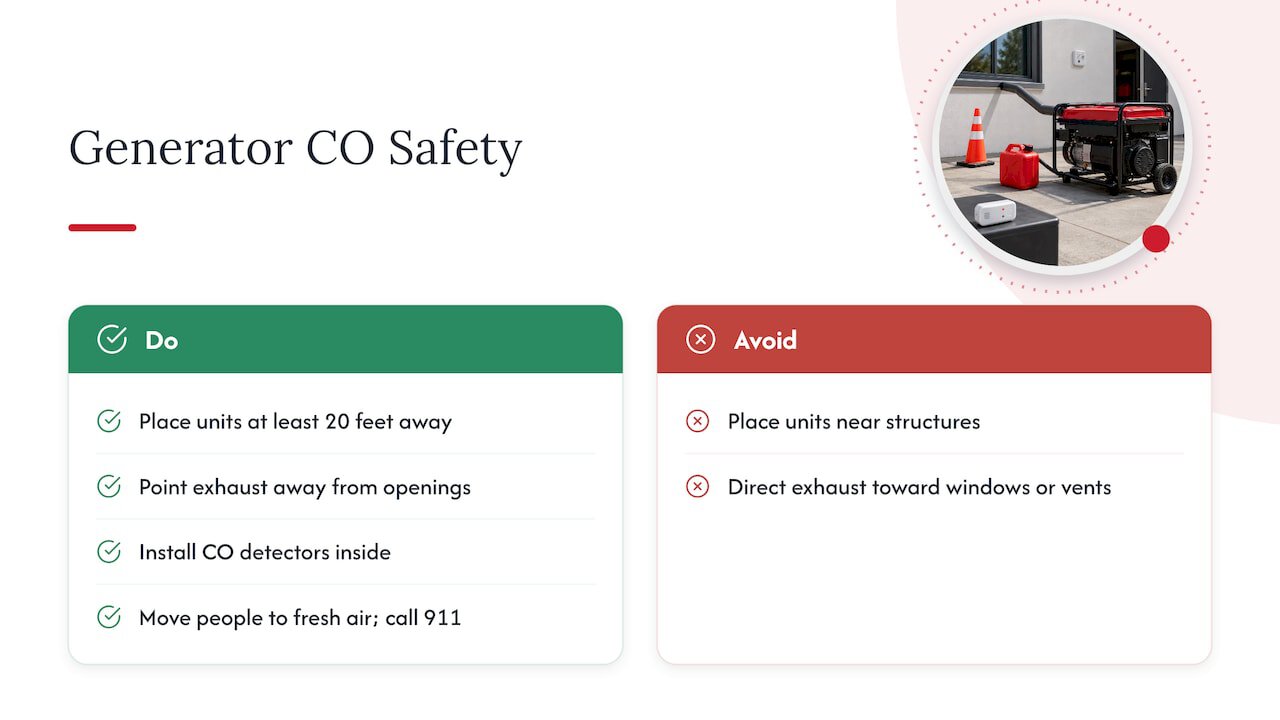
The CDC’s report on carbon monoxide poisonings after Hurricanes Katrina and Rita is a sobering case study. It also shows that generators placed outside but close to a building can still lead to CO exposure through window air conditioners, wall gaps or vents. Place units on the side of the building away from air intakes, and install CO detectors inside.
If your site has an electrician, have them confirm connections and transfer switches before the season. If anyone feels dizzy, nauseated or has a headache near a running generator, move them to fresh air and call 911.
How we support hurricane fuel plans
Anytime Fuel Pros delivers diesel (dyed and clear), gasoline and DEF directly to job sites, equipment yards, generators and data centers. Our primary markets are San Antonio, Austin, Dallas-Fort Worth and Salt Lake City, and through our national partner network we serve sites anywhere in the continental U.S. under one point of contact.
For storm planning, the services that matter most are emergency fuel delivery, scheduled recurring deliveries, fuel tank rentals and mobile fleet fueling. We offer 24/7 service and, in covered areas, 3-hour emergency response. Pricing is quoted per order, so see our full fuel services or talk with us about a seasonal plan before the next system forms. Data center operators can read about emergency fuel services for data centers, and public agencies can look at our disaster response services.
A one-page readiness checklist
- [ ] Runtime calculated for every generator at realistic load
- [ ] Five-day, 70% load target met or a gap plan in place
- [ ] Fuel tested in the last six months, filters replaced
- [ ] Seasonal tank rental or scheduled top-offs booked
- [ ] Vendor confirmed able to operate without grid power
- [ ] Priority customer language in the agreement, plus a backup supplier
- [ ] Named fuel coordinator, access lead and receiving lead, each with a backup
- [ ] Generators sited 20 feet from buildings, CO detectors installed
- [ ] Delivery log template and invoice process agreed in advance
For a broader template, our emergency fuel plan guide and hurricane season preparation article go further on procurement.
FAQ
How much diesel should a business keep on site for a hurricane?
Enough to carry your critical load for at least five days at 70% load, according to guidance in the EPA’s Power Resilience Guide. Calculate daily use as generator kW x 0.07 gallons per hour per kW x 24 hours, then apply your realistic load. Add fuel for equipment and vehicles you need for recovery.
Can I count on my fuel vendor during a hurricane?
Only if the agreement and the vendor’s own operations support it. Ask whether the vendor can operate without grid power, whether your site is named a priority customer, and what its plan is if drivers evacuate. Keep a backup supplier regardless.
How long can diesel be stored before a storm?
It depends on conditions, but diesel can degrade and grow microbes. NFPA 110 committee materials call for testing at least twice a year and for polishing or replacing fuel stored 12 months or longer. Ask your fuel supplier or lab for a recommendation specific to your tank.
Where should I put a generator during a hurricane outage?
Outdoors, at least 20 feet from any building, with exhaust directed away from windows, doors and vents, and never in a garage or basement. Add working CO detectors inside. Keep it elevated above likely flood levels.
Sources
- EPA Power Resilience Guide for Water and Wastewater Utilities (2023)
- EPA Incident Action Checklist: Power Outages
- U.S. Department of Energy, United States Fuel Resiliency
- EIA, This Week in Petroleum (September 13, 2017)
- NFPA 110 public comment circulation memo
- NFPA generator safety tips
- CDC MMWR: Carbon monoxide poisonings after two major hurricanes
- Ready Business Power Outage Toolkit
- Ready Business Hurricane Toolkit
Recent Comments