
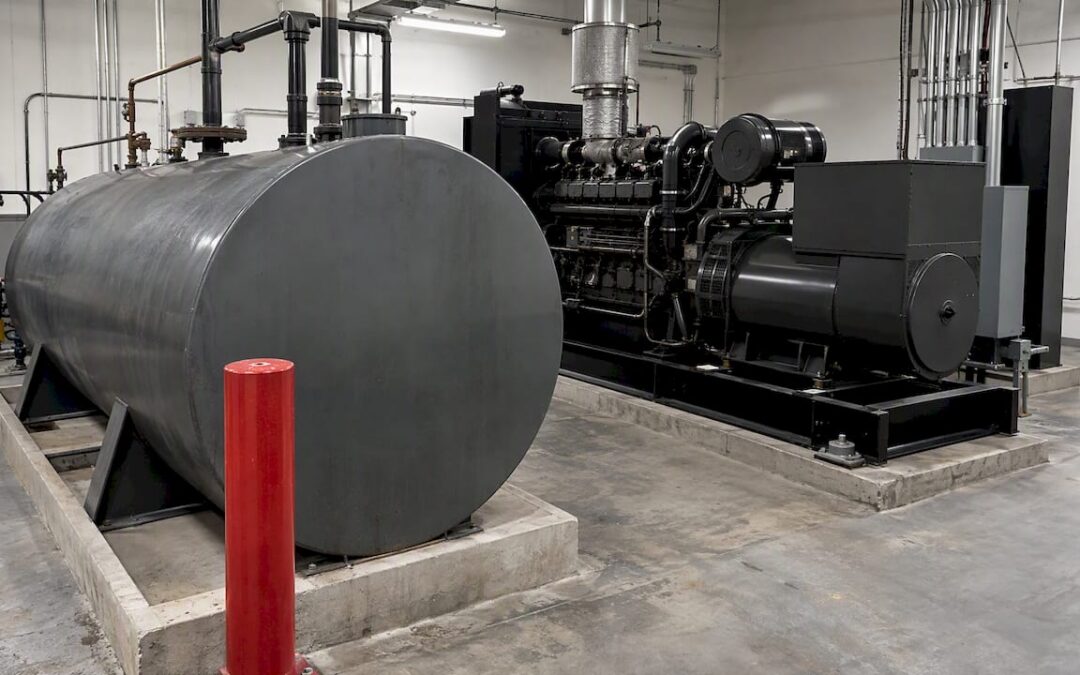
Diesel is still the standard for standby reliability because its supply chain is mature and widely supported. Pipeline natural gas and LNG offer longer runtime and cleaner combustion, but they bring supply-contract and permitting work. Renewable diesel (HVO), LPG, CNG, and hydrogen fuel cells cut emissions yet face supply or maturity limits. Across every option, fuel quality and delivery planning decide whether generators start when you need them.
TL;DR:
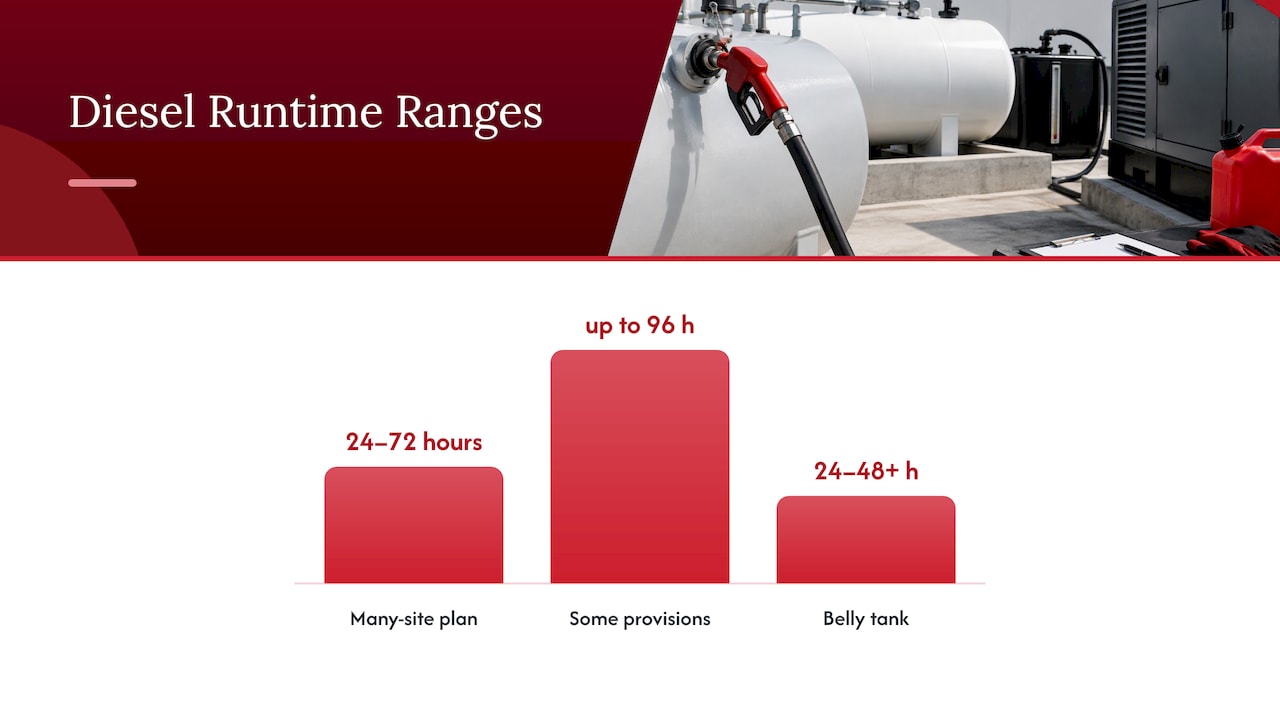
- Diesel sites commonly plan for 24–72 hours of runtime, and some provision up to 96 hours when local rules permit larger storage.
- Check whether underground tanks meet the EPA 10% capacity test, because regulated systems require release detection and containment under federal rules.
- Set an ASTM D975 baseline, sample diesel using ASTM D4057 methods, drain tank water, and schedule fuel polishing for long term storage.
- Standby sites often top off monthly to quarterly, but prolonged outages require written emergency response windows and qualified suppliers for high pressure or cryogenic deliveries.
- Pair pipeline gas with a diesel fallback only when gas supply is firm and redundant; LNG supports multi day runtime when cryogenic delivery is available.
Table of Contents
- Which generator fuel types do data centers use, and what do they trade off?
- How does on-site storage determine runtime?
- How do you keep stored fuel ready to run?
- What delivery cadence keeps generators fueled through tests and outages?
- How does fuel choice change permitting and emissions work?
- What should a defensible fuel strategy checklist include?
- Where do hydrogen, fuel cells, and batteries fit today?
- How do we keep your backup fuel flowing?
- FAQ
- Sources
Which generator fuel types do data centers use, and what do they trade off?
Every fuel trades runtime, emissions, and logistics against each other. Here is how the main options line up for a data center generator fuel decision:
- Diesel: The default for standby. Familiar to every technician, available through established delivery networks, and typically planned for 24–72 hours of runtime from on-site tanks. Its drawback is particulate and CO2 emissions.
- HVO (renewable diesel): Compatible with some existing generator lines after an OEM review. A Kao Data case study found that switching to HVO cut CO2 substantially and extended storage life, though cost is higher and supply is limited.
- Pipeline natural gas: Pipeline-fed natural gas offers virtually unlimited runtime, with combustion producing roughly 25–30% less CO2 per unit of energy than diesel. Watch contract firmness and pipeline redundancy.
- LNG: Cryogenic tanks support multi-day runtime and are not held to the same large-tank restrictions as diesel, but they need specialist cryogenic delivery.
- LPG/propane and CNG: A 2025 industry brief places LPG at smaller scales with fast deployment and CNG at shorter-duration outages. Expect engine derating, so consult the OEM.
- Hydrogen fuel cells: Demonstrations reached 48 hours of backup, but hydrogen supply and cost remain barriers.
How does on-site storage determine runtime?
Runtime is a storage question first and a fuel question second. For diesel, tank size, fire-code limits, and your testing schedule set the ceiling. Many sites plan for 24–72 hours, and some provision up to 96 hours where local rules allow.
Tank type shapes permitting and upkeep:
- Belly tanks: Integrated into the generator base, commonly sized for 24–48 hours or more.
- Day tanks: Feed the engine from a larger bulk tank and keep supply steady during long runs.
- Aboveground or underground bulk tanks: Extend runtime beyond what a belly tank holds, with more permitting work.
Underground storage triggers federal rules. The EPA’s guidance for emergency power generator systems explains how the 10% underground capacity test decides whether your tank system counts as a regulated UST, which brings release detection and containment requirements.
LNG changes the math. Cryogenic storage supports extended runtime through scheduled deliveries, and pipeline gas removes the on-site volume question altogether.
How do you keep stored fuel ready to run?
Diesel does not stay healthy on its own. Tank ullage is a primary driver of degradation: the air space above the fuel invites condensation, then microbial growth and corrosion. Keep tanks full, cool, and drained of water.
A practical maintenance routine:
- Set a fuel-quality baseline at first fill, using ASTM D975 as the diesel specification.
- Sample on a schedule following ASTM D4057 methods, and log every result.
- Drain water from tank bottoms and use floating suction where the design allows.
- Schedule fuel polishing and lab testing for long-term storage.
- Exercise generators monthly. NFPA guidance calls for exercising under load, or using a load bank, to avoid wet-stacking.
Pro Tip: Treat the first lab report as your baseline. A fuel trend you can compare year over year catches degradation long before a failed start does.
For audit documentation, see our guide on diesel generators for data centers.
What delivery cadence keeps generators fueled through tests and outages?
Standby-only sites burn most of their fuel on testing, so top-offs commonly run monthly to quarterly depending on the test regime. An extended outage changes everything. Prolonged events need emergency deliveries on top of the scheduled ones, which is why response windows belong in writing. Our guide to power outage fuel logistics walks through the cadence in detail.
Gaseous fuels play by different rules. LNG, CNG, and propane need cryogenic or high-pressure trailers, vaporization, and swap logistics, so only qualified suppliers belong on the list.
Ask for these in any fuel contract:
- A defined emergency response window and proof of delivery
- Dyed versus clear fuel handling, and DEF supply where engines need it
- Fuel-testing documentation for every delivery
- Transparent, itemized invoicing
How does fuel choice change permitting and emissions work?
Fuel choice sets your compliance workload. Natural gas and LNG can reduce CO2 emissions and particulates versus diesel, which can simplify some air permitting.
Standards to keep within reach:
- NFPA 110 for emergency and standby power systems
- NFPA 58 for LPG and NFPA 59A for LNG
- EPA UST rules for underground storage, as covered above
- EPA NSPS JJJJ, which the Transtech brief references for gas engines
Gaseous fuels carry methane-slip risk. Mitigate with oxidation catalysts and careful calibration, and count lifecycle emissions in ESG reporting. HVO can reduce lifecycle CO2 dramatically, but cost and limited supply shape both permit and procurement plans. Reporting on the diesel generator boom shows why regulators are watching air-pollution exposure closely.
What should a defensible fuel strategy checklist include?
Turn the tradeoffs into questions your team can score:
- Required runtime: How many hours, with what refueling assumption?
- Footprint and storage limits: What do fire code and site layout allow?
- Emissions target: What are your permit and ESG commitments?
- Permit risk tolerance: Can you absorb UST or air-permit timelines?
- Logistics maturity: Does a qualified supplier serve your site today?
- Fallback plan: Dual-fuel capability or scheduled deliveries?
Then ask suppliers whether supply is firm or interruptible, what the emergency SLA is, how they document fuel testing, and whether they handle dyed fuel, clear fuel, and DEF. For gaseous fuels, ask about cryogenic or high-pressure delivery experience. Our emergency fuel plan guide lists procurement clauses worth borrowing.
Weigh total cost in four buckets: fuel, storage CapEx, O&M (polishing, engine upkeep), and compliance.
Pro Tip: Hybrid setups often win. Securing gas supply and pipeline redundancy is critical, so pair pipeline gas with a diesel fallback, or choose LNG when multi-day runtime is needed and cryogenic logistics exist.
Where do hydrogen, fuel cells, and batteries fit today?
Hydrogen is real but early. In a DOE-documented demonstration at a Microsoft data center, a 1.5-MW hydrogen fuel cell paired with a battery microgrid achieved a 48-hour runtime. The same work flagged hydrogen cost and availability as barriers to broad adoption.
- Solid-oxide and modular fuel cells: High efficiency and low criteria emissions, with a faster deployment profile than large turbines.
- Battery storage: Viable for short-duration outages. For hybrid designs, grid-scale battery storage is worth evaluating.
- Long-duration backup: Still depends on fuel unless hydrogen supply matures.
Watch hydrogen hub development and the scaling of HVO supply as signals that broader adoption is near.
How do we keep your backup fuel flowing?
Backup power only works if the tank is full when the grid fails. We deliver on-site diesel on scheduled top-off cycles, respond to emergencies around the clock, and supply bulk fills, DEF, and fuel polishing coordination. Our deliveries support your fuel supply needs.
[CTA_IMAGE_PLACEHOLDER]
Ready to lock in continuity? Explore emergency fuel delivery and we will build a delivery plan around your runtime targets.
FAQ
What fuel is used to power data centers?
Most data center backup generators run on diesel, with natural gas, LNG, propane, and CNG used at some sites. Renewable diesel (HVO) and hydrogen fuel cells are emerging options. The right choice depends on runtime, storage space, and permitting.
Do all data centers use diesel generators?
No. Some projects use natural gas reciprocating engines and turbines, which PowerMag reports are increasingly used as prime power to avoid long grid-connection lead times. Diesel remains the common choice for standby because of its reliability and delivery support.
What kind of generators do data centers use?
Most sites use standby diesel generators with integrated belly tanks, while larger campuses add gas engines, turbines, or fuel cells. The Anvilfield field guide notes that these options trade speed, scale, efficiency, and emissions.
How long do data center generators need to run?
Diesel setups are commonly planned for 24–72 hours of runtime, with some sites provisioning up to 96 hours where codes allow. Gas and LNG can run longer when supply is firm.
Sources
- Rd2go
- Federal UST Requirements for Emergency Power Generator UST Systems
- February H2IQ Hour: Hydrogen Fuel Cell Generator Demonstration at Microsoft Data Center: Text Version | Department of Energy
Recent Comments