

On-site commercial diesel delivery, commonly called “hart diesel” in procurement shorthand, is the service category where a specialized tanker comes to your site, fills your equipment, generators, or fleet vehicles directly, and leaves you with a per-asset dispensing report. Anytimefuelpros (AFP) provides exactly this, with 24/7 emergency capability and nationwide reach through a partner network that covers every state in the continental U.S.
To start an order, have the following ready before you call or submit a request:
- Site address and access instructions (gate codes, contact name on site, weight restrictions)
- Asset list with tank capacities (generators, excavators, loaders, fleet vehicles)
- Fuel type required: clear diesel (on-road) or dyed diesel (off-road/tax-exempt)
- Estimated volume and whether this is a one-time emergency or a recurring scheduled need
- Billing information and whether you need consolidated invoicing across multiple sites
Minimum order sizes vary by truck class and region. Emergency same-day service is available around the clock. For multi-site programs, AFP assigns a single point of contact so you are not coordinating with a different dispatcher every time.
Table of Contents
- Why do facilities and fleets choose on-site diesel delivery?
- What do on-site hart diesel services actually include?
- How does hart diesel delivery work from order to fill?
- Why wet hosing often beats long-term tank storage for fuel quality
- Compliance, fuel types, and safety basics buyers must check
- Pricing basics and invoicing: what drives cost and how billing stays transparent
- What a 24/7 hart diesel emergency partner must deliver
- How to choose a hart diesel delivery partner: procurement checklist
- Quick industry examples and common use cases
- Key Takeaways
- Anytimefuelpros delivers hart diesel where your operation needs it
Why do facilities and fleets choose on-site diesel delivery?
On-site delivery cuts downtime, reduces labor waste, and closes the accountability gap that unmanaged fueling creates. When crews drive to a retail station or fuel card stop, each trip burns a noticeable amount of productive time per driver, per day. Across a fleet of ten operators, that adds up fast.
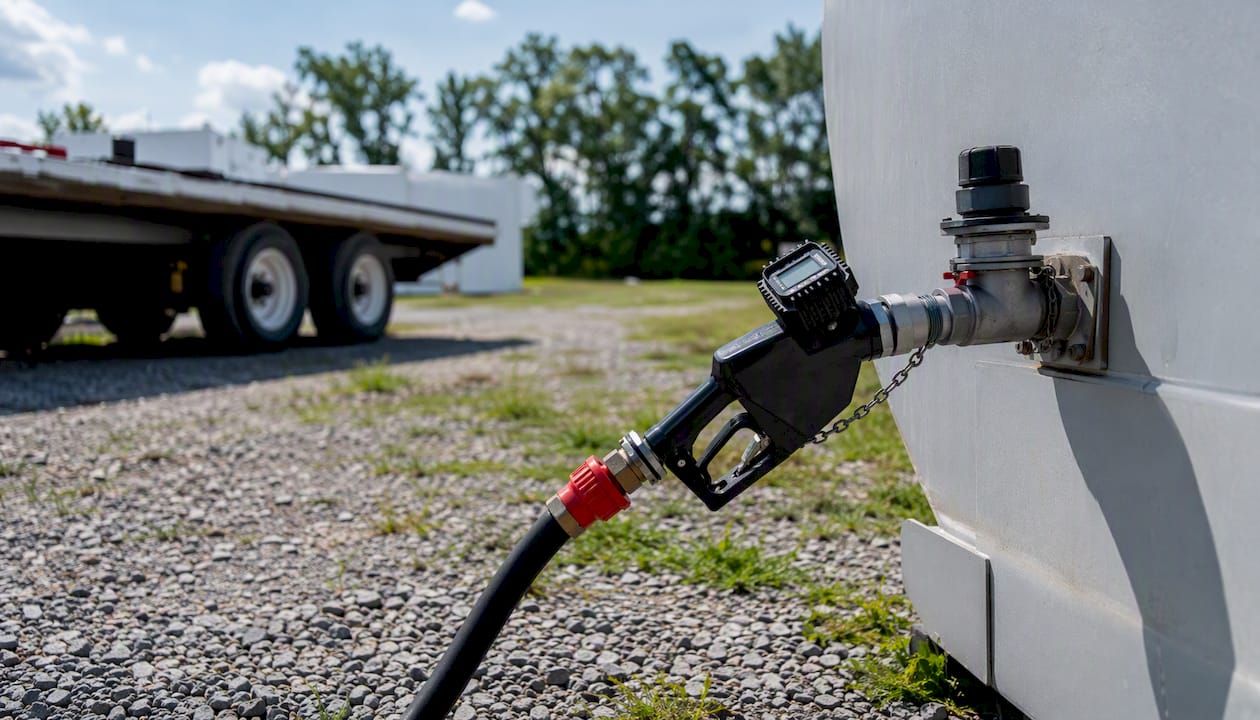
The financial case goes beyond labor. Unmanaged on-site tanks attract theft, require insurance riders, and create contamination liability. Wet hosing closes the unaccounted-for-gallon gap that fuel cards routinely produce, because every gallon dispensed is recorded against a specific asset. That per-asset data feeds directly into job costing and tax records.
Key operational advantages:
- Reduced equipment downtime from fuel shortages mid-shift
- Faster fleet dispatch when vehicles are fueled overnight or pre-dispatch
- Lower contamination and theft risk versus stationary bulk tanks
- Accurate job costing through per-asset fuel tracking and digital delivery reports
- Single vendor for multi-site programs, eliminating regional patchwork contracts
AFP’s 24/7 availability means an unplanned generator outage at 2 AM does not wait until morning.
What do on-site hart diesel services actually include?
The full service catalog covers more than a simple tank fill. AFP delivers clear diesel, dyed off-road diesel, and DEF, and the right service type depends on your operation.
| Service | Best For | Delivery Type | Fuel Types | Typical Minimum | Response Window |
|---|---|---|---|---|---|
| Wet hosing (fleet fueling) | Construction fleets, trucking yards | Scheduled or on-demand | Clear or dyed diesel | 500 gal | Same-day to next-day |
| Bulk tank fill | Mining, data centers, large job sites | Scheduled recurring | Clear or dyed diesel | — | Scheduled |
| Generator top-off | Data centers, events, telecom | Scheduled or emergency | Clear diesel | — | Emergency: 2–4 hrs |
| DEF delivery | Any Tier 4 fleet or generator | Scheduled | DEF | Varies by region | Scheduled |
| Emergency/after-hours | Any critical operation | On-demand 24/7 | Clear or dyed diesel | Varies | 2–6 hrs |
Providers maintain a mix of tanker sizes, from units under 5,000 gallons up to full bulk trucks, so they can reach constricted job sites and remote locations that larger vehicles cannot access. AFP separates on-road clear diesel and off-road dyed diesel during delivery to prevent tax and compliance violations. Consolidated invoicing and per-asset dispensing reports come standard, making it straightforward to reconcile fuel costs by project or cost center. For sites with aging stored fuel, on-site fuel polishing services are also available.
How does hart diesel delivery work from order to fill?
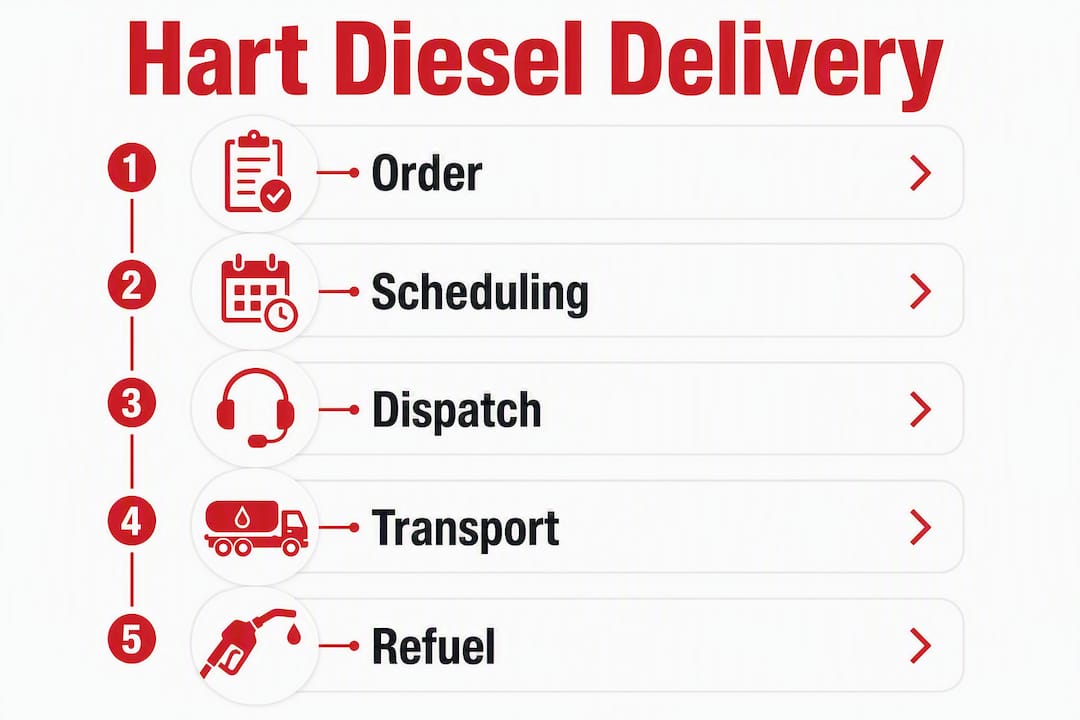
Ordering follows three steps: account setup, route or schedule planning, and delivery with reporting. The process is designed so procurement teams can hand off day-to-day coordination to dispatch once the account is live.
What dispatch needs from you:
- Site address, gate access, and on-site contact
- Asset list with tank sizes and current fuel levels
- Preferred delivery window (overnight, first light, mid-day)
- Fuel type and volume estimate
- Billing contact and purchase order number if required
Providers in congested urban markets often schedule early-morning “first light” deliveries to avoid rush-hour delays and ensure equipment is ready at shift start. For heavy equipment fueling schedules, aligning delivery cadence with burn rates prevents both shortfalls and overfills.
| Delivery Type | Typical Lead Time | Notes |
|---|---|---|
| Emergency / after-hours | 2–6 hours | 24/7 dispatch; pre-authorized billing speeds response |
| Same-day standard | 4 hours | Subject to regional capacity |
| Next-day scheduled | — | Confirmed window at booking |
| Recurring scheduled | Weekly / bi-weekly | Route-optimized; volume adjustments on request |
Why wet hosing often beats long-term tank storage for fuel quality
Fresh, filtered deliveries via wet hosing reduce contamination risk compared with fuel sitting in a stationary on-site tank. Stagnant tanks collect sediment and water over time, and modern Tier 4 engines are particularly sensitive to particulate and water contamination. Injector damage from degraded fuel is expensive and often goes undetected until a machine fails mid-shift.
Wet hosing bypasses that contamination path entirely. Fuel moves from a supply terminal to your asset in one trip, typically through an onboard filtration system. For sites that do maintain bulk storage, fuel polishing removes water, sediment, and microbial growth before the fuel reaches an engine.
On-site delivery quality checklist:
- Confirm the tanker’s onboard filter micron rating (10 microns or finer is standard for Tier 4 equipment)
- Request a visual check of the fuel sample at delivery (clarity, color, no visible water separation)
- Ask for delivery-level filtration documentation or a certificate of analysis for bulk fills
- Inspect tank vents and fill caps before accepting delivery to prevent post-delivery contamination
Pro Tip: Require your vendor to provide filtration specs and delivery-level testing records in the contract. A supplier who cannot produce these documents is a liability for any operation running Tier 4 equipment.
Compliance, fuel types, and safety basics buyers must check
Verify the correct fuel product before the first delivery. Using dyed off-road diesel in on-road vehicles is an IRS and state tax violation; using clear diesel in off-road equipment is simply overpaying. The distinction matters operationally and legally.
Compliance checklist for vendor selection:
- Proper DOT placarding on all delivery vehicles
- DOT-qualified drivers with current certifications
- MSDS (Safety Data Sheet) available for each fuel product delivered
- Proof of general liability and pollution liability insurance
- Secondary containment plan for bulk tank fills (EPA requirement for above-ground storage)
- Written emergency spill response procedures
On-site safety before delivery: clear the fill area of ignition sources, post no-smoking signage, confirm the delivery crew has PPE, and designate a site contact who can direct the driver to the correct asset. Document these steps in your site safety plan before the first delivery, not after.
Professional vendors provide insurance certificates, DOT driver qualifications, and written emergency procedures during account setup. If a vendor cannot produce these documents on request, treat that as a disqualifying red flag.
Pricing basics and invoicing: what drives cost and how billing stays transparent
Fuel cost has several components, and understanding each one prevents invoice surprises.
| Cost Factor | Scheduled Delivery | Emergency Delivery |
|---|---|---|
| Per-gallon commodity rate | Daily market rate | Daily market rate |
| Delivery fee | Lower (route-optimized) | Higher (expedited dispatch) |
| After-hours / emergency surcharge | Not applicable | Applies |
| Equipment / tank rental | Optional add-on | Optional add-on |
| Minimum order fee | May apply below threshold | May apply |
| Applicable fuel taxes | Per product type | Per product type |
Scheduled recurring deliveries cost less per delivery than emergency calls, because the route is planned and the truck is already in the area. Procurement teams running multi-site programs benefit most from consolidated invoicing: one invoice per billing cycle, broken down by site and asset, rather than a stack of individual delivery receipts. AFP provides per-asset dispensing reports that integrate with fleet management systems, making job costing and tax recordkeeping straightforward. Payment options typically include credit card, ACH, and net terms for established accounts.
What a 24/7 hart diesel emergency partner must deliver
An emergency-capable partner provides defined SLA windows, named escalation contacts, and regional staging that allows rapid response without relying on a single truck. During major events like hurricanes or grid failures, providers may need to fuel dozens of generator sites within tight windows.
Questions to ask vendors before signing:
- What is your guaranteed initial response time for emergency calls in my region?
- Do you have pre-positioned inventory or regional staging near my primary sites?
- Who is my escalation contact if the first dispatcher cannot confirm a truck?
- What is your surge capacity during a regional grid event?
Operational emergency readiness checklist:
- Pre-register all sites with your vendor (address, access, asset list, fuel type)
- Pre-authorize a billing threshold so dispatch can roll without waiting for approval
- Store vendor emergency contact numbers in your incident response plan
- Confirm generator fuel delivery protocols with your vendor before an outage, not during one
Pro Tip: Set a pre-authorized credit or account threshold with your fuel vendor before storm season. Waiting for billing approval during a power outage costs hours you cannot recover.
How to choose a hart diesel delivery partner: procurement checklist
Choose the partner that meets your SLA, provides transparent per-delivery reporting, and has proven emergency surge capacity in your region. Coverage gaps and vague SLA language are the two most common failure points in fuel vendor contracts.
Numbered procurement checklist:
- Confirm coverage in all your operating regions, including remote or hard-to-access sites
- Request proof of insurance (general liability and pollution liability), DOT certifications, and MSDS for each product
- Verify fuel quality controls: onboard filtration specs, testing protocols, and product separation procedures
- Review billing terms: consolidated invoicing, net terms, per-asset reporting, and dispute resolution process
- Ask for sample SLA language: guaranteed response windows, escalation contacts, and surge capacity commitments
- Request references from operations similar to yours (data center, construction, municipal fleet)
- Run a pilot delivery before committing to a multi-site contract
Red flags that should disqualify a vendor: no fuel testing records, inability to separate clear and dyed diesel, no written emergency procedures, and vague or absent SLA language. A short pilot contract, even a single delivery, reveals how a vendor handles site access, reporting, and communication before you roll them out across multiple locations.
Quick industry examples and common use cases
On-site diesel delivery maps differently to each industry, but the core value is the same: fuel arrives where it is needed, when it is needed, without pulling operators off productive work.
- Data centers: Scheduled generator top-offs after load tests, plus emergency fueling for data centers during grid events; typical cadence is weekly or post-test, with emergency response within 2–4 hours
- Construction and excavation: Wet hosing for excavators, dozers, and loaders overnight or pre-shift; dyed off-road diesel; volumes of 500–2,000 gallons per visit depending on fleet size
- Events and entertainment: Bulk generator fills for festivals and film production; temporary power requires precise timing and often same-day top-offs during multi-day events
- Municipal fleets: Depot fueling via wet hosing or bulk tank fill; consolidated billing simplifies government procurement and reporting requirements
- Mining operations: Remote-site bulk delivery for heavy equipment; high volumes, infrequent access, and the need for a vendor who can reach locations larger trucks cannot
Multi-site programs benefit most from a single vendor with nationwide reach. AFP’s partner network allows procurement teams to manage fueling across Texas, Utah, and the rest of the continental U.S. under one contract, one invoice, and one point of contact. For a broader look at industries served by on-site delivery, the range extends from oil and gas to disaster response.
Key Takeaways
On-site commercial diesel delivery reduces equipment downtime, closes fuel accountability gaps, and gives procurement teams a single vendor for scheduled, bulk, and emergency fueling across multiple sites.
| Point | Details |
|---|---|
| Wet hosing closes accountability gaps | Per-asset dispensing records eliminate unaccounted-for-gallon losses common with fuel cards. |
| Fuel quality protects Tier 4 engines | Fresh, filtered deliveries reduce sediment and water contamination that damages high-precision injectors. |
| Emergency pre-authorization saves hours | Pre-authorized billing thresholds allow 24/7 dispatch without approval delays during outages. |
| Compliance starts with fuel type | Verify clear vs. dyed diesel before every delivery to avoid IRS tax violations and overpayment. |
| Anytimefuelpros covers primary and nationwide markets | AFP serves San Antonio, Austin, Dallas–Fort Worth, and Salt Lake City, with partner coverage across the continental U.S. |
Anytimefuelpros delivers hart diesel where your operation needs it
When equipment downtime is the real cost and a missed generator fill becomes a data center incident, the vendor you choose matters more than the price per gallon. Anytimefuelpros provides on-site clear and dyed diesel, DEF, wet hosing, bulk tank fills, and scheduled and emergency diesel delivery with 24/7 dispatch and nationwide partner coverage. Primary markets include San Antonio, Austin, Dallas–Fort Worth, and Salt Lake City, with the ability to coordinate multi-site programs anywhere in the continental U.S. under a single contract and consolidated invoice.
To get a fast quote, have your site addresses, asset list, fuel types, and estimated volumes ready. AFP handles multi-site billing in one consolidated statement and can pre-authorize emergency dispatch thresholds so your incident response plan does not stall waiting for a purchase order. Contact Anytimefuelpros to set up your account or request a site-specific quote, and ask about pre-authorization options before your next storm season or planned outage window.
Recent Comments