
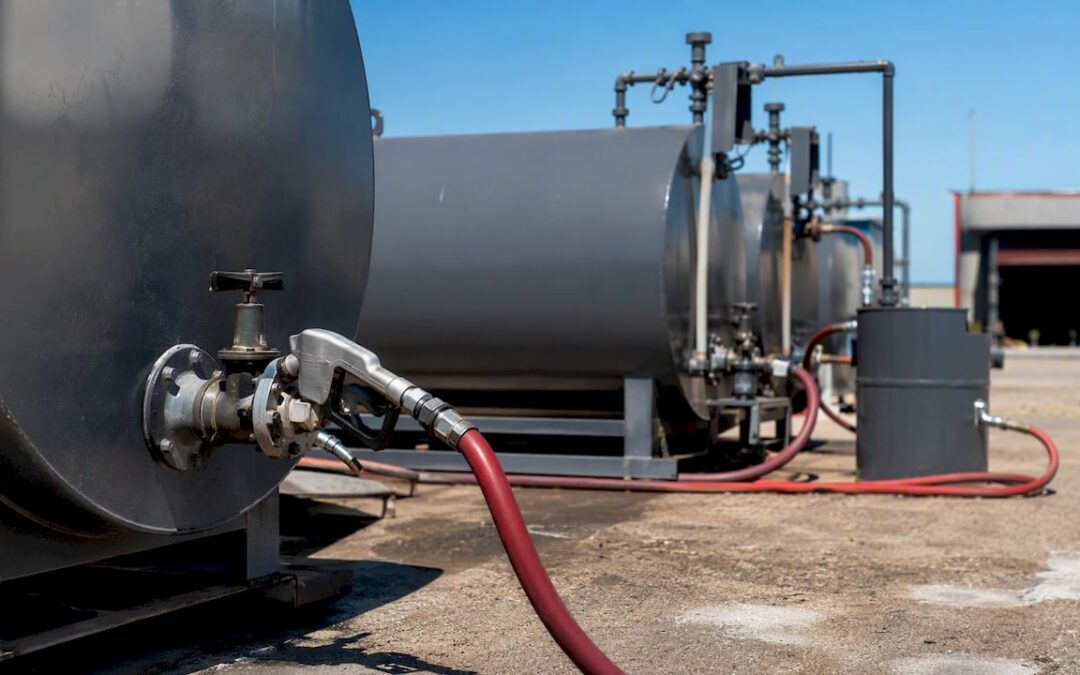
On-site bulk fuel pricing is not a single number. It’s a delivered per-gallon rate plus a set of fees that vary by site, volume, fuel type, and vendor. Before you accept any quote, check three things first: the per-gallon delivered price (not the terminal rack price), the delivery or minimum fee, and whether the fuel is dyed off-road diesel or clear on-road diesel.
Quick checklist for every quote:
- Per-gallon delivered price, with the terminal basis shown separately
- Delivery fee or per-trip minimum (commonly a few hundred dollars for smaller fills)
- Fuel type: dyed (off-road, tax-exempt) vs. clear (on-road, taxed)
Example cost note: A jobber might buy diesel at a regional terminal rack price, then add a distributor margin, a transport per-gallon add-on, and a delivery fee. A 1,000-gallon fill with a per-gallon over rack charge plus a delivery fee can add several cents per gallon to your effective cost before taxes. That math belongs in every budget conversation.
Pro Tip: Ask every vendor to show the terminal basis and their margin separately. A quote that bundles everything into one opaque per-gallon number is harder to compare and easier to pad.
Key Takeaways
Delivered bulk fuel pricing is built from terminal rack basis, distributor margin, transport costs, delivery fees, taxes, and ancillary fees. Demand every component itemized on every quote.
| Point | Details |
|---|---|
| Demand terminal basis | Require vendors to show the terminal and NYMEX differential, not just a per-gallon total. |
| Require custody receipts | Custody-transfer receipts on every delivery are the only reliable protection against billing disputes. |
| Negotiate delivery minimums | Cap emergency fees and per-trip minimums in the contract before you sign. |
| Use telemetry to time orders | Remote tank monitoring reduces emergency fills and lowers average delivered cost. |
| Anytimefuelpros | Provides itemized quotes, custody receipts, 24/7 emergency response, and national multi-site coverage. |
Table of Contents
- What drives bulk gas prices on delivered fuel?
- What every line item on a bulk fuel quote actually means
- How to request an accurate bulk fuel quote (RFP checklist)
- Illustrative pricing scenarios for budgeting
- Contract terms and compliance items to lock down before signing
- Practical ways to lower your delivered fuel spend
- Anytimefuelpros delivers transparent, procurement-ready bulk fuel pricing
- Sources
What drives bulk gas prices on delivered fuel?
The delivered price you pay is built from several layers, and understanding each one is what separates a procurement team that negotiates well from one that just accepts the invoice.
Terminal/rack pricing and regional basis. Jobbers buy fuel at regional terminals, where the price is typically quoted as a differential to NYMEX futures. Local pipeline logistics, terminal location, and regional supply-demand conditions all shift that differential, which is why the same futures price produces different rack prices in Dallas versus Salt Lake City. Regional terminal basis varies meaningfully between terminals, and that variance flows directly into your delivered cost.
The jobber’s role. Jobbers buy at terminals and add negotiated margins and service fees that shift with your purchase volume, delivery regularity, and payment terms. A customer ordering 5,000 gallons on a predictable weekly schedule gets a different margin structure than one calling for 500 gallons on short notice. Jobbers are also often locked into the price they paid for their inventory until they move it, which means a customer who times a bulk purchase when terminal prices dip can capture real savings.
Distance and access premiums. Remote sites, difficult access roads, and locations far from refineries or pipeline terminals carry delivery premiums. These are real costs: longer tanker routes, more driver time, and sometimes specialized equipment. They should appear as explicit line items on any quote, not buried in the per-gallon total.
- After-hours and emergency delivery fees (often a flat surcharge or per-gallon premium)
- Remote or hard-access site charges
- DEF handling fees when diesel exhaust fluid is added to the order
Pro Tip: Check which region carries the lowest delivered rates for your fuel type before locking in a multi-site contract. Geographic basis differences can be significant enough to affect sourcing decisions.
What every line item on a bulk fuel quote actually means
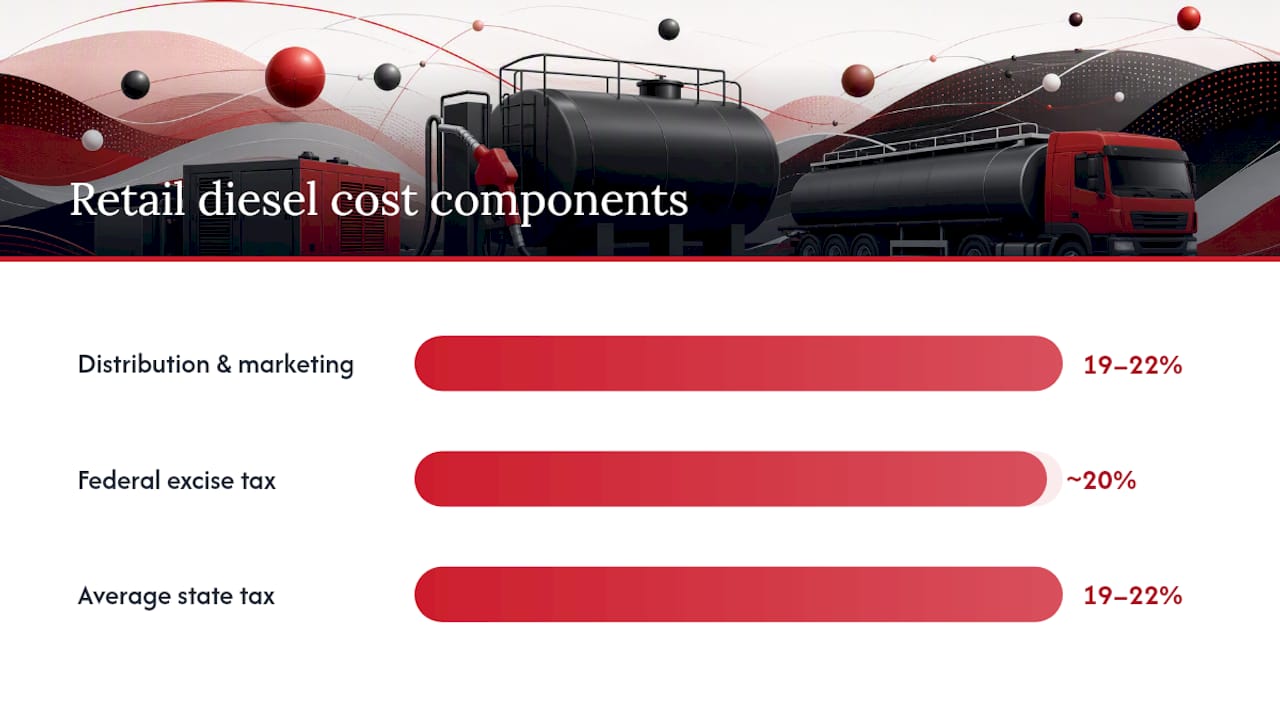
Delivered bulk fuel pricing has a predictable structure once you know what to look for. Distribution and marketing costs have accounted for roughly 19–22% of retail diesel price in recent EIA data, which gives you a benchmark for evaluating whether a vendor’s margin is reasonable.
| Line Item | What It Covers | Notes for Buyers |
|---|---|---|
| Per-gallon delivered price | Terminal rack basis + distributor margin + transport add-on | Demand terminal basis to be shown separately |
| Delivery / minimum fee | Per-trip cost or minimum-gallon charge | Commonly a few hundred dollars; negotiate for scheduled routes |
| Federal excise tax | ~20% of retail diesel price | Applied at retail; sometimes excluded from wholesale quotes |
| Average state tax | 19–22% of retail diesel price | Varies by state; confirm which party is taxed |
| Tank rental / monitoring | Monthly fee for vendor-supplied tank and telemetry | Clarify ownership, maintenance responsibility |
| Environmental / disposal fee | Regulatory compliance costs | Should be itemized, not bundled |
| DEF surcharge | Handling and delivery of diesel exhaust fluid | Separate line item; confirm per-gallon or per-delivery basis |
| Payment fee | Credit card processing or ACH discount | ACH often earns a per-gallon discount |
Custody-transfer receipts are the documentation that confirms exactly how many gallons were delivered, at what time, and to which tank. Without them, invoice disputes are difficult to resolve. On-site delivery with custody-transfer receipts is the standard you should require from any vendor.
For tank rental and on-site storage details, confirm whether the vendor owns the tank, who handles maintenance, and whether telemetry is included or billed separately.
How to request an accurate bulk fuel quote (RFP checklist)
Vendors can only quote accurately when you give them complete information. Incomplete RFPs produce incomparable quotes.
Standard data to provide in your RFQ:
- Fuel type required: clear diesel, dyed off-road diesel, gasoline, or DEF
- Tank capacity and target fill level (gallons)
- Site address and access notes (road conditions, weight limits, hours of access)
- Delivery windows and preferred schedule (daily, weekly, on-demand)
- Required SLA: maximum response time for emergency fills
- Telemetry or remote monitoring requirements
Quote lines to demand from every vendor:
- Per-gallon delivered price with terminal basis shown (which terminal, NYMEX differential)
- Delivery fee or per-trip minimum, stated separately
- All taxes itemized, with confirmation of which party bears each
- Tank rental and monitoring fees, if applicable
- Payment terms and any ACH or early-payment discounts
- All pass-through surcharges listed explicitly
Vendor qualification questions:
- Proof of insurance and DOT compliance
- Custody-transfer receipt process and delivery confirmation method
- Invoicing cadence and dispute resolution window
- Multi-site coverage and national partner network capability
- References for your sector (data centers, mining, construction, municipal)
- Sample SLA document
Red flags to watch for:
- No terminal basis shown; just an opaque per-gallon total
- “Call for price” line items with no cap or formula
- Open-ended surcharges with no ceiling
- No custody documentation offered
Pro Tip: Ask for a sample invoice from a recent delivery before signing. The format of a real invoice tells you more about a vendor’s transparency than any sales conversation.
Illustrative pricing scenarios for budgeting
These are budgeting illustrations only. Actual prices vary by region, season, market conditions, and vendor. Use these to frame internal budget conversations, not as quotes.
For the emergency scenario, the after-hours surcharge alone can add a significant flat fee, plus a per-gallon premium. Locking in a pre-negotiated emergency rate in your contract eliminates that uncertainty. Scheduled delivery programs reduce the frequency of emergency fills and lower your average delivered cost over time.
Contract terms and compliance items to lock down before signing
Pricing model selection matters as much as the per-gallon rate itself.
- Fixed price: Predictable budgeting; vendor carries market risk. Best for short-term contracts or volatile markets.
- Indexed/float (NYMEX ± basis): Your price moves with the market. Transparent, but requires budget flexibility.
- Cost-plus with defined margin: Terminal rack price plus a fixed cents-per-gallon margin. The most auditable model for high-volume buyers.
- Hybrid: Fixed margin with a market-linked base. Common for multi-year contracts.
Contract clauses to negotiate:
- Minimum delivery volume and cancellation terms with defined notice periods
- Volume and frequency discounts with explicit thresholds
- Capped emergency delivery fees or pre-negotiated emergency rates
- Billing cycle, dispute window (typically 30 days), and late-payment penalties
- ACH payment discount, documented in the contract
Compliance items that belong in every contract:
- Dyed diesel (off-road) use restrictions and IRS recordkeeping requirements
- Clear diesel (on-road) tax reporting obligations
- Environmental handling and spill response responsibilities
- DOT and OSHA requirements for on-site fuel storage
Pro Tip: Dyed diesel is tax-exempt for off-road equipment, but using it in on-road vehicles carries IRS penalties. Confirm fuel type assignments in writing for every delivery point.
Practical ways to lower your delivered fuel spend
The biggest lever most procurement teams leave on the table is predictability. Jobber margins and service fees respond directly to volume, delivery regularity, and payment terms. Operational reliability converts into price advantage.
- Consolidate deliveries: Fewer trips at higher volumes lower the per-gallon delivery cost.
- Commit to a schedule: Predictable routes reduce the jobber’s logistics cost, and that savings is negotiable.
- Offer faster payment: ACH on delivery or net-7 terms often earn a per-gallon discount. Document the agreed discount in the contract.
- Use telemetry: Remote tank monitoring lets you order at optimal fill levels, avoiding both emergency fills and costly partial-trip minimums. Mobile fuel delivery with telemetry reduces the frequency of unplanned orders.
- Negotiate multi-site pricing: A single vendor covering multiple locations gives you consolidated volume leverage.
- Ask for terminal-basis disclosure: Comparing terminal basis across vendors reveals whether you’re paying a fair margin or an inflated one.
- Include performance incentives: Tie a portion of the contracted margin to on-time delivery and invoicing accuracy.
Pro Tip: Trade payment speed for per-gallon discounts where cash flow allows. Small per-gallon discounts on large volumes can result in noticeable savings over time.
Anytimefuelpros delivers transparent, procurement-ready bulk fuel pricing
Procurement teams that need apples-to-apples quotes on on-site diesel, gasoline, and DEF delivery get exactly that from Anytimefuelpros. AFP provides custody-transfer receipts on every delivery, scheduled and on-demand service, 24/7 emergency fuel response, and telemetry options that support accurate ordering and invoice reconciliation. Primary markets include San Antonio, Austin, Dallas-Fort Worth, and Salt Lake City, with nationwide coverage through a vetted partner network for multi-site and multi-state contracts.
AFP serves data centers, mining operations, construction sites, municipal fleets, and events, with sector-specific references available on request. Transparent invoicing and scheduled delivery are standard, not add-ons. Use the RFP checklist in this guide and request a quote from Anytimefuelpros at Anytimefuelpros to get a fully itemized, terminal-basis quote you can compare directly against any other vendor.
Sources
External references:
Anytimefuelpros pages:
Recent Comments