
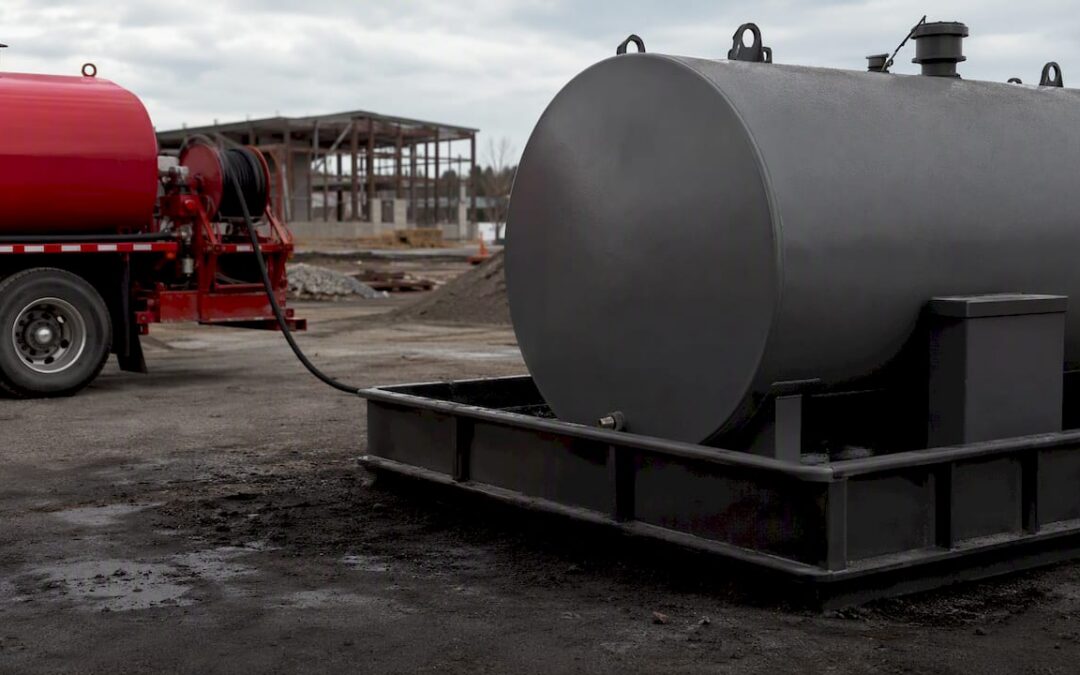
A reliable emergency fuel plan guarantees continuous on-site fuel delivery or sufficient reserve to run defined critical loads for a reserve period appropriate to the criticality of the site, secured through pre-contracted vendor commitments, measurable activation triggers, and documented SLA response times. Without those three elements locked in before a disruption, you are making procurement decisions under pressure, which is exactly when costs spike and vendors run short.
Your 24-hour action checklist:
- List every fuel-dependent asset and its hourly or daily consumption rate
- Calculate days-of-fuel on hand for each critical load
- Confirm your primary vendor’s emergency response window in writing
- Name a backup vendor and verify their service area covers your site
- Set a written activation trigger (example: inventory drops below an operating days threshold)
- Confirm your vendor provides metered receipts and electronic proof of delivery (POD)
Business Continuity Management guidance identifies five planning areas for fuel disruptions: reducing dependency, cutting usage during the event, improving supply-chain resilience, reallocating resources, and maintaining ready communication plans. Your emergency fuel plan should address all five.
Key Takeaways
A sound emergency fuel plan combines a defined days-of-supply target, pre-contracted vendor SLAs with measurable response times, and pre-authorized activation triggers so your team acts without delay when supply is disrupted.
| Point | Details |
|---|---|
| Size reserves with a formula | Required gallons = daily consumption × target days; add a 10–15% buffer for load spikes and delivery gaps. |
| Lock in contract terms before a crisis | Require index-based pricing, separate fuel line items, metered receipts, and a written emergency response window. |
| Set measurable activation triggers | Pre-authorize responses at defined thresholds (e.g., inventory below three operating days) to eliminate decision paralysis. |
| Test the plan before you need it | Run a tabletop exercise quarterly and a vendor response test semi-annually; update the plan within 30 days of each drill. |
| Anytimefuelpros as your contracted partner | AFP provides 24/7 emergency delivery, GPS PODs, index-based pricing, and nationwide coverage under a single contract. |
Table of Contents
- Which sites and assets should your emergency fuel plan cover?
- How do you calculate the fuel volumes your plan actually needs?
- On-site storage vs. contracted delivery: what the regulations require you to know
- What delivery modes does a contracted fuel plan use?
- What contract and SLA terms protect you when supply gets tight?
- How do you set activation triggers and manage the response?
- What should you check when evaluating emergency fuel vendors?
- How do you test and maintain your fuel plan?
- A compact emergency fuel plan template you can use now
- What does emergency fuel capability actually cost?
- Complementary tactics to reduce fuel dependency and supply-chain risk
- How Anytimefuelpros supports your emergency fuel plan
- Sources
Which sites and assets should your emergency fuel plan cover?
Not every asset warrants the same protection level. Start by mapping fuel-dependent assets to the services they support, then assign a coverage tier based on the consequence of failure.
| Site Type | Critical Assets | Recommended Coverage Level |
|---|---|---|
| Data center | Backup gensets, UPS systems | Tier 1: 7-day reserve plus 4-hour emergency response SLA |
| Hospital / municipality | Emergency generators, fleet vehicles | Tier 1: 7-day reserve plus same-day delivery commitment |
| Construction / mining | Excavators, dozers, haul trucks, compressors | Tier 2: 3-day reserve plus next-day bulk fill |
| Event / entertainment | Portable generators, production power | Tier 2: On-demand delivery within 4 hours of call |
| Logistics yard | Tractor fleet, yard hostlers | Tier 2: Scheduled wet-hose plus 24-hour emergency fill |
Assign a named owner to each asset row. That person is responsible for monitoring consumption and initiating the activation call. AFP’s data center fueling program is one example of how a vendor can map its capabilities directly to Tier 1 uptime requirements.
How do you calculate the fuel volumes your plan actually needs?
Accurate sizing prevents both under-ordering during a crisis and costly over-storage between events.
- Inventory every fuel-consuming asset. Record make, model, fuel type, and rated consumption (gallons per hour for generators and heavy equipment; miles per gallon for fleet vehicles).
- Apply the days-of-supply formula. Days of supply = total on-hand gallons ÷ daily consumption. To size a target reserve: required gallons = daily consumption × target days.
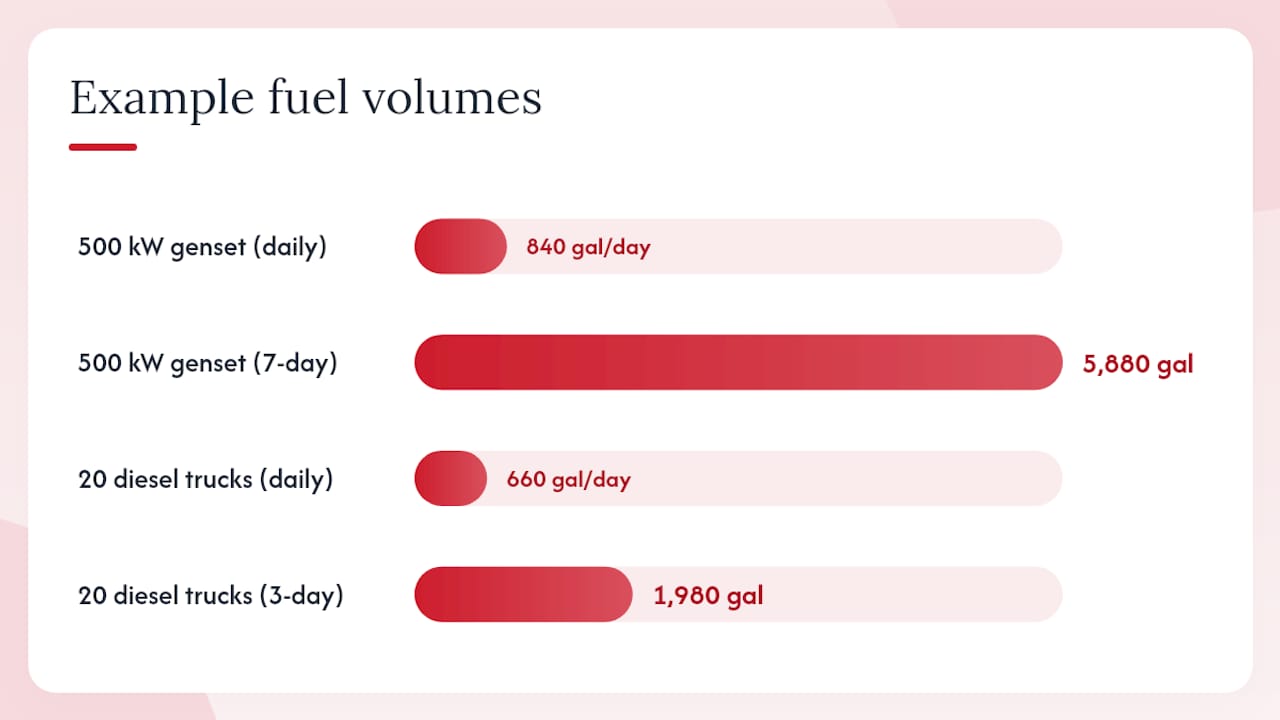
- Example for a 500 kW diesel genset. A 500 kW genset running at 75% load consumes roughly 35 gallons per hour. At 24-hour continuous operation, that is 840 gallons per day. A seven-day reserve requires 5,880 gallons on site or committed for delivery.
- Example for a small fleet. Twenty diesel trucks averaging 6 mpg and 200 miles per day each consume roughly 33 gallons per day per truck, totaling 660 gallons per day. A three-day reserve requires 1,980 gallons.
- Account for all fuel types separately. Clear diesel (on-road), red-dye diesel (off-road), gasoline, and DEF must be tracked and stored independently. Cross-contamination between clear and dyed diesel creates tax liability and equipment damage.
- Build in a consumption buffer. Add 10–15% to your calculated volume to account for load spikes, idle time, and delivery timing gaps.
Pro Tip: Install tank telemetry or level sensors on every primary storage tank. Real-time data eliminates manual dip-stick readings, catches slow leaks early, and gives your vendor accurate fill quantities before the truck rolls, which reduces delivery time on site.
Bulk tank fill scheduling guidance covers how to align replenishment cycles with consumption patterns to avoid running tanks below safe operating levels.
On-site storage vs. contracted delivery: what the regulations require you to know
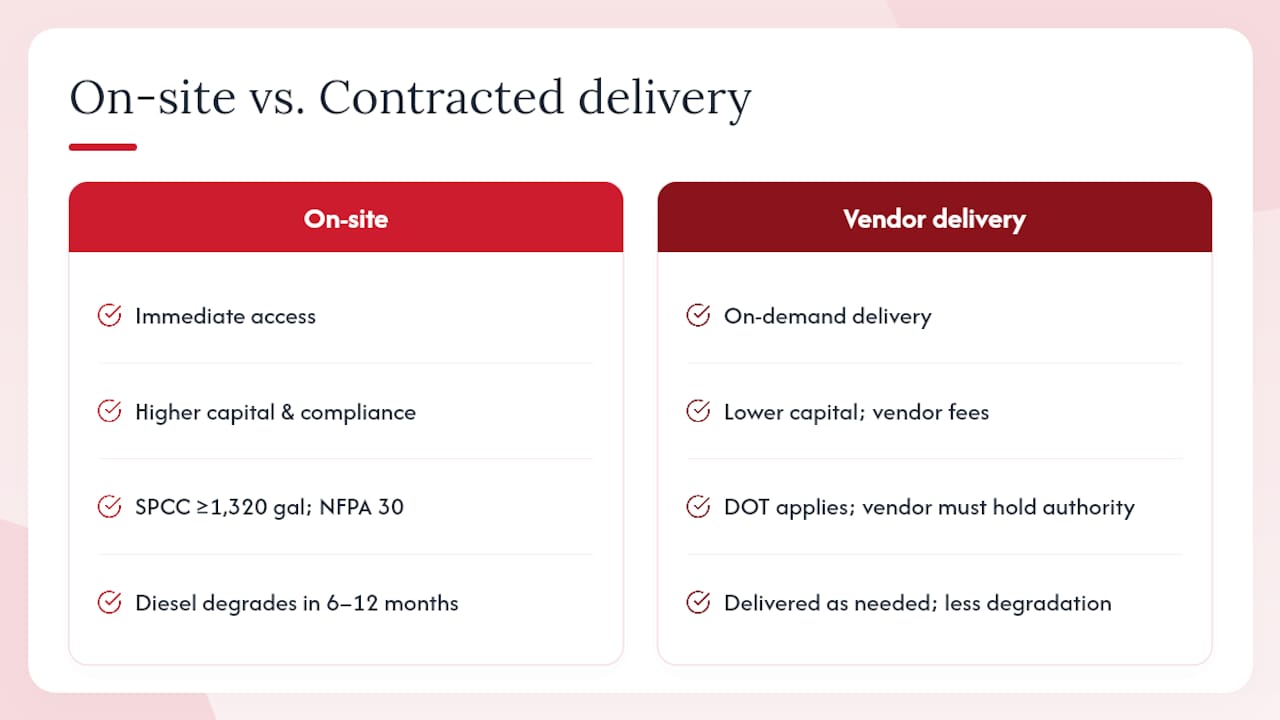
On-site bunkering gives you immediate access regardless of road conditions or vendor availability. The trade-off is compliance cost, maintenance burden, and capital outlay.
Tanks above 1,320 gallons of oil in aggregate at a single facility typically trigger Spill Prevention, Control, and Countermeasure (SPCC) plan requirements under EPA regulations. NFPA 30 governs flammable and combustible liquid storage, including tank construction, venting, and secondary containment. DOT regulations apply the moment fuel moves by truck, so your vendor must hold current DOT operating authority. Local fire codes often set stricter limits than federal standards, so check with your Authority Having Jurisdiction before sizing a permanent tank.
Fuel stored on site degrades. Diesel begins to oxidize and form sediment within 6–12 months without a fuel stabilizer or biocide treatment. A tank that sits full through a quiet season and then gets called on during a hurricane may deliver contaminated fuel to a generator at the worst possible moment. Turnover scheduling, periodic fuel testing, and polishing contracts prevent that failure mode.
Pro Tip: Site aboveground storage tanks away from loading docks and access roads to keep emergency truck lanes clear. Secondary containment must hold 110% of the largest tank’s capacity per SPCC guidance. Install a leak detection sensor at the containment sump and connect it to your building management system so an alarm fires before a spill becomes a reportable event.
For sites where permanent storage is impractical, bulk fuel delivery and on-site storage options through a contracted vendor can replace or supplement fixed tanks with rental units deployed on demand.
What delivery modes does a contracted fuel plan use?
Four operational modes cover most commercial scenarios, and each has distinct site requirements.
| Delivery Mode | Best Use Case | Key Site Requirement |
|---|---|---|
| Scheduled bulk fill | Routine replenishment of fixed tanks | Hard-standing pad, clear access lane, designated sign-off contact |
| Emergency rapid response | Unplanned outage or supply gap | 24/7 dispatch number, site access after hours, spill kit on hand |
| Wet-hose fleet fueling | Overnight fleet fueling at logistics yards | Yard map shared with driver, vehicles staged, meter printout required |
| Tank rental fill-in | Temporary sites, events, disaster response | Level ground, secondary containment, DEF kept separate |
Site-preparation checklist for emergency deliveries:
- Access lane minimum 14 feet wide and rated for a loaded tanker (up to 80,000 lbs)
- Hose run from truck to tank no longer than your vendor’s standard hose length (confirm in advance)
- Spill kit staged within 50 feet of the fill point
- Qualified site contact available to sign the delivery receipt
- Tank gauge or telemetry reading available before the truck arrives
Emergency fuel deployment vehicle types vary by capacity and terrain capability, so share your site access constraints with your vendor during onboarding, not during the emergency.
What contract and SLA terms protect you when supply gets tight?
Procurement-ready contract language removes ambiguity before a crisis creates it. Generator contract guidance recommends separating fixed and variable charges, requiring a separate fuel line item with units and delivery dates, capping admin fees, and keeping metered records for audit purposes.
Pro Tip: Require an index-based fuel escalation formula tied to a published benchmark such as the OPIS rack price or the DOE weekly retail diesel average. Cap the admin fee at a fixed dollar amount per delivery. This structure makes every invoice predictable and auditable, and it prevents a vendor from absorbing a price spike into an opaque “fuel surcharge.”
Procurement checklists for generator and fuel contracts advise documenting whether fuel is vendor-managed or customer-supplied, specifying minimum reserve levels, and requiring emergency delivery commitments in writing. SLA metrics to lock in: response time window (example: four hours for Tier 1 sites), minimum deliverable volume per dispatch, prioritized dispatch status during declared emergencies, and a service-credit remedy if the vendor misses the window.
Require GPS delivery confirmation and electronic POD on every fill. Those records support insurance claims, regulatory audits, and internal cost allocation. Insurance alignment with business continuity matters here: your vendor’s liability coverage and your own property policy need to be compatible, particularly for spill liability and cargo loss during transport.
How do you set activation triggers and manage the response?
Decision paralysis is the most common failure mode during a fuel disruption. Pre-authorized triggers eliminate it. BCM guidance for fuel shortages recommends specific thresholds: a 15% price rise above baseline or depot inventory falling below three operating days are examples of triggers that should fire a pre-authorized response without requiring executive approval.
- Set inventory triggers. Example: when on-hand fuel drops below a predefined days of supply threshold for any Tier 1 asset, the named owner places an emergency order automatically.
- Set price triggers. Example: when the OPIS rack price rises more than 15% above the 30-day average, activate the index-based contract clause and notify finance.
- Set supply-chain triggers. Example: a missed scheduled delivery or a carrier delay notification activates the backup vendor call.
- Define the authority matrix. The site manager authorizes standard fills. The operations director authorizes emergency premium spend above a set dollar threshold. A named backup holds authority when either is unavailable.
- Activation timeline. Hours 0–24: confirm inventory, place emergency order, notify stakeholders. Days 2–5: monitor deliveries, reconcile PODs, communicate status to leadership. Beyond day 7: activate mutual-aid agreements and secondary vendors.
What should you check when evaluating emergency fuel vendors?
Vendor evaluation checklist:
- Proof of current DOT operating authority and NFPA awareness for tank handling
- Certificate of insurance covering general liability, cargo, and environmental/spill liability
- References from at least two mission-critical sites (data center, hospital, or municipality)
- Documented 24/7 dispatch capability with a direct emergency line, not a general voicemail
- Surge capacity: confirm the vendor can deliver to multiple sites simultaneously during a regional event
- Backup carrier agreements: ask who covers your site if their primary truck is unavailable
- GPS tracking and electronic POD on every delivery
- Separate line items on invoices for fuel volume, delivery fee, and any surcharges
- Written emergency SLA with a stated response time and a service-credit remedy
Red flags: vague pricing language with no index reference, no metering or POD capability, single-source dependency with no named backup, and an emergency SLA that says “best effort” rather than a specific time window. Road freight and environmental liability coverage is a baseline requirement for any vendor handling bulk fuel transport.
How do you test and maintain your fuel plan?
A plan that has never been exercised is a document, not a capability. Run three exercise types on a defined schedule.
Tabletop exercise (quarterly): Walk the activation timeline with the authority matrix team. Use a scenario that combines a price spike with a simultaneous delivery delay to expose hidden dependencies and approval bottlenecks.
Vendor response test (semi-annual): Place a test order through your emergency dispatch line and measure actual response time against the contracted SLA. Do this before hurricane season and before winter.
Full activation drill (annual): Execute a simulated emergency fill from trigger to signed POD. Include the backup vendor so you confirm their service area and capacity firsthand.
Pro Tip: After every exercise, write a one-page after-action report. Note the time from trigger to first vendor contact, any authority gaps, and any site-access issues the driver encountered. Update the plan within 30 days. Plans that get updated after exercises stay current; plans that don’t get updated become liabilities.
Monitor daily: tank telemetry readings, OPIS price index versus your contract baseline, and open POD reconciliation. Review contracts annually and after any incident that activated the plan.
A compact emergency fuel plan template you can use now
One-page activation checklist:
- Trigger confirmed: [named owner] checks tank telemetry or receives missed-delivery alert
- Step 1 (0–1 hour): Call primary vendor emergency line; state site name, fuel type, volume needed, and access instructions
- Step 2 (1–2 hours): If primary vendor cannot commit to SLA window, call backup vendor
- Step 3 (2–4 hours): Notify operations director and finance of emergency spend; log authorization
- Step 4 (on delivery): Site contact signs metered receipt and electronic POD; photograph tank gauge before and after fill
- Step 5 (within 24 hours): Reconcile POD against invoice; file in audit folder; update inventory log
Two-page plan structure:
- Scope and critical assets: list of sites, assets, fuel types, and daily consumption rates
- Roles and authority matrix: named owners, backup owners, spend authorization thresholds
- Fuel sizing summary: days-of-supply targets and current on-hand volumes by site
- Delivery modes and vendor contacts: primary and backup vendor names, emergency lines, contracted SLA windows
- Activation triggers: inventory thresholds, price thresholds, supply-chain triggers, and pre-authorized responses
- Escalation chart: trigger fires → site owner acts → operations director notified → mutual aid activated
For multi-site operations, replicate the scope and roles sections per site and add a central coordinator role responsible for cross-site inventory visibility and vendor prioritization during a regional event.
What does emergency fuel capability actually cost?
Cost has four main drivers: base fuel price, delivery minimums, emergency response premiums, and any tank rental or hazmat fees. Understanding each one lets finance build a defensible budget rather than a guess.
A conservative multi-day scenario for a mid-sized data center running two 500 kW gensets (consuming over one thousand gallons per day) requires a substantial volume of on-hand or committed fuel. At current commercial diesel pricing, this represents a significant capital commitment before delivery fees are added, with longer reserve durations increasing exposure accordingly.
Pro Tip: Budget separately for hurricane season (June through November) and winter storm periods. Demand spikes during those windows drive both fuel prices and delivery premiums upward. Locking in index-based pricing before the season starts, rather than spot-buying during it, is the single most effective cost-control move available to procurement.
Procurement controls that keep costs predictable: cap emergency response premiums as a fixed dollar amount per delivery in the contract, require index-based escalation with a published benchmark, and use true-up accounting so monthly invoices reconcile against actual meter reads rather than estimated volumes. Generator contract invoice guidance recommends keeping metered records as the authoritative source for any billing dispute.
Complementary tactics to reduce fuel dependency and supply-chain risk
No single vendor relationship eliminates supply risk. These tactics reduce exposure across the supply chain.
Operational tactics:
- Route rationalization: reduce daily fleet miles during a disruption to extend fuel reserves
- Appointment clustering: consolidate deliveries and pickups to cut per-trip fuel consumption
- Fleet mix review: identify which vehicles could shift to hybrid or alternative fuel for non-critical runs
Sourcing tactics:
- Pre-onboard at least two vetted backup carriers with confirmed service areas and capacity
- Negotiate mutual-aid agreements with neighboring facilities or municipalities for shared reserve access during regional events
- Use multi-source procurement for bulk storage: split tank fills between two suppliers to avoid single-source dependency
For events and municipalities, a partner network with nationwide reach gives you a single point of contact that can coordinate multiple regional carriers under one contract and one invoice, which removes the coordination burden during a fast-moving disruption.
How Anytimefuelpros supports your emergency fuel plan
Anytimefuelpros delivers 24/7 emergency on-site diesel and DEF to data centers, construction sites, mining operations, municipalities, and live events across Texas, Utah, and the continental United States through a vetted national partner network. Every delivery includes GPS tracking, metered receipts, and electronic POD, which maps directly to the audit and SLA requirements this guide outlines. Index-based pricing, transparent line-item invoicing, and a single point of contact for multi-site accounts remove the coordination friction that makes emergency procurement expensive.
To put Anytimefuelpros into your fuel contingency plan, request a sample SLA and invoice template, add AFP to your next RFP, and schedule a vendor readiness drill before your next high-risk season. Explore the full range of on-site fuel delivery services or contact the AFP team directly to confirm coverage for your sites and get a quote.
Sources
- Business Continuity Management for Critical Infrastructure during Fuel Shortages
- Generator Contract and Invoice Clauses for Small Business
- Generator vendor contract negotiation checklist
Recent Comments