
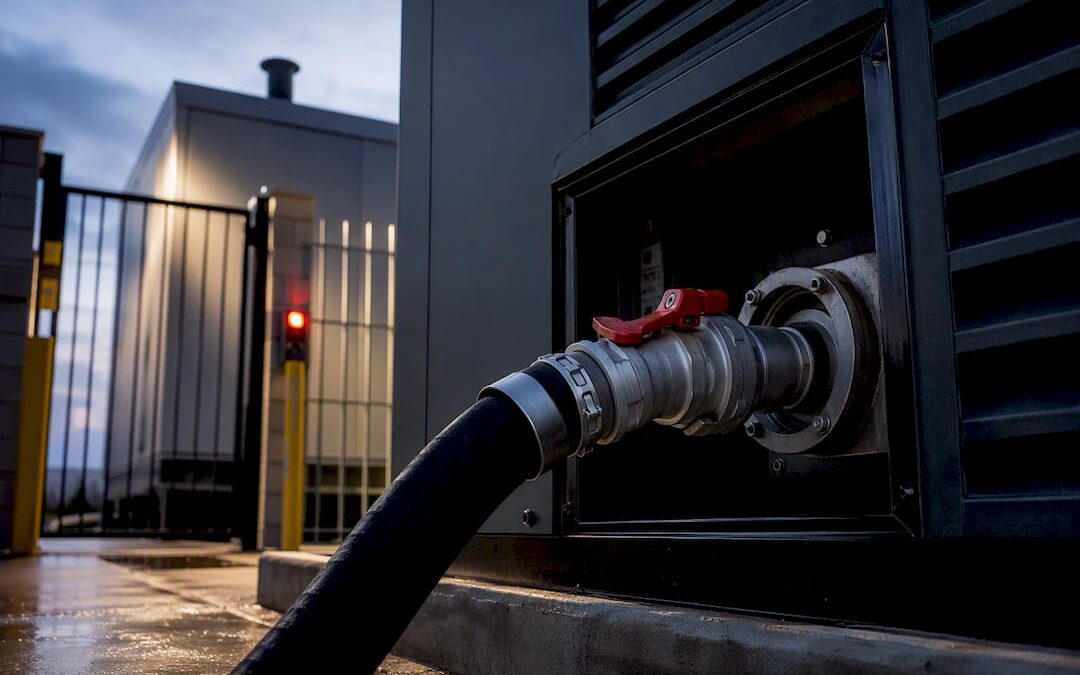
Expect three distinct bands: 20 to 60 minutes for staged urban and job-site deliveries, several hours when trucks must be routed from farther out, and 24 hours or more once weather, road closures, or wide-area disruption enter the picture. Access, resource scarcity, and time of day all push those windows longer. The moment you sense trouble, call your fuel provider with your exact location, fuel type and quantity, and any site access notes. That single call sets everything else in motion.
TL;DR:
- Emergency fuel response times vary significantly based on delivery distance, with urban calls taking 20 to 60 minutes and regional disruptions exceeding 24 hours.
- Precise location, fuel type, site access details, and on-site contact information dramatically reduce dispatch delays during emergencies.
- Pre-negotiated service level agreements should be tailored to criticality, with backups and pre-positioned reserves for essential assets like data centers.
- Regional disruptions extend recovery times to several weeks or months, depending on staging, supply chain restoration, and prioritization plans.
- Building and maintaining an updated, authorized contact roster and pre-arranged contracts can significantly accelerate emergency fuel response and reduce downtime.
Table of Contents
- What Drives Emergency Fuel Response Time Up or Down
- How Emergency Fuel Delivery Works, From Call to Fill
- Building SLAs and Reserves That Actually Shorten Downtime
- What Happens When the Disruption Is Regional, Not Local
- An Emergency Fuel Checklist Built From Field Experience
- Get Faster, More Predictable Fuel Response With Anytime Fuel Pros
- Emergency Fuel Planning Resources
- Sources
What Drives Emergency Fuel Response Time Up or Down
A generator running dry at a downtown data center and a fleet stranded at a remote mine site face completely different math. Understanding why helps you set expectations before you’re standing in a parking lot watching equipment go idle.
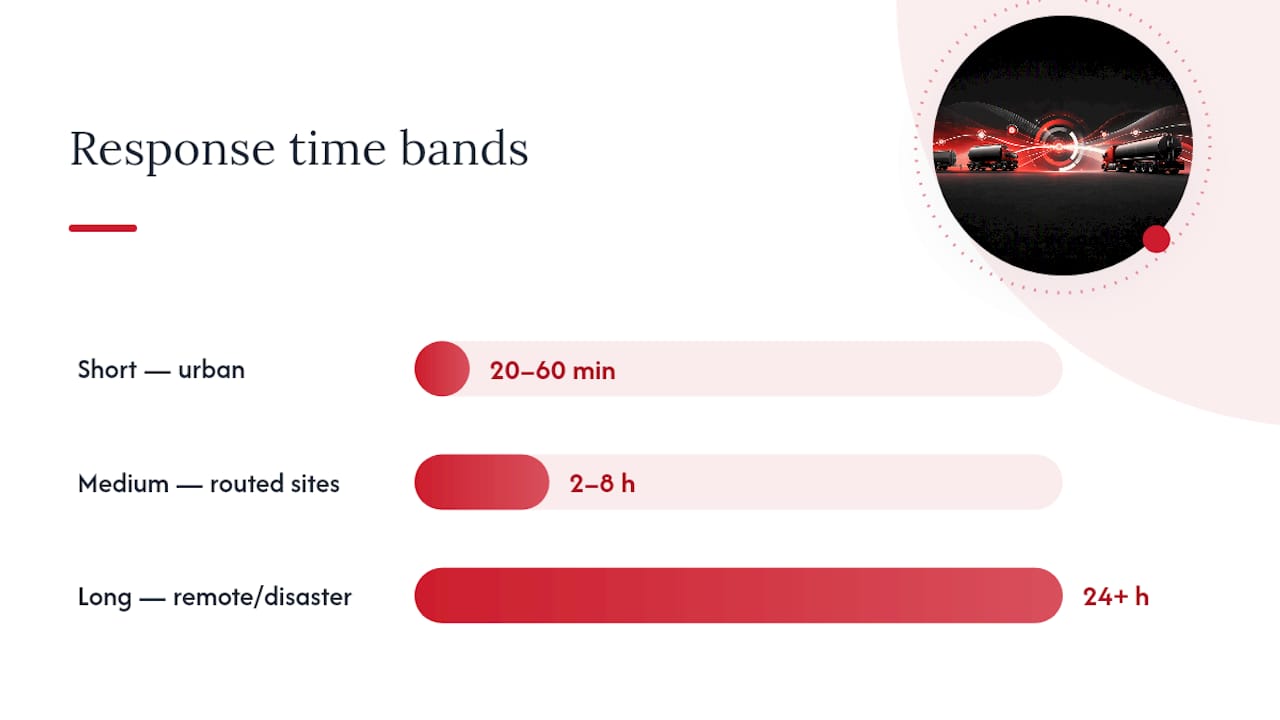
Three bands cover most real-world scenarios:
- Short (20 to 60 minutes): Urban roadside calls or job sites within a provider’s existing delivery zone, especially where a bobtail truck is already staged nearby.
- Medium (2 to 8 hours): Job sites outside normal routes, off-hours calls requiring driver reassignment, or requests needing a full tanker instead of a bobtail.
- Long (24 hours to several days): Remote mine or ranch locations, multi-site disaster response, or any scenario tangled up in road closures and permit delays.
Dispatch logistics matter more than most managers realize. A bobtail truck can reach a nearby site fast, but a large tanker requires a licensed driver within federal hours-of-service limits and sometimes a specific road permit for oversized loads. DEF deliveries add a wrinkle too, since diesel exhaust fluid needs separate handling to avoid contamination, which can tack extra minutes onto an otherwise routine stop.
Traffic and time of day compound everything. A 2 p.m. call in Dallas rush hour behaves nothing like a 2 a.m. call on an open highway. Weather closes roads, site access paperwork can stall a truck at a gate for 20 minutes, and after a hurricane or major grid failure, the math changes entirely.
State fuel-action plans build around a 0 to 96 hour window just to stabilize operations after a major event, with some resupply tasks stretching to 21 days or longer according to Oregon’s planning documents. That’s not your typical Tuesday delivery, but it’s the reality once a region-wide disruption hits.
How Emergency Fuel Delivery Works, From Call to Fill
Every minute you save on the phone is a minute shaved off your ETA. Dispatchers can only route a truck as fast as you can give them a usable location and a clear picture of what’s needed.
When you call, have this ready:
- Exact location. GPS coordinates work best; a nearest cross street, DOT mile marker, or landmark works when coordinates aren’t handy.
- Fuel type and quantity. Clear diesel, dyed off-road diesel, gasoline, or DEF, plus your tank or vehicle capacity.
- Site access details. Gate codes, security check-in requirements, low clearance, or soft ground that could bog down a tanker.
- Point of contact on-site. Someone who can meet the driver and confirm the delivery.
Once you provide that information, the dispatcher verifies your account or authorizes payment, checks which bobtail or tanker sits closest to your coordinates, and gives you a realistic ETA rather than a hopeful one. From there, site prep matters: clear a path for the truck, keep the vehicle or tank properly grounded, and make sure anyone required to be present (a site supervisor, a security escort) is actually available when the driver arrives. Roadside deliveries on active highways may need basic traffic control, like hazard cones or a spotter.
Delivery close-out is where paperwork protects everyone. The driver should hand over a fuel ticket showing quantity delivered, and someone on your end should confirm that number against the tank gauge before the truck leaves.
Pro Tip: Save your provider’s dispatch line as a direct contact in your phone, not buried in a shared inbox. During an actual emergency, the ten seconds you spend hunting for a number is ten seconds the truck isn’t moving.
Providers like Anytime Fuel Pros structure intake around these exact fields specifically because incomplete information is the single biggest cause of ETA slippage.
Building SLAs and Reserves That Actually Shorten Downtime
Response time isn’t just a logistics problem. It’s a contract problem, and most operations teams don’t realize how much of it they can negotiate before an emergency ever happens.
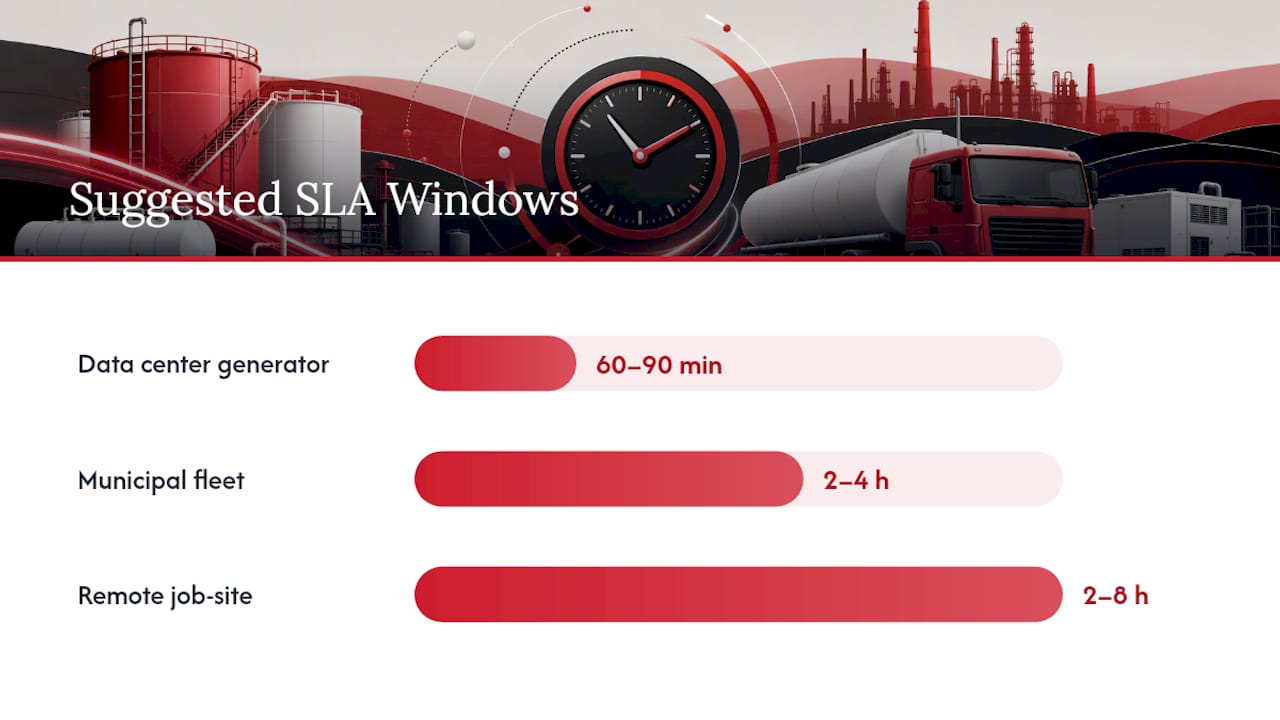
Critical assets deserve tighter guarantees than noncritical ones. A backup generator keeping a data center online justifies a 60 to 90 minute SLA target; a landscaping crew’s diesel tank probably doesn’t need the same urgency, and paying for it is wasted budget. Matching your SLA tier to actual criticality keeps costs sane while protecting the equipment that can’t afford to sit idle.
Contracts worth signing typically include:
- A guaranteed response window, stated in hours or minutes, not “as soon as possible”
- Surge capacity commitments for named event types (storms, grid failures, planned outages)
- Priority status during regional emergencies, not just routine calls
- Clear invoicing and reconciliation terms so fuel tickets match monthly billing
- Insurance and indemnity language covering on-site delivery incidents
Pre-positioned tankage changes the equation entirely. If a generator burns 30 gallons an hour and you want three days of runway without a delivery, you need roughly 2,160 gallons on-site, before accounting for load variation. Bulk fuel storage and tank rentals let you hold that buffer without owning the infrastructure outright.
| Asset Type | Suggested SLA Window | Rationale |
|---|---|---|
| Data center backup generator | 60 to 90 minutes | Zero tolerance for extended downtime |
| Municipal fleet vehicles | 2 to 4 hours | Service disruption but not life-safety critical |
| Remote job-site equipment | 2 to 8 hours | Distance and access typically dominate |
| Scheduled recurring top-off | Pre-set calendar window | Predictable demand, no urgency premium needed |
Authorized-user rosters round it out. When your provider already knows who can approve a delivery and charge it to your account, you cut out the back-and-forth that eats real minutes during an actual crisis.
What Happens When the Disruption Is Regional, Not Local
Commercial emergency fuel delivery works beautifully for isolated incidents. It runs into hard limits when an entire region goes down at once, and every operations manager should know where that line sits before they need to find it the hard way.
State fuel-action plans generally assume 0 to 96 hours just to stabilize basic distribution after a major event, with some tasks running 21 days to 180-plus days for full recovery. That’s the framework Oregon uses, and comparable states build similar tiers into their own plans.
A few structural realities shape those timelines:
- States activate Incident Support Bases (ISBs), Forward Staging Areas (FSAs), and State Staging Areas (SSAs) to move bulk fuel into a disaster zone once local supply chains break down, as South Carolina’s emergency refuel appendix outlines.
- Local plans quantify the scale involved. Multnomah County’s fuel management plan puts peak emergency diesel needs in the hundreds of thousands of gallons per day, with full supply-chain restoration potentially taking 6 to 18 months in a worst-case regional scenario.
- Master fuel contracts and pre-designated Fuel Points of Distribution, recommended in Illinois’s emergency operations fuel appendix, determine who gets priority once government agencies start rationing supply.
The practical takeaway: pre-positioned reserves are your buffer for the first 96 hours. Beyond that, commercial delivery gets constrained by the same staging systems everyone else is competing for, so coordinating with your local emergency operations center before the event beats scrambling during it.
An Emergency Fuel Checklist Built From Field Experience
Anytime Fuel Pros built its dispatch process around one recurring problem: the accounts that recover fastest are the ones who did the paperwork before the emergency, not during it.
The pre-event checklist that shows up again and again:
- Authorize site access in advance so a driver isn’t waiting at a locked gate.
- Pre-designate tank locations and gauge points so there’s no confusion on arrival.
- Set up password-protected delivery authorization tied to specific named contacts.
- Schedule recurring top-offs for predictable demand, freeing emergency capacity for actual emergencies.
Pro Tip: If you manage multiple sites, put one person in charge of the authorized-contact list and update it quarterly. Stale contact rosters are the number one reason pre-contracted deliveries still get delayed.
Whether it’s a generator top-off during a grid event or a bulk fill at a remote job site, having a single point of contact and consolidated invoicing removes friction exactly when you can least afford it.
Get Faster, More Predictable Fuel Response With Anytime Fuel Pros
Some fuel providers are built to close the exact gaps this article just walked through: emergency dispatch, a nationwide partner network for multi-site operations, and scheduled top-offs that keep your reserves from ever hitting a crisis point in the first place.
That combination matters because most fuel emergencies aren’t really fuel problems. They’re coordination problems, and coordination is exactly where a single point of contact and pre-authorized account access pay off. Customers running data centers, mining operations, or municipal fleets can benefit from having one number to call regardless of how many sites they manage, consolidated invoicing instead of a stack of separate vendor bills, and prioritized dispatch tied to a contract rather than a cold call. If you’re evaluating diesel fuel delivery for emergency and on-demand needs, or want to size out a bulk storage setup before your next storm season, request a quote today and get your account authorized before you need it, not after.
Emergency Fuel Planning Resources
- Oregon Fuel Action Plan — state-level timelines for major disruptions
- South Carolina emergency refuel plan (Appendix 9) — ISB, FSA, and SSA staging structure
- Multnomah County fuel management plan — peak demand and recovery scale estimates
- Illinois emergency operations plan: fuel management appendix — master contracts and distribution points
- Anytime Fuel Pros service pages — operational checklist and emergency delivery services
Sources
- South Carolina emergency refuel plan (Appendix 9)
- Oregon Fuel Action Plan
- Multnomah County fuel management plan (2023)
- Illinois emergency operations plan: fuel management appendix
Recent Comments