
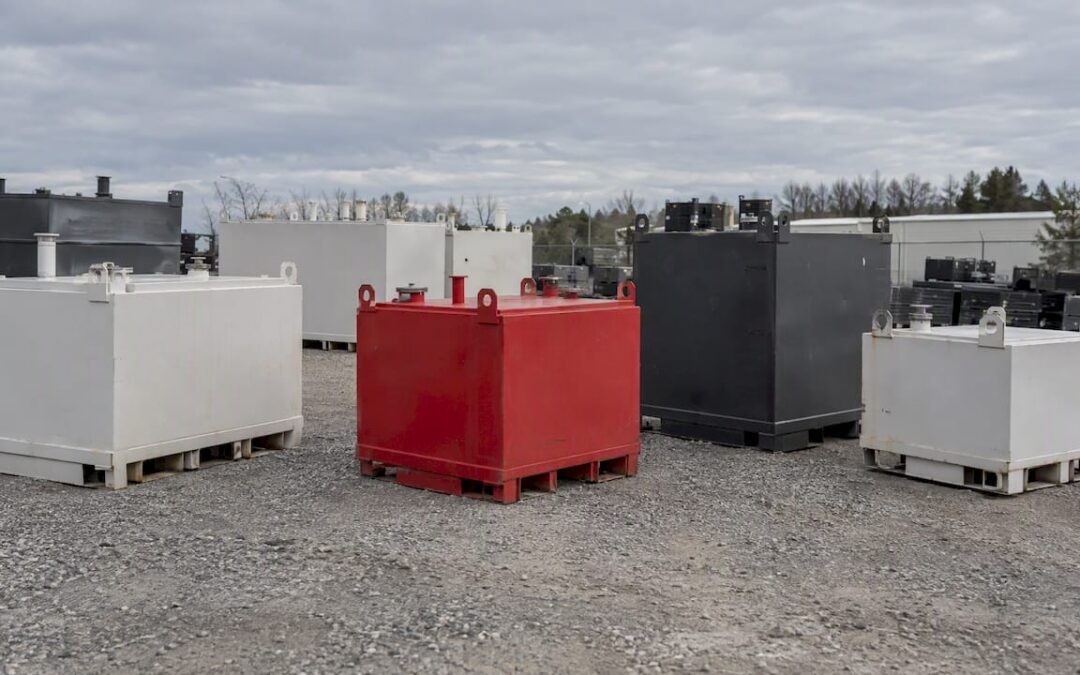
Fuel tank rental cost is rarely one number. The rate card you see covers the tank itself, by the day, week, or month. The final bill also includes delivery and pickup, setup, minimum terms, compliance work, and the fuel you put in it. Plan for all of those, and the quote you get will make sense.
We deliver diesel, gasoline, and DEF to job sites, yards, and data centers, and we rent fuel tanks as part of that service. We do not publish a tank rental price, because the honest answer depends on your site. This guide explains how the cost is built, so you can compare quotes on equal terms and decide whether a rented tank is the right tool at all.
TL;DR
- Tank rental is priced on capacity, rental term, and logistics. The daily or monthly rate is only part of the total.
- Mobilization and demobilization fees are often left off advertised rate cards, and can equal or exceed a month of rent depending on distance and site access.
- Total aboveground oil storage over 1,320 gallons can trigger EPA’s SPCC rule, which adds planning and secondary containment cost.
- Some operations do better with scheduled mobile fueling than with a tank. Run both numbers before you commit.
Table of Contents
- What a fuel tank rental quote actually includes
- The factors that move the price
- A worked example: building a real project budget
- Why mobilization fees deserve their own line
- Compliance can change the cost of a rental
- Renting a tank vs. scheduled mobile fueling
- Generators and data centers: size for the runtime, not the rent
- How to get an accurate quote
- How Anytime Fuel Pros can help
- FAQ
- Sources
What a fuel tank rental quote actually includes
A quote for a rented tank usually breaks into five parts. Ask every provider to itemize them, because two quotes with the same monthly rate can differ by hundreds of dollars once the rest is added.
- The tank rent. This is billed per day, week, or month. Larger tanks cost more, and longer terms usually bring a lower effective daily rate.
- Mobilization and demobilization. This is the cost of getting the tank to your site, setting it, and collecting it later. It is priced by distance and site accessibility, so it is the line most likely to surprise you.
- Setup and accessories. Pumps, hoses, meters, fill ports, and piping to a generator or boiler can be included or billed separately.
- Deposits, minimums, and fees. Many rentals carry a minimum term. One published example shows a 30-day minimum plus a $150 mobilization fee on a small tank, which shows how a short job can still be billed as a full month.
- The fuel. The tank is not the fuel. Diesel is billed per gallon at the market price on the day of delivery, and that is usually the largest line on any project.
The habit that saves the most money is simple: compare total landed cost for your actual project length, not the headline rate.
The factors that move the price
Tank capacity
Rental tanks come in sizes from a few hundred gallons to several thousand. Smaller portable tanks suit a single machine or a small crew. Larger double-wall tanks suit generators, yards, and multi-machine sites. Rate cards generally climb with capacity, but cost per gallon of storage tends to fall as you go up, so oversizing a little can be cheaper than refilling a small tank constantly. Oversizing also has a limit, which is the compliance threshold covered below.
Rental term
Daily rates look cheap until a job runs long. A project that slips from two weeks to six turns a daily rate into a monthly one, and some providers bill at the higher short-term rate until you convert. Ask what the rate becomes at 30, 60, and 90 days, and whether you can extend without a new mobilization.
Distance and site access
A tank going to a paved yard near a city is cheap to move. A tank going to a quarry road, a remote lease, or a tight urban pad needs a different truck, more time, and sometimes a crane or forklift. That is why mobilization is quoted by site rather than printed on a card. It also explains why a regional rate from one state tells you little about a job in another.
Construction type and features
Double-wall construction, dispensing equipment, lockable cabinets, and gauges add cost. They also reduce loss, theft, and spill risk, so they often pay for themselves. Fuel theft is a real pain point on open sites, and a locked, metered tank gives you a record of every gallon.
Fuel type
Off-road equipment runs on dyed (red) diesel, and on-road trucks need clear diesel. Gasoline and DEF have different storage requirements. A tank used for one fuel generally should not be switched to another without cleaning, and dyed diesel carries its own recordkeeping. Tell your provider what the tank will hold before you sign.
A worked example: building a real project budget
Here is how we would walk a site manager through the math. The numbers below are placeholders for you to replace with the figures on your own quotes, not our prices.
Scenario: a 10-week excavation job, six machines, one tank on site.
- Tank rent: your quoted monthly rate multiplied by 3 months, because 10 weeks crosses into a third month on most minimum-term contracts.
- Mobilization plus demobilization: two line items, quoted separately.
- Setup: pump, meter, hose, and any containment accessories.
- Compliance: signage, a spill kit, and any plan documentation.
- Labor: a person checking levels and logging fuel each day.
- Fuel: gallons per machine per day, times machines, times working days, times your delivered price.
Then add the cost no rate card shows: the fill-up trips. If a foreman or a laborer spends 45 minutes a day getting fuel to the tank, or crews drive to a retail station, that is paid time with no production. Idle equipment is the quiet profit killer on most sites, and a tank that runs dry compounds it, because the whole crew waits.
Once you add these up, the tank rent itself is often the smallest part of the total. The labor, downtime risk, and fuel price spread decide whether the setup is efficient.
Why mobilization fees deserve their own line
Mobilization is the cost most renters overlook. Because it depends on distance and access, providers rarely advertise it. One industry source notes that these fees can equal or exceed a full month of rent, and that pricing also depends on piping requirements, permitting, inspection needs, and demobilization.
Practical ways to control it:
- Ask for mobilization and demobilization as two separate numbers.
- Ask whether the fee changes if you extend the term or move the tank on the same site.
- Confirm who is responsible for placement, leveling, and a base or containment pad.
- Tell the provider about gates, soft ground, overhead lines, and truck access before they quote.
- If you have several sites, ask whether a single provider can serve all of them. Repeated mobilizations to scattered locations add up quickly.
Compliance can change the cost of a rental
This is where a cheap tank becomes an expensive one. Fuel storage is regulated, and the rules depend on how much oil you store in total, not on how many tanks you rent.
The 1,320 gallon SPCC trigger
The EPA’s Spill Prevention, Control, and Countermeasure rule applies to facilities that store more than 1,320 U.S. gallons in total of aboveground containers (counting only containers of 55 gallons or more) and that could reasonably discharge oil to navigable waters. Add up everything on the site: a rented 1,000 gallon tank plus a 500 gallon tank plus a generator belly tank can cross the line.
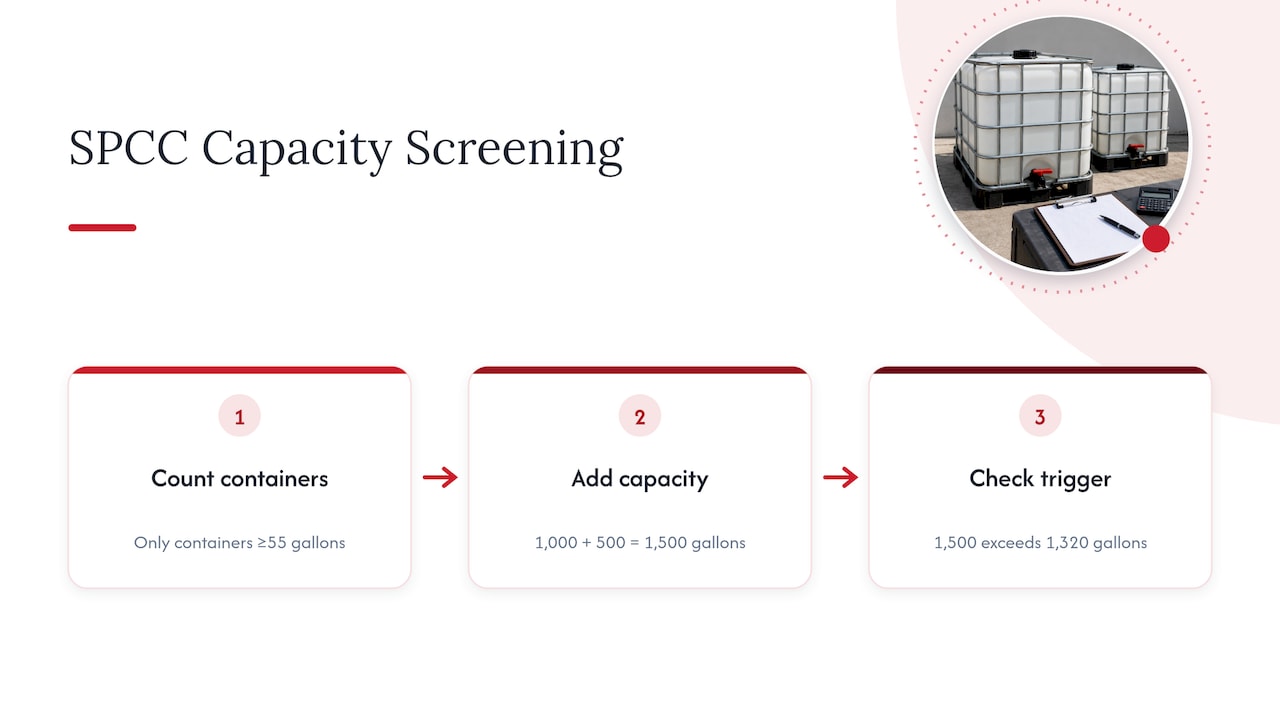
Crossing it means an SPCC plan, and the EPA’s aboveground storage tank guidance explains who may be subject. Staying under it is a legitimate planning goal. Our guides on avoiding the 1,320 gallon SPCC trigger and the SPCC checklist for facility managers walk through how to count capacity correctly.
Local fire code and permits
Federal rules are only the start. State and local fire marshals often add requirements for temporary installations, and federal land agency guidance notes that aboveground tanks fall under authorized state regulations and industry standards that depend on location. NFPA 30 also sets distance and installation requirements for larger tanks, which can include barriers, vent placement, and signage. Call your local fire marshal early, before the tank is ordered, and ask what permit and setback rules apply to your parcel.
Signage is a small cost that gets skipped. If you need a refresher on what a site must post, this overview of construction site signage requirements covers the types contractors commonly order.
We lay out the full planning sequence in our audit-ready construction fueling plan and in temporary fuel tank regulations for facility managers.
Renting a tank vs. scheduled mobile fueling
A tank is not always the cheapest way to get fuel to equipment. Compare it with mobile delivery straight into the machines, often called wet hosing.
| Factor | Rented tank on site | Mobile fueling or wet hosing |
|---|---|---|
| Fixed cost | Rent, mobilization, setup | None for a tank |
| Labor | Crew fuels from the tank | Delivery truck fuels equipment |
| Compliance load | Storage rules and possible SPCC count | No tank to count |
| Best for | Long projects, many machines, remote sites, generators | Fleets, yards, short jobs, tight sites |
| Fuel theft exposure | Depends on locks and metering | Metered delivery ticket |
| Risk of running dry | You manage levels | Scheduled and on-demand dispatch |
A tank usually wins on long, high-volume, remote work where trucks would have to visit constantly. Mobile fueling usually wins when volumes are modest, the job is short, the site is cramped, or you want to stay clear of storage regulations. Many operations use both: a tank for steady base demand and delivery for peaks. We explain the delivery side in how mobile fuel delivery saves businesses money and in our guide to bulk fuel delivery and storage on job sites.
Generators and data centers: size for the runtime, not the rent
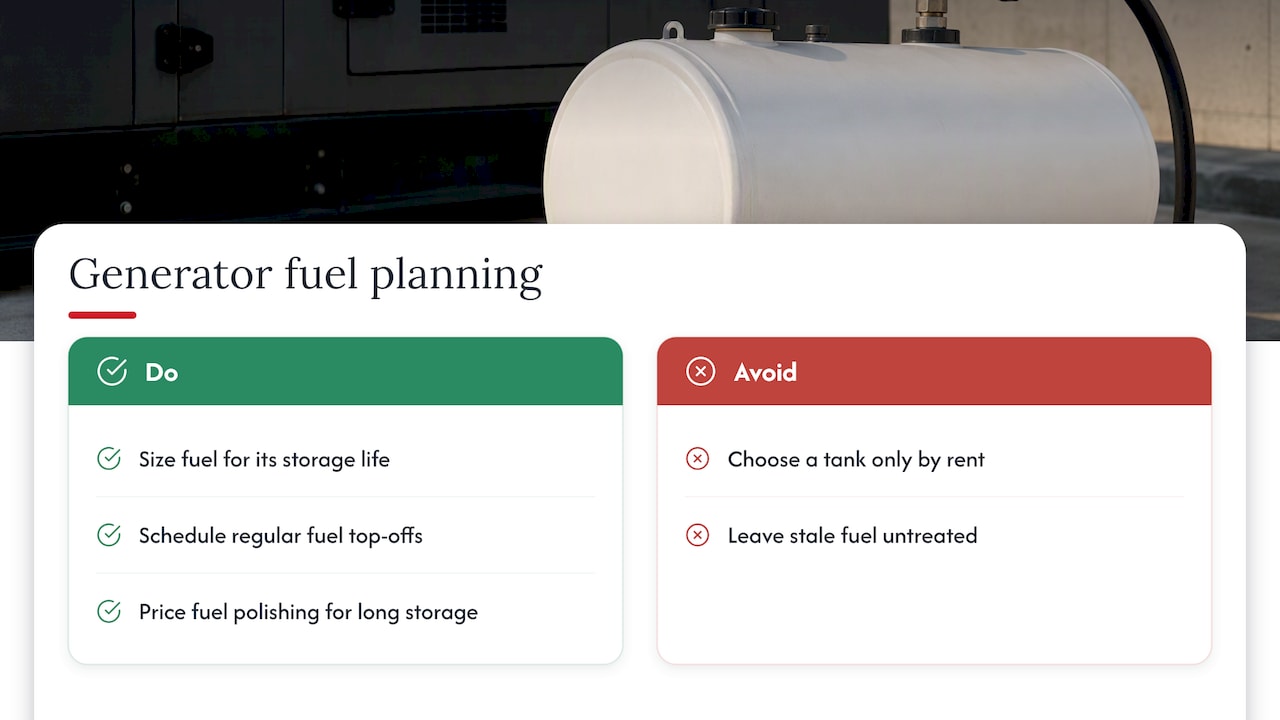
For backup generators, the question is not which tank is cheapest. It is how long the generator must run if the grid fails and how fast fuel can be resupplied. Stored diesel also ages. California’s building code language for aboveground fuel storage at healthcare facilities says tanks should be sized so the fuel is consumed within its storage life, or that provisions exist to remediate or replace stale fuel. That is one state’s rule for one facility type, but the principle applies widely: a huge tank full of old diesel is a liability, not insurance.
For mission-critical sites, the better budget often pairs a right-sized tank with scheduled top-offs and an emergency delivery agreement. Fuel polishing is also worth pricing if fuel sits for long periods.
How to get an accurate quote
Have these answers ready before you call any provider, including us:
- Fuel type: red diesel, clear diesel, or gasoline.
- Expected gallons per week and total project duration.
- Exact site address and truck access conditions.
- Whether the tank feeds a generator or fuels mobile equipment.
- Total oil storage already on site, including generators and other tanks.
- Whether you need metering, locking, or reporting for a government contract.
- Whether you will need after-hours or emergency refills.
Then ask for an itemized quote that separates rent, mobilization, demobilization, setup, taxes, and fuel. Compare quotes by total project cost.
How Anytime Fuel Pros can help
We deliver red diesel, clear diesel, gasoline, and DEF to businesses in San Antonio, Austin, Dallas-Fort Worth, and Salt Lake City, and nationwide through our partner network. We offer fuel tank rentals together with scheduled and on-demand delivery, so you can solve storage and resupply with one vendor. Our service runs 24/7, and our itemized invoicing shows each charge, which makes tank budgets easier to audit.
If you want a tank quote for a specific site, or want us to compare a tank against mobile fueling for your volumes, start with our fuel services page or review bulk fuel delivery. If a tank has already run dry, our emergency fuel delivery team handles after-hours calls.
FAQ
How much does it cost to rent a fuel tank?
It depends on capacity, term, location, and logistics, and published rates vary widely by provider and region. The tank rent is only part of the bill, since mobilization, demobilization, setup, and fuel are usually extra. We quote each project individually, because site access and duration change the total.
Are there minimum rental terms?
Often, yes. Some providers set a 30-day minimum, so a two-week job can still be billed as a month. Ask about the minimum, the rate for extensions, and whether a short term has a higher daily rate before you sign.
Do I need a permit or plan for a rented fuel tank?
Possibly. EPA’s SPCC rule can apply once total aboveground oil storage on a site exceeds 1,320 gallons, and local fire marshals may require permits, setbacks, or signage for temporary tanks. Confirm with your local fire marshal early, and count every container of 55 gallons or more on the site.
Is it cheaper to rent a tank or have fuel delivered to equipment?
For short jobs, small fleets, or tight sites, delivery directly into equipment avoids rent and mobilization fees. For long, high-volume, or remote projects, a tank can cut delivery visits. Price both for your project length and gallons, including labor and downtime risk.
Sources
- Aboveground Storage Tanks, US EPA
- SPCC overview and applicability, US EPA
- Aboveground Storage Tank Management, National Park Service
- Aboveground fuel storage code provisions, California HCAI
- Fuel tank rental pricing factors, CommTank
- Diesel fuel tank rental terms, PRL Co.
Recent Comments