

Scheduled delivery sends a truck on a set rhythm or when a tank hits a trigger level, so nobody on your team has to place the order. Will-call puts you in control: you request each delivery yourself. Scheduled fits steady, forecastable burn. Will-call fits intermittent, shifting, or short-term demand. Most operations that run critical equipment end up combining the two.
The real question is not which model sounds better. It is which one leaves the smaller gap between the fuel you have and the fuel you need, at the lowest total cost. This guide walks through how each model works, where each one breaks, and how to match the choice to your site.
TL;DR
- Scheduled (keep-full) delivery trades some flexibility for predictability: easier budgeting, planned routing, and no one watching gauges.
- Will-call delivery keeps control with you and avoids unneeded drops, but a missed order means a rush dispatch or a stalled machine.
- Choose scheduled for fleet yards, fixed equipment, mining, and generator tanks. Choose will-call for short projects, events, and moving sites.
- A hybrid, with a scheduled base plus on-demand and emergency capacity, is usually the most resilient setup.
- Mission-critical sites should size onsite fuel and replenishment lead time first, then pick the delivery mode.
Table of Contents
- How each model works
- The hidden cost of will-call: who is watching the tank?
- The hidden cost of scheduled delivery: the stale forecast
- When scheduled delivery is the better fit
- When will-call is the better fit
- Why a hybrid usually wins
- Mission-critical sites: plan the lead time, not just the schedule
- Public-sector buyers: structure beats spot buying
- A simple way to decide
- How Anytime Fuel Pros supports both models
- FAQ
- Sources
How each model works
The two ordering modes are simple to define. Under will-call, the customer requests each delivery. Under automatic or keep-full delivery, the distributor schedules deliveries to keep the tank stocked, according to OctaneIQ’s glossary entry on will-call and automatic delivery. That same source notes that automatic delivery commonly relies on historical consumption or tank monitoring.
In practice, that looks like this on a commercial site:
| Scheduled / recurring | Will-call / on-demand | |
|---|---|---|
| Who triggers the order | The supplier, on a calendar or a tank-level trigger | You, each time |
| Who monitors the tank | Shared, or the supplier | You or your crew |
| Best for | Steady, predictable burn | Variable or short-term burn |
| Main risk | Over-delivery if usage drops, or a stale forecast if it rises | Ordering too late |
| Budgeting | Easy to forecast | Varies with each order |
| Control | Lower | Higher |
The table shows the central tradeoff: predictability against control. Scheduled service makes timing and budgeting easier and can improve route efficiency. Will-call avoids unnecessary deliveries when usage changes, but it raises the risk of late orders, rush dispatches, or an operational interruption if inventory monitoring fails. Exact pricing varies by market, volume, fuel type, site access, and urgency, per the same industry guidance.
The hidden cost of will-call: who is watching the tank?
Will-call looks cheaper on paper because you only pay for fuel you order. The cost shows up elsewhere.
Someone has to check gauges. Someone has to estimate how many days of fuel are left, and someone has to call before the tank gets low. On a busy site, that someone is often a superintendent or foreman with a dozen other priorities. When the check slips, three things tend to follow:
- A rush order. Short-notice dispatch usually costs more than a planned drop, and it lands on whatever the truck schedule happens to be.
- Idle equipment. An excavator or a loader waiting on fuel is a crew paid to stand still. Momentum on site drops fast, and the cost compounds when other trades are sequenced behind that work.
- Crew trips to a retail station. The workaround for an empty tank is usually a truck and a driver heading off site with jerry cans. That is paid labor, not productive work.
A quick worked example, with numbers you should replace with your own: if five operators and a fuel runner lose two hours each to a dry tank, that is twelve paid labor hours before you count the machine hire rate or the schedule slip. The fuel itself is rarely the expensive part of the failure.
Will-call is not the wrong choice. It is the right choice only when someone owns the monitoring task and the penalty for a late order is small.
The hidden cost of scheduled delivery: the stale forecast
Scheduled delivery has its own failure mode, and it is quieter. A schedule is a forecast. When the forecast is right, you get smooth operations. When usage changes and the schedule does not, you get one of two problems:
- Over-delivery. A project slows, a machine goes down for repairs, or weather halts work. The tank is still topped off on the calendar, and you are carrying more fuel than you need, with the cash and storage that implies.
- Under-delivery. A new machine arrives, a shift is added, or a generator runs during an outage. The tank drains faster than the schedule assumes, and you are back to ordering in a hurry.
The fix is not to abandon scheduling. It is to review the schedule against actual consumption on a regular cadence, and to keep a way to request an extra delivery between scheduled stops. Good records of gallons delivered per stop make that review quick. For more on why tracking matters, see our piece on job site fuel tracking.
When scheduled delivery is the better fit
Choose scheduled or keep-full delivery when consumption is recurring and reasonably forecastable. The research behind this guide points to fleet yards, fixed construction equipment, mining operations, and generator tanks as the usual candidates, because scheduling shifts monitoring and dispatch work away from site personnel and supports planned routing (OctaneIQ).
Here is how that plays out by operation type.
Fleet yards and trucking
A yard that fuels the same vehicles every night has a predictable burn rate. Scheduled bulk tank fills or overnight mobile fleet fueling keep vehicles ready at shift start and remove the trip to a retail pump. Predictable delivery also makes it easier to reconcile gallons against vehicles, which helps with the problem of fuel going missing. If that is a concern for you, this overview of preventing fuel theft in fleets covers the monitoring side of the issue.
Long-running construction and excavation
On a multi-month earthmoving job, the fleet burns a steady amount week to week. A recurring drop to an on-site tank, combined with a quick check before big pushes, keeps equipment running without a fuel runner. Our guide to bulk fuel delivery and storage on job sites explains how to size the tank for that rhythm.
Mining and quarry operations
Heavy equipment in remote locations burns a lot of diesel and sits far from the nearest station. A planned cadence of bulk fuel delivery protects against the worst outcome, a haul truck stopped because the tank ran dry far from anywhere.
Backup generators
Generator tanks are the classic case where nobody looks at the gauge until something goes wrong. Scheduled top-offs keep tanks at a known level so the generator is ready when the grid is not. That said, generators are also the place where a pure schedule is not enough, which we cover below.
When will-call is the better fit
Will-call earns its place when demand is intermittent, locations move, or quantities and fuel types change between deliveries. The same research lists short projects, special events, and surge operations as natural fits (OctaneIQ).
- Short projects. A three-week site cleanup does not justify a recurring plan. Order when you need it.
- Events and productions. Festivals, concerts, and film shoots fuel generators and lighting towers for a defined window. Quantities depend on headcount, weather, and schedule changes, which makes forecasting a guess.
- Moving sites. Pipeline, utility, or road work shifts location constantly. A fixed schedule would chase equipment that is no longer there.
- Mixed fuel needs. If one delivery is red diesel for equipment and the next is clear diesel for on-road trucks plus DEF, you order what you need that day. Our pages on red dye diesel delivery and clear diesel delivery show how the two differ.
The discipline that makes will-call work is simple: set a reorder point. Decide that when the tank hits a specific level, or when a set number of days of fuel remain, someone places the order. Then give that task to one named person with a backup. Will-call without a reorder rule is just hoping.
Why a hybrid usually wins
For many operations the best answer is not either-or. A hybrid model is usually more resilient: scheduled base deliveries cover predictable consumption, while will-call or emergency capacity handles weather, production surges, new equipment, project extensions, and generator runtime that invalidate the baseline forecast (OctaneIQ).
A practical hybrid looks like this:
- Set a scheduled delivery sized to about your typical burn between stops.
- Define a low-level trigger that prompts an extra will-call order between stops.
- Line up an emergency option with a known response time, so a surprise does not become a scramble. Our guide to emergency fuel response time targets explains how to think about those targets.
- Review actual gallons against the schedule every month or at each major project phase.
This keeps the savings and low workload of scheduling while preserving the flexibility of will-call.
Mission-critical sites: plan the lead time, not just the schedule
Data centers, hospitals, telecom, and utilities should not pick a delivery mode based on routine consumption alone. A generator that rarely runs has a tiny “normal” burn, yet its real job is to run for days when everything else fails.
The better approach is to size usable onsite fuel, define how long replenishment takes, and document alternate supply arrangements in case roads or access are disrupted. For a reference point, NRC guidance for safety-related emergency power systems at nuclear plants uses seven days of onsite fuel or the time needed to replenish from offsite, whichever is longer, and recommends pre-disaster replenishment agreements (NRC Regulatory Guide 1.137). That figure is a nuclear-power example, not a rule for every U.S. facility. Data centers and other operators should set their targets from their own continuity plans and regulatory standards.
The planning principle still carries over: a routine schedule is not the same as resilience. Ask:
- How many hours or days of runtime do we hold onsite at full load?
- How long would it take a supplier to reach us in a storm or outage?
- Do we have a written agreement for priority or emergency service?
- What is our fallback if our primary supplier cannot reach the site?
Our emergency fuel plan guide is built for procurement teams working through exactly these questions.
Tank compliance comes first
Delivery planning for generator sites cannot be separated from tank compliance. For facilities with applicable underground storage tanks, EPA’s federal requirements for emergency generator UST systems cover items such as release detection, spill and overfill prevention, corrosion protection, compatibility, and inspections. State rules may add to those, so check with your state tank program. A delivery plan should therefore record tank status, usable capacity, site access, and compliance records, not just a requested gallon amount.
Public-sector buyers: structure beats spot buying
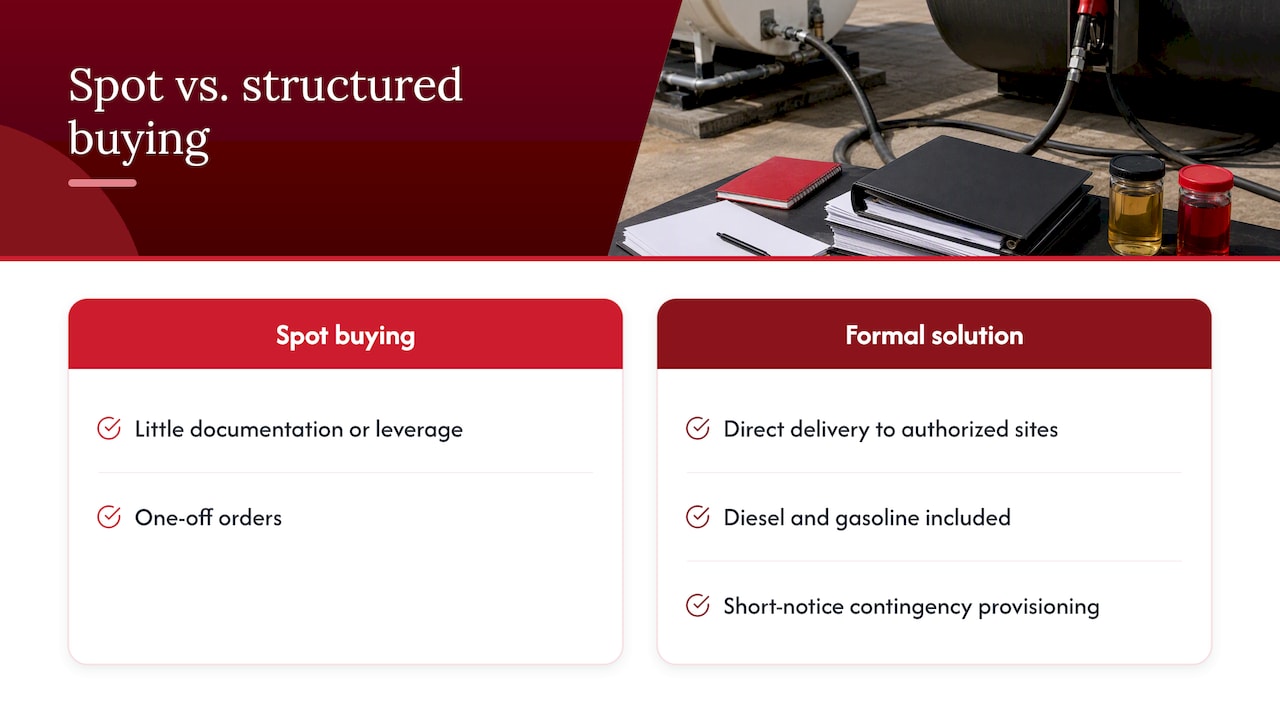
Municipal and government buyers often face a different version of this decision. Ad hoc spot buying leaves little documentation and little leverage. Direct-delivery fuel can instead be structured as a formal purchasing solution. The Department of Energy described its Direct Delivery Fuels Solution as covering commercial fuel delivered directly to authorized government locations, including diesel and gasoline and short-notice provisioning for humanitarian relief and contingency operations (DOE announcement). The announcement cited estimated potential savings of about 10% for that federal solution. That figure belongs to the federal procurement context and should not be read as a typical commercial discount.
The takeaway for agencies: weigh delivery structure, documentation, and contingency capability alongside unit price. A contract that pairs scheduled fleet fueling with an emergency tier is easier to audit than a string of one-off orders.
A simple way to decide
Score your site on five questions. Each “yes” points toward scheduled delivery.
- Is your weekly fuel use within roughly 20 to 25 percent of the same figure last month? (Use your own tolerance.)
- Will the equipment stay in one place for at least a few months?
- Is a stalled machine or dark generator expensive enough that you do not want to rely on someone remembering to call?
- Do you want a steady monthly budget line rather than variable orders?
- Would your supervisors rather spend time on production than on gauges?
If you answered yes to four or five, start with scheduled delivery. If you answered yes to two or fewer, start with will-call plus a firm reorder rule. Three is the sweet spot for a hybrid.
How Anytime Fuel Pros supports both models
We deliver on-site diesel (red dye and clear), gasoline, and DEF, and we run both scheduled recurring deliveries and on-demand orders, with emergency and after-hours response for critical operations. Our primary markets are San Antonio, Austin, Dallas-Fort Worth, and Salt Lake City, and our national partner network extends service across the continental United States, so multi-site operations can work with one point of contact. In covered areas, our emergency response target is three hours, and invoices are itemized so you can match every delivery to a site and a unit.
If you are setting up a recurring plan, start with our fuel services overview, or ask us to build a hybrid schedule when you place an order. For emergencies, see emergency fuel delivery.
FAQ
What is a scheduled fuel delivery?
A scheduled delivery is a planned drop of fuel on a set calendar or when a tank reaches a trigger level. Your supplier handles the timing, so you do not place each order. It works best where fuel use is steady and predictable.
What does will-call fuel delivery mean?
Will-call means you request each delivery yourself when you need fuel. You keep full control over timing and quantity. You are also responsible for ordering before the tank reaches a critical level.
Is scheduled delivery cheaper than will-call?
Not automatically. Scheduled delivery can lower costs through planned routing and by avoiding rush orders, but pricing depends on market, volume, fuel type, access, and urgency. Compare total cost, including crew time and downtime risk, not just the per-gallon figure.
Can I use both on the same site?
Yes, and many operations should. Use a scheduled base delivery for predictable burn, and keep will-call or emergency service available for surges, weather, and project changes.
How much fuel should a backup generator site keep on hand?
There is no universal number. Size it from your own runtime requirement, supplier lead time, and any regulatory or continuity standards that apply. The NRC’s seven-day guidance applies to nuclear safety-related systems and is only a planning reference for other facilities.
Sources
- What is Will-call vs. automatic delivery? | OctaneIQ Glossary
- Federal UST Requirements for Emergency Power Generator UST Systems | US EPA
- Regulatory Guide 1.137 Revision 2, Fuel Oil Systems for Emergency Power Supplies | NRC
- OMB Announcement, Best-in-Class Mandatory Solution – Direct Delivery Fuels | US DOE
Recent Comments