
Same-day fuel delivery typically arrives within 2 to 6 hours of your call, next-day service runs on a scheduled morning or afternoon window, and standard commercial or residential orders land within 1 to 5 business days depending on location. On-site pumping itself only takes about 20 to 40 minutes once the tanker arrives. The real variable isn’t the pump. It’s depot proximity, tanker availability, and whether your site is easy to reach.
TL;DR:
- Same-day fuel delivery typically arrives within 2 to 6 hours, depending on site access, depot proximity, and tanker availability, especially during peak seasons.
- Total lead times for scheduled deliveries range from 1 to 5 business days, influenced significantly by order size, site accessibility, and seasonal demand spikes.
- Rapid emergency fueling requires precise site information and clear access, with response times often between 2 to 4 hours, or up to 6 hours in complex cases.
- Preparing your order with current tank levels, GPS coordinates, and access instructions reduces delays; requesting guaranteed response times and proof-of-delivery details solidifies commitments.
- Digital proof-of-delivery and negotiated surcharges improve schedule reliability, especially for after-hours, remote, or small-volume orders.
Table of Contents
- Fuel Delivery Lead Times at a Glance
- What Actually Moves the Needle on Delivery Speed
- How Same-Day and Emergency Delivery Really Works
- Scheduling a Delivery So It Actually Shows Up on Time
- Why Proof of Delivery Protects Your Timeline, Not Just Your Invoice
- Costs and Surcharges That Change Your Timing Too
- Your Two-Minute Pre-Order Checklist
- Get Fuel Delivered on Your Timeline, Not Just Theirs
- Sources
Fuel Delivery Lead Times at a Glance
Every supplier quotes lead times a little differently, but the ranges cluster tightly once you strip away the marketing language. Here’s how the windows typically break down:
- Next-day delivery: a scheduled window the following business day, usually communicated as a morning or afternoon block rather than an exact minute.
- Standard residential or light commercial: 1 to 5 business days, with many providers in dense service areas promising 24 to 48 hours as their default.
- Bulk commercial fills: often require depot scheduling, which can push total lead time out further even when the drive itself is short.
Total lead time and pumping time are two different clocks. A supplier might quote a “2 hour window” for arrival, but the fuel transfer itself adds another 20 to 40 minutes on top. Expect a precise ETA once a driver is dispatched and en route, but only a broader time window during initial scheduling. That’s normal, not a sign of a disorganized vendor.
What Actually Moves the Needle on Delivery Speed
Lead time isn’t a fixed number. It’s the product of five variables, and understanding which ones you control changes how you plan.
Depot proximity and route planning set the floor. A site 15 minutes from a supplier’s depot has a fundamentally different earliest-availability window than one two hours out, and route sequencing determines whether your delivery slots into an existing run or requires a dedicated trip.
Order size and tanker capacity matter more than most managers expect. A 500-gallon top-off can often ride along with other stops on a driver’s route. A 5,000-gallon bulk fill usually requires matching a specific tanker to your order and may need a dedicated loading window at the depot, which adds time even when the destination is close.
Seasonality is the caveat every logistics manager eventually learns the hard way. Winter heating demand, harvest season, and storm response all compress the supply chain at once, and the EIA’s data on seasonal petroleum demand helps explain why lead times that run 24 hours in April can stretch to 3 or 4 days in January.
Site access issues (locked gates, narrow lanes, low clearance, permit requirements for restricted sites) delay dispatch because dispatchers need to confirm a tanker can physically reach your tank before they send one.
Account setup and fuel type add friction too. New accounts, payment verification, and dyed versus clear diesel handling commonly add a full business day to a first order, even when everything else is straightforward.
How Same-Day and Emergency Delivery Really Works
When you call for emergency fuel, the dispatcher isn’t just checking a calendar. They’re running a triage sequence: verifying your exact location, confirming site access, nailing down fuel grade and volume, and checking whether a tanker with that capacity is actually free.
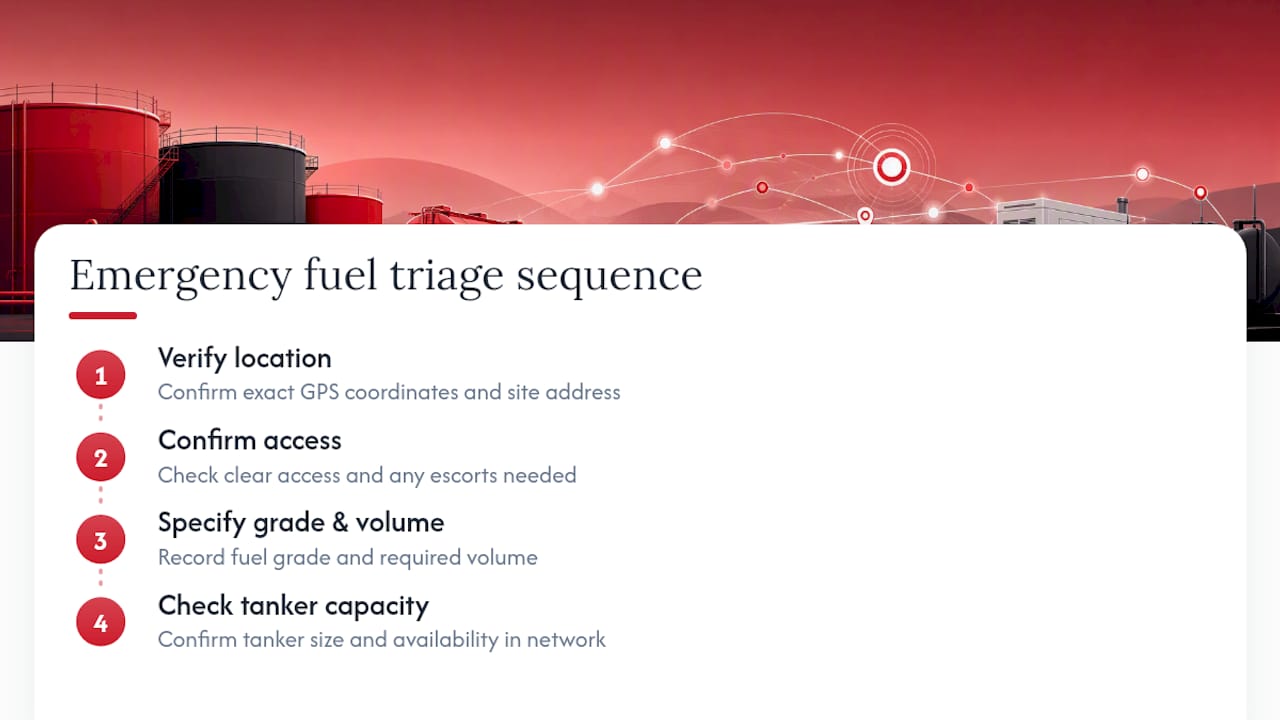
That process is why realistic same-day windows sit at 2 to 4 hours in many commercial markets, sometimes stretching to 6 hours depending on where you fall in the day’s route plan. Some providers advertise a firm emergency SLA, often around 3 hours, but that number only holds when your site checks every box: known location, clear access, and enough volume to justify the trip.
A few things push a request out of same-day territory even at a well-run supplier. A remote site with unclear GPS coordinates slows verification. A depot that’s already committed its tankers to a storm-response contract elsewhere means yours waits. Hazardous or restricted access, like a mine site requiring an escort, adds a coordination step dispatchers can’t skip.
This is where a national partner network changes the math. A single-depot supplier can only dispatch what’s parked in its own yard. A supplier working through a contracted partner network across multiple regions can tap the nearest available tanker instead of the nearest owned one, which is often the difference between a 3-hour response and a next-day scramble.
Scheduling a Delivery So It Actually Shows Up on Time
The fastest way to shrink your lead time is to hand the dispatcher everything they need before they have to ask for it. Here’s the sequence that works:
- Pull a dip reading and confirm tank capacity. Suppliers need your current fuel level and total capacity to size the delivery correctly.
- Have GPS coordinates ready, not just a street address, especially for job sites, remote yards, or multi-building campuses.
- Confirm fuel grade and volume needed (clear diesel, dyed diesel, gasoline, or DEF) before you call.
- Note access instructions and any permits the driver will need at the gate.
- Have your billing method confirmed since payment verification is a common source of first-order delay.
- Set internal reorder triggers, a buffer level that automatically kicks off an order before you’re running on fumes.
For same-day requests, the flow is call intake, verification, dispatch insertion into an existing route, then ETA confirmation once a driver is assigned. If you find yourself placing urgent orders more than once a month, a standing scheduled delivery arrangement removes most of that variability entirely.
Why Proof of Delivery Protects Your Timeline, Not Just Your Invoice
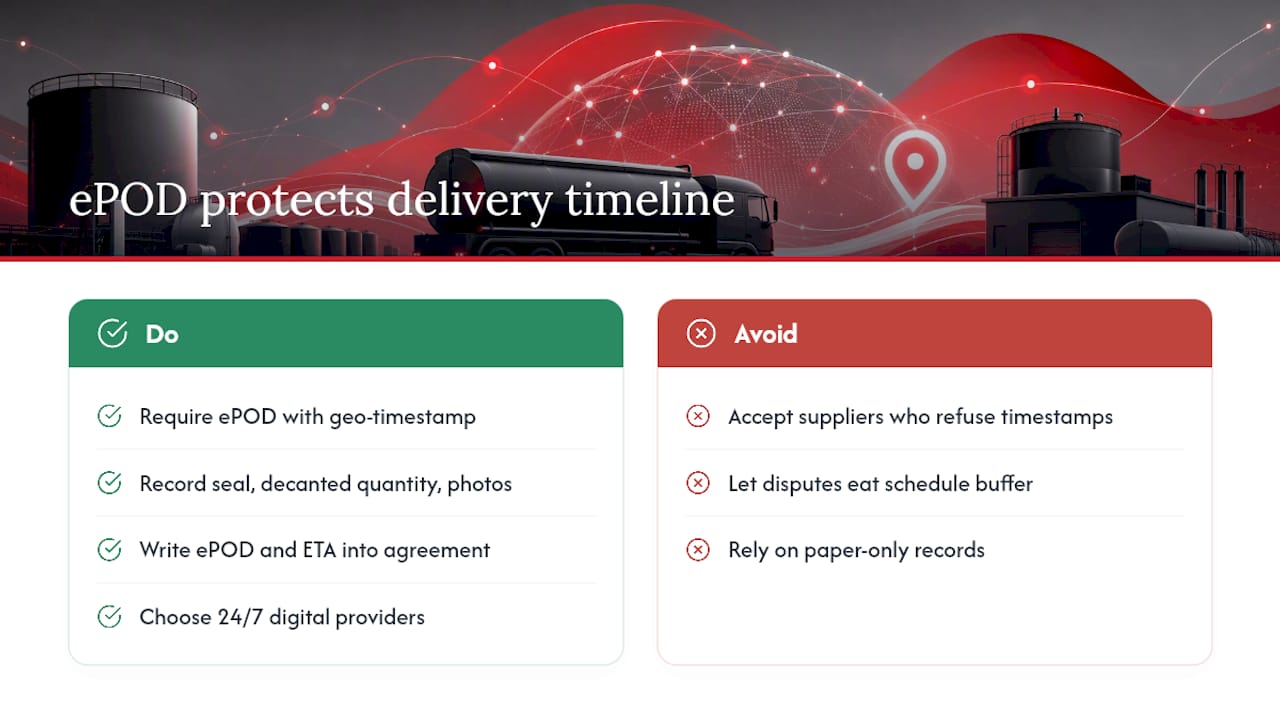
Electronic proof-of-delivery, or ePOD, records the tanker seal number, the decanted quantity, a geo-timestamp, and photos at the moment fuel transfers into your tank. Those fields aren’t paperwork for its own sake. They create an auditable record that settles short-delivery disputes in minutes instead of days.
That matters for lead time planning because unresolved disputes eat schedule buffer. When a delivery is questioned and there’s no geo-timestamped record, reconciliation can drag out over a week, during which your fuel logs and your actual tank levels disagree. Digitized delivery workflows close that gap by making late or partial deliveries visible in real time, not after the fact.
Providers running 24/7 emergency response, a national partner network, and digital invoicing tend to handle this well because the ePOD record and the dispatch system talk to each other.
Pro Tip: Write ePOD and ETA update requirements directly into your service agreement. A supplier that won’t commit to timestamped delivery records in writing usually can’t back up its lead-time promises either.
Costs and Surcharges That Change Your Timing Too
Speed and price are linked more often than suppliers advertise upfront. After-hours calls, holiday dispatch, and remote-access sites commonly carry a surcharge, and minimum-volume premiums apply when your order falls below a tanker’s efficient load size. If your order doesn’t match available tanker capacity, dispatch can slip while the supplier waits to pair your fill with another nearby stop.
Account status changes this equation. Prepaid accounts and established contracts almost always get dispatch priority over first-time or COD orders, because there’s no payment verification step slowing things down.
Worth negotiating into any recurring arrangement: response-time credits if a guaranteed window is missed, a capped rush fee instead of an open-ended after-hours charge, and clear rules for what triggers a remote-access surcharge before you agree to it.
Your Two-Minute Pre-Order Checklist
Before you pick up the phone, confirm four things: your dip reading, your GPS coordinates, that payment is ready, and any access notes the driver needs. That’s it. Most avoidable delays trace back to one of those four items being incomplete when the dispatcher answers.
Then ask your supplier three questions that turn vague promises into commitments:
- What’s your guaranteed response time, and what happens if you miss it?
- What does your proof-of-delivery record actually capture, seal number, quantity, timestamp, photos?
- What triggers a surcharge, and is there a cap?
If you’re calling in urgent orders more than once a quarter, that’s your signal to convert to a scheduled contract instead of repeating this checklist under pressure every time.
Get Fuel Delivered on Your Timeline, Not Just Theirs
Anytimefuelpros built its dispatch model around the exact friction points covered above: depot proximity, tanker matching, and site access verification, so quoted windows hold up instead of sliding. Through a national partner network, Anytimefuelpros can source the nearest available tanker rather than the nearest owned one, which is often what separates a same-day response from a next-day wait.
That matters most when you’re the operations manager who can’t afford a guessing game. Every delivery ships with digital proof-of-delivery records covering timestamp, quantity, and site confirmation, so reconciliation happens fast and your fuel logs match reality. Emergency requests route through 24/7 dispatch built for the exact triage sequence described above.
If you’re tired of vague ETAs and want a supplier that treats a quoted window as a commitment, request a delivery quote now and get a real timeline for your site, not a marketing range.
Sources
- ePOD for fuel, petroleum & LPG delivery — Fretron
- Electronic proof-of-delivery (ePOD) — Webfleet
- Oil and petroleum explained — U.S. Energy Information Administration (EIA)
Recent Comments