
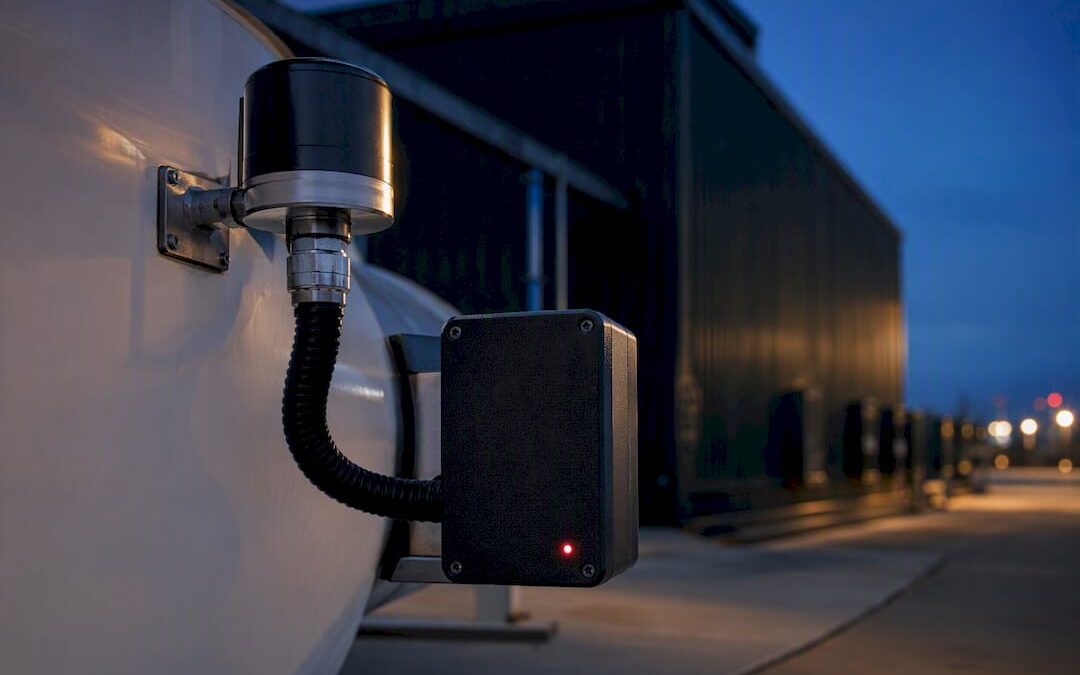
Remote tank monitoring feeds continuous level, temperature, and status data from tank-mounted sensors to a cloud dashboard that flags problems before they become downtime. Built on IIoT connectivity like LTE-M and paired with a partner network like Anytime Fuel Pros, it replaces manual dipstick checks with alerts that trigger the right response automatically. The payoff shows up fast: fewer emergency runs, fewer wasted truck rolls, and replenishment schedules built on actual consumption data instead of guesswork.
TL;DR:
- Cellular connectivity options like LTE-M and satellite are crucial for sites with poor signal, and gateways can reduce data plan costs when monitoring multiple tanks.
- Radar sensors are best for hazardous, contaminated, or buried tanks due to their non-contact measurement method and certification options like IP68, ATEX, or UL.
- Automatic threshold alerts significantly reduce emergency and unnecessary fuel deliveries by providing real-time level and temperature data for scheduling.
- Validating vendor certifications, open API access, and redundancy features before purchase ensures data security and system integration for scalable operations.
- Proper site surveys, port sizing, and calibration are essential to prevent retrofit delays, and maintenance costs decrease once alerts reduce manual checks.
Table of Contents
- What Is Remote Tank Monitoring and Who Uses It?
- Which Sensor Type Fits Your Tank and Fluid?
- How Do Connectivity and Cloud Platforms Work Together?
- How Does Tank Monitoring Reduce Costs and Prevent Theft?
- What Should You Check Before Installing a Monitor?
- How Do You Evaluate a Tank Monitoring Vendor?
- How Does Monitoring Pair With On-Site Fuel Delivery?
- How Do You Connect Tank Data to ERP and Business Systems?
- What Do Battery Life and Total Cost Really Look Like?
- Is Your Tank Data Actually Secure?
- What Regulations Apply to Remote Tank Monitoring?
- How Do You Troubleshoot a Monitoring System That Stops Reporting?
- Anytime Fuel Pros: Turning Alerts Into Action
- Sources
What Is Remote Tank Monitoring and Who Uses It?
A remote tank monitoring system has four working parts: a sensor that measures level (and often temperature or pressure), a telemetry unit that transmits readings, a cloud dashboard that stores and displays the data, and an alert engine that notifies someone when a threshold gets crossed. Cross a low-level trigger, and the system can automatically flag dispatch, either to your own fleet or to a fuel delivery partner.
The asset types covered are broader than most managers expect:
- Stationary bulk storage tanks at job sites, farms, and equipment yards
- Mobile fuel bowsers and skid tanks that move between locations
- Propane tanks for heating, generators, and process equipment
- IBCs, totes, and drums holding chemicals or lubricants
Because the telemetry runs on IIoT infrastructure rather than a single site network, a regional manager can watch fifty tanks across three states from one screen. Some IIoT platforms report managing over 100,000 tanks across more than 70 countries, which tells you the architecture scales far past a single facility’s needs.
Which Sensor Type Fits Your Tank and Fluid?
Sensor choice is where most monitoring projects succeed or stall. Each type trades off accuracy, mounting complexity, and tolerance for messy real-world conditions.
- Radar sensors measure level without touching the fluid, which makes them a strong fit for hazardous or contaminated media. Non-contact radar holds up well across diverse fluid types precisely because nothing in the sensor ever contacts what’s inside the tank.
- Pressure/hydrostatic transducers sit at the tank bottom and infer level from fluid weight; they’re economical but need recalibration if fluid density shifts.
- Ultrasonic sensors bounce sound waves off the surface and work well on open, calm liquids, but foam or heavy vapor can scatter the signal and throw off readings.
- Float sensors are simple and cheap, though moving parts mean more maintenance and less precision on viscous or sludgy fluids.
Buried tanks, agitated vessels, and tanks with mixers all complicate ultrasonic and float readings, which is why radar tends to win in those environments. Certifications matter as much as measurement method: look for IP68 enclosure ratings and, for flammable or hazardous stored products, ATEX, IECEx, or UL certification on the sensor itself.
Pro Tip: Match sensor type to your worst-case condition, not your average one. A tank that’s usually calm but occasionally foams during fast fills needs a sensor rated for that edge case, not just the easy days.
How Do Connectivity and Cloud Platforms Work Together?
Connectivity determines whether your data actually arrives, and that choice depends entirely on where your tanks sit. LTE-M and NB-IoT cellular networks handle most sites well, since they’re built for low-power, infrequent transmissions from equipment that isn’t near Wi-Fi. Cat-1 cellular offers higher bandwidth where you need faster reporting. Satellite becomes the fallback for genuinely remote sites, mine locations, or rural farmland where cellular coverage doesn’t reach.
Architecture matters too. Direct-to-cloud devices transmit straight from the sensor, which is simpler to deploy but limits you to one device per data connection. Gateway architectures let multiple sensors on a site share one connection, which cuts data plan costs when you’re monitoring several tanks in one yard.
Whichever route you pick, demand these platform features before you commit:
- Open API access for pulling data into your own systems
- Multi-channel alerting through SMS, email, and webhook
- Centralized device management for firmware and configuration
- Data export in standard formats, not a proprietary lock-in
- Redundant hosting so a single server outage doesn’t blind you
Platforms built around dashboards, alarm rules, and integrations are the ones that hold up as your tank count grows past a handful of sites.
How Does Tank Monitoring Reduce Costs and Prevent Theft?
Telemetry only matters if it changes what your team does next. Here’s how the data converts into operational savings:
- Threshold alerts replace calendar-based checks. Instead of sending someone to eyeball a tank every Tuesday, the system notifies you when levels actually hit a reorder point, which cuts emergency deliveries and unnecessary top-offs alike.
- Consumption forecasting smooths routing. Once you have weeks of data, you can predict when a tank will hit empty and schedule a fill during a normal route instead of paying an emergency premium.
- Level drops correlated with GPS and engine data flag theft. A tank draining overnight with no matching engine hours or dispatch record is a red flag a dashboard can catch in minutes rather than weeks, and correlating level data with vehicle telemetry is exactly how these systems distinguish siphoning from normal use.
- Temperature and level logs support compliance. Audit trails matter for regulated fuel or chemical storage, and automated logging beats a handwritten sheet when an inspector asks for history.
Add it up, and the ROI comes from three levers: fewer truck rolls, lower emergency delivery costs, and less unplanned downtime when equipment runs dry mid-shift.
What Should You Check Before Installing a Monitor?
Retrofitting an existing tank is where projects hit unexpected snags. Work through this checklist before you order hardware:
- Port size and mounting type. Confirm the tank’s port dimensions and thread standard, commonly 2-inch NPT, before ordering a sensor. Mismatched threads are a frequent retrofit headache that stalls installs and forces last-minute adapter orders. If you’re also evaluating tank capacity as part of the project, it helps to size the tank correctly at the same time.
- IP rating and hazardous-area certification. Match the enclosure rating and any ATEX/IECEx/UL requirement to the product actually stored, not a generic default.
- Battery life and replacement plan. Know upfront how the device gets serviced once it’s mounted 20 feet up a bulk tank.
- SIM and data plan. Confirm coverage at the exact site, not just “cellular should work here.”
- Connectivity survey. Walk or map the site to confirm signal strength; low-signal sites may need a satellite unit or a repeater.
- Commissioning. Calibrate against a known volume, set your alert thresholds, and test alert delivery end-to-end before trusting the system with a real fill.
Pro Tip: Photograph every tank fitting during the site survey, not just the ones you think are standard. A five-minute photo now saves an afternoon of adapter-hunting during install.
How Do You Evaluate a Tank Monitoring Vendor?
Run every vendor through the same short list before signing anything.
- Sensor accuracy and connectivity redundancy. Ask what happens when the primary cellular signal drops. Is there a satellite fallback, or does the tank go dark?
- Platform openness. Does the API let you pull data into your own ERP or dispatch system, or does the vendor expect you to live inside their dashboard permanently?
- Certifications. Get the actual documentation for hazardous-area ratings, not a verbal assurance that the device is “compliant.”
- Total cost of ownership. Separate device price from subscription cost, and ask whether billing is per-tank or per-site, since that changes fast as you scale.
- Service terms. Confirm installation support, warranty length, and whether there’s a real SLA on data uptime and alert delivery, not just a marketing claim.
Red flags worth walking away from: a closed data silo with no export option, vague certification language that dodges a direct answer, and any vendor who can’t explain their connectivity redundancy in one sentence.
How Does Monitoring Pair With On-Site Fuel Delivery?
Telemetry is only half the equation. Once a low-level alert fires, someone has to act on it, and that’s where monitoring meets delivery. A threshold breach can trigger a scheduled fill during normal operations, or an emergency dispatch when a generator can’t wait. Reconciling sensor readings against delivery tickets afterward is how you catch discrepancies between what the sensor logged and what actually got pumped, which matters for both billing accuracy and inventory integrity.
This pairing works especially well for data center backup generators that can’t tolerate a missed refill, remote construction sites where a dry tank means idle equipment, and disaster response operations where fuel demand spikes with zero warning. Anytime Fuel Pros services jobs like these through scheduled and emergency delivery built around exactly this kind of alert-driven workflow.
How Do You Connect Tank Data to ERP and Business Systems?
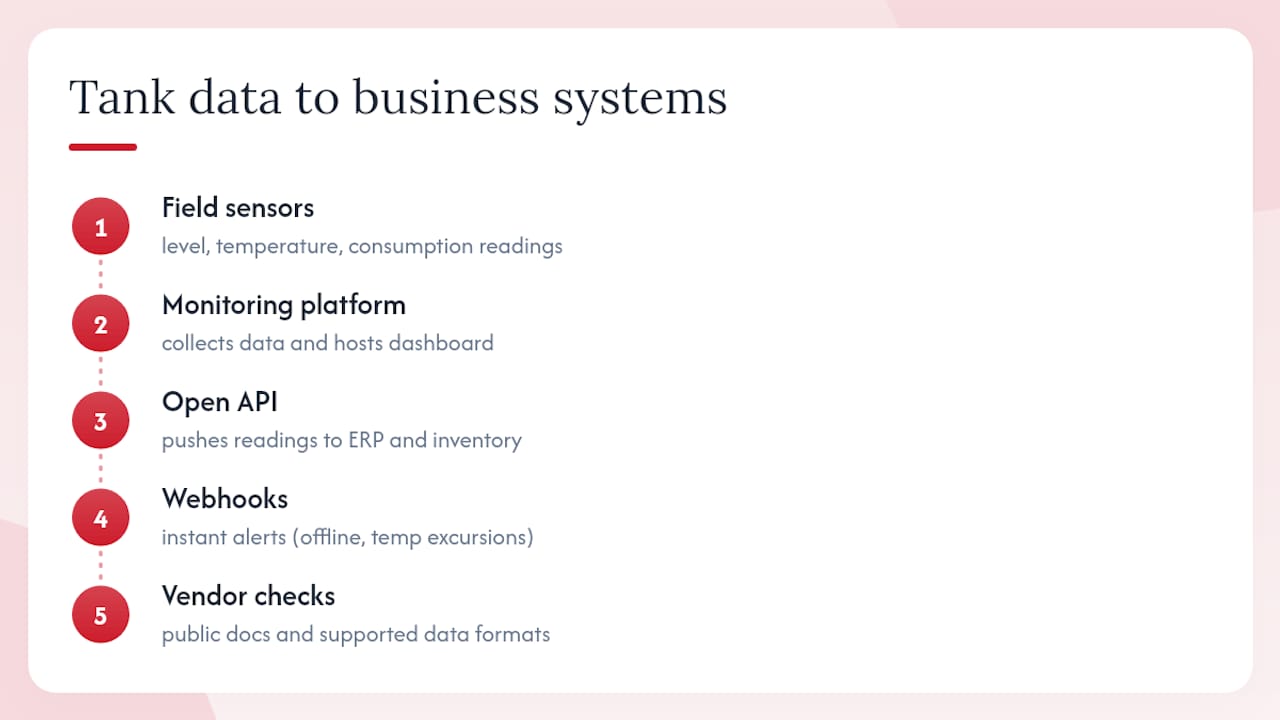
A tank monitoring dashboard that only lives on its own screen is half-useful. The real value comes when level, temperature, and consumption data flow into the systems your team already runs, procurement software, maintenance ticketing, or an ERP platform tracking fuel and inventory costs across sites.
An open API is the mechanism that makes this possible. Instead of someone manually copying numbers from a monitoring dashboard into a spreadsheet, the API pushes readings directly into your inventory management system, updates reorder triggers automatically, and can even generate purchase orders when a tank crosses a set threshold. ERP and API integration is one of the features that separates a platform built for scale from one built for a single site.
Webhook support matters just as much as the API itself. A webhook lets the monitoring platform notify an external system the instant an event happens, a low-level alert, a sensor going offline, a temperature excursion, rather than waiting for that system to poll for updates on a schedule. For operations running dispatch software or a maintenance CMMS, that immediacy is what turns a data point into an action.
Before committing to a platform, ask specifically what data formats the export supports and whether the API documentation is public or locked behind a sales call. A vendor confident in their integration will hand over documentation without friction. One that hedges or stalls is often signaling a closed system dressed up with API language on the sales page.
What Do Battery Life and Total Cost Really Look Like?
Battery-powered sensors dominate this market because running conduit and AC power to a tank in a back field usually costs more than the sensor itself. Reporting frequency drives battery drain more than anything else: a device pinging hourly lasts far longer than one streaming readings every few minutes. Some industrial-grade monitors advertise battery life up to 10 years at low reporting frequencies, paired with IP68 enclosures rated for outdoor exposure.
Total cost of ownership breaks into three buckets: hardware, data, and labor. Hardware is the one-time sensor and telemetry unit cost. Data is the recurring SIM or satellite plan, and this is where budgets get surprised. Scaling from a handful of tanks to several hundred multiplies your per-device data plan costs fast if you haven’t negotiated bulk pricing or throttled reporting frequency on low-priority tanks. Labor is the ongoing cost of battery swaps, recalibration, and troubleshooting, which shrinks dramatically once your team trusts the alerts enough to stop double-checking with manual dips.
The mistake to avoid is optimizing hardware cost while ignoring data plan math at scale. A $50 cheaper sensor multiplied across 200 tanks saves real money once. A data plan that’s $2 more per device per month compounds every single month, for as long as the device is in service.
Is Your Tank Data Actually Secure?
Tank-level data feels mundane until you consider what it actually reveals: fuel consumption patterns, site activity schedules, and inventory levels that a competitor or thief would find valuable. A dashboard showing exactly when a remote site’s fuel runs low is also a map of when that site is most vulnerable.
Encryption in transit and at rest should be table stakes for any platform handling this data, and you should ask directly rather than assume. Device authentication matters too. A sensor sending unauthenticated data over an open cellular connection is a door left unlocked; look for platforms that require device-level credentials so a spoofed sensor can’t inject false readings into your dashboard.
Access control inside the platform matters just as much as the perimeter. Not every user needs visibility into every tank across every site, and not every user needs the ability to change alert thresholds. Role-based permissions keep a junior scheduler from accidentally silencing a critical low-level alarm meant for a site superintendent.
Ask vendors directly where data is hosted, who owns it once it’s in their system, and whether it can be fully exported if you switch platforms later. A vendor that treats your consumption history as their proprietary asset, rather than yours, is a partnership risk as much as a security one.
What Regulations Apply to Remote Tank Monitoring?
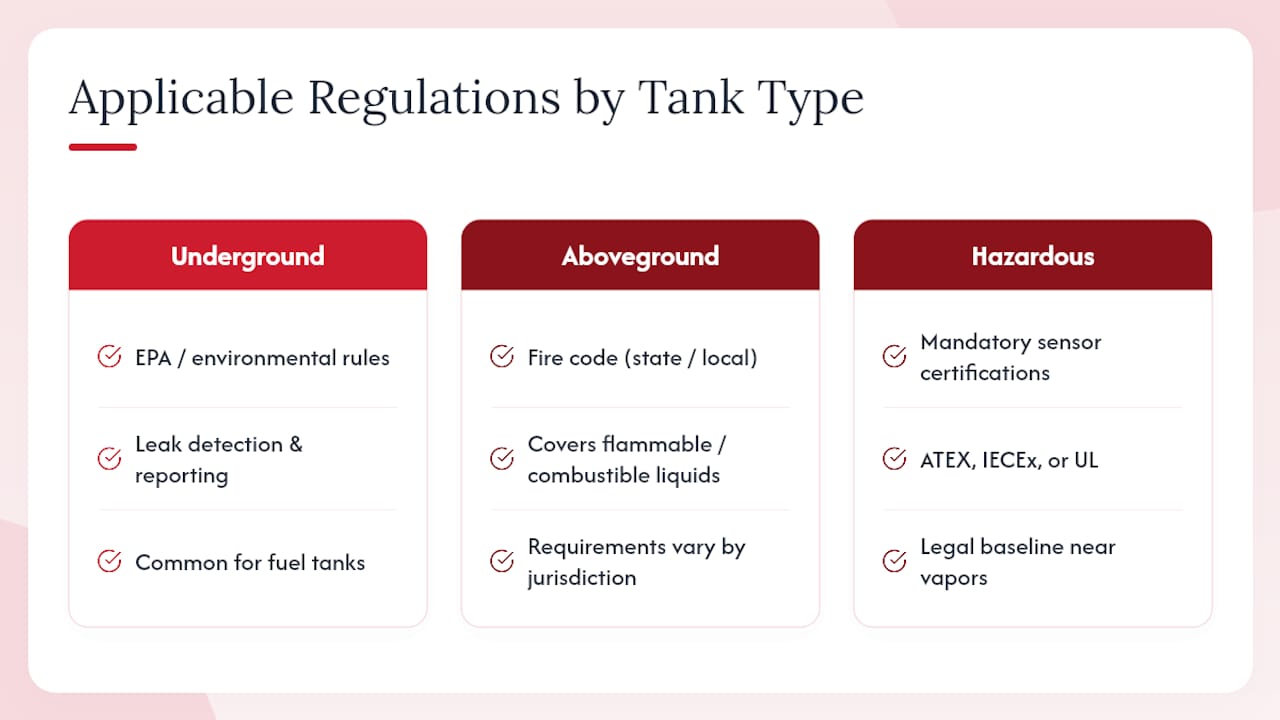
Regulatory requirements around tank monitoring vary by what’s stored and where the tank sits, so there’s no single blanket standard to check off. Fuel storage tanks, particularly underground ones, often fall under environmental protection agency rules governing leak detection and reporting. Aboveground storage tanks holding flammable or combustible liquids typically fall under fire code requirements that vary by state and municipality.
For hazardous locations, the certification requirements discussed earlier for sensor selection, ATEX, IECEx, or UL, aren’t optional extras. They’re often the legal baseline for installing electronic equipment near flammable vapors. Skipping that certification isn’t just a technical risk; it can violate the fire code that governs the site.
Temperature and level logging plays directly into compliance for temperature-sensitive product storage, since an automated, timestamped record beats a handwritten log when demonstrating due diligence to an inspector or auditor. Retaining that data for the period your jurisdiction or industry requires matters as much as capturing it in the first place.
None of this replaces a conversation with your local fire marshal or environmental compliance officer about your specific tank, product, and location. Monitoring vendors can tell you what their sensor is certified for. They generally can’t tell you what your specific site is legally required to have, and treating a sales rep’s certification claim as legal advice is a mistake worth avoiding.
How Do You Troubleshoot a Monitoring System That Stops Reporting?
Most tank monitoring failures fall into a short list of repeat offenders, and working through them in order usually finds the problem faster than guessing.
Start with connectivity. A device that’s gone silent is more often a signal problem than a sensor failure: check whether the cellular carrier changed network bands, whether a SIM plan lapsed, or whether something new on site, a metal structure, parked equipment, is blocking signal path. Next, check the battery. A device reporting erratically, with gaps that grow longer over time, is often showing early battery drain before it fails outright.
If the device is reporting but the numbers look wrong, recalibration is the usual fix. Sensors can drift over months, especially pressure transducers if fluid density has changed, or ultrasonic units if buildup has formed on the sensor face. A quick manual dip compared against the dashboard reading tells you fast whether you’re looking at a real level or a drifted one.
Alert failures deserve their own check, separate from sensor accuracy. A system can be reading correctly but failing to notify anyone if a webhook endpoint changed, an email filter caught the alert, or a phone number on file is outdated. Test alert delivery on a schedule, not just at installation, since contact information and integrations both drift over time without anyone noticing until an alert that mattered never arrived.
Anytime Fuel Pros: Turning Alerts Into Action
A monitoring dashboard tells you a tank is running low. It doesn’t put fuel in it. That’s the gap Anytime Fuel Pros fills, accepting monitoring-based refill schedules and turning a threshold alert into an actual delivery, whether that’s a routine scheduled top-off or a same-day emergency response when a generator can’t wait.

This combination works best in situations where downtime isn’t an option: data center backup generators that need guaranteed fuel on hand, mining operations running equipment in locations too remote for a quick station run, construction sites where idle machinery burns labor costs by the hour, and disaster response scenarios where demand spikes overnight. Anytime Fuel Pros operates in Texas and Utah directly, and reaches sites nationwide through a trusted partner network, giving multi-site operators one point of contact instead of juggling regional vendors.
If your tanks are already wired for alerts, or you’re planning a monitoring rollout, the next step is lining up a delivery partner who can act on those alerts the same day. Start with a look at emergency and on-demand diesel delivery to see how scheduled fills and rapid response fit around the thresholds you’re already tracking.
Sources
- WIKA IIoT tank monitoring brochure (2026)
- Rivio — Remote tank monitoring systems
- ThingsBoard — tank level monitoring use case
- Icon Process Controls — Sentinel Lite product page
- Datoms — Remote fuel tank monitoring
Recent Comments