

Single vendor multi-site fueling is the practice of consolidating all fuel procurement, delivery, and management across multiple locations under one accountable supplier. For operations directors, fleet managers, and procurement officers running equipment across Texas job sites, Utah mining operations, or a nationwide fleet, fragmented fuel vendors create a quiet profit killer. Each additional supplier adds billing complexity, accountability gaps, and coordination overhead that compounds across every site. This guide covers what you need to implement consolidated fueling, how to execute the rollout without disrupting operations, and the pitfalls that derail most attempts.
What does single vendor multi-site fueling actually require?
Multi-site fuel vendor consolidation, the industry term for this practice, is more than signing a new contract. It requires a structured assessment of your existing fueling infrastructure before any vendor conversation begins.

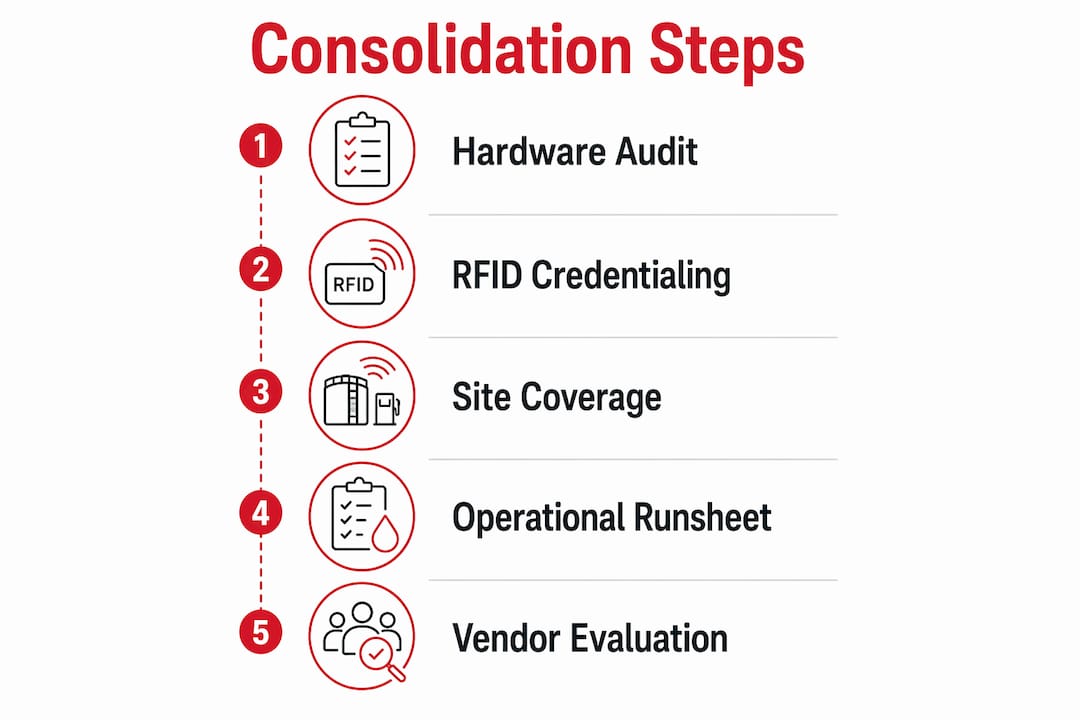
Start with a diagnostics phase. Documenting existing fueling hardware and communication protocols before development avoids unexpected equipment replacements and costly downtime mid-rollout. This means cataloging every fuel island, pump controller, tank monitor, and RFID reader across all sites. Skipping this step is the most common cause of budget overruns.
The core tools required for a functioning consolidated fueling program include:
- Unified RFID credentials. A single card or fob that authenticates drivers and equipment across all locations. WEX Inc. launched the first unified card handling both fuel and EV charging in 2026, providing detailed transaction data and volume-based pricing advantages. That level of credential consolidation reduces administrative complexity across mixed fleets.
- Integrated fleet management software. A platform that pulls transaction data from every site into one dashboard. Real-time visibility into fuel consumption by site, vehicle, or driver is what separates consolidated fueling from simply having one invoice.
- Network coverage verification. Your vendor must have physical or partner coverage at every location you operate. A single vendor with gaps in your network is worse than two vendors with full coverage.
- Hardware compatibility assessment. Older pump controllers may require protocol adapters or full replacement. Know this before you commit.
| Requirement | Why it matters |
|---|---|
| Hardware audit | Prevents mid-rollout equipment surprises |
| RFID credential system | Enables unified driver authentication across sites |
| Fleet management platform | Delivers real-time data and consolidated reporting |
| Network coverage map | Confirms vendor reach matches your site footprint |
| Protocol documentation | Ensures software integration without custom workarounds |
Pro Tip: Request a site-by-site coverage map from any vendor before signing. A vendor who cannot produce one within 48 hours is not operationally ready for your account.
How to execute a multi-site fueling rollout without disrupting operations
The biggest mistake in rolling out a consolidated fueling program is attempting to cut over all sites simultaneously. A staged approach by site groups is the standard for high-uptime operations.
Here is the sequence that works:
- Group sites by geography and volume. Start with your lowest-volume sites or those with the newest hardware. Early wins build internal confidence and surface integration issues at low risk.
- Run parallel systems during transition. Keep the existing vendor active at each site until the new system has operated stably for at least 30 days. Staged cutover with rollback options for 30 days reduces risk during fueling system transitions. That buffer is not optional for critical operations.
- Synchronize hardware and software updates before go-live. Coordinate with your vendor and internal IT to complete all pump controller configurations, RFID programming, and platform integrations before drivers touch the new system.
- Schedule cutovers during off-peak periods. A construction fleet cuts over on a Sunday. A municipal fleet cuts over during a holiday week. Timing matters more than most teams acknowledge.
- Brief drivers and site operators in advance. Drivers who show up to a changed pump interface without warning create support calls, workarounds, and data gaps. A 15-minute briefing per site prevents hours of cleanup.
The transition timeline varies significantly by scale. Small fleets with standard hardware typically finish in weeks, whereas extensive municipal or customized deployments take months. Plan your timeline against your actual hardware complexity, not your preferred go-live date.
- Assign a single internal owner for the rollout. Distributed ownership means no one is accountable when issues arise.
- Document every exception during the parallel period. These exceptions become your post-rollout training material.
- Confirm DEF delivery and dyed diesel compliance requirements are mapped into the new system before cutover, not after.
Pro Tip: Build a one-page site-specific runsheet for each location covering pump IDs, RFID card types, emergency contacts, and rollback procedures. Laminate it and leave it at the fuel island.
What are the real benefits of consolidating to a single fuel supplier?
The operational case for single supplier fueling solutions is built on four measurable outcomes: lower administrative cost, better cost control, improved uptime, and data you can actually use.
Consolidated vendor portfolios promote cost control and efficiency gains beyond what standalone component management can achieve. That is because a single accountable partner has an incentive to manage your total cost of ownership, not just their slice of it.
The specific benefits break down as follows:
- Unified billing and reporting. One invoice, one reconciliation process, one point of contact for disputes. For a company running 15 sites across three states, this alone eliminates dozens of hours of monthly administrative work.
- Volume pricing. Consolidated fuel spend gives you negotiating leverage you cannot access when purchases are split across regional vendors.
- Accountability without gaps. Fragmented vendors manage symptoms; a single accountable partner manages overall outcomes like uptime and cost-per-mile. When a site goes down, there is no finger-pointing between suppliers.
- Compliance visibility. Dyed diesel usage, DEF volumes, and government contract reporting all flow through one platform. Audit preparation drops from days to hours.
- Supplier diversity support. The Shell and Hightowers partnership demonstrates how hybrid vendor consolidation can cover 30,000+ locations while supporting diversity-certified suppliers under one billing and reporting program. Enterprise procurement teams can meet ESG goals without sacrificing network coverage.
The data integration benefit is often underestimated. Unified fuel management platforms give procurement and finance teams a common platform for managing national-scale fuel programs. When fuel data connects to telematics and maintenance records, you can calculate true cost-per-mile and identify which sites or vehicles are burning fuel inefficiently.
| Metric | Fragmented vendors | Single vendor |
|---|---|---|
| Billing complexity | Multiple invoices, formats, contacts | One invoice, one reconciliation |
| Accountability | Shared, often disputed | Single point of ownership |
| Data visibility | Siloed by vendor | Unified across all sites |
| Volume pricing | Limited, site-by-site | Consolidated spend leverage |
| Compliance reporting | Manual aggregation | Automated, platform-driven |
What challenges and mistakes should you avoid?
The most common failure in multi-site fuel management is treating vendor consolidation as a software purchase. Vendor consolidation is a structural commitment that changes incentives from managing isolated parts to managing the entire fleet outcome. Signing a new platform contract without changing the underlying vendor relationships does not deliver the benefits.
The other mistakes that consistently derail rollouts:
- Skipping the hardware audit. Teams that assume existing pump controllers are compatible without documentation routinely discover mid-project that 20% of their sites need hardware replacement. That discovery at week six of a planned four-week rollout is expensive.
- Simultaneous cutover across all sites. Without a rollback path, a software misconfiguration at one site can cascade. Group-by-group deployment with localized standalone operation modes is not overcautious. It is standard practice for any fleet where downtime has a dollar cost.
- Ignoring network coverage gaps. A vendor with strong coverage in Texas but no partner presence in Utah is not a single vendor solution for a company operating in both states. Verify coverage before negotiating price.
- Mismatched fueling locations. Your vendor’s network must align with where your drivers actually fuel, not where the vendor’s marketing map shows coverage. Request transaction-level data from reference customers in your operating regions.
- Overlooking ESG and diversity requirements. For municipal fleets and enterprise procurement teams, supplier diversity is a contractual obligation. Confirm your consolidated vendor can document diversity spend before you sign.
The structural shift matters more than the technology. A company that replaces five vendors with one but keeps the same fragmented accountability model will see the same outcomes with a smaller vendor list.
Pro Tip: Ask any prospective vendor for three reference accounts with a similar site count and geographic spread to yours. A vendor who hesitates on this request has not operated at your scale.
How Anytimefuelpros supports multi-site fueling operations
Anytimefuelpros delivers on-site diesel, gasoline, DEF, and bulk fuel directly to job sites, equipment yards, data centers, and municipal fleets across Texas, Utah, and nationwide through a trusted partner network. For multi-site operations, Anytimefuelpros provides a single point of contact for scheduled and emergency fuel delivery across all your locations, with transparent invoicing and 24/7 response capability. Whether you are managing a construction fleet in Dallas, a mining operation in Utah, or a generator network across multiple data centers, Anytimefuelpros coordinates delivery without requiring you to manage regional vendors separately. Get answers to your specific fueling requirements at the fuel delivery questions page, or explore on-site fuel delivery options for your business.
Key takeaways
Consolidated fueling under a single vendor reduces administrative overhead, improves accountability, and gives multi-site operations the data visibility needed to control total fuel costs across every location.
| Point | Details |
|---|---|
| Diagnostics before contracts | Audit all hardware and protocols before selecting a vendor to avoid mid-rollout surprises. |
| Staged rollout with rollback | Deploy site-by-site with 30 days of parallel operation before full cutover. |
| Accountability is structural | Consolidation only works when the vendor owns outcomes, not just transactions. |
| Coverage verification is non-negotiable | Confirm physical or partner network coverage at every site before signing. |
| Data integration drives savings | Unified platforms connect fuel, telematics, and maintenance data for true cost visibility. |
FAQ
What is multi-site fuel vendor consolidation?
Multi-site fuel vendor consolidation is the process of replacing multiple regional or site-specific fuel suppliers with a single accountable vendor managing procurement, delivery, billing, and reporting across all locations. The goal is unified visibility and reduced administrative complexity.
How long does a multi-site fueling rollout take?
Small fleets with standard hardware typically complete the transition in weeks. Large municipal or enterprise deployments with custom hardware integrations can take several months. The diagnostic and hardware audit phase determines the actual timeline.
What tools are required for consolidated fueling?
The core requirements are unified RFID credentials for driver and equipment authentication, an integrated fleet management platform for real-time reporting, and a vendor with verified network coverage at all operating locations.
Can a single vendor support both fuel and EV charging?
Yes. WEX Inc. launched the first unified card covering both fuel and EV charging in 2026, providing transaction-level data and volume pricing across mixed fleets. This approach reduces credential complexity as fleets transition to electric vehicles.
What is the biggest mistake companies make when consolidating fuel vendors?
The most common mistake is treating consolidation as a software purchase rather than a structural accountability change. Replacing vendor contracts without changing the accountability model produces the same fragmented outcomes with fewer vendors.
Recommended
- Why More Job Sites Are Choosing On-Site Fuel Delivery (And Why Yours Should Too) – Anytime Fuel Pros
- Mastering Fuel Tanks: Choosing the Right Capacity for Your Project – Anytime Fuel Pros
- How On-Site Fuel Delivery Can Elevate Your Business – Anytime Fuel Pros
- On-Site Diesel Delivery Setup: A Guide for Operations Managers
Recent Comments