
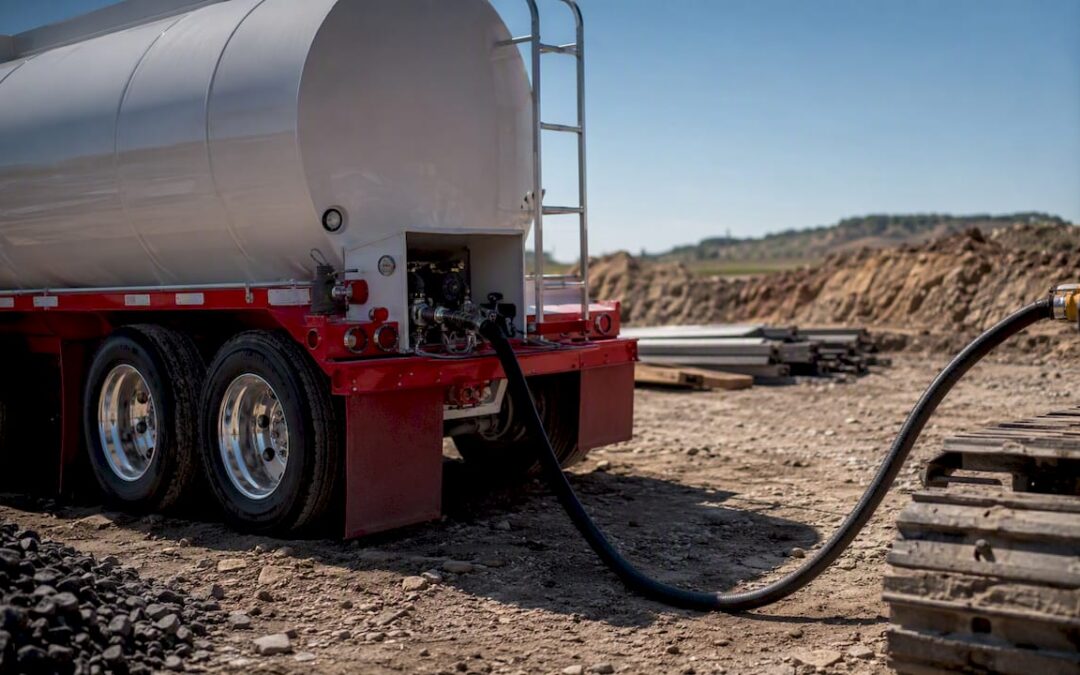
For construction fleets operating across multiple job sites, Anytimefuelpros is the recommended fuel delivery partner — offering on-site clear and dyed diesel, DEF, bulk tank services, 24/7 emergency response, and nationwide coverage through a vetted partner network.
Why procurement and fleet managers choose Anytimefuelpros:
- Coverage: Primary markets in San Antonio, Austin, Dallas-Fort Worth, and Salt Lake City, with continental U.S. delivery through a national partner network — one point of contact for multi-site contracts.
- Scheduled and emergency delivery: Recurring scheduled fills plus 24/7 after-hours emergency response, so a dry excavator at 2 AM does not become a half-day shutdown.
- Fuel types: On-site clear diesel (on-road), red dye diesel (off-road/tax-exempt), and Delivered fuel types include on-site clear diesel, red dye diesel, and DEF, all provided from a single source.
- Billing transparency: Itemized invoicing, telematics-supported proof-of-delivery, and no surprise line items.
Ready to verify coverage for your sites? Request a quote or check your service area before you read further.
Key Takeaways
The most effective approach to contracting diesel fuel suppliers for construction fleets is to lead with SLA requirements, verify compliance documentation before signing, and consolidate fuel types and sites under a single provider with a proven partner network.
| Point | Details |
|---|---|
| Demand written SLAs | Require committed response times for both scheduled and emergency deliveries before contract signature. |
| Confirm all fuel types | Verify the supplier delivers clear diesel, red dye diesel, and DEF to avoid managing multiple vendors. |
| Require proof-of-delivery | POD records with timestamps and gallons dispensed are the audit trail for billing accuracy and SLA compliance. |
| Validate insurance and MSDS | Pollution liability coverage and current MSDS documents are non-negotiable compliance requirements for on-site fueling. |
| Anytimefuelpros as recommended partner | Anytimefuelpros covers all five core service categories with 24/7 emergency response and nationwide partner-network reach. |
Table of Contents
- Why on-site diesel delivery is the right call for construction fleets
- What services and fuel types should you expect from top diesel suppliers?
- How do top suppliers guarantee on-time delivery for construction sites?
- What EPA and OSHA compliance should your diesel supplier demonstrate?
- How do diesel suppliers price deliveries, and what drives cost differences?
- How should you evaluate and choose a diesel supplier for your fleet?
- What does onboarding a new fuel supplier look like?
- Payment methods and billing cycles
- Anytimefuelpros delivers what construction fleets actually need
- Sources
Why on-site diesel delivery is the right call for construction fleets
Diesel is the backbone of construction equipment. Equipment World’s reporting confirms that diesel remains the dominant power source for heavy machinery, and that supplier differentiation comes down almost entirely to reliable last-mile delivery rather than the fuel itself. That distinction shapes every procurement decision you make.
When a dozer, excavator, or telehandler runs dry mid-shift, the cost is not just the fuel. It is the idle operator, the delayed subcontractor waiting on that machine, and the workflow sequencing that unravels downstream. Local on-site diesel delivery eliminates the labor cost of sending a crew member off-site to a retail station, which on a large site can consume an hour or more per trip.
The maintenance angle matters too. Cummins technical documentation shows that modern heavy-duty construction engines can extend service intervals and improve fuel economy when fuel quality is consistent. Contaminated or degraded fuel shortens those intervals. Field guides and technician reports place typical oil-change intervals between 250 and 500 operating hours depending on oil type and machine workload. Predictable, scheduled fueling supports those maintenance windows rather than disrupting them.
Concrete business impacts of on-site delivery:
- Reduced equipment idle time from fuel-related stoppages
- Fewer labor hours spent on off-site refueling runs
- Lower risk of fuel contamination from improper handling at retail pumps
- Faster mobilization at project start when a tank is pre-staged and filled
- Simplified compliance documentation for dyed diesel usage on tax-exempt equipment
The multiplier effect is real: one dry machine can stall three downstream trades. Procurement teams that treat fuel delivery as a logistics function rather than a commodity purchase protect schedule and margin simultaneously.
What services and fuel types should you expect from top diesel suppliers?
The best diesel for construction fleets is not a single product. It is a service stack. Top construction fleet diesel providers offer five core service categories, and a supplier that cannot cover all five is a partial solution at best.
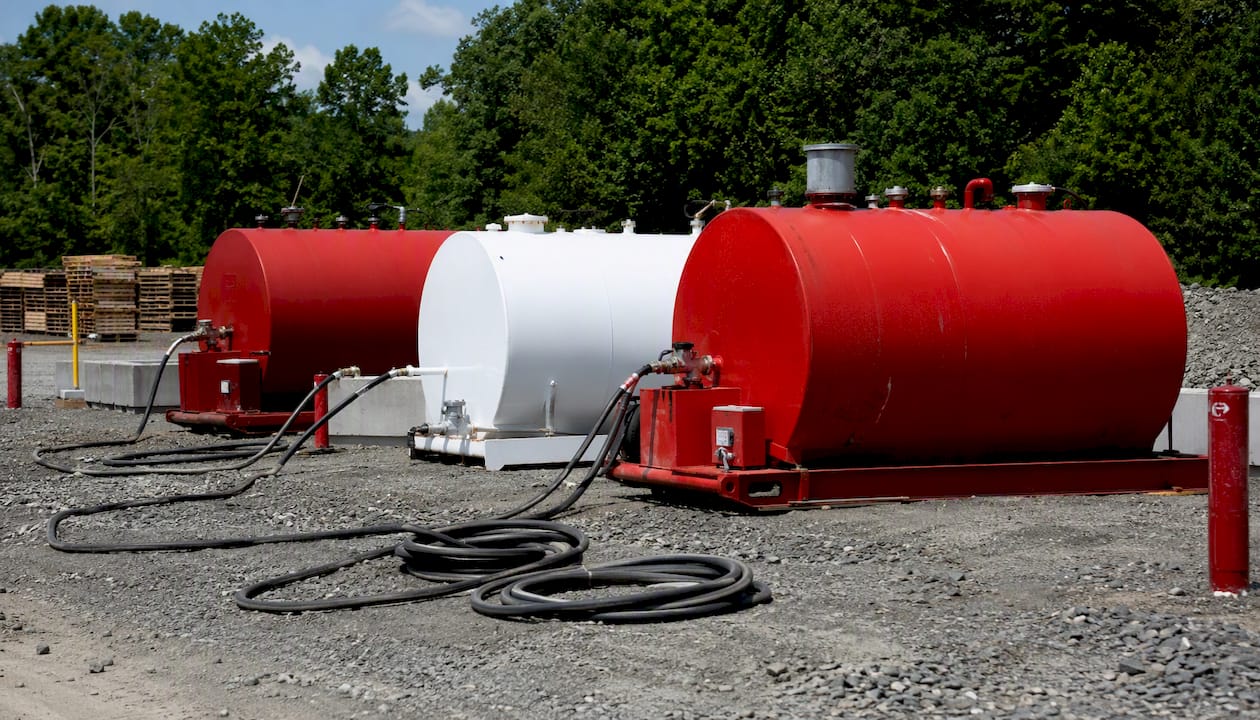
Core service categories:
| Service Type | Best For | Key Benefit |
|---|---|---|
| Direct-to-equipment fueling | Active job sites with dispersed heavy equipment | Zero downtime for operators; fuel comes to the machine |
| Bulk tank delivery and rental | High-volume sites needing on-site storage | Reduces delivery frequency; lowers per-gallon logistics cost |
| DEF delivery | Tier 4 Final engines requiring diesel exhaust fluid | Keeps SCR systems functional; avoids derate events |
| Emergency and after-hours response | Unexpected dry-outs, weather delays, surge demand | Prevents overnight or weekend shutdowns |
| Fleet wet hosing and yard fueling | On-road trucks and support vehicles at equipment yards | Consolidates on-road and off-road fueling under one vendor |
Fuel grades and when to choose each:
- Diesel #2 (standard): The default choice for most construction equipment in temperate conditions. Higher energy content per gallon and lower cost than Diesel #1.
- Diesel #1 (winter/premium): Lower viscosity and better cold-weather performance make it the right call when gelling risk is real. Seasonal blends are common in northern markets.
- Red dye diesel (off-road): Tax-exempt fuel for non-road equipment — excavators, dozers, loaders, generators. Federal law requires dyed diesel for off-road use; using clear diesel in off-road equipment is a compliance violation.
- Clear diesel (on-road): For licensed on-road vehicles including fuel trucks, pickups, and support equipment that operate on public roads.
- **DEF is required for all Tier 4 Final engines. Final engines. Running low on DEF triggers engine derate events that cut power output. Bundling DEF delivery with diesel simplifies logistics.
On fuel quality assurance: Ask any supplier for their sampling and testing procedures. Reputable providers pull samples from each delivery load, maintain Material Safety Data Sheets (MSDS) for all products, and can document fuel source and batch. Bulk fuel delivery and storage setups should include filtration at the point of transfer to prevent water and particulate contamination from reaching your equipment.
Pro Tip: Request a copy of the supplier’s MSDS and a sample fuel quality report before signing a contract. If they cannot produce either within 24 hours, that is a signal about their operational discipline.
How do top suppliers guarantee on-time delivery for construction sites?
Last-mile reliability is the primary competitive differentiator among diesel delivery services for construction fleets. The fuel molecule is a commodity. The logistics system behind it is not.
Construction fuel logistics at high-performing suppliers depend on a specific set of operational capabilities. When you are evaluating providers, these are the systems that separate a reliable partner from one that will leave you dry on a Friday afternoon:
- Dedicated jobsite tankers: Purpose-built delivery trucks with metered dispensing, not repurposed pickup tanks. Meter accuracy matters for billing and inventory reconciliation.
- Route optimization software: Suppliers serving multiple sites daily need dynamic routing to handle schedule changes, traffic, and emergency calls without cascading delays.
- GPS tracking on delivery vehicles: Real-time visibility into truck location lets your site superintendent confirm an ETA rather than waiting on a phone call.
- Proof-of-delivery (POD) systems: Digital delivery tickets with timestamp, gallons dispensed, and driver signature. This is the audit trail that resolves billing disputes and confirms SLA compliance.
- Backup partner networks: A supplier with a single-region operation cannot cover a multi-state contractor. Providers like Anytimefuelpros operate through a nationwide partner network, giving you one contract and one invoice regardless of how many states your projects span.
- Telematics integration: The strongest suppliers can feed delivery confirmation data into your fleet management or ERP system, eliminating manual reconciliation.
Pro Tip: During vendor evaluation, ask for three months of POD logs from a current construction customer. Review timestamp accuracy against promised delivery windows. Gaps between promised and actual delivery times tell you more than any sales presentation.
The backup network point deserves emphasis. A supplier that serves only one metro area forces you to manage separate vendor relationships for every region. That administrative overhead adds up, and it creates gaps in coverage exactly when you need continuity most.
What EPA and OSHA compliance should your diesel supplier demonstrate?
Suppliers must demonstrate EPA and OSHA compliance before you sign a contract. Verbal assurances are not sufficient. Construction sites carry significant liability exposure for fuel spills, improper storage, and worker safety incidents, and that liability can extend to the contractor if the supplier’s practices are deficient.
Compliance checklist to request from any supplier:
- **EPA storage compliance applies to above-ground storage tanks (ASTs) over 1,320 gallons of oil-equivalent capacity. gallons of oil-equivalent capacity trigger Spill Prevention, Control, and Countermeasure (SPCC) plan requirements. Confirm the supplier’s delivery tanks and any rental tanks they provide meet EPA SPCC standards.
- OSHA hazard communication: Suppliers must maintain MSDS/SDS for all fuel products and provide them to site personnel. OSHA’s Hazard Communication Standard applies to fueling operations and requires proper safety documentation.) applies to fueling operations.
- Dyed diesel controls: Red dye diesel is restricted to off-road use. Suppliers must have documented procedures for preventing dyed fuel from entering on-road vehicles. An IRS audit finding dyed diesel in a licensed vehicle carries significant penalties.
- Spill response plan: Any supplier delivering bulk fuel to a job site should carry a written spill response procedure and the equipment to execute it. Ask for the written plan, not a verbal summary.
- Insurance certificates: Require a certificate of insurance showing general liability and pollution liability coverage. Pollution liability is the one most suppliers omit; it covers fuel spill cleanup costs.
Pro Tip: State and local regulations often add requirements beyond federal EPA and OSHA minimums. In California, Texas, and Utah, for example, state environmental agencies have their own AST and spill-prevention rules. Require your supplier to confirm compliance with the specific state rules for each project location, not just federal standards.
For bulk storage compliance specifics, how bulk diesel storage compliance works in the U.S. covers the federal and state-level touchpoints your safety team needs to review.
How do diesel suppliers price deliveries, and what drives cost differences?
Pricing for construction fleet diesel delivery is driven by four variables: the fuel commodity price, the delivery service model, distance and logistics, and contract terms. Understanding each one lets you compare bids on equal terms rather than chasing the lowest headline per-gallon number.
The main cost drivers:
- Per-gallon fuel price: Tied to the daily rack price at the nearest terminal. Suppliers add a margin above rack; that margin is the negotiable element, not the rack price itself.
- Delivery service fee: A flat or per-trip charge covering truck, driver, and dispatch. Some suppliers bundle this into the per-gallon price; others break it out. Ask which model applies so you can compare apples to apples.
- Minimum volume charges: Most suppliers set a minimum delivery volume (often 100–500 gallons per drop). Drops below the minimum trigger a small-load surcharge. Consolidating deliveries across equipment types reduces this exposure.
- Tank rental fees: If the supplier provides an above-ground storage tank, expect a monthly rental fee. Weigh this against the per-gallon savings from less frequent bulk deliveries.
- Emergency and after-hours premiums: After-hours, weekend, and emergency calls carry a premium over scheduled rates. The size of that premium varies widely; get it in writing before you need it.
- Card and billing fees: Some suppliers charge a processing fee for credit card payments or for weekly versus monthly billing cycles. Net-30 invoicing with ACH payment is typically the lowest-cost billing arrangement.
Negotiable contract levers:
- Volume commitments in exchange for a fixed margin above rack
- Scheduled delivery windows (e.g., Tuesday/Thursday only) that reduce supplier dispatch costs and earn a rate reduction
- Consolidated billing across all project sites under one monthly invoice
- Price-cap or price-collar clauses that limit exposure to commodity spikes
- Waived small-load surcharges above a minimum monthly volume threshold
Understanding how diesel fuel gets from refineries to your fleet also helps procurement contextualize why rack prices move and when to lock in contract terms.
How should you evaluate and choose a diesel supplier for your fleet?
Use an SLA-and-evidence-first approach. Any supplier can claim reliability; the ones worth contracting can prove it with documents, references, and sample SLA language before you sign.
Questions to ask every candidate supplier:
- What is your service area, and do you use a partner network for coverage outside your primary region?
- What is your guaranteed response time for scheduled deliveries, and what is your SLA for emergency calls?
- Walk me through your emergency process — who do I call, what is the escalation path, and what is the maximum response time you will commit to in writing?
- What fuel testing and sampling procedures do you follow, and can you provide a recent fuel quality report?
- What does your proof-of-delivery system capture, and can it integrate with our fleet management or ERP platform?
- What is your billing cadence, and can you provide itemized invoices broken out by site and fuel type?
- What insurance coverage do you carry, including pollution liability?
- What is your written spill response procedure, and who is responsible for cleanup costs?
Red flags that should disqualify a supplier:
- SLA language that says “best efforts” or “as soon as possible” with no committed time window
- No references from construction or heavy equipment customers
- Inability to produce POD logs from existing accounts
- General liability insurance only, with no pollution liability coverage
- No documented procedure for separating dyed and clear diesel deliveries
- Vague or verbal-only answers to questions about emergency response
Trust signals to request before contract signature:
- Sample SLA clause with committed response times for scheduled and emergency deliveries
- At least one customer case study or reference from a construction, mining, or excavation account
- Three months of POD logs from a current customer (with customer permission)
- MSDS for all fuel products to be delivered
- Certificate of insurance including pollution liability
What does onboarding a new fuel supplier look like?
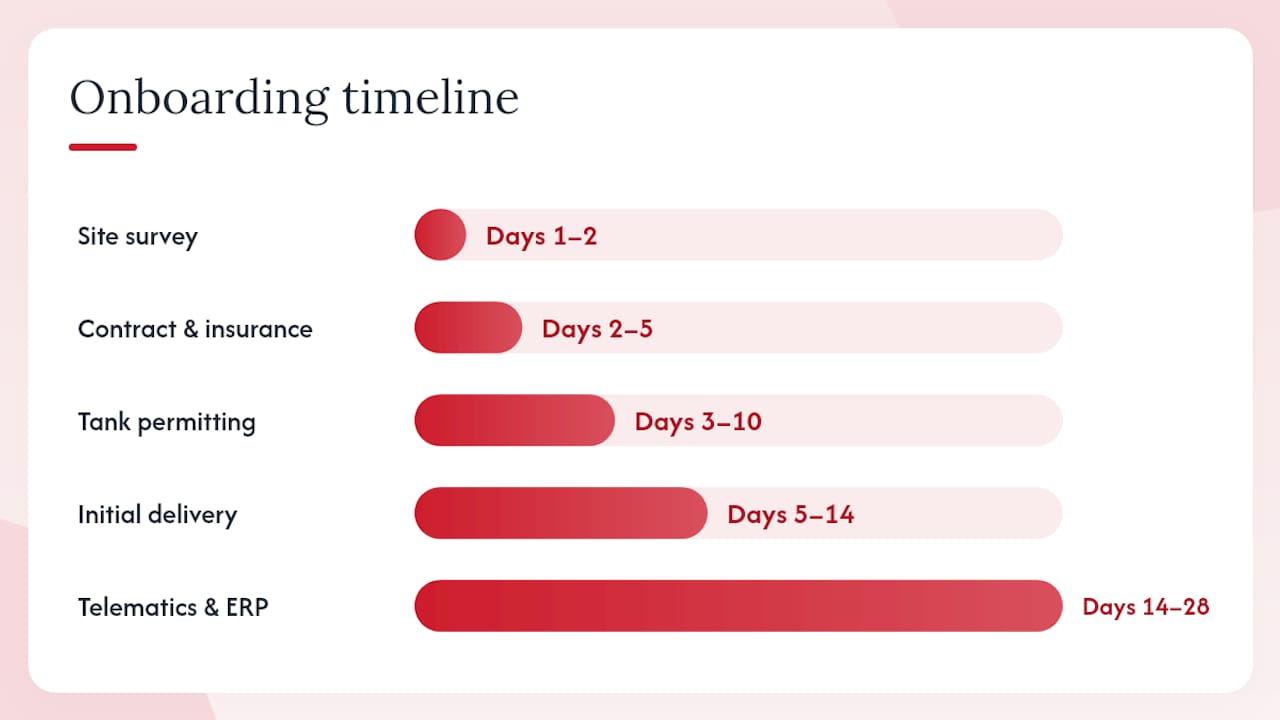
Typical onboarding runs 1–4 weeks depending on whether a tank installation and permitting are required. Simple recurring deliveries with no new tank can activate in 48–72 hours once contracts and insurance documents are exchanged.
Standard onboarding timeline:
- Days 1–2: Site survey and needs assessment. Supplier confirms access routes, equipment count, estimated daily consumption, and preferred delivery windows.
- Days 2–5: Contract execution, insurance certificate exchange, and MSDS delivery. Both parties confirm fuel types, volumes, and billing terms.
- Days 3–10: Tank permitting and installation (if applicable). Above-ground storage tanks may require local fire marshal approval and EPA SPCC plan documentation before first fill.
- Days 5–14: Initial delivery scheduling and first delivery. Supplier confirms meter calibration and POD system setup.
- Days 14–28: Telematics and ERP integration (if applicable). First billing cycle review to confirm invoice accuracy against POD records.
Onboarding responsibilities:
| Task | Supplier Responsibility | Client Responsibility |
|---|---|---|
| Site access and route confirmation | Conduct site survey, identify access constraints | Provide site contact, gate codes, and access schedule |
| Tank installation and permitting | Deliver and install rental tank; provide SPCC documentation | Obtain local fire marshal approval; designate tank location |
| Insurance and compliance documents | Provide COI, MSDS, spill response plan | Confirm receipt and file with safety team |
| Delivery scheduling | Set up recurring delivery schedule in dispatch system | Confirm preferred delivery windows and volume estimates |
| POD and billing setup | Configure POD system; issue first invoice | Verify POD records against first delivery; approve billing contact |
For short-term or emergency projects, expedited onboarding is possible. Suppliers with established partner networks can often activate delivery within 24 hours for a site within their coverage area when no tank installation is required. The on-site diesel delivery setup guide covers the full setup process for operations managers who need a step-by-step reference.
Payment methods and billing cycles
Most commercial diesel suppliers offer net-30 invoicing as the standard billing cycle, with net-15 and weekly billing available for high-volume accounts or short-duration projects. ACH bank transfer is generally the lowest-cost payment method; credit card payments typically carry a processing fee of 2%–3%.%, which adds up quickly on large-volume fuel contracts.
Procurement teams managing multi-site projects should request consolidated billing: one invoice per billing cycle covering all delivery locations, broken out by site, fuel type, and date. This structure simplifies cost allocation across project codes and makes it easier to reconcile POD records against charges.
Some suppliers offer fuel card programs for on-road fleet vehicles, which can run on a separate billing cycle from bulk and on-site deliveries. If your fleet includes both on-road trucks and off-road equipment, confirm whether the supplier can consolidate both under a single account or whether you will receive separate invoices.
For government and municipal accounts, many suppliers support purchase order-based billing and can accommodate extended payment terms required by public procurement rules. Confirm this capability early if your organization operates under government contracting requirements.
Anytimefuelpros delivers what construction fleets actually need
Construction procurement does not need another fuel vendor that covers one metro area and goes silent on weekends. It needs a partner that shows up on schedule, responds to emergencies without negotiation, and sends an invoice that matches the delivery ticket.
Anytimefuelpros meets the full procurement checklist. On-site diesel delivery covers both clear on-road and red dye off-road diesel, DEF, bulk tank fills, and emergency response — all under one contract. Primary markets in San Antonio, Austin, Dallas-Fort Worth, and Salt Lake City are served directly; the national partner network extends that coverage to any project site in the continental United States, with a single point of contact and consolidated invoicing regardless of how many states your work spans.
The trust signals procurement needs are available on request: insurance certificates including pollution liability, MSDS for all fuel products, written spill response procedures, and POD records from existing construction accounts. Telematics-supported delivery confirmation integrates with fleet management platforms, so your billing reconciliation is backed by data, not memory.
For multi-site contractors, the value is the consolidation. One vendor relationship, one invoice, one emergency number. Whether you are fueling excavators in Texas or dozers in Utah, Anytimefuelpros brings the fuel to the machine. Check your service area or place an order to get started.
Sources
- OSHA
- EPA
- Top Diesel Engine Manufacturers for Construction Equipment | Equipment World
- Best Heavy Duty Diesel Equipment Oil Guide for Excavators & Dozers | Boom & Bucket
- Diesel #1 vs. Diesel #2: Is Premium Worth It? | Papé Kenworth
Recent Comments