
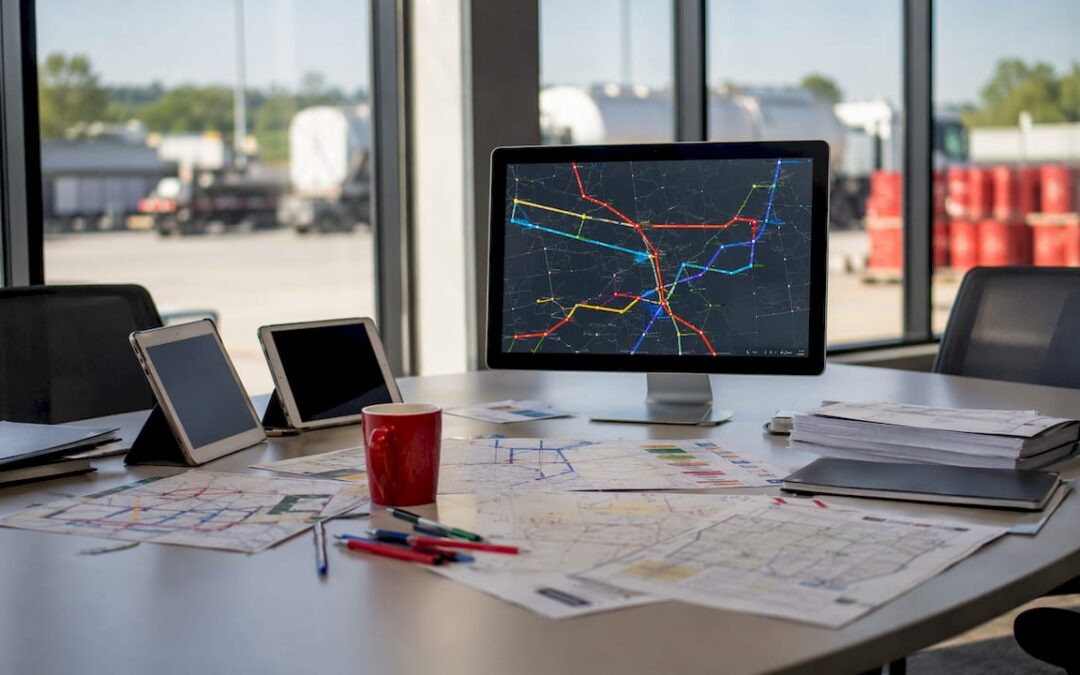
What is a fuel delivery route schedule?
A fuel delivery route schedule is a planned timetable that maps optimized delivery routes, vehicle assignments, and timing windows for fuel distribution operations. It is not simply a list of stops in order of distance. The schedule coordinates multiple variables simultaneously to keep trucks moving efficiently, drivers compliant, and customers supplied without interruption.
The core elements of any well-built fuel delivery route schedule include:
- Delivery sequence: The order in which stops are served, factoring in geographic clustering, product type, and time-window constraints
- Timing windows: Customer-specified or site-restricted hours during which fuel can be accepted and unloaded
- Vehicle load capacity: Compartment volumes and product assignments per tanker, matched to each stop’s demand
- Product compatibility: Segregation rules ensuring diesel, gasoline, and other fuels never share incompatible compartments
- Compliance constraints: DOT Hours of Service (HOS) limits, HAZMAT routing restrictions, and terminal loading windows
- Return-to-base parameters: Depot location, end-of-shift deadlines, and wash or inspection requirements
The operational goal is to reduce deadhead miles, hit delivery windows reliably, and maintain full regulatory compliance across every run. Modern scheduling goes beyond static planning. AI-powered dispatch tools now enable real-time adaptation when traffic, equipment failures, or urgent orders disrupt the original plan.
Table of Contents
- Why fuel delivery routing is harder than standard freight logistics
- Key data inputs that drive accurate fuel route scheduling
- Best practices and tools for planning fuel delivery routes in 2026
- How depot throughput and delivery windows shape your route schedule
- Advanced tactics for keeping fuel schedules on track under pressure
- What effective fuel delivery scheduling looks like in practice
- Anytimefuelpros delivers the schedule your operation actually needs
- Key Takeaways
Why fuel delivery routing is harder than standard freight logistics
Fuel distribution scheduling carries a layer of complexity that general freight routing simply does not face. The combination of hazardous materials, multi-product tankers, and strict regulatory oversight means a single sequencing error can cost far more than a missed delivery window.
The most significant fuel-specific challenges include:
- Multi-compartment tanker sequencing: A tanker carrying diesel, gasoline, and dyed diesel in separate compartments must be loaded and discharged in a precise order. Product incompatibility mandates exact sequencing to prevent cross-contamination, which can render an entire load unsellable.
- HAZMAT regulatory compliance: Fuel tankers operate under federal HAZMAT rules that restrict certain routes, tunnels, and urban corridors. Schedulers must build these restrictions into every route before dispatch.
- DOT Hours of Service limits: HOS regulations cap driving at 11 hours within a 14-hour duty period. Every route must fit within those legal limits, which directly constrains how many stops a driver can cover in a single shift.
- Variable delivery volumes: Unlike parcel delivery, fuel demand fluctuates based on consumption rates, weather, and operational activity at each site. A construction site running three shifts burns fuel at a different rate than one running a single shift.
- Site access constraints: Tank access points, weight-restricted roads, and low-clearance entries can eliminate otherwise efficient routing options entirely.
- Emergent order handling: Urgent or same-day fuel requests must be inserted into existing routes without violating HOS limits or creating compliance gaps.
Pro Tip: Before finalizing any route sequence, verify equipment compatibility at each delivery site. A tanker configured for bottom-loading that arrives at a top-load-only site creates an immediate delay. Build site access profiles into your scheduling system so incompatible assignments never reach dispatch.
Key data inputs that drive accurate fuel route scheduling
Effective fuel distribution scheduling depends on the quality of data feeding the system. Garbage in, garbage out applies here with real financial consequences.

| Data Parameter | What It Captures | Impact on Scheduling |
|---|---|---|
| Tank fill levels | Current inventory at each delivery site | Determines delivery urgency and sequence priority |
| Delivery time windows | Customer-specified or site-restricted hours | Constrains feasible route sequences |
| Vehicle compartment volumes | Capacity per compartment by product type | Drives load planning and stop count per route |
| Geographic location clusters | Proximity groupings of delivery sites | Enables route density optimization |
| Consumption models | Historical and projected burn rates by site | Informs proactive delivery timing |
| Real-time tank sensors | Live fill data from remote monitoring | Triggers level-based delivery dispatch |
| HAZMAT route restrictions | Prohibited roads, tunnels, and zones | Eliminates non-compliant routing options |
| Driver HOS status | Available hours per driver at dispatch time | Sets maximum feasible route duration |
| Depot loading windows | Terminal operating hours and slot availability | Anchors route start times |
| Vehicle type and configuration | Tanker size, compartment count, pump type | Matches vehicle to site requirements |
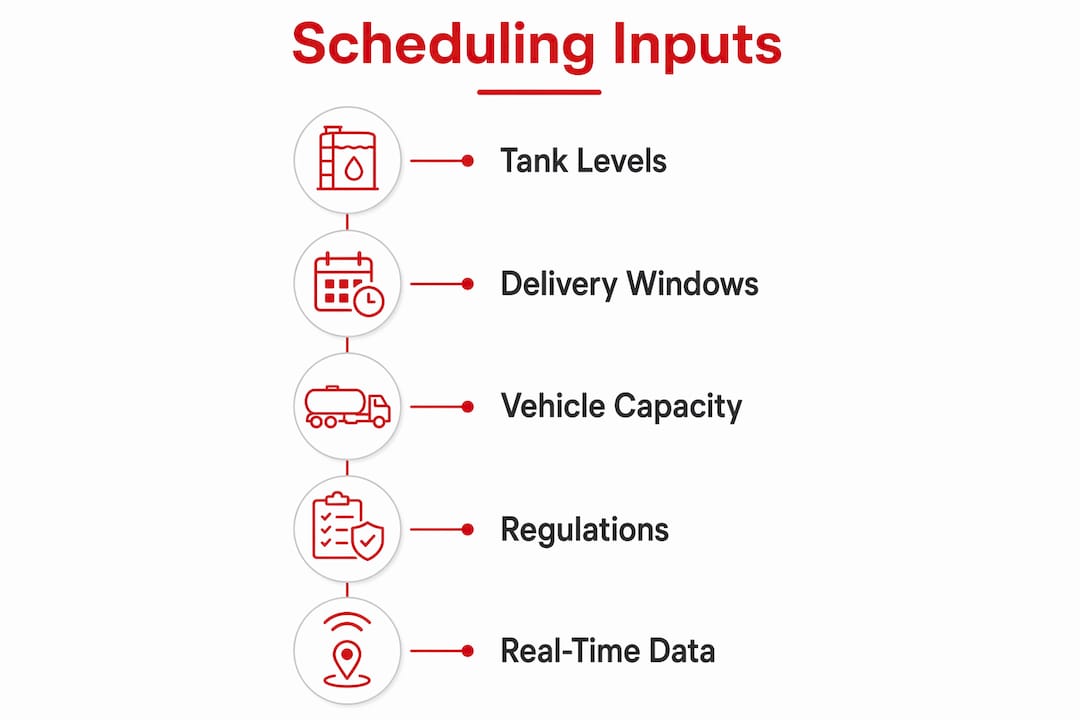
Real-time tank sensors are particularly valuable. When a site’s fill level drops to a defined threshold, the system can automatically trigger a delivery order and slot it into the next available route. This level-based approach consistently outperforms calendar-based scheduling, which dispatches trucks on fixed intervals regardless of actual demand. Moving from calendar-based to level-based triggers raises delivery fill efficiency from 58% to 72%, reducing total trips while improving vehicle utilization.
Consumption models add another layer of precision. A data center running backup generators during a regional power event burns fuel at a rate that no fixed schedule anticipates. Schedulers who integrate live consumption data can respond before a site runs dry rather than after.
Best practices and tools for planning fuel delivery routes in 2026
Static routing built on yesterday’s data is a liability in 2026. The fuel distributors running the most efficient operations use dynamic, multi-variable optimization that accounts for distance, time windows, vehicle capacity, product compatibility, and compliance simultaneously.
Key practices that separate high-performing operations from average ones:
- Adopt level-based delivery triggers. Switching from fixed-interval schedules to threshold-based dispatch increases route density and reduces unnecessary trips. Drivers run fuller loads to stops that actually need fuel.
- Use multi-variable route optimization. Distance-only routing misses the bigger picture. Effective optimization balances mileage, time windows, load capacity, regulatory constraints, and customer access in a single calculation.
- Integrate live traffic data. Real-time traffic feeds allow the dispatch system to reroute around accidents, road closures, and congestion before a driver loses time sitting in traffic.
- Automate emergency order insertion. AI-powered dispatch platforms can insert urgent orders into active routes, recalculate the sequence, and push updated instructions to the driver’s mobile device without requiring a dispatcher to manually rebuild the route.
- Plan for return-to-base constraints. Every route must account for the driver’s end-of-shift deadline and the depot’s closing time. Failing to build this in creates overtime violations and stranded vehicles.
Pro Tip: In rural or remote delivery areas, cellular coverage drops out at the worst possible moments. Use an offline-first mobile app that lets drivers complete their workflow, capture electronic Proof of Delivery (ePOD), and sync everything automatically once connectivity returns. This protects both compliance documentation and billing accuracy.
The technology behind fuel delivery operations has advanced significantly. Platforms like FuelGenius now offer AI-driven dispatch that creates routes respecting time windows, HAZMAT rules, and HOS limits, with live rerouting built in. The operational gap between distributors using these tools and those still relying on spreadsheets is widening every year.

How depot throughput and delivery windows shape your route schedule
A route that looks efficient on paper can collapse at the terminal gate. Depot throughput limits, meaning the number of trucks a terminal can load within a given period, directly affect when drivers can depart and how many stops they can realistically complete before their HOS clock runs out.
Practical strategies for managing these constraints:
- Book terminal loading slots in advance. Treat depot appointments the same way you treat customer delivery windows. A driver waiting two hours for a loading bay loses productive route time that cannot be recovered.
- Stagger dispatch times. When multiple trucks need to load at the same terminal, staggered appointments prevent bottlenecks and keep the fleet moving.
- Align customer windows with terminal availability. If a terminal only loads between 5 AM and 2 PM, customer delivery windows that require a 6 PM arrival are structurally impossible without a second trip or a different loading location.
- Build wait-time buffers into route cost calculations. Ignoring terminal loading hour restrictions results in bottlenecks and lost productive time. When schedulers account for realistic loading durations, route plans reflect actual capacity rather than theoretical capacity.
- Monitor terminal throughput in real time. Some terminals publish live queue data. Integrating that feed into your dispatch system lets you reroute a driver to an alternate terminal when the primary location is backed up.
The same logic applies at the delivery end. A construction site that closes its fuel access gate at 4 PM cannot receive a delivery at 4:30 PM, regardless of how the route was planned. Schedulers who treat customer operating hours as hard constraints rather than preferences build routes that actually execute as planned.
Ignoring terminal throughput in scheduling leads to bottlenecks that erode efficiency and increase expenses. Building terminal loading windows into route plans as hard constraints is not optional for operations that need to run at full capacity.
Advanced tactics for keeping fuel schedules on track under pressure
Even a well-built schedule encounters disruptions. Equipment failures, traffic incidents, and urgent customer requests are not edge cases in fuel distribution. They are regular operating conditions. The question is whether your system can absorb them without cascading into compliance violations or missed deliveries.
Advanced scheduling tactics used by high-performing fuel distributors:
- Service queue management: Route scheduling is more than shortest-path calculation. Service queues and product compatibility drive sophisticated prioritization. A stop carrying a high-priority customer with a narrow delivery window gets sequenced ahead of a lower-priority stop even if the geography suggests otherwise.
- Multi-compartment load sequencing: Dispatchers managing multi-product tankers face what amounts to a three-dimensional puzzle. Each compartment must be loaded in the correct order, matched to the correct stop, and discharged without contaminating adjacent products. Automated load planning tools handle this sequencing faster and more accurately than manual methods.
- Real-time schedule recalculation: Modern fuel delivery systems recalculate and dispatch updated routes automatically when conditions change. A driver who encounters a road closure gets a revised route pushed to their device within minutes, not after a phone call to dispatch.
- Automated compliance alerts: HOS monitoring integrated into the dispatch platform flags drivers approaching their legal limits before a violation occurs. This gives dispatchers time to reassign stops rather than scramble after the fact.
- Offline-first driver workflows: In low-connectivity areas, offline-first mobile applications ensure drivers can complete deliveries, capture signatures, and document compliance data without waiting for a cell signal. Data syncs automatically when connectivity returns.
Pro Tip: When building routes for drivers near the end of a work week, factor in cumulative HOS hours, not just daily limits. A driver who has already logged 55 hours over six days has limited availability even if their daily clock reset. Build weekly HOS tracking into your scheduling system to avoid last-minute route failures.
Continuous monitoring matters as much as the initial plan. Automated alerts for schedule deviations, missed check-ins, and delivery confirmations give operations managers visibility without requiring them to manually track every truck. The benefits of scheduled fuel delivery compound when the monitoring layer catches problems early enough to correct them before they affect customers.
What effective fuel delivery scheduling looks like in practice
Real-world scheduling problems rarely match textbook examples. The most instructive cases come from operations that faced genuine constraints and built systems to handle them.
Multi-product distribution across a dense urban market
A fuel distributor serving a metropolitan area with dozens of service stations faces a classic multi-compartment challenge. Each tanker carries regular gasoline, premium gasoline, and diesel in separate compartments. The loading sequence at the terminal must match the discharge sequence at each station, and no two incompatible products can share a compartment wall without a certified separator. Schedulers who automate this load-matching process eliminate the contamination risk that manual sequencing introduces. The result is fewer rejected loads, lower wash costs, and tighter route execution.
Level-based dispatch for a construction fleet operation
A large excavation contractor running dozers, excavators, and telehandlers across multiple job sites switched from weekly fuel deliveries to a level-based trigger system. Remote tank monitors at each site transmitted fill data to the dispatch platform. When any tank dropped below 25%, the system generated a delivery order and slotted it into the next available route. Drivers arrived at sites that needed fuel rather than sites that were scheduled for fuel. Trip frequency dropped while the volume delivered per trip increased, which directly reduced labor costs per gallon delivered.
Emergency insertion during a regional power outage
During a major storm event, a fuel distributor serving data centers and hospitals received a surge of emergency orders within hours. The dispatch platform’s emergency insertion capability allowed operators to slot urgent deliveries into active routes, recalculate sequences in real time, and push updated instructions to drivers already on the road. No driver exceeded HOS limits. Every critical site received fuel within the response window. Operations that rely on manual rerouting in these scenarios typically cannot match that response speed.
Remote site delivery with offline documentation
A mining operation in a low-connectivity region required regular diesel delivery to equipment yards accessible only by unpaved roads. Drivers used an offline-first mobile app to capture delivery confirmations, record meter readings, and collect electronic signatures at each stop. Data synced to the back-office system when drivers returned to coverage. Billing was accurate, compliance documentation was complete, and the operation ran without the delays that paper-based processes typically introduce in remote environments.
Anytimefuelpros delivers the schedule your operation actually needs
Fleet managers and logistics coordinators who have read this far understand one thing clearly: a fuel delivery route schedule is only as good as the operation executing it. Planning tools matter. Data quality matters. But so does having a fuel partner whose own operations are built around the same principles.
Anytimefuelpros serves commercial operations across Texas, Utah, and nationwide through a trusted partner network, delivering diesel and gasoline directly to job sites, equipment yards, data centers, mining operations, and live events. Scheduled recurring deliveries, 24/7 emergency response, and transparent invoicing are standard. Whether you need a reliable weekly schedule for a construction fleet or rapid-deployment fueling during a disaster response, Anytimefuelpros builds the delivery plan around your operational constraints, not a generic template.
For operations with multi-site or multi-state fueling needs, a single point of contact through Anytimefuelpros eliminates the vendor management overhead that comes with managing regional suppliers separately. Get answers to your specific scheduling questions or request a delivery by visiting Anytimefuelpros today.
Key Takeaways
A fuel delivery route schedule balances vehicle capacity, product compatibility, regulatory compliance, and real-time conditions to minimize cost and maximize delivery reliability.
| Point | Details |
|---|---|
| Level-based triggers outperform fixed schedules | Switching from fixed-interval schedules to threshold-based dispatch increases route density and reduces unnecessary trips. |
| Multi-compartment sequencing is non-negotiable | Precise load and discharge order prevents cross-contamination and protects fuel quality on every run. |
| Depot throughput must be built into route plans | Ignoring terminal loading windows creates bottlenecks that erode driver productivity and increase costs. |
| HOS compliance shapes every feasible route | DOT rules cap driving at 11 hours within a 14-hour duty period, setting a hard ceiling on route length. |
| Anytimefuelpros executes scheduled and emergency delivery | AFP serves commercial operations nationwide with recurring schedules, 24/7 emergency response, and transparent invoicing. |
Recent Comments