
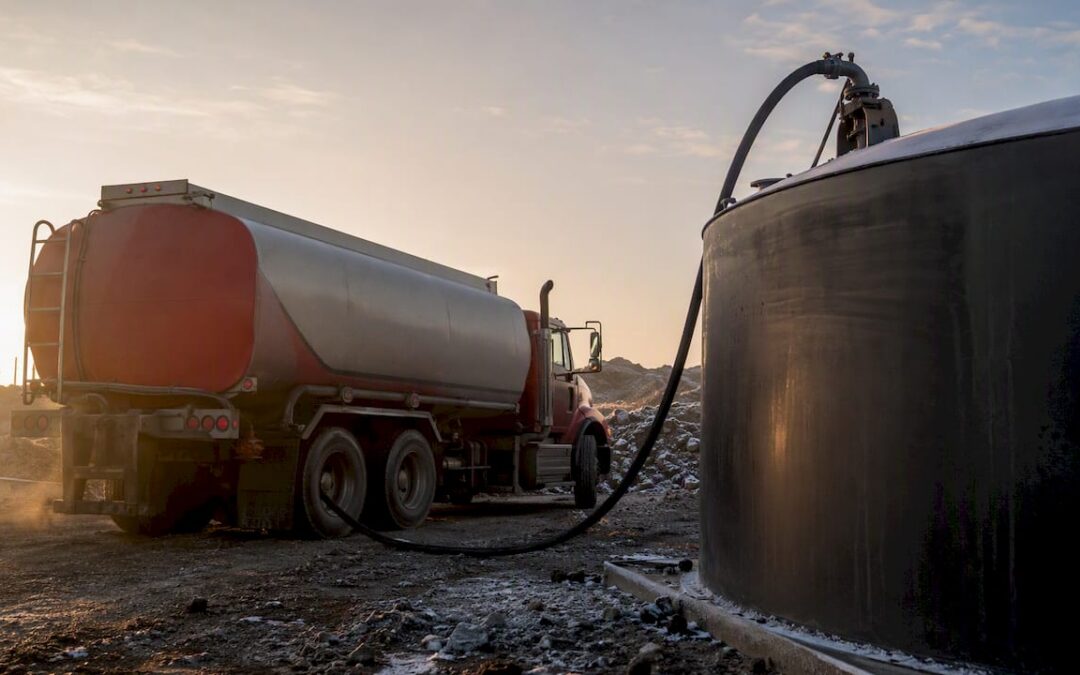
The best place to buy bulk Grade #1 (winter-grade) diesel for on-site commercial delivery is through a licensed commercial fuel distributor that offers scheduled and emergency on-site service, not a retail pump or truck stop. Anytimefuelpros delivers bulk Grade #1 diesel directly to job sites, equipment yards, generator pads, and fleet yards across Texas, Utah, and the continental U.S. through its partner network. All deliveries conform to ASTM D975, the primary U.S. diesel specification. This guide covers bulk on-site procurement only.
Before you call a supplier, have these items ready:
- Grade designation: Grade No. 1-D (winter-grade diesel), not a retail blend
- Cloud point or CFPP target in °F, matched to your region’s expected low temperatures
- Sulfur specification: S15 (ultra-low sulfur) for most on-road and generator applications
- Minimum order volume and tank capacity
- Preferred delivery window: recurring schedule, on-demand, or emergency after-hours
Key Takeaways
Specifying Grade No. 1-D with a named cloud point and CFPP target in your purchase order is the single most important step to guarantee cold-weather fuel performance on site.
| Point | Details |
|---|---|
| Specify the grade and cold-flow target | Name Grade No. 1-D, cloud point, and CFPP in every PO; ASTM D975 leaves these to buyer-supplier agreement. |
| Procure winter-spec fuel, don’t treat it | EPRI guidance warns that additive treatment of large stored tanks is unreliable; order the right grade upfront. |
| Secondary containment is required | Size containment to 110% of the largest on-site container and use impervious transfer surfaces before any delivery. |
| Lock in contracts before peak season | Grade #1 supply tightens during cold snaps; recurring delivery agreements reduce allocation risk. |
| Anytimefuelpros | Scheduled, emergency, and multi-site Grade #1 delivery with documented tickets and 24/7 dispatch nationwide. |
Table of Contents
- What does “bulk Grade #1 winter diesel” actually mean?
- Exact specification checklist for your RFP or purchase order
- How on-site bulk diesel delivery actually works
- Pricing components and seasonal timing for Grade #1 diesel
- On-site storage, compliance, and winter maintenance
- How to choose a fuel delivery partner for winter Grade #1 diesel
- Copy-ready purchase order template for Grade #1 winter diesel
- Anytimefuelpros delivers Grade #1 winter diesel where you need it
- Sources
What does “bulk Grade #1 winter diesel” actually mean?
Grade No. 1-D is a lighter distillate than Grade No. 2-D. It has a significantly lower cloud point and cold filter plugging point (CFPP), which means it resists wax crystal formation at temperatures where No. 2 diesel would gel and clog filters. For a generator running through a January cold snap in Utah or a dozer fleet on a northern construction site, that difference is the line between continuous operation and a shutdown.
The cloud point is the temperature at which wax crystals first appear in the fuel. The CFPP is the temperature at which those crystals are dense enough to block a fuel filter. ASTM D975 sets required diesel properties but leaves cloud point and CFPP limits to agreement between buyer and supplier, using 10th-percentile temperature maps as a regional guide. That means your purchase order must name the target, or the supplier has no contractual obligation to meet it.
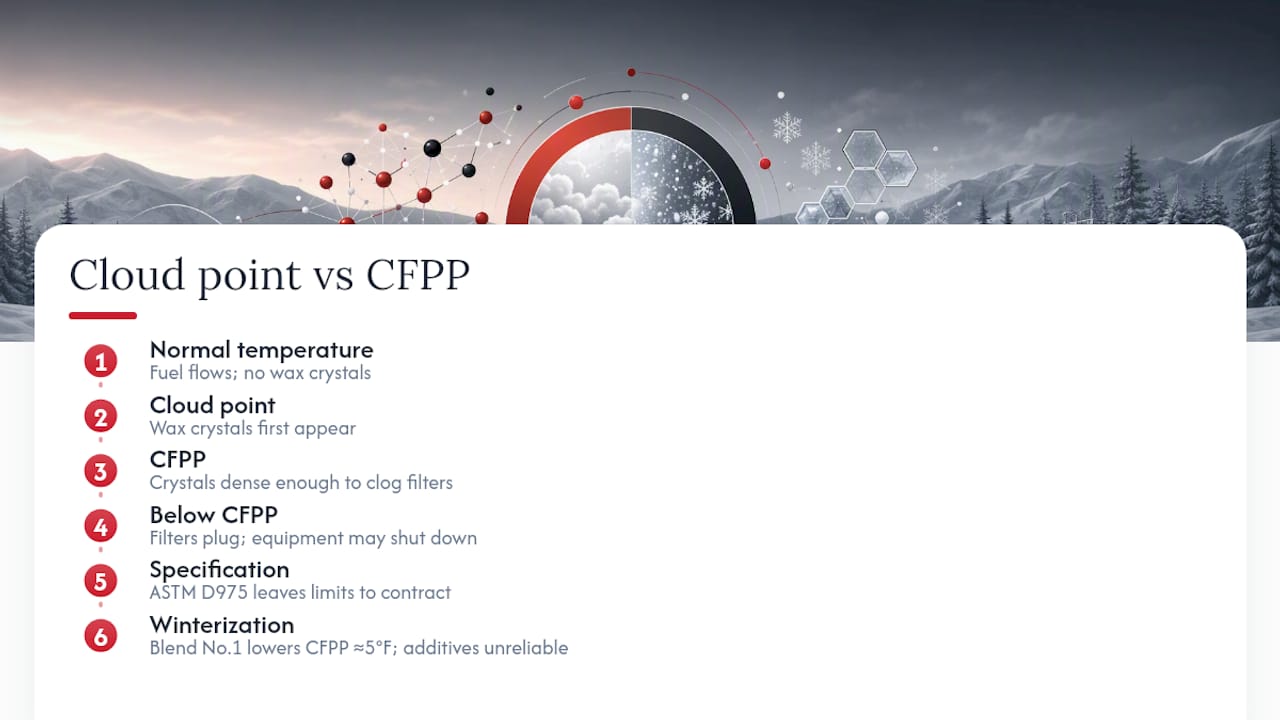
Suppliers winterize fuel two ways: blending No. 1 into No. 2, or treating No. 2 with flow-improver additives. Blending No. 1 into No. 2 lowers CFPP by approximately 5°F](https://en.wikipedia.org/wiki/Winter_diesel_fuel), making it a practical field tool when used with accurate calculations. Additives alone, however, are not reliable for large storage tanks. EPRI guidance recommends procuring fuel already suited to winter temperatures rather than relying on post-delivery additive treatment for high-volume tanks, where mixing is inconsistent and effectiveness is difficult to verify without lab testing.
Exact specification checklist for your RFP or purchase order
Every line item below should appear in your PO before you send it to a supplier. Missing even one can result in a non-conforming delivery that your team cannot legally or safely use.
Required specification line items:
- Product name: Grade No. 1-D Diesel Fuel
- Standard reference: ASTM D975, current edition, properties to be met at time and place of delivery
- Cloud point target: [state °F/°C and test method, e.g., ASTM D2500]
- CFPP target: [state °F/°C and test method, e.g., ASTM D6371]
- Sulfur maximum: 15 ppm (S15) unless site-specific off-road exemption applies
- Additive allowances: [state approved or disallowed additives, or “supplier standard package only”]
- Dye requirement: Clear (on-road/generator) or Red-dyed (off-road/tax-exempt off-road use)
- Minimum order volume: [gallons]
- Delivery window: [recurring schedule frequency or emergency response SLA]
- Tank ID, coordinates, and access instructions
- Secondary containment confirmation required from driver
- Invoicing: itemized delivery ticket with meter reading, product grade, and timestamp
Sample product line for your PO:
“Supplier shall deliver Grade No. 1-D Diesel Fuel conforming to ASTM D975 (current edition), with a cloud point not exceeding [X°F] and CFPP not exceeding [Y°F] as measured at the time and place of delivery. Deliveries not meeting these cold-flow properties will be rejected.”
Anytimefuelpros supports scheduled recurring deliveries, 24/7 emergency response, and multi-site coordination through its nationwide partner network, giving procurement a single point of contact regardless of how many locations are in play.
How on-site bulk diesel delivery actually works
Service types available from commercial distributors:
- One-time tank fill: A highway tanker delivers to your storage tank. Standard for generators and large equipment yards.
- Scheduled recurring delivery: Fixed cadence (weekly, bi-weekly, monthly) with automatic dispatch. Best for data centers and active construction sites.
- Wet-hose fleet fueling: The driver fuels individual vehicles or equipment directly. Common for mining yards and municipal fleets.
- Emergency/after-hours delivery: Dispatched within hours of a call. Carries a surcharge but prevents costly downtime.
- DEF delivery: Often bundled with diesel delivery to reduce truck rolls.
Lead times for Grade #1 winter diesel vary by region and season. Standard orders typically deliver within 24–48 hours in primary markets; peak winter demand can push that to 72 hours or more in some regions. Emergency orders through Anytimefuelpros are dispatched around the clock.
Site prep matters. Your access lane must accommodate a highway tanker of standard length suitable for site access, and the staging area must be clear of overhead obstructions. Open-dome loading requires a downspout to the bottom of the compartment and proper bonding and grounding to control static discharge during transfer. Secondary containment must be in place before the driver begins pumping.
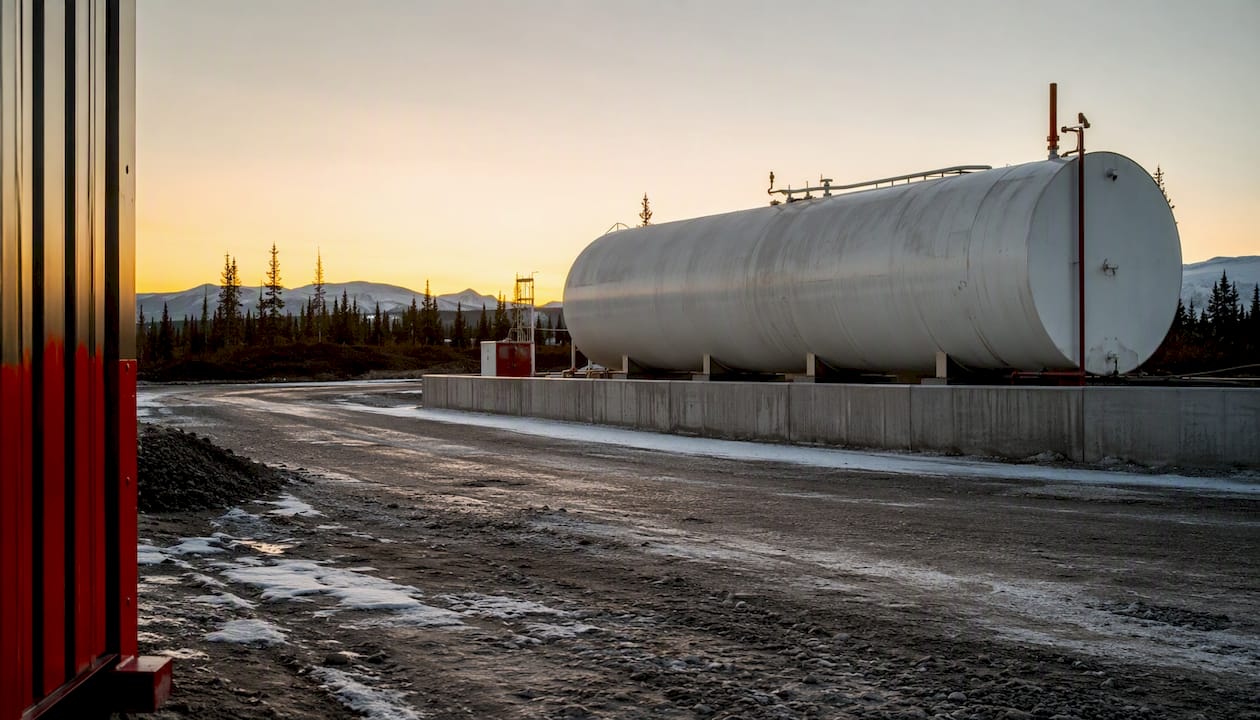
Pro Tip: Provide your supplier with accurate tank ullage, the tank’s heating or circulation system details, and your target cloud point before the first delivery. Suppliers who know your setup can pre-confirm fuel spec and avoid a rejected load on a cold morning.
Pricing components and seasonal timing for Grade #1 diesel
Grade No. 1-D typically carries a premium over No. 2-D because it is a lighter, less abundant distillate. That premium widens during cold snaps when regional demand spikes.
| Cost Component | Notes |
|---|---|
| Base fuel price (per gallon) | Tied to daily rack price; Grade #1 premium over #2 varies by region and season |
| Delivery fee (per stop) | Flat fee per truck roll; varies by distance and market |
| Minimum delivery charge | Applied when order volume falls below supplier minimum |
| Emergency/after-hours surcharge | Added for off-hours dispatch; confirm rate in your contract |
| Tank rental or mobilization fee | Applies if supplier provides a temporary storage tank |
| Taxes and road fees | Federal excise tax applies to clear (on-road) diesel; dyed diesel is tax-exempt for qualifying off-road use |
| Fuel testing or lab charges | Optional; confirm whether supplier includes a certificate of analysis |
Seasonal planning checklist:
- Lock in a recurring delivery contract before November to avoid peak-season allocation constraints
- Confirm your supplier’s Grade #1 inventory position for your region before the first hard freeze
- Build a 72-hour emergency buffer into your tank level thresholds
- Review winter operations planning before the season starts
On-site storage, compliance, and winter maintenance
Secondary containment is not optional. Best management practices require containment sized to 110% of the largest container on site, with impervious transfer surfaces and sealed, labeled containers. Sites storing larger fuel volumes may trigger SPCC (Spill Prevention, Control, and Countermeasure) plan requirements under EPA regulations or state aboveground storage tank (AST) registration thresholds. Confirm your volume against both federal and state thresholds before your first bulk delivery.
Storage maintenance through winter:
- Test fuel on receipt and quarterly during storage; request a certificate of analysis from your supplier
- Keep tanks as full as practical to reduce condensation and water accumulation
- Schedule fuel polishing if stored fuel is more than 6 months old or shows haze or sediment
- Use tank heaters or circulation systems for outdoor tanks in sub-freezing climates
- Avoid topping a cold tank with warm fuel without calculating the blend effect on cloud point
On dyed diesel: red-dyed diesel is tax-exempt and restricted to off-road use. Using it in on-road vehicles is a federal violation with significant penalties. Your PO should specify clear or dyed fuel explicitly, and your delivery records must match. ASTM D975 properties apply regardless of dye status.
IHSA field fueling guidance recommends maintaining a spill response kit sized to the transfer volume at every fueling point. For typical highway tanker deliveries, that means absorbent booms, pads, and a containment vessel on site before the driver opens the valve.
How to choose a fuel delivery partner for winter Grade #1 diesel
- Confirm service footprint. Ask whether the supplier can cover all your sites, including remote or multi-state locations, under a single contract. A partner network matters here.
- Require documented bulk delivery experience. Ask for references in your industry: generator fueling, construction, mining, or municipal fleet. Experience with complex site logistics signals operational competence.
- Get SLA terms in writing. Standard delivery lead time, emergency response window, and escalation contacts should all be in the contract before you sign.
- Verify invoicing transparency. Itemized delivery tickets with meter readings, product grade, timestamp, and driver ID are the minimum. Ask to see a sample invoice before committing.
- Ask about cold-flow assurance. A credible supplier will name the cloud point and CFPP they can guarantee for your region and provide test results on request.
- Check insurance and spill response. Confirm the supplier carries adequate liability coverage and has a documented spill response procedure for on-site incidents.
Red flags to walk away from: a supplier who cannot name a cloud point guarantee, has no written emergency response SLA, provides vague or bundled invoices with no line-item breakdown, or cannot produce a safety data sheet (SDS) and certificate of analysis on request.
Copy-ready purchase order template for Grade #1 winter diesel
| PO Field | Buyer Completes |
|---|---|
| Vendor name and contact | [Supplier name, rep name, phone] |
| Delivery address and tank ID | [Street address, GPS coordinates, tank number] |
| Product specification | Grade No. 1-D Diesel Fuel, ASTM D975 (current edition) |
| Cloud point requirement | Not to exceed [X°F / Y°C], ASTM D2500 |
| CFPP requirement | Not to exceed [X°F / Y°C], ASTM D6371 |
| Sulfur maximum | 15 ppm (S15) |
| Dye requirement | Clear / Red-dyed [select one] |
| Minimum quantity | [Gallons] |
| Delivery window | [Date/time range or recurring schedule] |
| Invoicing instructions | Itemized ticket: meter reading, grade, timestamp, driver ID |
| Acceptance protocol | Buyer reserves right to reject non-conforming fuel; supplier to provide certificate of analysis on request |
| Emergency contact | [Buyer 24/7 contact name and number] |
Anytimefuelpros delivers Grade #1 winter diesel where you need it
Anytimefuelpros removes the procurement risk that comes with sourcing winter-grade diesel from a supplier who cannot guarantee cold-flow specs or show up at 2 AM when a generator goes low. Scheduled recurring deliveries keep your tanks topped on a cadence that matches your consumption, and 24/7 emergency dispatch means a cold-snap shortage does not become a shutdown. The nationwide partner network gives multi-site operations a single point of contact instead of a patchwork of regional vendors, each with different invoicing formats and SLA terms.
Every delivery comes with a documented delivery ticket, transparent per-gallon and per-stop pricing, and fuel testing available on request. Anytimefuelpros serves data centers, construction fleets, mining operations, municipal agencies, and generator-dependent facilities across Texas, Utah, and the continental U.S.
Contact Anytimefuelpros to request a quote, confirm Grade #1 availability in your region, or set up a recurring delivery contract. Start with the diesel fuel delivery service page or reach out directly through the fuel delivery questions page.
Sources
- D0975-26b
- Fuel Handling Procedure (IHSA)
- Best Management Practices for Fueling and Maintenance of Excavation and Earthmoving Equipment
Recent Comments