

For commercial fuel procurement, the Gulf Coast states — Texas, Louisiana, Mississippi, and Oklahoma — consistently produce the lowest landed delivered prices in the U.S. According to Dispatched’s 2026 trucking fuel research, Gulf Coast suppliers post a baseline advantage of roughly $0.20–$0.50 per gallon below the national average, a delta that carries directly into commercial delivered pricing when your supplier sources from Gulf terminals. One critical caveat: if your fleet operates across multiple states, IFTA redistributes your tax burden by miles driven, not by where you fueled, so a low-tax purchase state doesn’t automatically lower your net fleet tax cost.
Immediate actions for procurement teams:
- Prioritize suppliers with confirmed Gulf Coast terminal access when soliciting bids
- Run IFTA-adjusted cost models before committing to a regional sourcing strategy
- Lock in scheduled bulk delivery contracts to reduce per-gallon transport allocation
Table of Contents
- What drives state-by-state differences in commercial delivered fuel pricing?
- Which regions consistently deliver the lowest commercial fuel prices?
- How is on-site delivered fuel priced, and what does a real quote look like?
- Practical procurement strategies that lower your delivered fuel cost
- What to verify before you sign a delivered-fuel contract
- Key Takeaways
- Anytimefuelpros delivers Gulf Coast pricing and 24/7 reliability nationwide
- Sources and further reading
What drives state-by-state differences in commercial delivered fuel pricing?
The headline per-gallon number on a supplier quote reflects at least six distinct cost layers, and understanding each one is what separates a procurement win from a surprise invoice.
The primary drivers:
- Refinery and terminal density. The Gulf Coast hosts the highest concentration of U.S. refining capacity. Suppliers who source directly from Gulf terminals skip multiple pipeline and distribution hops, which cuts base cost before any tax or delivery fee is applied. The path from refinery to your fleet is shorter, and that distance shows up in the price.
- State excise taxes. State diesel excise taxes range from roughly $0.16–$0.20 per gallon at the low end (Texas, Mississippi) to more than $0.70 per gallon in Pennsylvania. That spread alone can account for more than half a dollar per gallon on a delivered quote.
- Environmental compliance overlays. California’s Low Carbon Fuel Standard (LCFS) and cap-and-trade program add a material cost layer that has no equivalent in Gulf Coast states. These mandates push California’s commercial diesel cost well above the national average.
- Transport distance and mode. Truck delivery from a terminal 50 miles away costs less per gallon than a 400-mile haul. Pipeline and barge access in the Gulf region keeps base transport costs low; landlocked or coastal Northeast markets pay more.
- Delivery-specific fees. Minimums, after-hours surcharges, and delivery window restrictions all affect landed cost, sometimes more than the underlying fuel price differential.
Pro Tip: When comparing supplier bids, ask each vendor to disclose their terminal sourcing location. A supplier pulling from a Gulf Coast terminal in Texas or Louisiana can reliably offer a lower base cost than one sourcing from a regional rack in the Northeast, even when their quoted per-gallon price looks similar at first glance.
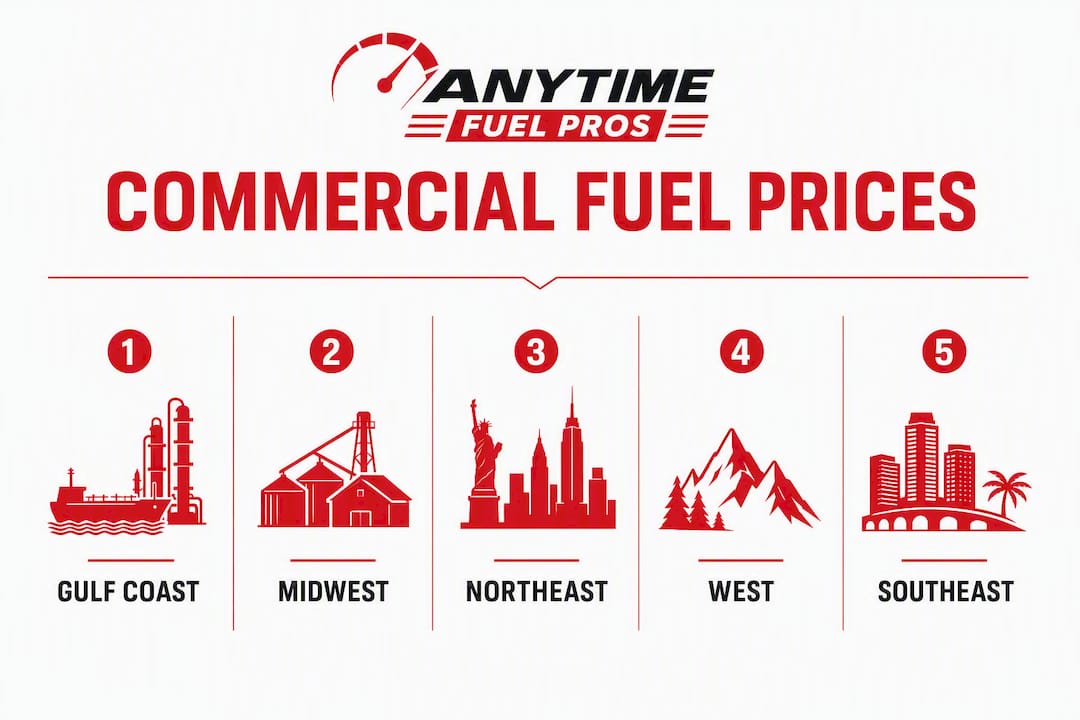
Which regions consistently deliver the lowest commercial fuel prices?
The table below reflects typical delivered commercial diesel pricing patterns based on 2026 regional market data and state IFTA diesel tax rates.
| Region / State | Typical Delivered Delta vs. National Average | Key Cost Drivers |
|---|---|---|
| Texas | $0.20–$0.50/gal below | Gulf refinery access, $0.20/gal excise, dense terminal network |
| Louisiana | $0.20–$0.50/gal below | Gulf Coast sourcing, $0.20/gal excise, barge/pipeline access |
| Mississippi | $0.20–$0.50/gal below | Low diesel excise tax, Gulf proximity |
| Oklahoma | $0.20–$0.50/gal below | $0.19/gal excise, I-40 corridor terminal access |
| Kansas / Nebraska / South Dakota | $0.20–$0.50/gal below | Low excise, central Plains pipeline access, moderate transport distance |
| California | more than $0.70 per gallon above | LCFS, cap-and-trade, $0.60+ effective adders, transport constraints |
| New York / Northeast | $0.30–$0.60/gal above | High excise, limited terminal access, environmental mandates |
Oklahoma led mid-2026 retail diesel rankings among the lowest prices, just ahead of Texas., driven by their low state excise rates and Gulf terminal proximity. Those retail-side patterns translate directly to commercial delivered pricing when your supplier sources from the same supply chain.
Watch for exceptions. Refinery outages along the Gulf Coast can temporarily compress or eliminate the regional advantage. Hurricane season disruptions are the most common trigger — a single major storm can spike Gulf Coast delivered prices by $0.30–$0.60/gal for two to four weeks. Building emergency SLA clauses into your contracts before storm season is a practical hedge. For seasonal supply-shock planning, hurricane preparedness for fuel delivery is worth reviewing before you finalize contract terms.
How is on-site delivered fuel priced, and what does a real quote look like?

Every delivered commercial fuel quote is built from the same components. Knowing each line item lets you compare vendors on a true apples-to-apples basis.
Quote components:
- Rack/wholesale price (the terminal base price, changes daily)
- State fuel excise tax (per-gallon, fixed by state)
- Federal excise tax (applicable to on-road clear diesel)
- Local taxes and fees (county or municipal overlays where applicable)
- Environmental compliance adders (LCFS credits, carbon costs in applicable states)
- Transport cost (distance from terminal to site, converted to $/gal)
- Delivery fee (fixed charge per delivery, typically $20–$70)
- Minimum order requirement (commonly 100–300 gallons)
- After-hours or emergency surcharge ($0–$0.15/gal)
Worked example — Gulf Coast Texas delivery:
- Rack price (Gulf terminal): $3.20/gal
- Texas state excise: +$0.20/gal
- Federal excise (on-road): +$0.244/gal
- Transport uplift (75-mile haul, ~$0.08/gal): +$0.08/gal
- Delivery fee allocation ($45 fee ÷ 500 gal minimum): +$0.09/gal
- Landed cost: $3.814/gal
Run the same model for a Northeast supplier with a $0.50/gal excise, a $0.20/gal LCFS adder, and a 200-mile haul, and the landed cost climbs past $4.50/gal on identical rack conditions. That $0.69+ gap per gallon across a 50,000-gallon annual contract is roughly $34,500 in avoidable spend.
IFTA adjustment note: For multi-state fleets, IFTA calculates tax liability by miles driven in each jurisdiction, not by purchase location. Fueling heavily in Texas doesn’t reduce your IFTA obligation in Pennsylvania if your trucks log most of their miles there. Use IFTA-adjusted per-gallon models when comparing cross-state fueling strategies.
Standardizing vendor quotes — steps for procurement:
- Request rack index disclosure (which terminal, which pricing index)
- Confirm state and federal tax line items separately
- Convert the delivery fee to a per-gallon equivalent (fee ÷ minimum gallons)
- Add transport distance uplift based on terminal-to-site mileage
- Apply any environmental adders specific to your state
- Compare final landed $/gal across all bids using the same rack date
Practical procurement strategies that lower your delivered fuel cost
The biggest savings in commercial fuel procurement come from contract design, not from chasing single-digit per-gallon differences between quotes.
- Source from Gulf Coast-capable suppliers. Terminal access is the single largest structural cost driver. Prioritize vendors who can document their sourcing terminal.
- Use scheduled recurring bulk deliveries. Spreading the fixed delivery fee across larger, predictable volumes cuts the per-gallon delivery allocation significantly. Scheduled on-site fueling also eliminates the labor cost of sending drivers to retail stations.
- Consolidate multi-site orders. A single-vendor multi-site fueling arrangement reduces delivery fees, simplifies invoicing, and gives you negotiating leverage on minimums.
- Negotiate delivery fee caps and minimum order flexibility. A supplier willing to cap the delivery fee at $40 and drop the minimum to 150 gallons for emergency orders is worth more than one with a slightly lower rack price and rigid terms.
- Include emergency response clauses. Specify maximum response time, after-hours pricing caps, and SLA penalties. Fuel cost during a data center outage or a hurricane response is secondary to availability, but pre-negotiated pricing prevents gouging.
- Factor IFTA into route planning. Work with your fleet operations team to align fueling stops with high-mileage states where IFTA credits will offset purchase-state tax costs. IFTA-aware route optimization can meaningfully reduce net tax exposure for interstate fleets.
Pro Tip: Use the worked example model from the previous section to quantify the trade-off between a lower per-gallon price and higher delivery minimums. A supplier offering $3.75/gal with a 500-gallon minimum and a $60 delivery fee costs $3.87/gal landed. A supplier at $3.85/gal with a 200-gallon minimum and a $30 delivery fee costs $4.00/gal landed. The cheaper headline price isn’t always the cheaper fuel.
What to verify before you sign a delivered-fuel contract
Use this checklist as a contract-approval gate. Missing any item creates compliance exposure or invoice surprises.
- Fuel type and paperwork. Confirm whether you need clear diesel (on-road, taxed) or red-dye diesel (off-road, tax-exempt). Verify the supplier provides correct documentation for each. Red-dye diesel delivery for off-road equipment requires specific handling and recordkeeping.
- Permits and tank compliance. Confirm local storage permits, secondary containment requirements, and any county or municipal tank registration obligations before the first delivery.
- Delivery windows and emergency SLA. Get the standard delivery window and the after-hours response time in writing, with pricing for each.
- Proof of delivery (POD) and invoice transparency. Require line-item invoices showing rack price, each tax line, delivery fee, and any surcharges separately. POD documentation should include timestamp, gallons delivered, and driver signature.
- Terminal sourcing disclosure. Ask the supplier to name their sourcing terminal and confirm ULSD (ultra-low sulfur diesel) compliance and any biodiesel blend percentages that affect your equipment specs.
- Environmental blend requirements. Verify that the fuel meets your state’s blend mandates (B5, B20, ULSD) and confirm whether any compliance adder is included in the quoted price or billed separately.
For industrial sites with complex storage and permitting requirements, utility infrastructure fueling strategies covers the compliance framework in detail.
Key Takeaways
Gulf Coast states — Texas, Louisiana, Mississippi, and Oklahoma — consistently offer the lowest landed commercial delivered fuel prices in the U.S., driven by refinery density, low excise taxes, and terminal access.
| Point | Details |
|---|---|
| Gulf Coast advantage | Texas, Louisiana, Mississippi, and Oklahoma typically deliver fuel at a substantial discount below the national average. |
| IFTA caveat for fleets | IFTA redistributes tax by miles driven, not purchase location — always model IFTA-adjusted cost for multi-state operations. |
| Landed cost components | Rack price, state excise, transport uplift, and delivery fee allocation all affect the true per-gallon cost. |
| Contract design wins | Negotiating minimums, delivery fee caps, and emergency SLA terms often saves more than chasing a lower headline price. |
| Anytimefuelpros | AFP provides Gulf Coast-sourced bulk delivery, 24/7 emergency response, and transparent line-item invoicing for commercial and fleet buyers nationwide. |
Anytimefuelpros delivers Gulf Coast pricing and 24/7 reliability nationwide
Cutting your landed fuel cost starts with the right supplier, and that means Gulf Coast terminal access, transparent invoicing, and a partner who shows up when your operation can’t afford to wait.
Anytimefuelpros brings all of that together for facilities managers, fleet operators, and procurement teams across Texas, Utah, and the continental U.S. through its national partner network. AFP sources from Gulf Coast terminals to keep base costs competitive, delivers on scheduled bulk contracts that reduce your per-gallon delivery allocation, and maintains 24/7 emergency response for data centers, construction sites, municipal fleets, and events that can’t tolerate downtime. Every invoice breaks out rack price, taxes, delivery fee, and surcharges as separate line items, so your accounts payable team can reconcile in minutes.
AFP procurement-ready contract features:
- Scheduled recurring bulk delivery with flexible minimums
- Clear and red-dye diesel delivery with proper documentation
- DEF delivery and generator fueling
- 24/7 emergency fuel delivery with pre-negotiated SLA terms
- Consolidated multi-site invoicing under a single account
- Proof-of-delivery documentation on every order
Request a quote or get answers to your procurement questions at Anytimefuelpros fuel delivery services, or place an order directly at Order Now.
Sources and further reading
Procurement teams and operations analysts can verify the regional pricing data, IFTA rules, and delivery cost frameworks used in this guide through the following sources:
- State of Trucking Fuel Costs 2026 — Dispatched Research: Gulf Coast regional pricing advantage, California and Northeast cost overlays, and state excise tax ranges
- Diesel Prices by State 2026: Interactive Heatmap and Rankings — DieselCostPerGallon.com: Mid-2026 state-level diesel price rankings with Oklahoma and Texas leading the low-cost tier
- Questions to Ask Transportation Companies in 2026 — Ride Scouts: Vendor vetting checklist adaptable for evaluating fuel delivery partners and SLA terms
To request AFP-specific terminal sourcing disclosures, sample invoices, or formal procurement documentation, contact Anytimefuelpros directly through the fuel delivery questions page.
Recommended
- The 2024 Election and Diesel Prices: What Businesses Should Prepare For – Anytime Fuel Pros
- The Dirtiest Secret in the Fuel Industry: Are You Getting What You Paid For? – Anytime Fuel Pros
- How Much Downtime Is Fueling Costing Your Fleet? – Anytime Fuel Pros
- From Refineries to Your Fleet: How Diesel Fuel Gets Delivered – Anytime Fuel Pros
Recent Comments