
A gallon of U.S. diesel fuel contains about 137,381 Btu, according to the U.S. Energy Information Administration (EIA). That is the standard figure for distillate fuel with less than 15 parts per million sulfur, and it is the number to use for most planning work. You will see others, such as 138,700 or 128,700, and the reasons are covered below.
This guide is for fleet managers, site superintendents and facilities teams who need a number they can defend. It covers what a Btu is, how diesel compares with gasoline, kerosene and heating oil, how to total the energy in a tank or a delivery, and why gross versus net gallons matters when the invoice arrives.
TL;DR
- Use 137,381 Btu per gallon for ultra-low-sulfur diesel (15 ppm or under). It is the EIA’s published figure.
- Published values run from roughly 128,000 to 139,000 Btu per gallon because of gross versus net heating values and fuel mix, not because the sources disagree about the fuel.
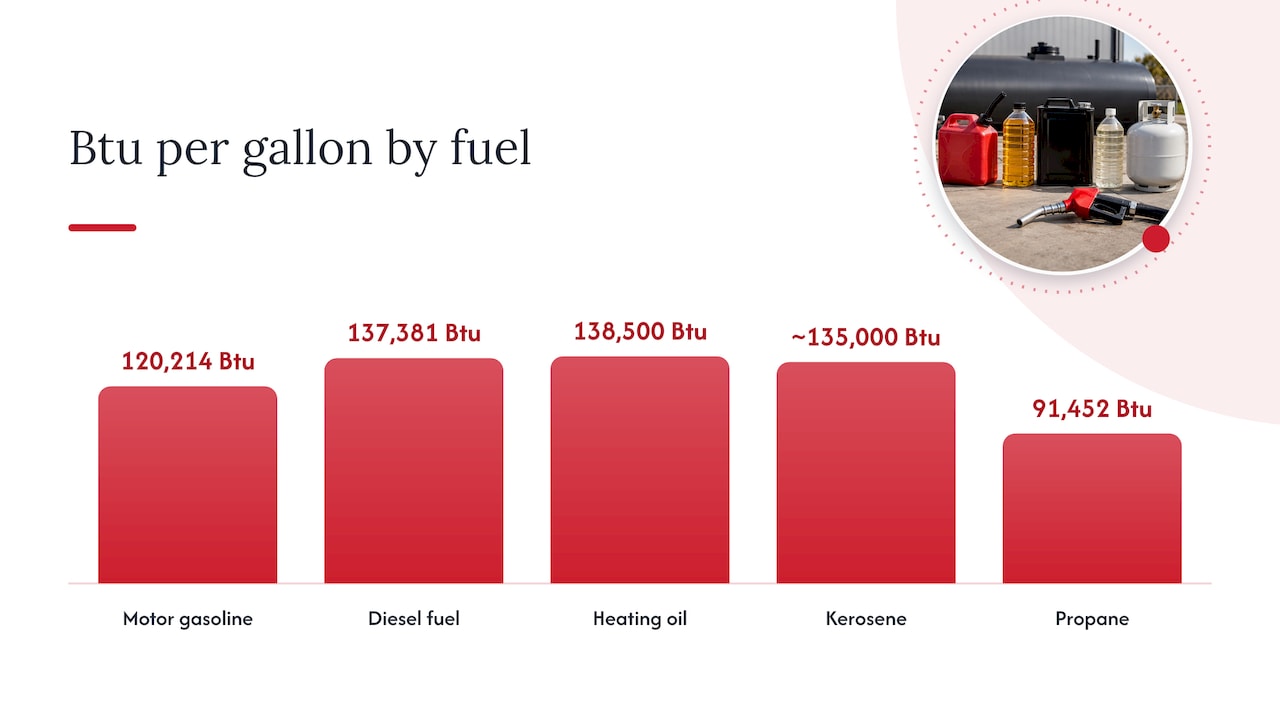
- Diesel carries more energy per gallon than gasoline (120,214 Btu), so a gallon of diesel goes further in the same engine class.
- Total energy is gallons times Btu per gallon: 5,000 gallons of diesel is about 686.9 million Btu.
- Gross gallons are the volume at the actual temperature. Net gallons are corrected to 60°F. Know which one your invoice uses.
Table of Contents
- What a Btu measures
- How many Btu are in a gallon of diesel
- Why you see different numbers
- Diesel compared with gasoline, kerosene and heating oil
- How to calculate the Btu in a tank or a delivery
- Gross gallons vs. net gallons
- Putting the number to work on site
- Fuel delivered to where the work happens
- FAQ
- Sources
What a Btu measures
A British thermal unit is the heat needed to raise one pound of water by 1°F, as the EIA defines it. It is a way to put different fuels on one scale. A gallon of diesel, a gallon of propane and a cubic foot of natural gas all release heat when burned, and Btu lets you compare how much.
For operations, that matters in three places. You size generators and burners against fuel energy. You compare the cost of one fuel against another per unit of energy rather than per gallon. And you reconcile consumption reports, especially where a contract or a grant asks for energy figures.
How many Btu are in a gallon of diesel
The EIA’s sample conversion factors list diesel fuel at 137,381 Btu per gallon. The same agency’s documentation, updated in its Monthly Energy Review, says that as of December 2025 it uses Argonne National Laboratory’s GREET model factors: 137,380 Btu per gallon for conventional diesel at 15 ppm sulfur or under, and 138,490 Btu per gallon for low-sulfur diesel between 15 and 500 ppm.
The one-Btu difference between 137,381 and 137,380 is rounding between publications. For any business calculation, 137,381 is fine.
Two practical points follow:
- On-road diesel and most off-road diesel sold today are ultra-low-sulfur, so the 137,381 figure applies to both clear and dyed (red) diesel. Dye is a tax marker, and nothing in the sources suggests it changes the energy value.
- Higher-sulfur distillate sits near 138,490 Btu per gallon. You are most likely to meet it in heating-oil contexts rather than in fuel for equipment.
Why you see different numbers
Search this topic and you will find 128,000, 137,381, 138,000 and 138,700 for the same fuel. Three things explain nearly all of it.
Gross versus net heating value
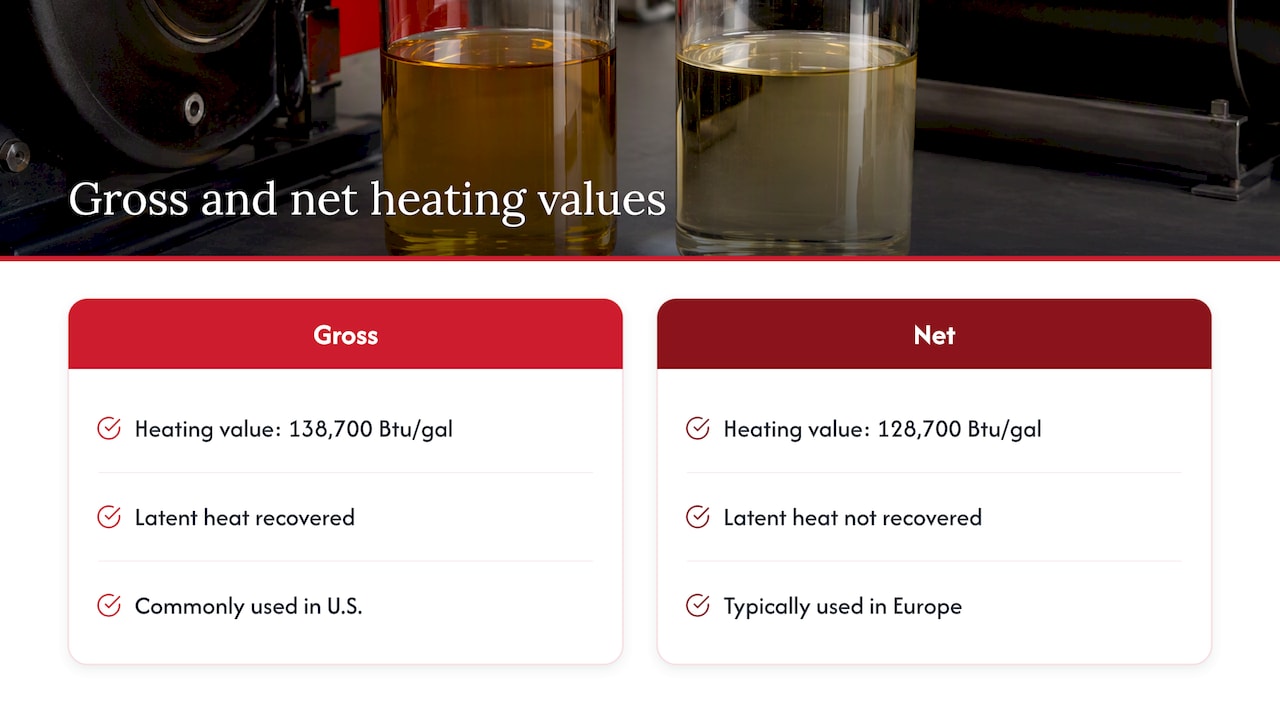
When diesel burns, hydrogen in the fuel forms water vapor. The gross (higher) heating value counts the energy you could recover by condensing that vapor. The net (lower) heating value does not. The EIA explains that gross values are commonly used in the United States, and net values typically in Europe, and that the gap usually runs 2% to 10% depending on the fuel’s hydrogen content.
An academic reference from the University of Illinois describes the higher heating value as assuming combustion products cool to 25°C, so the latent heat of the water is recovered, while the lower value assumes it is not.
A diesel engine exhausts hot gas, so it never recovers that latent heat. That is why engineers often work with the net figure. A U.S. Department of Transportation table, for example, cites 138,700 Btu gross and 128,700 Btu net per gallon of diesel. Both are right. They answer different questions.
Fuel mix changes over time and by region
The Department of Energy’s Alternative Fuels Data Center notes that diesel’s energy content and other properties vary by region and over time as fuel mixes and feedstocks change. Winter blends, summer blends and biodiesel content all move the number slightly. Published values are averages, not a guarantee for the gallon in your tank.
Different agencies, different edition dates
Older tables, such as the 1996 DOT figures, reflect older fuel specifications. The EIA also notes that some of its fuel values are weighted by each year’s mix, while others are static. When a figure matters, check the publication year.
| Figure (Btu per gallon) | Basis | What it is good for |
|---|---|---|
| 137,381 | EIA, diesel at 15 ppm sulfur or under | Default planning and reporting |
| 138,490 | EIA/GREET, low-sulfur diesel (15 to 500 ppm) | Higher-sulfur distillate |
| 138,700 | Gross, DOT transportation tables | Gross-basis comparisons |
| 128,700 | Net, DOT transportation tables | Engine efficiency work |
Diesel compared with gasoline, kerosene and heating oil
Diesel is among the most energy-dense fuels you can put in a tank. Here is how it stacks up.
| Fuel | Btu per gallon | Source |
|---|---|---|
| Motor gasoline | 120,214 | EIA |
| Diesel fuel | 137,381 | EIA |
| Heating oil | 138,500 | EIA |
| Kerosene | about 135,000 | EIA, 5.670 million Btu per barrel |
| Propane | 91,452 | EIA |
The kerosene figure comes from dividing the EIA’s per-barrel value by the 42 gallons in a barrel, a conversion the DOT’s frequently used tables also state.
Diesel versus gasoline. The Alternative Fuels Data Center puts one gallon of diesel at 113% of the energy in a gasoline gallon equivalent on its own basis. On the EIA’s numbers, the gap is a little larger, about 14%. Either way, the extra energy per gallon is one reason diesel dominates heavy equipment, generators and long-haul trucking. Diesel engines also convert that energy more efficiently, but that is an engine matter and not a property of the fuel.
Diesel versus kerosene and #2 fuel oil. Number 2 heating oil is chemically close to diesel, and its listed value of 138,500 Btu per gallon is within 1% of diesel’s. Kerosene is a lighter distillate and holds somewhat less energy per gallon. If a heater, a generator or a piece of equipment is approved for more than one of these fuels, the energy difference is small. The approval, the sulfur limit and the tax status are what decide the choice, not the Btu.
Diesel versus propane. Propane holds about two thirds of diesel’s energy per gallon, so a propane tank has to be much larger to store the same energy. For standby power, that is one reason many data centers and hospitals still specify diesel generators.
If you are choosing between grades for cold weather or engine requirements, our guide to diesel fuel types for commercial operations covers the practical differences, and diesel fuel ratings explains cetane and the other numbers on a spec sheet.
How to calculate the Btu in a tank or a delivery
The math is one multiplication. Total energy equals gallons times Btu per gallon.
- Take the gallons. A common bulk delivery is 5,000 gallons.
- Multiply by 137,381.
- Result: 686,905,000 Btu, or about 686.9 million Btu.
A few more examples at the same factor:
- 1,000 gallons: 137,381,000 Btu (about 137.4 million)
- 500 gallons: 68,690,500 Btu (about 68.7 million)
- One 55-gallon drum: 7,555,955 Btu (about 7.6 million)
- One barrel (42 gallons): 5,770,002 Btu (about 5.8 million)
To go the other way, divide the energy you need by 137,381. A process that needs 100 million Btu of fuel energy needs about 728 gallons at 100% efficiency. Real equipment loses some of the energy as heat, so divide again by the equipment’s efficiency to get the fuel you must actually buy.
Comparing fuel cost per million Btu
Price per gallon hides the energy difference between fuels. To compare, divide the price per gallon by the millions of Btu in a gallon. Diesel holds 0.137381 million Btu per gallon.
As an illustration only, a diesel price of $4.00 per gallon works out to about $29.12 per million Btu ($4.00 ÷ 0.137381). Heating oil at the same price per gallon, at 0.1385 million Btu, comes to about $28.88. That price is a placeholder to show the method, so substitute your own quote.
For current delivered pricing and what drives it, see what U.S. fleets pay for diesel delivery, or run your own scenario in our diesel calculator.
Gross gallons vs. net gallons
Btu per gallon assumes you know how many gallons you have. That is less simple than it sounds, because fuel expands as it warms and contracts as it cools.
The Texas Comptroller’s motor fuels audit manual treats this directly. In practice:
- Gross gallons are the actual physical volume at the current fuel temperature.
- Net gallons are the volume adjusted to a standard 60°F, which removes the effect of thermal expansion.
The Comptroller’s motor fuels audit procedures say fuel acquired should be computed at gross gallons to arrive at a true account. That is a statement about tax accounting in Texas, and other states and contracts may specify differently.
Why it matters for energy content
Energy tracks mass, and mass in a given volume changes with temperature. A gross gallon pulled in a hot Texas summer holds slightly less fuel by mass than a gallon at 60°F. The 137,381 Btu figure is an average, so for ordinary planning the gap is small. For large volumes it adds up, and temperature correction is how buyers and sellers keep large transfers fair.
What to check on your delivery ticket
- Does the ticket show gross gallons, net gallons or both?
- Is the fuel temperature recorded at the time of delivery?
- Does your contract bill on gross or net volume?
- When you reconcile against tank gauges, are you comparing like with like?
A transparent, itemized invoice shows these answers without a phone call. That is the standard we hold ourselves to on every delivery.
Putting the number to work on site
The Btu figure is most useful in four situations.
Backup generators. Data centers and critical facilities size on-site storage for a target runtime. Fuel energy is one input, along with generator load and efficiency. Keep stored fuel in condition too: stale or contaminated diesel is a bigger risk to runtime than a 1% variation in heat content. Our emergency fuel delivery page covers fuel polishing and rapid response.
Fleet and yard fueling. If you compare diesel against gasoline units on cost per mile, the energy gap is part of why diesel units often come out ahead on fuel burned per task. See our trucking yard fueling guide for how to set a yard up.
Winter operations. Cold weather changes how fuel flows, not how much energy it holds. Gelling is a handling problem, covered in winter diesel delivery planning.
Reporting. If you report energy use or emissions, use one consistent source and basis, and note whether you used gross or net values. Mixing the two can shift totals by several percent.
Fuel delivered to where the work happens
Knowing your fuel energy is only useful when fuel shows up on time. Anytime Fuel Pros delivers diesel, gasoline and DEF on site to job sites, equipment yards, generators, mines and events. Our primary markets are San Antonio, Austin, Dallas-Fort Worth and Salt Lake City, and our partner network extends delivery across the continental United States under one point of contact.

We offer red and clear diesel, DEF, bulk tank fills and tank rentals, plus bulk fuel delivery for larger sites, with 24/7 service and itemized invoicing. Tell us your volumes and schedule, and we will set up recurring or on-demand delivery that fits.
FAQ
How many BTU are in a gallon of diesel?
About 137,381 Btu per gallon for ultra-low-sulfur diesel, per the EIA. Gross-basis tables sometimes show 138,700, and net-basis tables show about 128,700. Use the EIA number unless a contract or standard names another.
Does red dye diesel have a different energy content than clear diesel?
The published factors are for diesel fuel by sulfur level, not by dye. Dye marks fuel as off-road for tax purposes, and nothing in the published values assigns it a different heat content. Both are typically ultra-low-sulfur today.
Which has more energy, diesel or gasoline?
Diesel. On EIA figures, a gallon of diesel holds 137,381 Btu against 120,214 for motor gasoline, roughly 14% more. The Alternative Fuels Data Center, using its own basis, puts diesel at 113% of a gasoline gallon equivalent.
What is the difference between gross and net gallons?
Gross gallons are the volume at the actual fuel temperature. Net gallons are corrected to 60°F. Check your contract and delivery ticket to see which one you are billed on.
How many BTU are in a barrel of diesel?
A barrel is 42 gallons, so a barrel of diesel holds about 5.77 million Btu at 137,381 Btu per gallon.
Sources
- British thermal units (Btu), U.S. Energy Information Administration
- EIA Monthly Energy Review, Appendix A: gross and net heating values
- EIA Thermal Conversion Factor Source Documentation
- EIA Approximate Heat Content of Petroleum Products
- U.S. DOT Frequently Used Tables
- Lower and Higher Heating Values of Gas, Liquid and Solid Fuels, University of Illinois
- Alternative Fuels Data Center: Fuel Properties Notes
- Alternative Fuels Data Center: Fuel Properties Comparison
- Texas Comptroller: Motor Fuels Tax Audit Procedures Manual
Recent Comments