
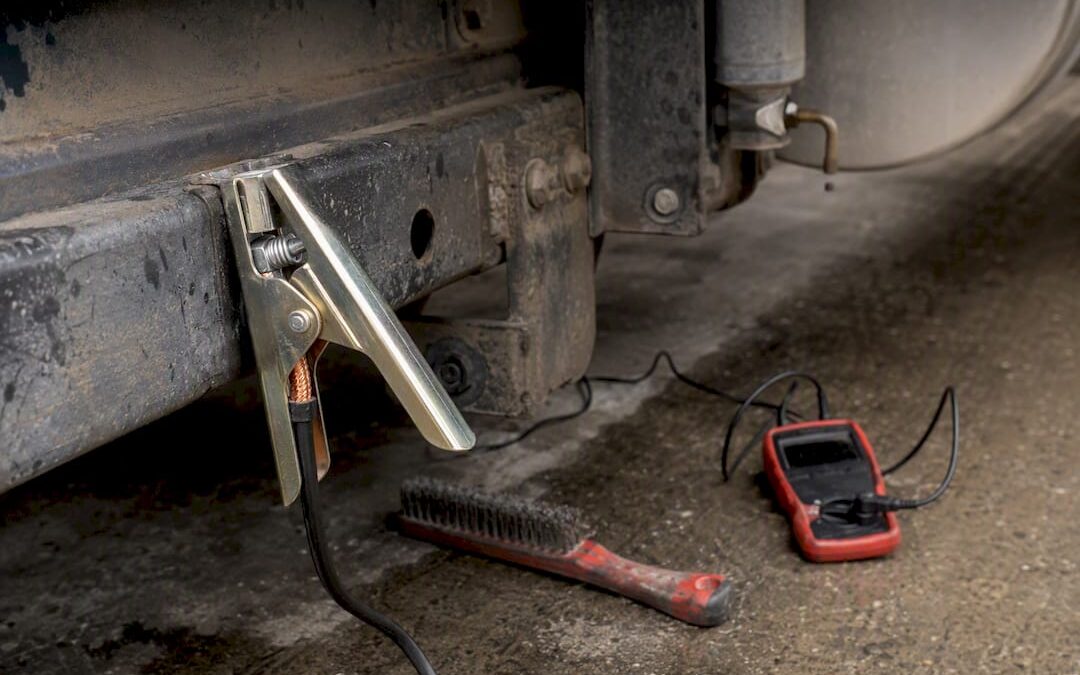
Bond the receiving tank or aircraft to the fuel source before any fuel flows, and keep that bond in place until the hose or nozzle is fully detached. That single rule prevents the vast majority of static ignition incidents during fuel transfer, and it applies whether you’re topping off a Gulfstream on the ramp or filling a 500-gallon skid tank at a job site.
Two things happen before the nozzle ever touches the fill port. First, attach the bonding cable to a designated bare-metal contact point, not a painted panel or a corroded bracket. Second, verify continuity with a resistance meter before you commit to flow.
- Attach the bond clamp to bare metal, confirm it’s seated, not just touching.
- Check resistance and confirm it reads within the accepted range before opening any valve.
Pro Tip: A bonding cable that “looks” connected but reads high resistance is worse than no bond at all. It gives crews false confidence.
Industry guidance commonly cites a bonding cable resistance threshold of less than 25 ohms as the benchmark for an effective equipotential connection. SAE, NFPA, and OSHA all publish standards touching on this procedure, and we’ll walk through exactly where each applies.
Key Takeaways
Bonding before fuel flow and maintaining that bond until full hose disconnection, verified by a sub-25 ohm resistance reading, is the single control that prevents most static ignition incidents during fueling.
| Point | Details |
|---|---|
| Bond before flow | Attach the bonding cable to bare metal and verify continuity before any fuel moves. |
| Hold the bond | Keep the connection intact until the hose or nozzle is fully detached, not before. |
| Know the threshold | Bonding cable resistance should read under 25 ohms using a calibrated meter. |
| Match the scenario | High-flow transfers over 25 gpm need a ‘Y’ bonding configuration to stay equipotential. |
| Inspect regularly | Check cables and clamps every shift and after any repair, and log every test result. |
Table of Contents
- Why Bonding and Grounding Prevent Static Ignition During Fuel Transfer
- Bonding vs. Grounding: What’s the Difference and When Does Each Apply?
- Step-by-Step Bonding Procedure for Aircraft and Industrial Refueling
- What Bonding Equipment and Resistance Thresholds Should You Expect?
- How Do You Test Bonding Continuity and How Often?
- Special Cases: Overwing, Hydrant, Hot Refueling, and Nonconductive Containers
- Which Standards Govern Bonding and Grounding for Fuel Systems?
- What Human Errors Cause Most Bonding Failures?
- What Should Be on a Field-Ready Bonding Checklist?
- Where to Read the Full Standards and Guidance
- Frequently Asked Questions
- Sources
Why Bonding and Grounding Prevent Static Ignition During Fuel Transfer
Fuel moving through a hose, a filter, or a nozzle generates friction. Friction separates electrons. That separation builds a static charge on the fuel itself and on any ungrounded metal surfaces it touches, including the tank, the hose fittings, and the aircraft skin. If that charge has nowhere to go, it accumulates until it finds a path, and if that path is a spark jumping across an air gap near fuel vapor, ignition follows.
Bonding closes that gap before it can become a spark. It equalizes the electrical potential between the fuel source and the receiving tank, so there’s no voltage difference left to discharge violently. Grounding takes it a step further by draining any residual charge into the earth itself.
Static ignition incidents during fuel transfer share a common thread: someone assumed metal-to-metal contact existed when it didn’t. A hose nozzle resting against a painted filler neck, a corroded clamp, or a bond disconnected seconds too early has been enough to let separated charges reunite as a spark.
- Fuel flow through a hose or filter builds static charge through friction.
- Bonding equalizes potential between the two conductive objects, removing spark risk.
- Grounding adds a path to earth for any charge bonding alone can’t neutralize.
A simple equipotential diagram, showing the fuel source, the bonding cable, and the receiving tank all drawn at the same electrical “height,” makes this easier to explain during a safety briefing than any paragraph of physics ever will.
Bonding vs. Grounding: What’s the Difference and When Does Each Apply?
Bonding equalizes electrical potential between two conductive objects, like a fuel truck and an aircraft, so no spark can jump between them. Grounding connects a conductive object to earth, giving stray charge somewhere to go beyond the two objects involved in the transfer.
For most aircraft refueling, bonding alone is the primary control. The aircraft and the fuel truck get bonded to each other, and that shared potential is usually enough because both are already sitting on grounded or semi-grounded surfaces. Fixed installations, storage tanks, and nonconductive containers are a different story. There, grounding equalizes potentials while also draining charge to earth, and skipping it leaves a gap bonding alone can’t close.
- Do you bond or ground first? Connect the earth ground first when one exists, then bond the receiving container to the dispensing source.
- Is grounding mandatory for aircraft refueling? Not always. Bonding is the primary requirement; grounding becomes necessary for fixed tanks and certain high-volume ground operations.
- What about nonconductive containers? Grounding rods or metallic floor plates are required since the container itself can’t carry a bond.
High-flow transfers change the math. Federal guidance flags transfers over 25 gallons per minute as needing specialized bonding configurations to maintain equipotential throughout the entire operation, not just at the moment of connection.
Step-by-Step Bonding Procedure for Aircraft and Industrial Refueling
The sequence matters as much as the equipment. Skipping a step or doing it out of order is how bonds fail silently.
- Secure the aircraft or vehicle. Set brakes, chock wheels, and shut down engines where the operation requires it.
- Attach the bonding cable to an approved contact point. This means bare metal, never a painted surface, a decal, or a rusted bracket.
- Connect the opposite end to the fueling equipment. The truck, cart, or dispensing hose needs its own verified bare-metal contact.
- Verify continuity before touching the nozzle to the fill port. Use a resistance meter and confirm the reading meets the accepted threshold.
- Touch the nozzle to the filler neck before removing the fuel cap, when procedure calls for it, to bleed off any residual charge at that specific joint.
- Begin fuel flow only after the bond is confirmed and held.
- Maintain the bond for the entire transfer, including topping off and any pauses in flow.
- Disconnect in reverse order, removing the nozzle and hose fully before breaking the bonding connection.
Resistance verification is where most shortcuts happen, and where they cost the most. Crews use an ohm meter at the bonding point, and the industry consistently cites a pass threshold under 25 ohms for the bond to be considered effective. If a test fails, the fix isn’t to force the connection. Move the clamp to a cleaner bare-metal spot, inspect the cable for fraying, and retest before proceeding.
Roles matter here too. The fueling operator handles the physical connection and flow control. A safety observer, separate from the operator on higher-risk transfers, confirms the bond visually and verbally before flow starts. A technician handles any equipment that fails testing, since a failed bond is a maintenance issue, not something to work around on the fly. This division of labor is exactly what site-level fuel delivery safety protocols are built to formalize, so no single person is guessing under time pressure.
What Bonding Equipment and Resistance Thresholds Should You Expect?
The hardware matters as much as the procedure. Guidance recommends heavy 12-gauge stranded wire for bonding cables, paired with clamps built to bite through surface coatings and reach true metal underneath, not just spring-loaded alligator clips that grip anything they touch.
- Bonding cable: 12 AWG stranded wire, sized to handle repeated flexing and field abuse.
- Clamps: designed for metal-to-metal contact, some with piercing teeth for painted or oxidized surfaces.
- Braided hose bonding: integrated conductive braiding in the hose itself, common on higher-volume dispensing equipment.
- ‘Y’ configuration: a split bonding setup used on flows above roughly 25 gpm to keep both the equipment and the receiving tank equipotential throughout the transfer.
Numeric thresholds give crews something concrete to check against. The industry standard for bond continuity sits below 25 ohms, while aircraft-specific technical orders sometimes call for tighter receptacle-to-skin tolerances, closer to the 0.1 to 1 ohm range, depending on the airframe and the applicable technical guidance.
Connection points are non-negotiable. Aircraft and fuel trucks have designated bare-metal bonding points for a reason, and paint, corrosion, or grease on that surface doesn’t just weaken a connection, it can invalidate it entirely while the meter still shows a false pass if the clamp happens to bridge a conductive edge.
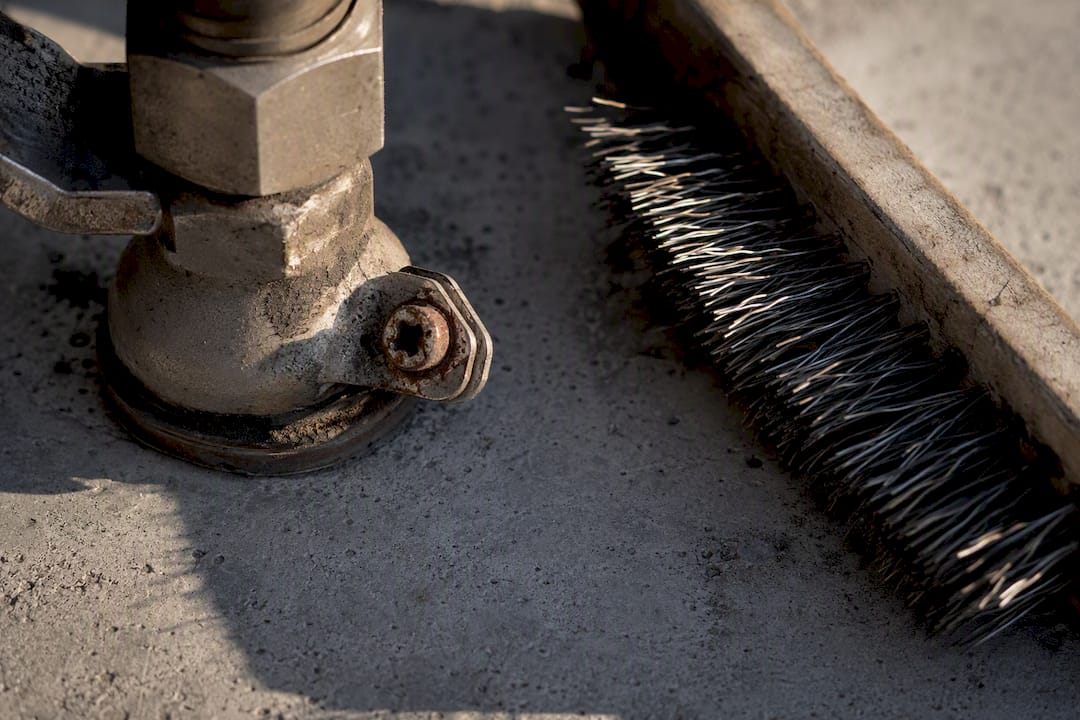
Pro Tip: Keep a wire brush in the field kit. Thirty seconds of cleaning a corroded bonding point beats explaining a failed inspection later.
For sourcing compliant hardware, general industrial suppliers like Grainger, safety equipment providers like Justrite, and laboratory supply houses like Fisher Scientific all carry bonding clamps, resistance meters, and grounding rods that meet these specs.
How Do You Test Bonding Continuity and How Often?
Testing bonding continuity takes a resistance meter (sometimes called a ground resistance bridge), the two contact points in question, and about thirty seconds. You clamp the meter leads to each bonding point, read the resistance, and compare it against the accepted threshold before you ever open a valve.
- Equipment needed: a calibrated ohm meter or ground resistance bridge.
- Test points: the bonding clamp contact and the corresponding bare-metal point on the paired equipment.
- Acceptable reading: under 25 ohms for standard bonding continuity checks.
- Record example: date, time, location, resistance reading, tester initials, pass or fail.
Pre-shift checks catch a surprising number of issues before they become a problem mid-transfer. Add periodic maintenance intervals on top of that, and always retest after any repair to a clamp, cable, or connection point.
- Replace any cable showing fraying, kinks, or exposed conductor strands.
- Clean contact points before every use, not just when a test fails.
- Store clamps so the jaws don’t corrode or bend out of shape between uses.
Pro Tip: A logbook that lives in the truck cab, not a filing cabinet back at the yard, is the difference between a record that gets filled out and one that gets forgotten.
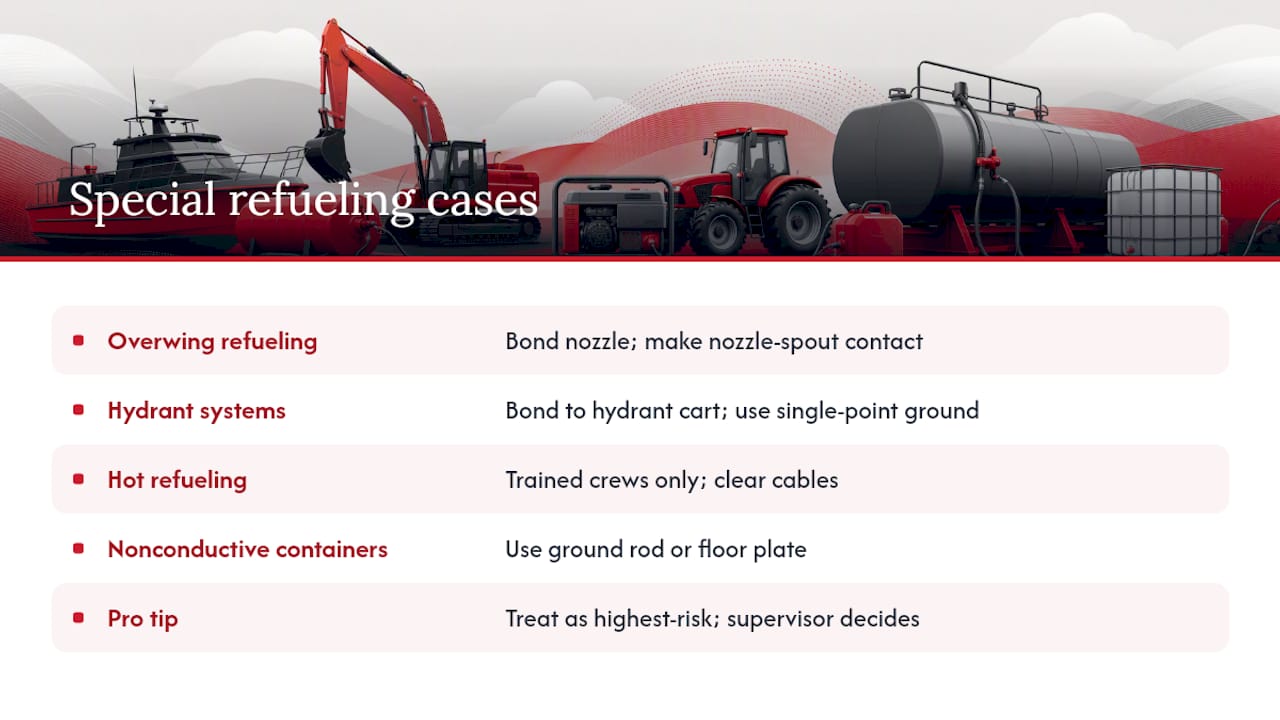
Special Cases: Overwing, Hydrant, Hot Refueling, and Nonconductive Containers
Standard bonding procedure covers most transfers, but several scenarios call for a different sequence entirely.
Overwing and open-port refueling requires the nozzle itself to be bonded, and on aircraft with multiple open ports, each nozzle needs its own verified bond rather than relying on one connection for the whole airframe. Nozzle-spout contact with the filler neck before cap removal remains best practice here, since braided hose bonding alone may not reliably bond the receiving tank until that physical contact is made.
Hydrant and single-point systems shift the bonding responsibility onto the servicing vehicle or cart rather than a full fuel truck, and single-point grounding is generally the preferred configuration for creating a stable equipotential work zone. Aircraft grounding may be redundant here if bonding to the hydrant cart is already verified.
Hot refueling (engine running) demands extra clearance discipline. Bonding hardware and cables need to stay well clear of intake and exhaust paths, and this procedure is typically restricted to trained crews under strict exclusion criteria.
Nonconductive containers, plastic drums or composite tanks, can’t carry a bond at all. Grounding rods or metallic floor plates become the control here, giving any accumulated charge a path to earth since the container itself won’t conduct one.
Pro Tip: When in doubt about which sequence applies, treat the transfer like the highest-risk case on the list. Downgrading procedure is a decision for a supervisor, not a guess made mid-shift.
Which Standards Govern Bonding and Grounding for Fuel Systems?
Four references anchor nearly every bonding and grounding procedure used across aviation and industrial fueling.
SAE Aerospace Information Report AIR5128A is the primary source for aircraft-specific bonding. It covers design, installation, testing, and inspection of electrical bonds for aircraft fuel systems specifically, and it’s the document to reference when an aircraft’s bonding hardware needs engineering justification.
NFPA 407 and NEC Article 250 address the broader electrical theory. NFPA and NEC materials distinguish bonding from grounding and provide conductor sizing tables that matter when a facility is designing or upgrading fixed grounding infrastructure rather than working with portable field equipment.
OSHA 1910.106 sets the regulatory floor for handling flammable and combustible liquids in the workplace, and it’s the standard OSHA inspectors reference when evaluating whether a facility’s fueling practices meet baseline safety expectations.
A compliance program that can’t produce a resistance reading, a test date, and a technician’s name for its last bonding check isn’t actually compliant. It just hasn’t been audited yet.
A short audit checklist covers most of what an inspector or supervisor will ask for:
- Documented resistance readings from the last 30 days of transfers.
- A visible, current calibration sticker on the test meter.
- Bonding cables inspected for fraying within the last maintenance cycle.
- Records showing bond continuity below 25 ohms on every logged transfer.
- Confirmation that bare-metal contact points are free of paint or corrosion.
What Human Errors Cause Most Bonding Failures?
Most bonding failures trace back to habit, not equipment. Crews assume metal-to-metal contact exists because a clamp looks attached, disconnect the bond seconds before the hose is fully clear, or keep using a clamp that’s been dropped, bent, or corroded for months.
- False assumption of contact without a resistance check.
- Disconnecting the bond before the nozzle is completely removed.
- Skipping clamp inspection because “it worked last time.”
- Rushing the sequence under time pressure or bad weather.
Training that sticks covers a pre-job brief, mandatory checklist use, a clear answer to who verifies the bond, and a verbal read-back of the resistance value before flow starts. High-flow operations should require a specific sign-off, not just general fueling certification, which is a distinction trained-operator programs are built around.
Pro Tip: Make the resistance read-back audible, not just written. A number spoken out loud and confirmed by a second person catches far more errors than a number scribbled on a clipboard.
What Should Be on a Field-Ready Bonding Checklist?
A laminated, one-page checklist on the truck removes guesswork exactly when crews are most likely to skip a step, mid-shift, under deadline pressure.
- Pre-arrival: confirm bonding cable, clamps, and meter are on board and undamaged.
- Bond procedure: attach to bare metal on both sides, verify seating visually.
- Continuity test: confirm reading under 25 ohms before any valve opens.
- Flow-start: double-check nozzle contact and cap removal sequence.
- Post-transfer disconnect: hose and nozzle first, bond connection last.
- Incident reporting: log any failed test or unusual reading immediately, not at end of shift.
Store spare clamps and a backup bonding cable in a dedicated, weatherproof compartment. A field kit that’s been rattling around loose in a truck bed corrodes fast, and a corroded spare defeats the purpose of carrying one.
Crews who run this checklist on every job, whether it’s a data center generator top-off or a remote mining site fill, catch the small failures before they become the kind of incident that shuts down a site. Anytime Fuel Pros builds this discipline into every on-site diesel delivery engagement, because a bonding failure on someone else’s equipment is still downtime on your job.
If your site handles high-volume transfers regularly, whether that’s bulk fuel storage or scheduled generator fueling, having a fuel partner who treats bonding procedure as standard practice, not an afterthought, is worth confirming before an emergency delivery lands on your site. Order fuel delivery from a crew that already runs this checklist on every stop.
Where to Read the Full Standards and Guidance
For deeper technical detail beyond field procedure, these are the documents worth keeping on hand:
- SAE AIR5128A covers aircraft-specific bond design, installation, and test methods in full engineering detail.
- NFPA 407 and NEC Article 250 explain conductor sizing and grounding theory for fixed installations.
- OSHA 1910.106 sets regulatory requirements for flammable liquid handling in any workplace.
- Stanford EHS grounding and bonding guidance offers a practical step-by-step transfer sequence useful for training new crew members.
- The Fuel Knowledge Hub collects practical, field-focused guidance for teams building out their own safety procedures.
Frequently Asked Questions
Do you bond or ground first during fueling?
Connect the earth ground first when one is present in the setup, then bond the receiving tank to the dispensing source before any fuel flows.
What resistance reading indicates a good bond?
Industry guidance commonly cites under 25 ohms as the threshold for effective bond continuity, measured with a calibrated resistance meter at the contact points.
Is grounding required for every aircraft refueling?
Not always. Bonding between the aircraft and the fuel truck is the primary control for most refueling operations, while grounding becomes necessary for fixed tanks, nonconductive containers, and certain high-volume transfers.
When should the bond be disconnected?
Only after the hose and nozzle are completely removed. Disconnecting the bond too early is one of the most common human-factor failures in fueling incidents.
Why doesn’t a visibly attached clamp guarantee a good bond?
Paint, corrosion, or grease on the contact surface can prevent true metal-to-metal contact even when a clamp looks properly seated, which is why a resistance check matters more than a visual inspection alone.
Sources
- Static Bonding and Grounding When Handling Flammable and Combustible Fuels
- Grounding and Bonding (Stanford EHS)
- The basics of grounding and bonding
- OSHA 1910.106
- SAE Aerospace Information Report (AIR) 5128A
Recent Comments