

Fuel delivery for utility companies is defined as the direct transport and supply of diesel, gasoline, or other fuels to on-site utility assets, including backup generators, storage tanks, and fuel distribution systems, to maintain uninterrupted power generation. This process, formally called utility fuel supply logistics, covers everything from bulk tank fills and scheduled deliveries to emergency dispatch during grid stress events. Providers like Foster Fuels Mission Critical and Anytimefuelpros operate within this space, offering both routine and emergency fuel procurement for utility companies. What separates effective fuel management for utilities from a basic delivery contract is the combination of physical infrastructure readiness, firm supply agreements, and logistics execution that holds up under pressure.
What is fuel delivery for utility companies and how does it work?
Fuel delivery for utility companies operates across two distinct layers: securing the fuel supply through contracts and certifications, and physically moving that fuel to where it is needed on time. Both layers must function together. A firm supply contract without reliable logistics execution is just paper. Logistics capability without a secured fuel source creates dangerous exposure during peak demand or emergency events.
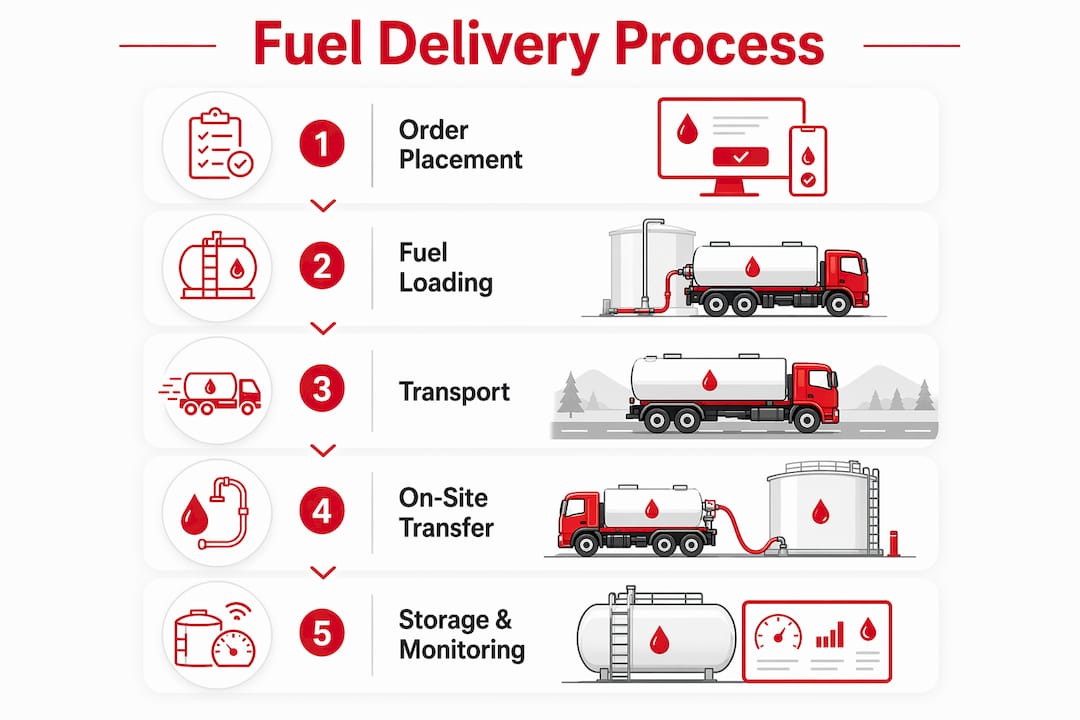
The physical delivery process begins when a utility’s fuel management team triggers an order, either on a scheduled basis or in response to a demand spike. A tanker truck, often carrying tens of thousands of gallons of ultra-low sulfur diesel (ULSD) or clear diesel, is dispatched directly to the plant or substation. Mobile fuel delivery eliminates the need for utility crews to transport fuel themselves, reducing labor costs and the risk of supply gaps.

Delivery is completed directly to on-site storage tanks or generator fuel systems, with the driver coordinating with plant personnel to confirm tank levels, product compatibility, and safety protocols. This direct-to-asset model is the industry standard for utility provider fuel options because it minimizes handling steps and reduces contamination risk. The entire workflow, from order trigger to confirmed delivery, is governed by service level agreements (SLAs) that define response times, volume commitments, and contingency procedures.
What infrastructure supports utility fuel delivery systems?
The physical infrastructure behind utility fuel delivery systems is more complex than a tank and a pump. Large-scale utility operations rely on purpose-built tank farms, transfer systems, and auxiliary equipment designed to handle high volumes with operational flexibility.
A well-designed utility fuel storage system typically includes the following components:
| Infrastructure Component | Function |
|---|---|
| Aboveground ULSD storage tanks | Hold bulk diesel reserves, often in multi-million gallon capacity |
| Pump skids and transfer systems | Move fuel between tanks and generation units with flexible routing |
| Recirculation lines | Maintain fuel quality during long storage periods |
| Fuel filtration and treatment units | Remove water and particulates to protect generator systems |
| Automated level monitoring | Trigger reorder alerts and track consumption in real time |
A Kiewit project converting the Astoria fuel oil tank farm illustrates the scale involved. That project incorporated two 2-million-gallon tanks alongside transfer pump skids designed to support multiple generation units simultaneously. This kind of infrastructure design allows a plant to receive a large delivery and immediately route fuel to whichever unit needs it, without manual intervention or bottlenecks.
Delivery scheduling must align with tank farm design. If a plant’s transfer pump capacity limits how fast fuel can be offloaded from a delivery truck, scheduling a 50,000-gallon delivery during peak generation hours creates a conflict. Fuel delivery planning must account for tank capacity, pump throughput, and plant operating cycles to avoid exactly this kind of friction.
Pro Tip: When evaluating your tank farm’s delivery readiness, confirm that your transfer pump skids can accept full tanker loads at the rate your SLA requires. A mismatch between delivery volume and offload speed is one of the most common causes of SLA breaches that never get attributed to the real source.
How do emergency and routine fuel delivery services operate for utilities?
Emergency and routine fuel delivery services for utilities differ primarily in trigger conditions and response speed, but both depend on the same underlying logistics infrastructure. Routine deliveries follow a scheduled cadence tied to consumption forecasts and tank level thresholds. Emergency deliveries are activated by unplanned events: extreme weather, grid stress, natural disasters, or equipment failures that accelerate fuel burn.
Providers operating in this space, including Foster Fuels, structure their emergency fuel delivery capability around four operational phases:
- Pre-incident planning. Providers conduct site surveys, document tank locations, access routes, and fuel specifications, and train response teams before any emergency occurs. Emergency contracts include contingency plans that define exactly what happens when a call comes in at 2 a.m. during a hurricane.
- Dispatch and routing. When an emergency is triggered, 24/7 dispatch teams identify the fastest safe route to the site, accounting for road closures, disaster zone access restrictions, and bridge weight limits for heavy tankers.
- Direct-to-asset delivery. Fuel is delivered directly to generators, storage tanks, or mobile equipment on site, eliminating intermediate handling and reducing the time between truck arrival and fuel availability.
- Volume confirmation and documentation. Delivery is confirmed with metered readings and electronic invoicing, giving utility managers an auditable record for compliance and cost tracking.
“Effective logistics planning for safe, fast delivery directly to generators is the key differentiator in emergency fuel response. Volume matters, but getting the truck to the right place at the right time is what prevents an outage.” — Foster Fuels operational framework
Large-volume capability is non-negotiable for utility-scale operations. Foster Fuels, for example, routinely fills large orders for power companies, with single deliveries capable of exceeding 100,000 gallons. That volume capacity means a utility can replenish a depleted tank farm in a single dispatch rather than coordinating multiple smaller loads during a time-critical event.
For remote or off-grid generation assets, mobile fuel services reduce transportation needs and integrate fuel treatment to maintain quality in harsh environments. This is particularly relevant for utilities operating distributed generation assets across rural Texas or Utah, where retail fueling infrastructure is sparse.
What is ERCOT’s Firm Fuel Supply Service and why does it matter?
ERCOT’s Firm Fuel Supply Service (FFSS) is a grid reliability program that requires qualifying generators to secure firm fuel contracts and on-site storage to guarantee power output during winter months when natural gas supply constraints are most severe. The program runs from November 15 to March 15 and sets certification criteria for firm gas transport agreements and storage arrangements.
The distinction between FFSS and physical fuel delivery logistics is one that utility decision-makers must understand clearly. FFSS governs the contractual and certification layer. It does not manage trucks or tank fills. A generator can be FFSS-certified and still face an operational failure if its physical delivery logistics are not equally reliable.
| Layer | What it covers | Primary risk addressed |
|---|---|---|
| Fuel supply assurance (FFSS) | Firm contracts, certified pipelines, storage commitments | Contractual fuel unavailability during grid stress |
| Physical delivery logistics | Scheduling, routing, tanker dispatch, on-site delivery | Operational fuel gaps from logistics failures |
| Combined approach | Both layers managed and coordinated | Full-spectrum fuel reliability |
FFSS shifts fuel reliability from reactive sourcing to proactive certification, which is a meaningful structural improvement over ad hoc procurement. This means utilities are no longer scrambling for spot-market fuel during a February cold snap. The program also works alongside ERCOT’s Emergency Response Service and Reliability Must-Run units, creating a multi-layered defense against outages rather than relying on any single mechanism.
For utility managers operating outside ERCOT, the FFSS model still offers a useful framework. Securing firm fuel contracts with certified suppliers, maintaining minimum on-site storage thresholds, and documenting contingency delivery plans are practices that reduce fuel supply risk regardless of which grid operator governs your region.
What are the key challenges in fuel delivery logistics for utilities?
Fuel delivery logistics for utilities carries a specific set of operational challenges that routine commercial fuel delivery does not face at the same scale or consequence level.
- Disaster zone access. During hurricanes, wildfires, or ice storms, road closures and bridge weight restrictions can block standard tanker routes. Providers must pre-plan alternate routes and maintain relationships with emergency management agencies to secure access clearances.
- SLA adherence under pressure. Delivery timing that is acceptable during normal operations becomes critical during a grid stress event. A two-hour delay in routine conditions becomes a potential outage trigger when a plant is running on reserve fuel.
- Coordination between delivery and internal distribution. Receiving a large fuel delivery is only half the task. The plant’s internal pump systems, transfer lines, and distribution manifolds must be ready to accept and route the fuel immediately. Misalignment between delivery arrival and internal readiness wastes time and creates safety risks.
- Fuel quality maintenance. Diesel stored in large aboveground tanks is susceptible to microbial growth, water contamination, and fuel degradation over time. Utilities that maintain large reserves must schedule fuel polishing and treatment alongside delivery cycles.
- Supplier qualification and contract structure. Not all fuel delivery providers carry the volume capacity, emergency response capability, or insurance coverage that utility-scale operations require. Vetting suppliers on response time guarantees, tanker fleet size, and disaster response protocols is a procurement step that directly affects operational reliability.
Pro Tip: Before signing a fuel delivery contract, ask the provider for documented evidence of emergency dispatch response times during a named disaster event. A provider’s performance during a real emergency is a far more reliable indicator than any SLA language in a contract.
Fuel delivery logistics for winter operations deserve particular attention. Cold weather increases generator fuel consumption, reduces diesel flow rates in cold storage tanks, and coincides with the highest probability of grid stress events. Utilities that treat winter fuel planning as a seasonal checklist rather than a year-round logistics discipline consistently face the steepest exposure.
How Anytimefuelpros supports utility fuel delivery needs
Anytimefuelpros delivers bulk diesel and emergency fuel directly to utility generators, storage tanks, and on-site assets across Texas, Utah, and nationwide through its partner network. Whether you are managing a scheduled top-off program for a distributed generation fleet or need rapid dispatch during a grid emergency, Anytimefuelpros operates with 24/7 availability and transparent invoicing that gives your operations team full visibility into every delivery.
For utility managers evaluating fuel delivery partners, Anytimefuelpros offers on-demand and emergency diesel delivery with the volume capacity and logistics infrastructure that utility-scale operations require. The team also supports disaster response fueling with pre-planned routes and direct-to-asset delivery protocols built for high-pressure scenarios. Contact Anytimefuelpros to discuss a delivery program structured around your specific tank capacity, consumption rates, and SLA requirements.
Key takeaways
Utility fuel delivery requires both firm supply contracts and reliable physical logistics. Neither layer alone is sufficient to prevent operational failures during emergencies or grid stress events.
| Point | Details |
|---|---|
| Two-layer fuel reliability | Secure firm fuel contracts and physical delivery logistics separately, then coordinate both for full coverage. |
| Infrastructure alignment | Tank farm design, pump capacity, and delivery scheduling must be coordinated to prevent offload bottlenecks. |
| Emergency planning precedes emergencies | Site surveys, contingency plans, and team training must be completed before an incident, not during it. |
| FFSS as a model | ERCOT’s FFSS framework demonstrates how proactive certification reduces fuel supply risk better than reactive sourcing. |
| Supplier vetting matters | Evaluate fuel delivery providers on documented emergency performance, not just contract language or stated response times. |
FAQ
What does fuel delivery for utility companies include?
Fuel delivery for utility companies includes bulk diesel transport, direct-to-generator and tank filling, emergency dispatch, scheduled recurring deliveries, and DEF supply. It covers both routine supply management and rapid-response fueling during outages or grid stress events.
How large are typical utility fuel deliveries?
Utility fuel deliveries frequently exceed 100,000 gallons per order for large power generation facilities. Providers like Foster Fuels are structured to handle these volumes with rapid dispatch to support both routine supply and emergency needs.
What is ERCOT’s Firm Fuel Supply Service?
ERCOT’s FFSS requires generators to hold firm fuel contracts and certified storage from November 15 to March 15 to guarantee output during winter grid stress. It is a contractual and certification program, not a physical delivery service.
How does emergency fuel delivery reach sites in disaster zones?
Emergency fuel providers pre-plan alternate routes, coordinate with emergency management agencies for access clearances, and dispatch 24/7 to deliver directly to on-site assets. Route planning and timing execution are as critical as fuel volume availability during disaster response.
How should utility managers select a fuel delivery provider?
Utility managers should evaluate providers on tanker fleet capacity, documented emergency response times during real events, SLA terms, insurance coverage, and the ability to handle large-volume single-dispatch orders. A provider’s performance record during named disasters is the most reliable qualification criterion.
Recommended
- Fuel Delivery for Logistics Yards: 2026 Operations Guide
- Fuel Delivery at the Heart of Winter Operations: How On-Site Services Keep Businesses Running – Anytime Fuel Pros
- Mobile Fuel Delivery Explained: How This Can Save Your Business Money – Anytime Fuel Pros
- Benefits of Fuel Delivery – Anytime Fuel Pros
Recent Comments