
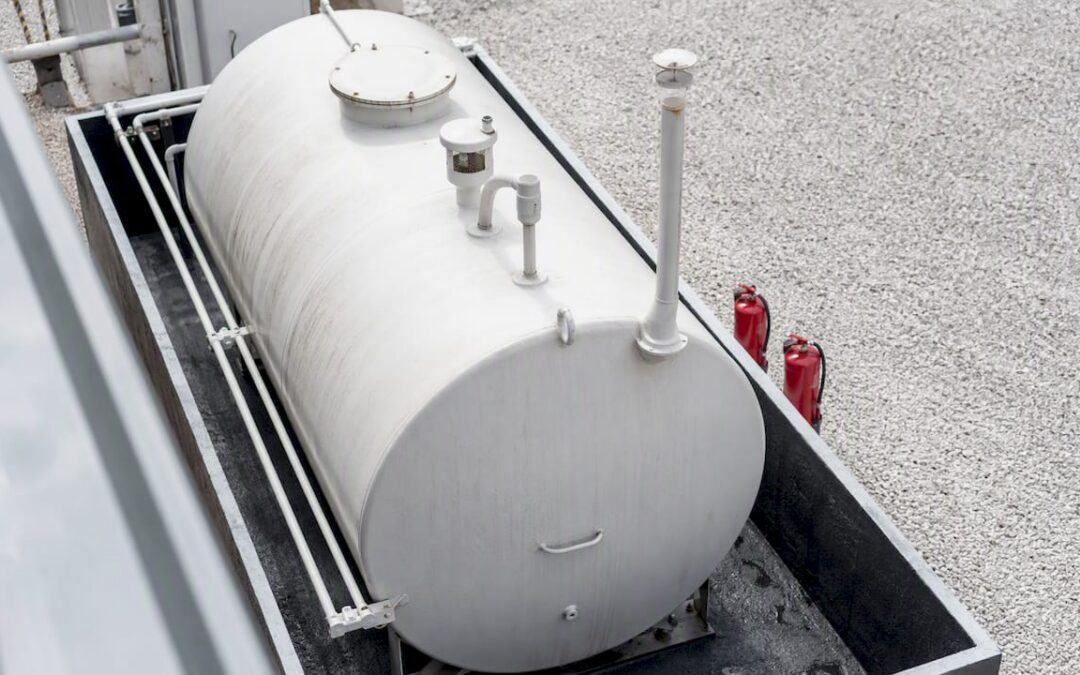
Diesel fuel is classified as a combustible liquid under NFPA 30, specifically Class IIIB, and that single classification determines nearly every storage, tank, and fire-protection requirement your facility faces. NFPA 30, the Flammable and Combustible Liquids Code, sets the national baseline for tanks, containers, piping, and fire protection systems governing diesel across industrial, construction, and municipal sites. If your facility stores diesel for generators, fleet fueling, or bulk operations, three documents matter more than any others: NFPA 30 itself, NFPA 110 if that diesel feeds emergency or standby power, and OSHA 1910.106 for workplace handling rules.
Before you read another paragraph, run these three checks:
- Compare your current diesel volume against the quantity thresholds that trigger AST or UST-level controls under NFPA 30 Chapter 22 or 23.
- Confirm secondary containment is in place and sized correctly, whether that’s diking, remote impounding, or a containment tank.
- Verify your fuel-quality testing schedule matches NFPA 110 intervals if the diesel supports emergency power.
Diesel’s Class IIIB status doesn’t make it low-risk paperwork. It means your facility qualifies for different (often more forgiving) container and tank thresholds than gasoline, but you still need documented fire protection, secondary containment, and testing records an AHJ can review in minutes, not hours.
Get these three items squared away first. Everything else in this guide builds on them.
Key Takeaways
NFPA 30 classifies diesel as Class IIIB and ties storage, tank, and fire-protection decisions to that classification alongside specified quantity thresholds and documented testing.
| Point | Details |
|---|---|
| Diesel is Class IIIB | Higher flash point than gasoline or kerosene, which shifts (not eliminates) storage and fire-protection thresholds. |
| Three standards, one tank | NFPA 30 sets storage baselines, NFPA 110 adds fuel-quality rules for standby power, OSHA governs workplace handling. |
| Secondary containment is mandatory | ASTs need diking, remote impounding, or a containment tank capped at 12,000 gallons under NFPA guidance. |
| Annual testing for standby fuel | NFPA 110 requires yearly fuel-quality testing using ASTM methods for generator-dedicated diesel. |
| Documentation wins audits | A current compliance binder with SDS, API 653 reports, and NFPA 25 records speeds up AHJ review more than equipment alone. |
Table of Contents
- What Does NFPA 30 Cover for Diesel Storage?
- Where Does Diesel Fall in NFPA 30’s Classification System?
- How Does NFPA 30 Intersect With NFPA 110 and OSHA?
- What Tank and Container Options Does NFPA 30 Allow?
- What Fire Protection and Layout Rules Apply to Diesel Storage?
- How Should You Handle Bonding, Grounding, and Dispensing Safely?
- What Inspection, Testing, and Recordkeeping Does NFPA 30 Require?
- What Documentation Do Inspectors Actually Want to See?
- What Should You Check This Week for NFPA 30 Compliance?
- Primary Sources and Code References to Keep on Hand
- Sources
What Does NFPA 30 Cover for Diesel Storage?
NFPA 30 functions as the national consensus code for storing, handling, and using flammable and combustible liquids, and it applies to diesel across containers, intermediate bulk containers (IBCs), portable tanks, aboveground storage tanks (ASTs), and underground storage tanks (USTs). The code addresses tanks, piping, storage arrangements, and fire protection systems for both indoor and outdoor setups, which is why it shows up in nearly every fire marshal conversation about diesel on a job site or at a data center.
NFPA 30 does not cover everything diesel touches, though. Transportation of diesel on public roads falls under DOT and PHMSA rules, not NFPA 30. Aerosol products get their own code in NFPA 30B, and spray-finishing operations using flammable liquids fall under NFPA 33. If your facility only stores and dispenses diesel on-site, NFPA 30 is almost certainly your controlling code, but it’s worth confirming nothing else on your site (paint booths, aerosol storage) pulls in a separate standard.
NFPA 30 was written to mitigate fire and explosion risk in industrial, commercial, and manufacturing settings, and it accomplishes that by tying tank design and storage arrangement directly to active, maintained fire protection systems verified through NFPA 30 compliance requirements.
Here’s the part most facility managers miss: NFPA 30 itself isn’t automatically the law. It becomes enforceable when states and municipalities adopt it into their fire codes, which happens through vehicles like the International Fire Code. Roughly every state fire code references NFPA 30 in some form, either directly or through the IFC Chapter 57 flammable and combustible liquids provisions, which means your local AHJ will cite specific NFPA 30 sections during inspection even though they’re technically enforcing your local fire code.
Where Does Diesel Fall in NFPA 30’s Classification System?
Diesel fuel is classified as Class IIIB under NFPA 30, a category defined by a flash point at or above 200°F. That single fact drives most of the practical differences between how you’re allowed to store diesel versus gasoline (Class IB) or kerosene (Class II).
Class IIIB status matters because NFPA 30 scales storage quantity limits, container requirements, and fire protection expectations based on flash point. Diesel’s higher flash point means:
- Higher allowable storage quantities before you trigger stricter control requirements compared to lower-flash-point fuels.
- More container and tank options remain viable without triggering explosion-proof electrical requirements in every scenario.
- Sprinkler and foam system requirements differ from what Class I or II liquids demand, though they aren’t eliminated.
That doesn’t mean Class IIIB diesel gets a free pass. It means the thresholds shift, not disappear. A few real-world scenarios illustrate how this plays out:
A small day tank feeding a backup generator at a strip mall or municipal building typically stays under quantity thresholds that avoid the heaviest AST controls, but it still needs venting, overfill protection, and often a fusible-link valve. A bulk AST supporting fleet refueling at a construction yard or trucking terminal, often in the 1,000 to 10,000-gallon range, triggers full Chapter 22 requirements: diking or secondary containment, emergency relief venting, and spacing from property lines. IBCs staged temporarily on a job site fall under portable container rules, which are lighter than AST rules but still require compatible construction, proper labeling, and limits on how long they sit before you need a permanent storage solution.
How Does NFPA 30 Intersect With NFPA 110 and OSHA?
NFPA 30 sets your storage and handling baseline. NFPA 110 adds fuel-quality, sizing, and standby-power-specific requirements when that diesel feeds an emergency generator. OSHA 1910.106 governs workplace handling regardless of what the fuel powers. All three can apply to the same tank simultaneously, and figuring out which one controls which decision is where most facility managers get tripped up.
| Standard | What it governs for diesel storage | When it applies |
|---|---|---|
| NFPA 30 | Tank construction, quantity thresholds, secondary containment, fire protection | Any diesel storage, regardless of end use |
| NFPA 110 | Fuel quality testing, tank sizing for runtime, standby-power reliability | Diesel dedicated to emergency or standby generators |
| OSHA 1910.106 | Workplace storage, handling, and transfer practices, worker safety | Any facility where employees handle or work near diesel storage |
A hospital’s backup generator tank is the textbook example of all three applying at once: NFPA 30 dictates the tank’s construction and containment, NFPA 110 requires annual fuel-quality testing because the generator supports life-safety power, and OSHA governs how employees handle transfers and what training they receive. A construction site’s bulk fuel tank for excavators, by contrast, typically only triggers NFPA 30 and OSHA, since it’s not tied to standby power.
Your local AHJ enforces whichever fire code your jurisdiction has adopted, and that code almost always incorporates NFPA 30 by reference. The International Fire Code’s Chapter 57 is the most common vehicle for that adoption, so when an inspector cites “Section 5704,” they’re often pointing you back to NFPA 30 language embedded in the local code.
What Tank and Container Options Does NFPA 30 Allow?
Quantity is the trigger point for nearly every rule change in NFPA 30. Small containers and cabinets carry the lightest requirements; indoor storage rooms add more; ASTs and USTs bring the full weight of Chapters 22 and 23.
Some jurisdictions get specific about where those lines sit. Ohio’s administrative code, for instance, requires diesel storage exceeding 660 gallons for building service equipment like backup generators to comply strictly with Chapter 22 tank requirements. That 660-gallon marker isn’t universal to every state, but it illustrates how local codes frequently pin a specific number to NFPA 30’s more general thresholds, and you need to check your own jurisdiction’s adopted figure rather than assume a national standard applies uniformly.
Here’s how the common storage options break down:
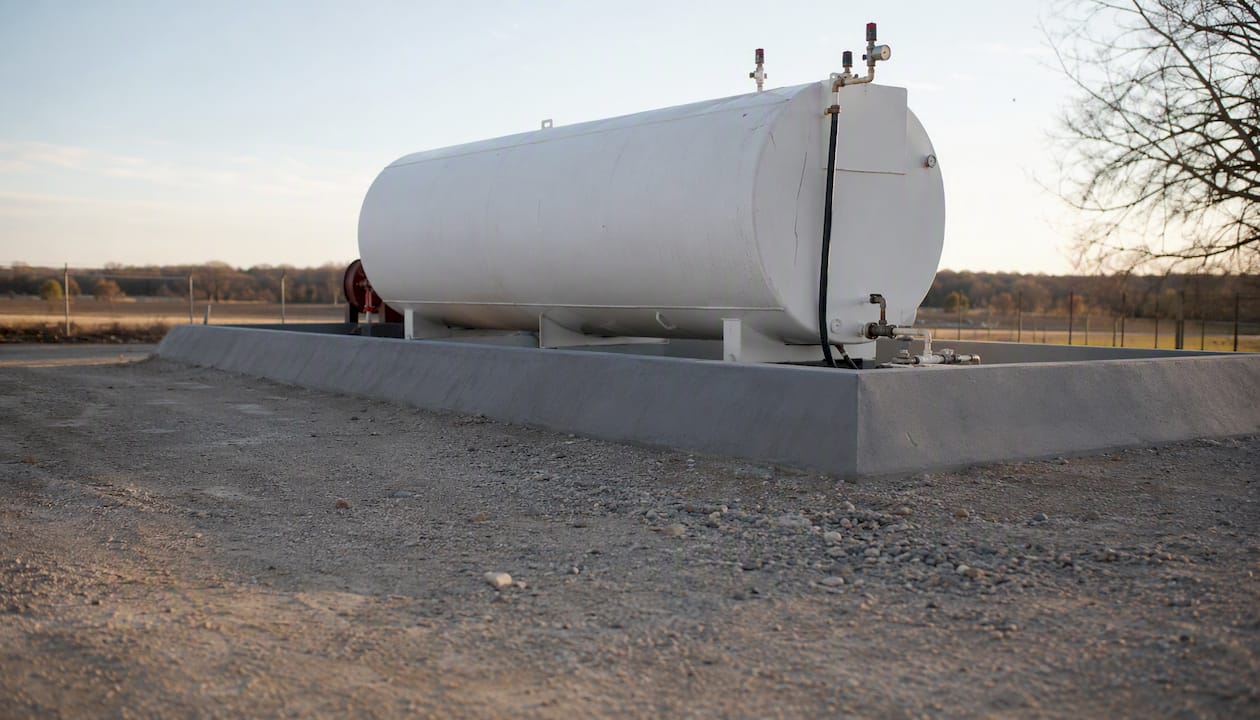
- Aboveground storage tanks (ASTs) need emergency relief venting and one of three secondary containment approaches: remote impounding, diking, or a containment tank. Containment tanks are capped at 12,000 gallons under NFPA guidance, with piping connections required above the normal maximum liquid level and alarms set at defined trigger points.
- Underground storage tanks (USTs) shift the risk profile toward corrosion protection, overfill prevention, and leak detection rather than surface fire exposure, and NFPA 30 Chapter 23 covers construction and monitoring requirements.
- Intermediate bulk containers (IBCs) work for temporary job-site storage but require compatible construction materials and proper labeling, and most jurisdictions limit how long they can serve as a substitute for a permanent tank.
- Drums and portable safety cans carry the lowest thresholds before triggering storage room or cabinet requirements, making them the right call for small maintenance operations rather than bulk fueling.
Pro Tip: If you’re choosing new tank equipment, selecting a UL-listed AST with built-in secondary containment (a “tank within a tank” design) often simplifies AHJ approval because the containment engineering is pre-certified rather than something your fire protection engineer has to justify on-site.
Facilities coordinating bulk diesel storage compliance across multiple sites tend to standardize on one or two tank configurations specifically to keep this approval process consistent from location to location.
What Fire Protection and Layout Rules Apply to Diesel Storage?
Sprinkler and foam requirements for diesel storage hinge on quantity, container type, and whether storage is indoors or outdoors, with NFPA 30 Chapter 16 working alongside NFPA 13 sprinkler design standards to set the specifics. Larger indoor storage arrangements, particularly palletized or rack storage of diesel in drums or IBCs, often require in-rack sprinklers or foam-water systems rather than standard ceiling coverage alone.
Fire protection engineers treat NFPA 30 as a risk-mitigation framework, not a checklist. Tank and storage decisions only work if they’re matched to fire protection systems that are actually active and maintained, which is why inspectors ask for current NFPA 25 sprinkler inspection records rather than taking the presence of sprinkler heads at face value.
Ventilation is where a lot of indoor diesel storage rooms fail inspection quietly. NFPA 30 sets minimum ventilation rates for indoor storage areas, and if your room’s floor grade or HVAC layout creates a low spot where vapors can pool, that “bowl” effect can trigger a requirement for engineering analysis or vapor detection equipment that a standard exhaust fan won’t satisfy. This comes up more often than you’d expect in retrofit projects, where a storage room gets carved out of existing warehouse space without anyone checking how the floor slopes.
Clearances and separation distances matter just as much as the tank itself. NFPA 30 organizes tank storage requirements across Chapters 21 through 23, covering aboveground, underground, and indoor tank rules, including how far a tank must sit from property lines, buildings, and other ignition sources. Skipping this step during site planning is one of the most common reasons a tank passes manufacturer specs but fails AHJ siting review.
How Should You Handle Bonding, Grounding, and Dispensing Safely?
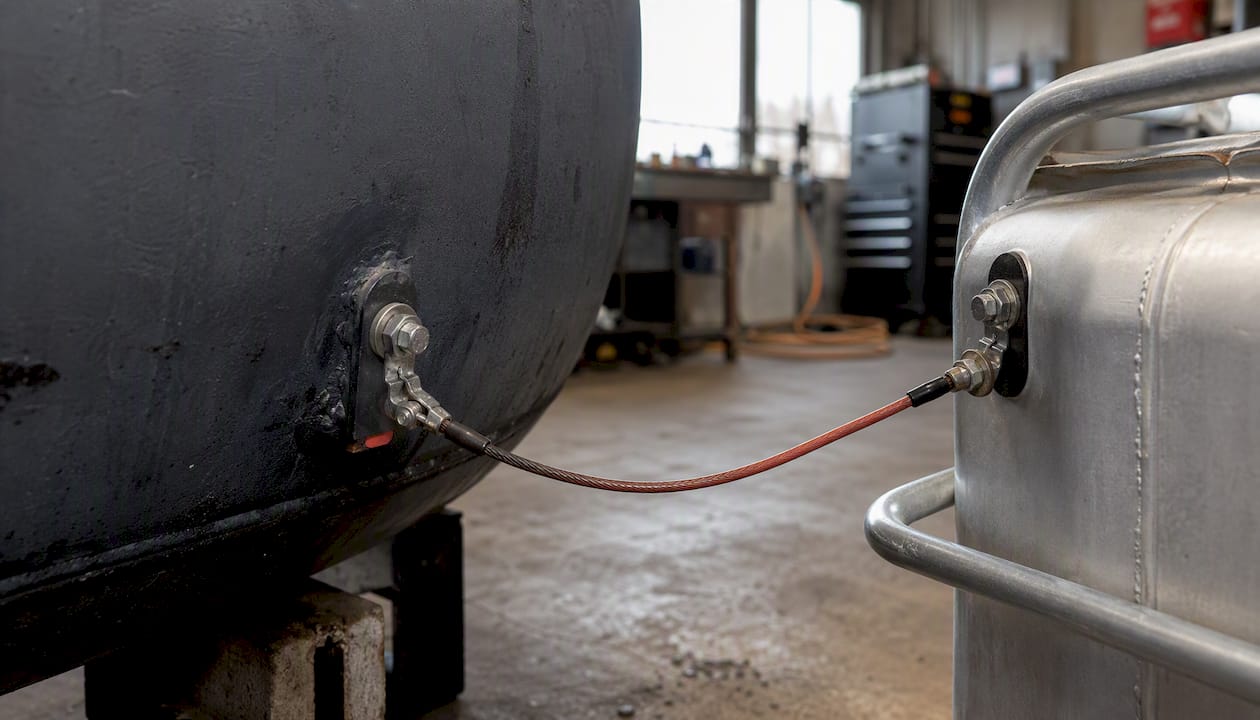
Bonding and grounding requirements kick in any time you’re transferring diesel between containers or into equipment, because static discharge during transfer is a real ignition risk even with a Class IIIB liquid’s higher flash point. NFPA 30 requires bonding between the delivery vehicle or transfer container and the receiving tank for most bulk transfer operations, particularly when transfer rates or container sizes increase static generation potential.
Electrical area classification is the other half of this picture. NFPA 70, the National Electrical Code, defines classified hazardous areas around tanks and dispensing points, and any electrical equipment installed in those zones (lighting, pumps, switches) needs to meet the classification for that specific area. Getting this wrong is expensive to fix after installation, since it usually means ripping out conduit and fixtures that weren’t rated for the zone they ended up in.
Practical ignition control for dispensing operations comes down to a short list of non-negotiables:
- Post clear signage identifying the hazardous area boundary and required precautions at every dispensing point.
- Use only bonding clamps and cables rated for the transfer application, and inspect them for wear regularly.
- Train operators on the specific transfer procedure for your site, not a generic industry checklist.
- Keep ignition sources (smoking materials, unrated portable equipment, hot work) out of classified zones entirely.
Pro Tip: Design your dispensing area with a smaller classified zone footprint from the start; locating pumps and electrical panels outside the hazardous boundary rather than inside it can eliminate the need for explosion-proof equipment altogether and cut both installation and maintenance costs.
If your team handles frequent transfers, reviewing on-site diesel delivery setup practices alongside your bonding procedures helps standardize what your crew does every time a delivery truck arrives.
What Inspection, Testing, and Recordkeeping Does NFPA 30 Require?
Fuel quality testing frequency depends heavily on whether your diesel supports emergency power. NFPA 110 mandates an annual fuel quality test using ASTM standards or manufacturer recommendations for any diesel dedicated to standby generators, and that testing should check for water at the tank bottom, microbial contamination, and fuel stability if storage exceeds twelve months. NFPA 110’s annex points specifically to ASTM D975 for diesel fuel specification, along with methods like ASTM D2709 and D6469 for water and sediment testing.
Tank inspection is a separate discipline from fuel testing, and API 653 is the standard AHJs and insurers expect to see cited for aboveground tank inspection and repair. A current API 653 report carries real weight during a compliance review because it demonstrates the tank shell, foundation, and appurtenances have been evaluated by a qualified inspector, not just visually eyeballed by facility staff.
| Activity | Frequency | Who holds the record | Retention period |
|---|---|---|---|
| Visual tank and containment check | Daily | Site operator or facility staff | 1 year minimum |
| Housekeeping and dispensing area review | Monthly | Facility or EH&S manager | 2 to 3 years |
| Fuel quality test (water, microbial, stability) | Annually | EH&S manager or fuel-testing vendor | Life of tank or per AHJ requirement |
| API 653 tank inspection | Per API interval (varies by tank condition) | Facility manager, filed with tank register | Life of tank |
| Sprinkler/fire system inspection (NFPA 25) | Annually, with quarterly checks | Fire protection contractor, filed on-site | Per local fire code, typically 3+ years |
Facilities managing standby generators often fold fuel-quality testing into a broader generator fuel maintenance program, which keeps the annual testing cadence from slipping when other priorities crowd the calendar.
What Documentation Do Inspectors Actually Want to See?
Ask any fire protection engineer what stalls an AHJ audit, and the answer is rarely equipment. It’s missing paperwork. Inspectors consistently ask first for a consolidated compliance binder, not a walk-through of the tank farm, because the documents tell them in minutes whether your facility has been maintaining the systems the tank hardware depends on.
That binder should contain, at minimum: current Safety Data Sheets for every stored liquid, a tank register listing construction details and capacity for each vessel, your most recent API 653 inspection report, ventilation design documentation, electrical area classification drawings, and NFPA 25 sprinkler and fire-system inspection records. Facilities that keep this binder current, rather than assembling it the week before an inspection, consistently move through AHJ reviews faster.
Ask any facility manager who’s been through a rough inspection what they’d change, and the answer is almost always the same: assemble the compliance binder before you need it, not during the walkthrough.
Training documentation matters just as much as equipment records. Facilities should maintain evidence of initial and recurring training covering liquid classification, bonding and grounding procedures, ignition control, and spill response, aligned with both NFPA expectations and OSHA Hazard Communication training requirements. Delivery tickets and cargo manifests should be archived as part of your fuel-quality baseline, since documentation gaps around fuel deliveries are one of the more common findings inspectors flag.
Pro Tip: Name one person as your audit owner, and have that person run a mock inspection twice a year using the same checklist your AHJ uses. Catching a missing API 653 report internally costs you an afternoon. Catching it during a real inspection can cost you a violation notice and a re-inspection fee.
What Should You Check This Week for NFPA 30 Compliance?
- Inventory your diesel volume against allowable quantity thresholds for your storage type (container, IBC, AST, UST) and confirm which chapter of NFPA 30 governs your current setup.
- Verify secondary containment is present and correctly sized, whether that’s diking, remote impounding, or a containment tank rated within the applicable capacity limit.
- Confirm your fuel-quality testing schedule matches NFPA 110 intervals if any diesel on-site supports emergency or standby power, and pull your most recent test results.
- Check your API 653 inspection date for every aboveground tank and schedule the next inspection if it’s due within six months.
- Assemble or update your compliance binder with current SDS sheets, tank register, ventilation drawings, and sprinkler inspection records.
- Loop in the right people early: your EH&S lead, maintenance supervisor, a third-party fuel-testing lab, and your AHJ contact if you’re planning any tank changes.
- Bring in a fire protection engineer or tank inspector if you’re adding storage capacity, changing tank type, or modifying your dispensing layout, rather than assuming existing sprinkler or ventilation design still applies.
Anytime Fuel Pros supports facilities working through this process by handling the diesel delivery and fuel management side of compliance, so your team can focus on documentation and tank readiness while deliveries stay on schedule. Whether you’re managing a generator fleet at a data center or bulk tanks at a construction yard, having a reliable delivery partner takes one variable out of your compliance equation entirely. Reach out through our fuel delivery questions page if you need help coordinating scheduled or emergency diesel delivery around your compliance calendar.
Primary Sources and Code References to Keep on Hand
- NFPA 30, Flammable and Combustible Liquids Code — the controlling code for tank construction, quantity thresholds, and fire protection.
- NFPA 110 fuel-quality testing guidance — consult this for annual testing intervals and ASTM method references for standby diesel.
- OSHA 1910.106, Flammable Liquids — the workplace regulatory standard for storage, handling, and transfer.
- IFC Chapter 57, Flammable and Combustible Liquids — the model code language most local jurisdictions use to adopt NFPA 30 provisions.
For tank inspection protocol, API 653 remains the industry reference AHJs and insurers expect cited on aboveground tank reports. For workplace training documentation, pair your NFPA 30 practices with OSHA’s flammable liquids training materials to keep your Hazard Communication records aligned with both agencies’ expectations.
Sources
- NFPA 110 — guidance on fuel quality testing and maintenance
- OSHA standard 1910.106 — Flammable liquids
- OSHA training: flammable liquids materials
- IFC 2018 Chapter 57 — Flammable and combustible liquids
Recent Comments